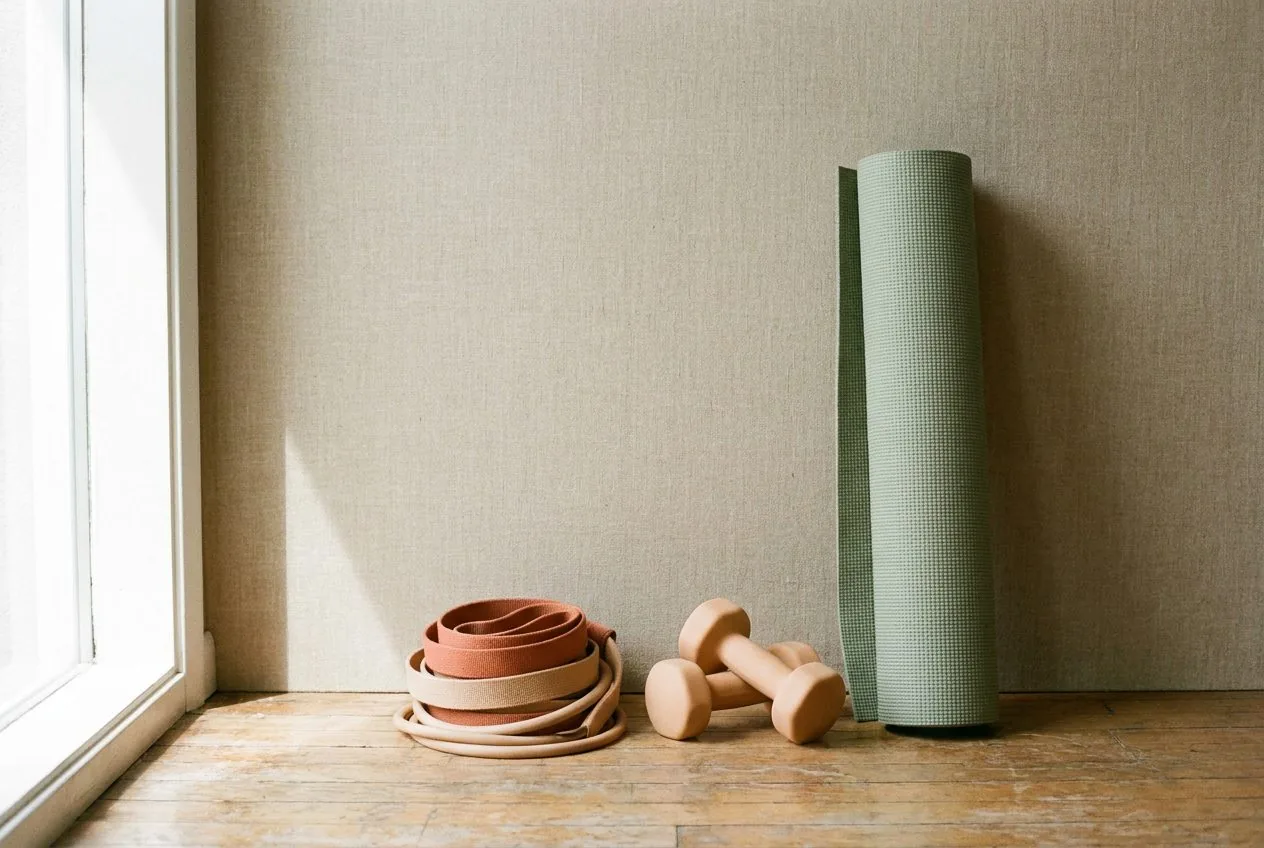
There is no single right home gym after 40, only the right one for your space, your budget, and the routine you will actually keep. The good news is that every useful version is cheaper and smaller than the fantasy in your head. Whether you have $50 or $300, the principles are identical: buy a few versatile pieces, keep them where you will see them, and let the habit, not the hardware, do the work. A small setup you reach for beats a big one you avoid, at every price.
So here are three complete home gym setups, one for each budget, all aimed at a midlife body that wants gentle, sustainable strength rather than a showroom. This is a buyer’s guide based on the features that matter for this reader, not a lab test of specific brands, and prices move constantly, so treat every figure as approximate and check current pricing before you buy.
This article is for information only and is not medical advice. Talk to your healthcare provider before starting a new exercise routine, especially if you have joint injuries, heart conditions, or dizziness.
The idea: same principles, three price points
Each setup below follows the same logic. Start with scalable resistance you can start light, add comfort so the floor is not an excuse, add measurable loading when you want to see progress, and add gentle cardio last, only if you will use it. The difference between the three is not quality; it is how far along that path you go. Pick the smallest one that removes your reasons not to start, and move up only when a real gap appears.
1. The Starter Corner: around $50 to $60
Who it is for: anyone beginning, anyone on the tightest budget, and anyone who wants to prove the habit before spending more.
What it includes: a resistance band set and a supportive mat, with a sturdy chair you already own as your bench.
Roughly: a band set runs around $20 to $30 and a mat around $25 to $40, so the whole corner lands near $60 or less.
What it covers: genuinely, your whole body (SAGE Open Medicine). A band set with a door anchor handles rows, presses, and curls for the upper body, while loop bands cover squats, side steps, and glute bridges for the lower body. The mat makes floor work comfortable, and the chair adds step-ups, incline push-ups, and sit-to-stands. Bands are the ideal starter because their resistance is lowest at the start of a move and builds as the band stretches, which is exactly what cautious midlife joints appreciate. If you want the deeper breakdown of band types, our best resistance bands for women over 40 guide walks through loop, tube, and fabric options.
This corner is not a compromise. For a great many women over 40, it is the entire home gym they ever need.
2. The Strength Builder: around $150 to $200
Who it is for: anyone who has used the starter corner and wants measurable loading, or anyone confident they will stick with strength work and wants to buy once.
What it includes: everything in the starter corner plus a light pair of adjustable dumbbells and a foam roller.
Roughly: adding adjustable dumbbells at around $80 to $120 and a foam roller at around $20 to $30 brings the full corner to roughly $150 to $200.
What it covers: the same whole-body work as the starter corner, plus precise, trackable progress. Where bands step up in bigger jumps between levels, adjustable dumbbells let you add a few pounds at a time, which makes it easy to see yourself getting stronger week to week. A light adjustable pair spanning roughly 5 to 25 pounds per hand covers most gentle strength work and saves the space of five separate pairs; look for a secure, quick-change mechanism and a comfortable handle. The foam roller rounds it out for recovery, which is part of how you stay consistent after 40, not a luxury add-on (Frontiers in Physiology). For what to look for in a pair, see our best adjustable dumbbells for women over 40 guide. Prefer a single bell to a pair? An adjustable kettlebell packs the same scalable loading into the smallest possible footprint.
This is the setup most women settle into for the long term: enough to progress for years, small enough to live in a corner.
3. The Strength and Cardio Corner: around $300
Who it is for: anyone who wants gentle indoor cardio alongside strength, especially if weather, time, or preference keeps them inside.
What it includes: everything in the strength builder plus a compact mini stepper.
Roughly: adding a mini stepper at around $80 to $130 brings the full corner to roughly $300.
What it covers: the complete strength setup, plus a way to add steady, low-impact movement without leaving the room. A mini stepper is small, quiet, and easy to tuck away, and it lets you add gentle cardio while you watch television or listen to a podcast, which supports steady daily movement and everyday energy. It is the piece to add last and only if you will use it, because walking outdoors is free and excellent and strength work is the priority. If you are weighing indoor cardio options, our walking pad vs mini stepper comparison covers which suits which space and routine.
This corner covers strength, mobility, recovery, and cardio in one small footprint, which is about as complete as a home gym after 40 ever needs to be.
The three setups at a glance
| Setup | Roughly | Best for | Key pieces |
|---|---|---|---|
| Starter Corner | $50 to $60 | Beginning, tight budgets | Bands, mat, a chair you own |
| Strength Builder | $150 to $200 | Measurable, long-term strength | Bands, mat, dumbbells, roller |
| Strength and Cardio | Around $300 | Strength plus indoor cardio | The above plus a mini stepper |
All figures are approximate as of mid-2026; equipment like this goes on sale constantly, so check current prices before you buy. And if you would rather build piece by piece than buy a tier at once, our home gym essentials under $250 breaks down the seven pieces worth owning one at a time.
Common mistakes when choosing a setup
Buying up a tier too soon. The strength and cardio corner looks the most complete, so it is tempting to start there. But an unused stepper and untouched dumbbells help no one. Earn each tier by using the one below it first.
Skipping the mat and roller. They feel optional, so they get cut, and then the floor is uncomfortable and recovery is neglected and the habit quietly fades. They are cheap insurance for consistency.
Owning gear you never program. Every setup here solves the “what with” problem, not the “what do I do” problem. Pair whichever you choose with a plan. Our small-space home gym how-to shows how to set up a corner and start using it the same afternoon.
Who should NOT upgrade yet
An honest note, because a guide that only says “spend more” is not being straight with you. If the starter corner has you moving three times a week, you may never need another tier, and that is a success, not a shortfall. If your real barrier is a plan rather than gear, no setup will fix that. And if you already own bands and a mat, prove the habit before adding weights or cardio. The best setup is the smallest one that keeps you showing up.
The honest bottom line
A home gym after 40 does not have a price tag; it has three sensible versions, and the right one is whichever you will actually use. A $60 band corner builds real strength for the cost of a night out. A $200 corner adds measurable progress you can track for years. A $300 corner folds in gentle indoor cardio for the days you cannot get outside. What any of them genuinely tends to support is steadier movement, more energy, and muscle that quietly protects your joints over time (CDC). Start with the setup that removes your excuses, keep it where you will see it, and let the habit do the real work. Find routines to run with your corner in our gentle strength section.
Frequently Asked Questions
- How much does a home gym cost for a woman over 40?
- Far less than most people fear. A genuinely useful starter setup of a resistance band set and a mat can land under $60, a fuller strength corner with adjustable dumbbells sits around $150 to $200, and adding gentle cardio like a mini stepper brings it to roughly $300. You never need the most expensive version to get strong; you need the few pieces you will actually use. Prices move constantly, so treat every figure as approximate and check current pricing before you buy.
- Which budget setup should I start with?
- Start with the smallest one that removes your excuses. For most women over 40, the starter band corner is plenty to prove the habit and build real strength, and it costs the least. Move up to the strength builder when you want measurable loading with dumbbells, and add cardio only if you genuinely miss it or want more daily movement indoors. Buying up a tier before you have used the one below tends to fill a corner with gear rather than build a routine.
- Do I need cardio equipment in a home gym after 40?
- Not at all, especially to begin. Walking outdoors is free and excellent, and gentle strength work is the priority for a midlife body. A compact cardio piece like a mini stepper earns its place only if weather, time, or preference keeps you indoors and you would use it while watching television. Think of it as a convenience that supports steady daily movement and energy, not a requirement. Add it last, if at all.
- Is it better to buy everything at once or build up slowly?
- Build up slowly, almost always. Buying a full setup in one go is how corners fill with equipment that never gets programmed. Start with one small setup, use it consistently for a few weeks, and let a real gap in your routine, not a sale, tell you what to add next. Slow building keeps the cost gentle, keeps you from over-buying, and means every piece you own has earned its spot.
Sources & references
Before you go
The 7-Day Protein-First Meal Plan for Women Over 40
A complete protein-first week, finished for you: your personal protein target, a one-page shopping list, 21 recipes at 25-35 g protein each, and a timed 90-minute prep schedule. Printable PDF, paired with a free 7-lesson email course.
Free guide
The 7-Day Protein-First Meal Plan for Women Over 40
A complete protein-first week, finished for you: your personal protein target, a one-page shopping list, 21 recipes at 25-35 g protein each, and a timed 90-minute prep schedule. Printable PDF, paired with a free 7-lesson email course.