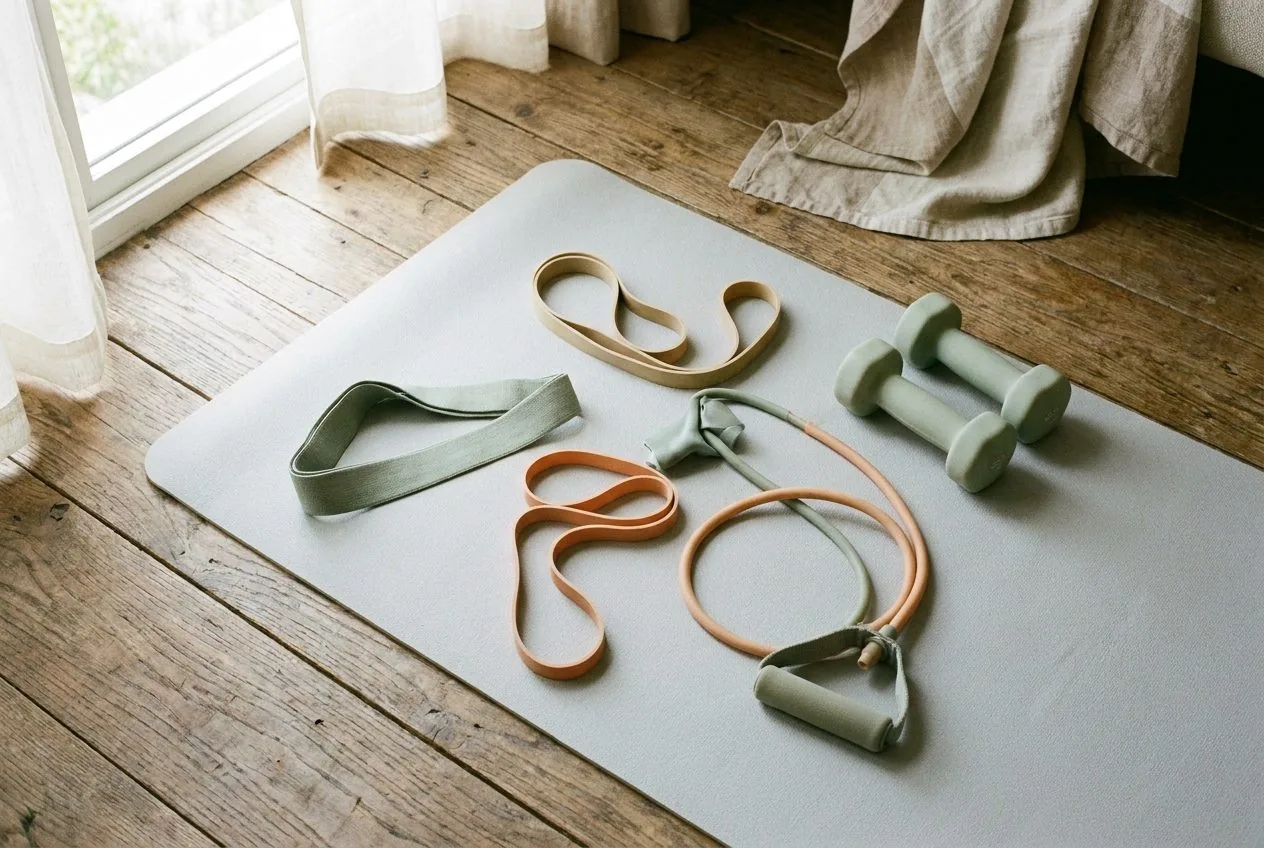
If you want the short answer before the detail: for most women over 40, the best setup is not a single band but a small combination. A set of tube bands with padded handles and a door anchor covers your upper body and mimics gym machines, and a set of fabric loop bands handles lower-body and glute work gently. Buy a set with a range of resistance levels, start lighter than feels heroic, and you will have a joint-friendly home gym for the price of one dumbbell.
A quick note on how we approach this. This is a buyer’s guide based on the features that matter for a midlife body and the trade-offs between band types, not a lab test of specific models. Bands are a commodity, brands come and go, and prices move constantly, so we focus on the type and features to look for, which stay true no matter what is in stock this month. Match the type to your goals and you will not go far wrong.
This article is for information only and is not medical advice. Talk to your healthcare provider before starting a new exercise routine, especially if you have joint injuries, heart conditions, or dizziness.
Why bands suit the over-40 body
Resistance bands earn their spot in midlife for reasons that have nothing to do with trends.
They are kind to joints. A band’s resistance is lowest at the start of a movement and highest near the end, as the band stretches. That ascending resistance feels natural and forgiving, which is exactly what stiff or cranky midlife joints appreciate. Our 7-day beginner yoga plan pairs well with band work for the same joint-friendly reason.
They travel and store anywhere. A whole set weighs very little and lives in a drawer. That matters more than it sounds, because the best equipment is the equipment you will actually use, and “no excuses, it is right here” beats a treadmill that becomes a clothes rack.
They grow with you. Bands provide progressive resistance, and muscle responds to progressive resistance at any age (Medicine & Science in Sports & Exercise). Start light, add resistance as you get stronger, and the same cheap set carries you for a long time. This is the engine behind our summer arms workout for women over 40, which leans on bands for exactly this reason.
The honest limit: at the very heavy end, dedicated lifters will out-grow most bands, and dumbbells are easier to load heavy and to measure. For the goals of most women over 40, though, bands do the job beautifully, with strength gains similar to weights in research comparisons (SAGE Open Medicine).
The five types, compared
Not all resistance bands are the same tool. Here is how the common types stack up for this reader.
| Type | What it is | Best for | Watch out for |
|---|---|---|---|
| Tube bands with handles | Cords with padded grips, often a door anchor | Rows, presses, curls, the most versatile all-rounder | Cheap clips can wear; check the attachment |
| Fabric loop bands | Wide cloth loops, usually a set of 3 levels | Glutes, hips, legs, gentle and no-roll | Limited to lower-body and warm-ups |
| Mini loop bands | Small thin rubber loops | Warm-ups, physical therapy, activation | Snap if over-stretched; lower durability |
| Flat therapy bands | Long flat latex sheets | Rehab, shoulders, very gentle starts | No handles; can be awkward to grip |
| Power/pull-up bands | Thick continuous loops | Assisted movements, heavy full-body | Often too strong for a gentle start |
For most women beginning or rebuilding a routine, the two that matter most are tube bands with handles for the upper body and fabric loop bands for the lower body. Together they cover almost everything you would want to do at home.
What to look for when you buy
A few features separate a set you will keep from one that frustrates you into quitting.
- A range of resistance levels. Buy a set, not a single band. You want light and extra-light options for learning and progressing, not one heavy band you cannot use with good form. Being able to go lighter on lateral raises than on rows is the whole point.
- Comfortable handles and a door anchor. For tube bands, padded handles save your grip, and a door anchor unlocks rows and presses that mimic gym cables. That one accessory greatly expands what you can do.
- Fabric over thin rubber for lower body. Fabric loop bands do not roll, pinch, or snap the way thin rubber mini-bands can, which makes them far more pleasant for glute and hip work.
- Material and latex. Many bands are natural latex, and rubber bands are a common latex product (MedlinePlus). If you have a latex allergy, look specifically for latex-free or fabric options and check the description before buying.
- Honest durability. The weak point on tube bands is usually the clip where the handle meets the cord. Inspect it periodically, and never stretch a band far beyond its intended range, both for longevity and for safety.
Our recommendation, by need
If you buy one thing: a tube band set with padded handles and a door anchor, in a range of resistance levels. It is the most versatile single purchase and covers your whole upper body plus many full-body moves.
If you buy two: add a set of three fabric loop bands for lower-body and glute work. This pairing is the sweet spot for a joint-friendly home routine and still costs less than most single pieces of gym equipment.
If you are rehabbing or very new to strength: start with flat therapy bands or light mini-loops and the gentlest movements, and graduate to handled tube bands as your confidence grows. There is no prize for starting heavy.
Whatever you choose, the bands are only as useful as the plan you run with them. Our gentle strength routines and the 4-week summer reset both give you a structure to put the bands to work.
Common mistakes with resistance bands
Buying the heaviest band. Enthusiasm says go strong. Sore tendons and sloppy form say otherwise. Start light, earn the next level.
Rushing the reps. Bands reward control. Snapping through a movement wastes the tension and risks a recoil. Slow and deliberate, especially on the lowering phase, keeps the band’s tension under control.
Ignoring the anchor point. A band anchored badly, in a door that can open or around something unstable, is an accident waiting to happen. Use a proper door anchor and check it before you pull.
Only training the lower body. The viral booty-band workouts are fun, but a balanced routine needs upper-body and back work too, which is where handled tube bands come in.
When a full program helps
Bands solve the equipment problem. They do not solve the “what do I actually do, and when do I progress” problem. If you know you do better with a plan that tells you exactly what to do, a structured program can turn a drawer full of bands into real, steady results.
Old School New Body is one option built around brief resistance sessions, its F4X system, which can suit a midlife body and a busy schedule (Old School New Body). As with any program, keep your expectations grounded, treat the marketing with healthy skepticism, and check with your provider before starting. A program gives you the structure and accountability; the bands give you the tool. Together they are far more than the sum of their parts.
The honest bottom line
You do not need an expensive rack of equipment to rebuild strength after 40. A thoughtful set of resistance bands, a handled tube set for the upper body and fabric loops for the lower, will cover the vast majority of what you want to do, gently and at home. Start lighter than your ego suggests, add resistance as you earn it, and give the habit enough weeks to show what it can do. The best resistance band is the one that lowers the bar to starting, and then quietly grows with you as you get stronger.
Frequently Asked Questions
- Are resistance bands good for women over 40?
- Yes, they are one of the most practical strength tools for midlife. Bands are joint-friendly, because the resistance is lightest at the start of a movement and builds gradually as the band stretches, and they are light, cheap, and easy to use at home or while traveling. They are not a full replacement for weights if your goal is maximum strength, but as a large part of a gentle, sustainable routine they are excellent. Pair them with enough protein and consistency and they earn their place.
- Which type of resistance band is best for beginners over 40?
- For most beginners, a set of tube bands with padded handles plus a door anchor is the most versatile starting point, because the handles are comfortable and the door anchor unlocks rows and presses that mimic gym machines. A set of fabric loop bands is a great, gentle addition for lower-body and glute work. Buy a set with a range of resistance levels so you can start very light and progress. Avoid buying the single heaviest band and hoping to grow into it.
- What resistance level should I start with over 40?
- Start lighter than you think. Bands are deceptively challenging, and the goal in the first weeks is clean form and confidence, not heavy resistance. Choose a set that includes light and extra-light options, and only move up when the current band feels genuinely easy for your target reps. Progressing gradually is exactly what protects midlife joints and keeps you consistent, which matters far more than the number on the band.
- Are resistance bands or dumbbells better for women over 40?
- Neither is simply better; they do slightly different jobs. Bands are gentler on the joints, more portable, and great for control and higher-rep work, while dumbbells are easier to load heavy and to measure progress precisely. Many women over 40 do best with both: bands for travel, warm-ups, and joint-friendly volume, and a couple of light dumbbells for straightforward strength. If you can only pick one to start, a versatile band set is the cheaper, lower-risk entry point.
- Can resistance bands really build strength after 40?
- Yes, within reason. Bands provide progressive resistance, and muscle responds to progressive resistance at any age, so as long as you take sets close to genuine effort and increase the challenge over time, bands build real strength. The main limit is at the very heavy end, where dedicated lifters will out-grow most bands. For the goals of most women over 40, steady strength, better posture, and joint-friendly movement, bands are more than capable.
- Are latex resistance bands a problem if I have a latex allergy?
- They can be, because many bands are made of natural latex. If you have a latex allergy, look specifically for latex-free bands, often made of fabric or synthetic rubber, and check the product description carefully before buying. Fabric loop bands are frequently latex-free and are a comfortable option regardless. When in doubt, contact the seller to confirm the material.
Sources & references
- SAGE Open Medicine, Elastic vs conventional resistance training meta-analysis (opens in new tab)
- Medicine & Science in Sports & Exercise, ACSM position stand on resistance training (2026) (opens in new tab)
- MedlinePlus, Latex allergy (opens in new tab)
- Old School New Body, official sales page (opens in new tab)
Before you go
The 7-Day Protein-First Meal Plan for Women Over 40
A complete protein-first week, finished for you: your personal protein target, a one-page shopping list, 21 recipes at 25-35 g protein each, and a timed 90-minute prep schedule. Printable PDF, paired with a free 7-lesson email course.
Free guide
The 7-Day Protein-First Meal Plan for Women Over 40
A complete protein-first week, finished for you: your personal protein target, a one-page shopping list, 21 recipes at 25-35 g protein each, and a timed 90-minute prep schedule. Printable PDF, paired with a free 7-lesson email course.