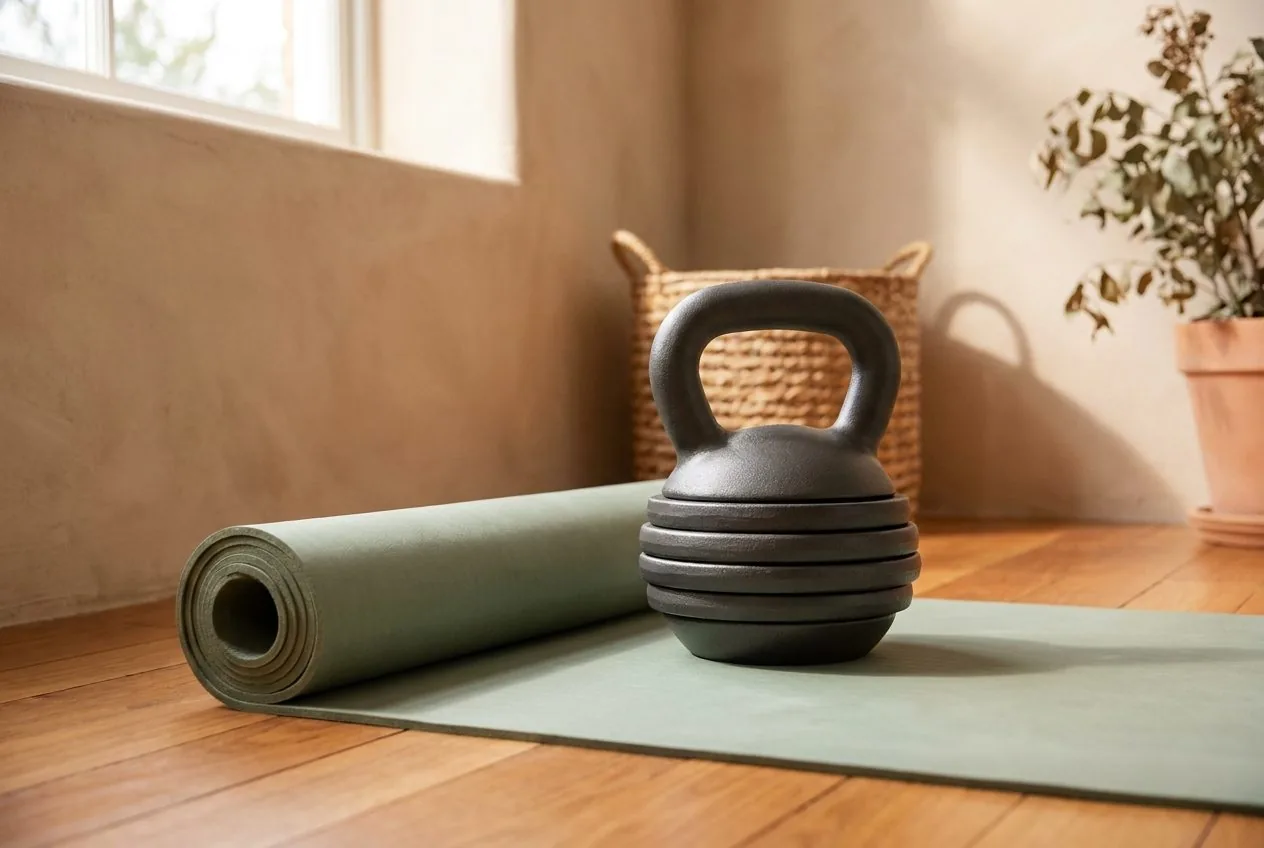
For most women over 40 building a home gym in a small space, yes: an adjustable kettlebell is worth it. One bell that dials from light to genuinely challenging replaces a whole row of fixed weights, can cost less than buying those bells one by one, and stores in a single tidy footprint by the wall. The verdict flips to skip in two honest cases: if you already own adjustable dumbbells and a routine you enjoy, the kettlebell is a pleasant extra rather than a need, and if swings are off the table for your back or hips right now, a gentler tool earns the money first. Here is the full worth-it math: what one adjustable bell actually replaces, who gets real value, the honest limits, and the four checks that matter if you buy.
This is a category verdict based on the features that decide whether a kettlebell suits a woman over 40, not a lab test of one branded model. Adjustable kettlebells are a fast-changing market and prices move constantly, so we focus on the specs that stay true no matter what is in stock this month.
Our pick, if the answer is yes: an adjustable kettlebell that starts light (around 8 to 10 pounds), climbs into the 30s or 40s, has a wide comfortable handle, and sits on a stable flat base. 8/10. For women over 40, the best bell is not the heaviest but the one with a genuinely light starting weight, a handle you can grip in both hands, and a secure adjustment you trust. Space saved and a gentle entry beat a high top-end number every time.
This article is for information only and is not medical advice. Talk to your healthcare provider before starting a new exercise routine, especially if you have joint injuries, heart conditions, or dizziness.
The worth-it math: what one bell replaces
Start with the arithmetic, because it is the heart of the case. Progressing safely with kettlebells means moving up in small steps over months, and with fixed bells each step is a new purchase and a new object on the floor. Three or four solid bells quickly cost more than one good adjustable model, and they claim a shelf in a room that probably is not a gym. One adjustable bell covers that whole range in a single footprint (Bowflex), which is exactly what a compact home gym needs: fewer objects, more range.
The savings are not only money and floor space. An adjustable bell removes the quiet friction of the in-between day: when the usual weight feels like too much, you dial it down instead of skipping. For a midlife routine that lives or dies on consistency, an easy setting on a low-energy day is worth more than an impressive top end.
What a kettlebell genuinely gives an over-40 routine
The appeal is not novelty; it is that one bell covers a lot of useful ground gently. Three things make it a smart fit for this reader.
It trains whole-body patterns. A swing, a goblet squat, and a suitcase carry each work many muscles together in the way daily life actually asks of your body, lifting, standing, and carrying. That functional flavor supports steadier movement and a stronger base for everyday tasks.
It builds grip and coordination. The weight of a kettlebell sits below the handle, off-center, so your hands, forearms, and core work a little harder to control it. Grip strength quietly fades with age (PLOS ONE), and a kettlebell gives it a gentle, regular reason to stay.
It grows with you. A light setting suits a true beginner and a hard week; the generous top end means the same bell still challenges you many months from now. You buy once and grow into it, rather than growing out of it.
The honest limit: a kettlebell is not the most precise tool for isolated arm work, and its swing takes a little learning. For most women over 40 that is a small price for its versatility, but it is worth knowing. If you want the fuller trade-off between the two weighted tools, our adjustable dumbbells vs kettlebells comparison covers when each shines.
Who gets real value
Buy with confidence if you want one versatile weighted tool for a small space, you like the idea of swings, goblet squats, and carries that work the whole body at once, and you would rather own a single adjustable bell than a row of fixed ones cluttering the floor. The bell starts light, grows with you, and stores in one small footprint, which is the entire brief for a compact home gym.
Who can skip the buy
Just as honestly, three kinds of people do not need this purchase. Skip if you already own a light pair of adjustable dumbbells and a routine you enjoy; the overlap is large, and our adjustable dumbbells for women over 40 review covers how far that tool alone can take you. Skip if what you are really missing is a plan rather than equipment, because another object in the corner will not create the routine. And skip if back or hip issues mean swings are not right for you yet; start with gentler loaded moves and revisit later. Skipping a purchase you do not need is a win, not a failure.
If the answer is yes: the four checks before you buy
Four things separate an adjustable kettlebell you will use weekly from one that frustrates you into quitting.
- Does it start light enough? The most common mistake is a bell whose lowest setting is already too heavy. A genuinely light bottom weight, around 8 to 10 pounds, lets you learn the swing and goblet squat with clean form.
- Is the handle comfortable and wide? You need room for two hands on the handle for swings, and a smooth, adequately thick grip that does not dig in. A cramped or rough handle ends sessions early.
- Is the adjustment secure and simple? You must trust the mechanism completely, because a weight that could shift mid-swing is a non-starter. Look for a clear, positive lock and a change process you can do in seconds.
- Is the base stable and floor-friendly? A flat, protected base that sits still between sets and does not scratch the floor makes the bell far more pleasant to live with in a shared room.
We weigh a light starting weight and a secure adjustment most heavily, because those two features decide whether a midlife beginner starts safely and keeps going.
You do not have to use a heavy setting, and you certainly should not start there. Begin at the lowest weight, learn the hinge with control, and keep every swing driven by your hips rather than your back. Add weight only when a setting feels genuinely easy for your target reps. The bell grows with you; you do not have to grow into it on day one. Once the basics feel steady, our standing kettlebell moves for balance gives you a gentle, balance-focused routine to use the bell with.
Pros and cons
| Pros | Cons |
|---|---|
| One bell replaces a rack of fixed weights | Adjustment adds a little bulk versus a solid bell |
| Trains whole-body patterns and grip together | The swing takes some practice to learn well |
| Saves space and money in a compact gym | Cheaper models can have a rough or narrow handle |
| A light setting suits true beginners and low-energy days | Not ideal for precise, isolated arm work |
| Progresses in small steps for months | A poor lock is a genuine safety issue, so buy carefully |
Honest criticisms
No product category is perfect, and pretending otherwise helps no one.
The cheap ones can feel rough. Budget adjustable bells sometimes have narrow or sharp-seamed handles and a bulkier profile than a solid cast bell. If comfort in the hand matters to you, read handle reviews closely before buying.
A kettlebell is not a whole routine. It covers swings, squats, and carries beautifully, but a complete plan still wants some pressing, rowing, and walking. It is one excellent tool, not the entire toolbox.
The swing has a learning curve. Done with a rounded back or a jerky pull, a swing is uncomfortable and unhelpful. It is worth learning the hip hinge with no weight first. Our kettlebell basics for full-body strength guide walks through the gentle patterns step by step.
What we will not promise
An adjustable kettlebell will not transform your body for you, and no honest guide should pretend otherwise. What consistent, controlled kettlebell work genuinely tends to support is a stronger everyday base, steadier movement, better grip, and muscle that quietly protects your joints over time (CDC). Results depend on doing the work regularly, eating enough protein, and giving it months rather than days. Buy the tool, then let the habit do the real work.
The honest bottom line
So, is an adjustable kettlebell worth it for a small home gym after 40? Yes, if you want one whole-body tool that starts genuinely light, grows with you for months, and lives in a single small footprint; the space and money math is comfortably in its favor over a row of fixed bells. No, without any guilt, if adjustable dumbbells already serve you or swings are not right for your body yet. If you buy, choose light-starting, wide-handled, securely locking, and stable, then learn the hinge before you load it and keep every rep slow and honest.
If you are weighing a kettlebell against a pair of adjustable dumbbells for your one weighted purchase, our adjustable dumbbells vs kettlebells comparison lays out which tool fits which goal, and the rest of our gentle strength section gives you routines to put your bell to work.
Frequently Asked Questions
- Is an adjustable kettlebell worth the money for a home gym?
- For most women over 40 building a small home gym, yes. One adjustable bell replaces a whole row of fixed kettlebells, which can cost less than buying three or four solid bells separately and takes up a single small footprint instead of a shelf. The value case weakens only if you already own adjustable dumbbells you enjoy, or if you know you will only ever use one weight, in which case a single fixed bell is cheaper still. Prices move constantly, so check current pricing before you decide.
- What weight adjustable kettlebell should a woman over 40 start with?
- Choose a model whose range starts genuinely light, ideally around 8 to 10 pounds at the bottom, and reaches into the 30s or 40s so you have room to grow. Start two-handed moves like swings and goblet squats at a light setting, and keep single-arm work lighter than that. The whole point of an adjustable bell is that you can start easy and dial up over months. Begin below what feels heroic, keep every rep controlled, and add weight only when your current setting feels genuinely easy for your target reps.
- Are kettlebells safe for women over 40?
- Used with light weight and good form, yes, and they can be very joint-friendly. The care points are the swing, which should be driven by your hips rather than your lower back, and the weight, which should stay controllable at all times. Learn the hip hinge with no weight first, start light, and keep movements slow and deliberate rather than fast and loose. If you have back, hip, or knee issues, begin with goblet squats and carries rather than swings, and check with your provider before starting.
- Is an adjustable kettlebell better than a set of fixed bells?
- For a compact home gym, usually yes. One adjustable kettlebell replaces several fixed bells, which saves both money and floor space, and it lets you progress in small steps without buying a new bell each time. Fixed bells feel more solid and change faster between moves, which matters in fast circuits, but for a midlife routine focused on control and gradual progression, the space and flexibility of an adjustable model win for most people. Prices move constantly, so check current pricing before you buy.
- Do I need a kettlebell if I already own dumbbells?
- Not necessarily. Dumbbells and kettlebells overlap a great deal, and you can build real strength with either. A kettlebell adds a distinct feel for swings, carries, and goblet squats, where its off-center weight trains grip and whole-body coordination in a way dumbbells do not quite match. If you already have adjustable dumbbells and a routine you enjoy, a kettlebell is a nice addition rather than a must-buy. If you are choosing your one weighted tool, weigh the two honestly before deciding.
Sources & references
Before you go
The 7-Day Protein-First Meal Plan for Women Over 40
A complete protein-first week, finished for you: your personal protein target, a one-page shopping list, 21 recipes at 25-35 g protein each, and a timed 90-minute prep schedule. Printable PDF, paired with a free 7-lesson email course.
Free guide
The 7-Day Protein-First Meal Plan for Women Over 40
A complete protein-first week, finished for you: your personal protein target, a one-page shopping list, 21 recipes at 25-35 g protein each, and a timed 90-minute prep schedule. Printable PDF, paired with a free 7-lesson email course.