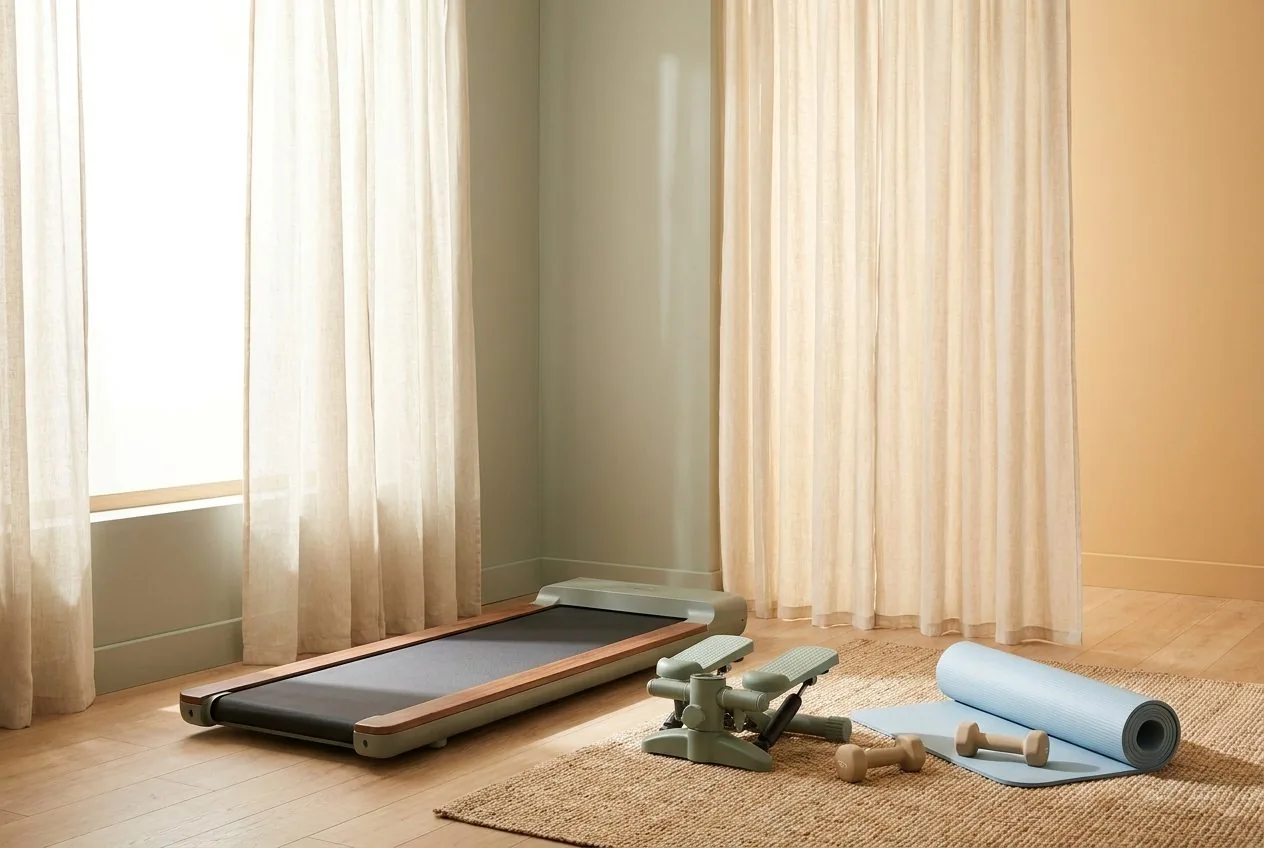
When you want to move more at home but the weather, your schedule, or your knees keep talking you out of it, a small piece of cardio gear can quietly change the math. Two of the most popular options for a busy midlife life are the walking pad and the mini stepper. Both are low-impact, both fit into a normal home, and both turn dead time into gentle movement, so the choice comes down to your space, your budget, and how your joints feel.
Short answer for skimmers: if you have a little floor space and want the most natural, comfortable movement, especially paired with a standing desk, choose a walking pad. If your space is tiny, your budget is tight, or you just want to add short bursts of movement in front of the TV, a mini stepper is the smaller, cheaper option. Neither is a weight-loss device; both are simple ways to remove the friction that keeps movement from happening.
This article is for information only and is not medical advice. Talk to your healthcare provider before starting a new exercise routine, especially if you have joint injuries, heart conditions, or dizziness.
The quick comparison
| Feature | Walking pad | Mini stepper |
|---|---|---|
| Price band | Higher | Lower |
| Footprint | Slim but needs floor space to use | Tiny; stores in a closet or under a bed |
| Motion | Natural walking, familiar and comfortable | Stepping; asks a bit more of the knees |
| Impact | Very low | Low, but more effort per minute |
| Noise | Quiet hum, often apartment-friendly | Usually quiet; check for creaks |
| Best paired with | A standing desk, calls, a favorite show | Short bursts in front of the TV |
Prices move constantly, so check current pricing before you buy.
Which should you pick? A quick decision framework
“I want the most comfortable, natural movement.” Walking pad. Walking is a motion your body already knows, so there is no learning curve and nothing to talk yourself into. It is the gentlest, most repeatable option for most people.
“I have a standing desk, or I want to move through my workday.” Walking pad, easily. Sliding one under a standing desk turns emails and calls into gentle steps without carving out separate workout time, which is an easy way to break up long sitting (ACSM).
“My space is genuinely tiny, or my budget is tight.” Mini stepper. It is a fraction of the size and cost, tucks away completely, and still adds real movement. For a small apartment or a first, low-commitment try, it is hard to argue with.
“I want quick bursts of effort, not long sessions.” Mini stepper. Because you lift your body weight with each step, effort climbs fast, so even a few minutes feels like something. Just be honest that stepping is less pleasant to sustain than walking, so plan for short sessions rather than long ones.
The over-40 lens: comfort and consistency
The reason this choice matters is not calories burned in a session; it is which machine you will still be using months from now. After 40, the winning strategy is gentle movement you can repeat on a busy, low-energy day, and comfort is what makes that possible.
On the joints. Both are low-impact, with none of the pounding of running. A walking pad tends to feel the gentler of the two, because walking is familiar. A mini stepper is still easy on the joints in the sense that there is no jarring, but the bent-knee stepping motion asks a little more of the knees and can feel like more work. If your knees are sensitive, that difference is worth weighing, and either way you should start slow and short.
On sustainability. The best machine is the one that lowers the bar the most for you specifically. For many women that is a walking pad, because stepping onto it takes no willpower and it pairs with things they already do. For others, especially in a small space, it is a stepper they can pull out for five minutes without rearranging the room. Be honest about your space and your habits, because the machine you will actually reach for beats the one that looks better on paper.
On what it can and cannot do. Neither device is a treatment or a weight-loss machine. What regular gentle movement genuinely tends to support is steadier energy, easier daily activity, and a habit that survives a busy week. Muscle matters just as much in the background, which is why we always pair cardio with a little strength work (CDC); our gentle strength section covers that half of the equation.
If a walking pad is where you are leaning, our full guide to the best walking pad for women over 40 covers what to look for, and our walking pad routine for busy women shows how to build the habit once it arrives.
A realistic first two weeks with either
Whichever you choose, the first two weeks decide whether it becomes furniture or a habit, so start smaller than feels necessary. The goal early on is not a hard workout; it is proving to yourself that the machine is genuinely easy to reach.
- Days 1 to 3. Use it for just 5 to 10 easy minutes, stacked onto something you already do: a phone call on the walking pad, a favorite show in front of the stepper. Keep the pace gentle enough to talk comfortably (National Institute on Aging).
- Days 4 to 7. Add a second short session on the days you feel like it, or stretch one session by a few minutes. Do not chase a daily step total yet; chase showing up.
- Week 2. Once it feels automatic to step on, let the sessions grow naturally. A little more time, a slightly firmer pace on the stepper, or a touch of incline on the walking pad if it has one. Add only what still feels comfortable.
Habits form when an action is repeated in the same context, so the pattern most likely to stick is one anchored to an existing routine (British Journal of General Practice). A walking pad under a standing desk rides on your workday; a mini stepper by the sofa rides on your evening show. Build the movement onto something already in your day and you remove the willpower entirely, which is the whole point. Our walking pad routine for busy women lays out a gentle four-week build if you want the steps mapped, and most of it adapts neatly to a stepper too.
Both are tools, not magic
Here is the honest part. Whichever you choose, the machine only removes the reasons movement does not happen; it does not do the moving for you, and it will not change your body on its own. A walking pad that lives under a desk and a mini stepper that lives by the sofa are both just ways to make “a little movement” one step away on a cold, tired, over-scheduled day. That is genuinely valuable, and it is also not a miracle. Go in expecting a gentle, repeatable habit rather than a transformation, and you are far more likely to keep it.
The honest bottom line
For most busy women over 40, the walking pad is the more comfortable, more natural, more sustainable choice, especially if you can pair it with a standing desk or a show you already watch. It costs more and needs a little floor space, but its familiar motion makes it easy to keep using. If you get as far as comparing models, our UREVO Strol 2E vs PACEROCKER face-off puts two popular pads side by side. The mini stepper wins when space or budget is the deciding factor, or when you want short bursts of movement without rearranging a room, and it is a genuinely useful, low-commitment way to add steps.
Pick the one that fits your home and your joints, start slow and short, and treat it as one small tool in a gentler bigger picture: regular movement, a little strength work, and enough protein to protect your muscle. Buy the machine that lowers the bar the most, then let the habit, not the hardware, do the real work.
Frequently Asked Questions
- Is a walking pad or a mini stepper better for women over 40?
- Neither is simply better; they suit different homes and bodies. A walking pad gives you a natural, familiar walking motion and pairs beautifully with a standing desk, but it needs floor space and costs more. A mini stepper is tiny, cheap, and stores in a closet, but the stepping motion asks a bit more of the knees and takes a little getting used to. Match the machine to your space, your budget, and how your joints feel.
- Which is easier on the knees, a walking pad or a mini stepper?
- For most people, a walking pad feels gentler, because walking is a motion your body already knows. A mini stepper is still low-impact, with no jarring or pounding, but the bent-knee stepping motion can feel like more work for sensitive knees. If your knees are a concern, start with whichever you choose at a slow, short, comfortable pace, and check with your provider first.
- Do mini steppers actually give you a good workout?
- They can, in short bursts. A mini stepper raises your effort quickly because you are lifting your own body weight with each step, so even a few minutes feels like something. The trade-off is that stepping can be harder to sustain than walking, so sessions tend to be shorter. It is a genuine way to add movement, especially in a tiny space, as long as you are honest about how long you will actually use it.
- Which is better for a small apartment?
- A mini stepper wins on pure size, because it tucks into a closet or under a bed and weighs very little. A walking pad is slim but still needs floor space to use and somewhere to slide it away. If square footage is your tightest constraint, the stepper is the obvious choice. If you have room to leave a slim pad out or under a desk, its comfort and larger movement may be worth the space.
- Can I use either one while working or watching TV?
- Yes, and that is a big part of their appeal. A walking pad is ideal under a standing desk for gentle movement through calls and emails, and it pairs well with a show. A mini stepper works in front of the TV too, though the stepping motion takes a little more attention than walking, so it suits shorter bursts rather than a whole film. Stacking movement onto things you already do is how it sticks.
Sources & references
Before you go
The 7-Day Protein-First Meal Plan for Women Over 40
A complete protein-first week, finished for you: your personal protein target, a one-page shopping list, 21 recipes at 25-35 g protein each, and a timed 90-minute prep schedule. Printable PDF, paired with a free 7-lesson email course.
Free guide
The 7-Day Protein-First Meal Plan for Women Over 40
A complete protein-first week, finished for you: your personal protein target, a one-page shopping list, 21 recipes at 25-35 g protein each, and a timed 90-minute prep schedule. Printable PDF, paired with a free 7-lesson email course.