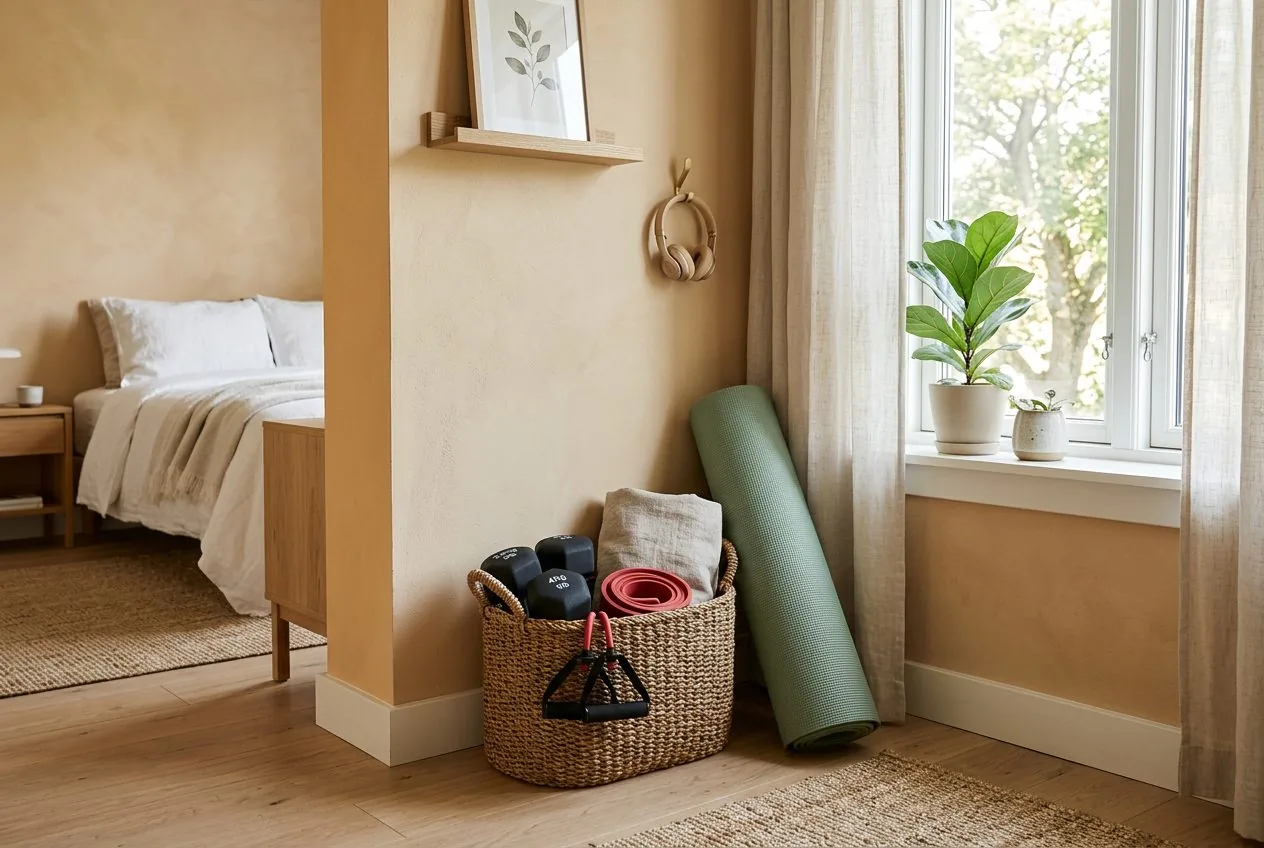
If you would love to get stronger at home after 40 but you do not have a spare room, a garage, or the budget for a wall of equipment, this guide is for you. The good news is that a small-space home gym is not a compromise. A lot of home gyms fail because people buy too much, too big, and too soon, and the intimidating pile ends up as a laundry rack in the corner. A tiny, well-chosen setup you actually reach for will always beat a room full of gear you avoid.
The method, in one line: claim one honest square of floor, buy only the two tools that cover almost everything, keep them in plain sight so a session starts in seconds, and grow the challenge by adjusting what you own rather than buying more. Small and visible beats big and hidden, every time.
This article is for information only and is not medical advice. Talk to your healthcare provider before starting a new exercise routine, especially if you have joint injuries, heart conditions, or dizziness.
Why small works better after 40
There is a quiet myth that a “real” home gym needs a dedicated room and a squat rack. For a midlife body that wants gentle, sustainable strength, the opposite is true. A small setup lowers the bar to starting, and starting is the entire game. When your gear lives in a basket by the sofa, a ten-minute session is a decision you can make on a tired Tuesday. When it lives in a closet upstairs, that same session quietly never happens.
Small also protects your joints and your wallet. A pared-back kit nudges you toward the movements that suit an over-40 body, controlled band work and light, measured lifts, instead of ego-driven heavy gear you are not ready for. And it keeps the cost low enough that the whole thing feels like a sensible experiment rather than a big commitment you have to justify.
The 5-step setup
Here is the whole method. None of it is about buying more; all of it is about removing friction so the sessions actually happen.
- Measure the space you actually have. Pick one honest spot and commit to it: a corner of the living room, a strip at the foot of the bed, a cleared closet shelf. You need about a bath-towel of floor to move on and a small shelf or basket for storage. Measuring first stops you from buying gear that has nowhere to go.
- Buy for the movements, not the fantasy. Two tools cover the vast majority of a gentle routine: a resistance band set for whole-body pulling, pressing, and lower-body work, and a light pair of adjustable dumbbells for loading you can measure (SAGE Open Medicine). That is a complete gym for most women over 40. Resist the big machines that promise everything and mostly collect dust.
- Make it grab-and-go. Store your gear in the open, in a basket or on a low shelf within arm’s reach of where you relax. The faster you can start a session, the more likely it is to happen. Visible gear gets used; hidden gear gets forgotten.
- Set one fixed station. Give the gym a permanent address, even a humble one: a mat rolled behind a door and a basket beside it. A station you do not have to assemble each time removes the “I would have to set it all up” excuse that kills so many good intentions.
- Progress by adjusting, not by buying more. When a move feels easy, add challenge with the gear you already own (CDC). Move up a band level, slow the lowering phase, or add a few pounds to the dumbbells. Buy new equipment only when a genuine gap appears in your routine, not because a sale is on.
A tiny setup that covers your whole body
You do not need a machine for each muscle. Here is how two tools, plus your own body, cover a full gentle-strength routine in a corner (CDC).
| Body area | Tool | Example move |
|---|---|---|
| Legs and hips | Bands or dumbbells | Goblet squat, banded side steps, glute bridge |
| Back and arms | Bands with a door anchor | Rows, band pull-aparts, curls |
| Shoulders and chest | Dumbbells or bands | Overhead press, floor press |
| Core and balance | Bodyweight on a mat | Dead bug, bird dog, standing marches |
All prices for gear like this are approximate as of mid-2026 and move constantly, so check current pricing before you buy.
Common mistakes when building a small gym
Buying a bulky machine first. A folding treadmill or a multi-station tower feels like a serious commitment, and that is exactly why it so often becomes furniture. Start with the small, flexible tools and earn the bigger purchase later, if ever. If gentle cardio is the gap you eventually want to fill, our walking pad vs under-desk elliptical comparison covers the two options that genuinely fit small homes.
Storing gear out of sight. The moment your bands go in a drawer and your dumbbells go in a closet, your home gym becomes theoretical. Keep it visible while the habit is young, even if it is not the tidiest look in the room.
Buying heavy too soon. Enthusiasm says go big; cranky joints and abandoned equipment say otherwise. A light, adjustable setup you can grow into beats a heavy one that intimidates you into quitting in week two.
Waiting for the perfect space. The corner you have today is better than the home gym room you might have someday. Claim the imperfect spot now and start.
Grab the printable setup guide
If you would like this setup and a simple starter session as a one-page checklist for the fridge or the wall by your new station, join our newsletter and we will send you our gentle-strength starter guide, along with honest reviews and protein-first recipes, with no shame and no miracle promises. Having the plan on paper, right next to your gear, makes showing up easier while the habit is still forming.
When a structured program helps
A small, well-placed gym solves the “will I start” problem. It does not always solve the “what exactly do I do, and when do I progress” problem. If you know you do better when someone tells you precisely what to do each session, a structured program can lift that decision off your plate. Our honest look at Old School New Body reviews one option built around brief, joint-friendly resistance sessions that suit a midlife body and a busy schedule. Keep your expectations grounded, and check with your provider before starting anything new.
The gear you actually need
Very little, and it all fits in a basket. A resistance band set and a light pair of adjustable dumbbells cover nearly everything a gentle home routine asks for, and together they usually cost less than a single piece of gym equipment. If you are choosing weights, our best adjustable dumbbells for women over 40 guide covers what to look for, and if you want the fuller shopping list for a corner setup, our best home gym under $150 breakdown walks through the priorities on a tight budget.
The honest bottom line
A home gym after 40 is not about square footage or hardware; it is about removing every reason not to start. Claim one honest corner, buy the two tools that do almost everything, keep them where you will see them, and let the challenge grow through what you already own. What a small, consistent setup genuinely tends to support is steadier everyday movement, more energy, and muscle that quietly protects your joints over the years (CDC). Set up your corner this week, keep the first sessions short enough to repeat, and let the habit, not the hardware, do the real work. The rest of our gentle strength section gives you routines to fill it.
Frequently Asked Questions
- How much space do I really need for a home gym after 40?
- Far less than most people assume. If you can lay down a mat and stand up with your arms out to the sides without hitting anything, you have enough room for a full gentle-strength routine. Bands, light dumbbells, and bodyweight moves all fit in about the space of a bath towel, and everything stores in a basket or on a shelf. The barrier to a home gym is almost never square footage; it is buying too much gear that then has nowhere to live.
- What should I buy first for a small home gym?
- Start with a resistance band set. It is the cheapest, gentlest, and most space-efficient tool of all, it covers your whole body, and it lets you start very light and progress in steps. A light pair of adjustable dumbbells is the natural second buy, because it adds resistance you can measure precisely without owning five separate pairs. Those two tools, plus a mat, handle the vast majority of a joint-friendly routine at home.
- Are adjustable dumbbells worth it for a small space?
- For a tight space, yes, because one adjustable pair replaces a whole rack. Instead of five sets of fixed dumbbells lining a shelf, a single adjustable pair spans a useful range and stores in one small footprint. Look for a light range, roughly 5 to 25 pounds per hand, which covers most gentle strength work after 40, and a secure mechanism that changes quickly. Prices move constantly, so check current pricing before you buy.
- Can I actually get stronger with such a small setup?
- Yes. Muscle responds to steady effort and gradual progression, not to how much equipment fills your home. A band set and a light pair of dumbbells give you plenty of room to challenge yourself while keeping good form, which matters more for midlife joints than lifting heavy too soon. What a small, consistent home setup genuinely tends to support is more everyday strength, steadier movement, and energy that lasts. The habit does the work; the gear just makes it easy to start.
Sources & references
Before you go
The 7-Day Protein-First Meal Plan for Women Over 40
A complete protein-first week, finished for you: your personal protein target, a one-page shopping list, 21 recipes at 25-35 g protein each, and a timed 90-minute prep schedule. Printable PDF, paired with a free 7-lesson email course.
Free guide
The 7-Day Protein-First Meal Plan for Women Over 40
A complete protein-first week, finished for you: your personal protein target, a one-page shopping list, 21 recipes at 25-35 g protein each, and a timed 90-minute prep schedule. Printable PDF, paired with a free 7-lesson email course.