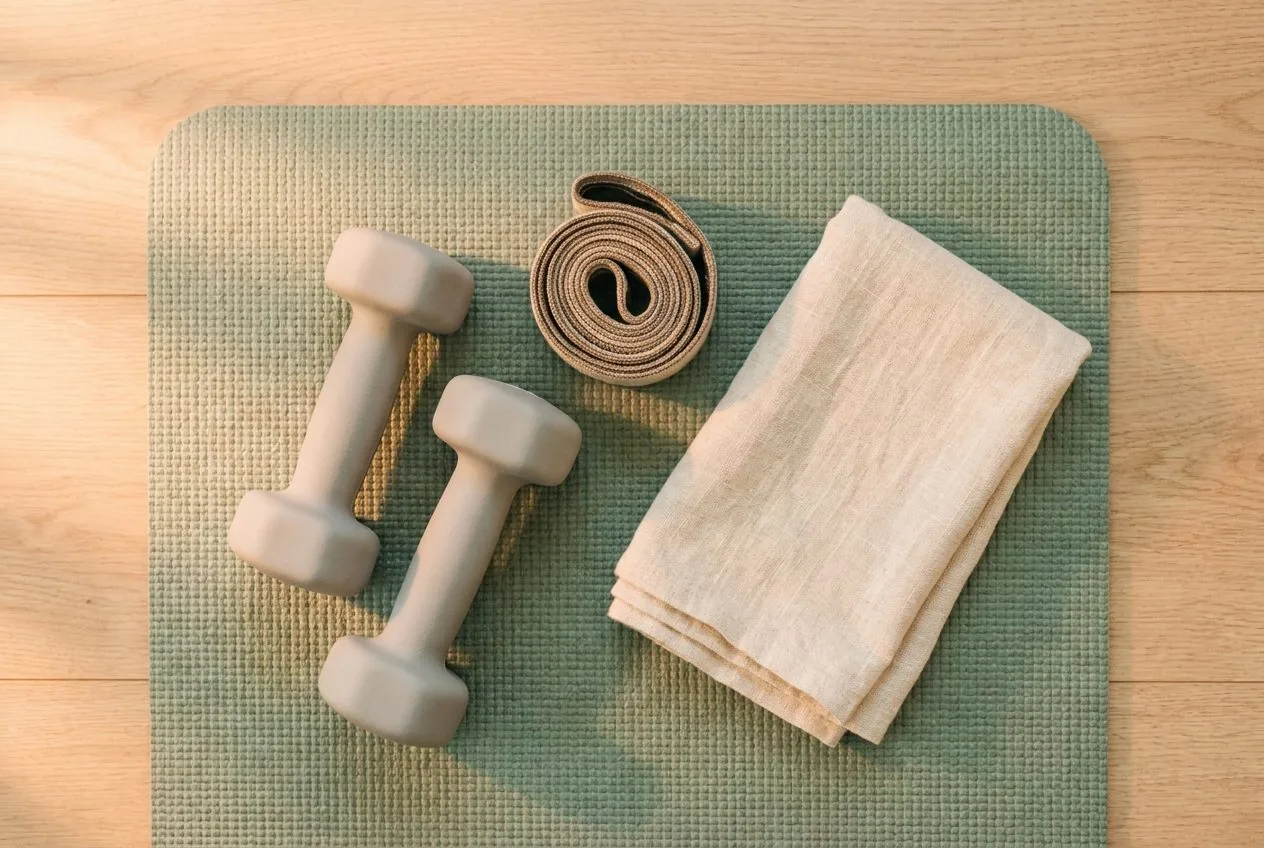
You do not need a garage full of equipment or a four-figure budget to train well at home after 40. You need a handful of versatile pieces that cover your whole body gently, store in a corner, and grow with you. The mistake most people make is buying one big machine or a matching set of everything at once, then watching the intimidating pile gather dust. A lean kit you actually reach for beats a room of gear you avoid.
So here are seven home gym essentials that together come in under $250, chosen for a midlife body that wants steady, joint-friendly strength rather than a showroom. This is a buyer’s guide based on the features that matter for this reader, not a lab test of specific brands, and prices move constantly, so treat every figure as approximate and check current pricing before you buy.
This article is for information only and is not medical advice. Talk to your healthcare provider before starting a new exercise routine, especially if you have joint injuries, heart conditions, or dizziness.
The idea: seven pieces, not seventy
A complete gentle routine needs only a few things: something to add scalable resistance, something to add measurable load, something comfortable to work on, something to help you recover, and a couple of small extras that make it all easier to use. Buy for the movements you will actually do, and the whole kit stays small, affordable, and, most importantly, used. Below, each pick includes what it does, roughly what to spend, and what to look for.
1. A resistance band set: the cheapest, most flexible start
What it does: covers your whole body with scalable resistance (SAGE Open Medicine). Rows, presses, curls, squats, and glute work all live here.
Roughly: a good set with a range of levels runs around $20 to $30.
What to look for: buy a set, not a single band, with light and extra-light options so you can start gently and progress. Tube bands with padded handles and a door anchor unlock rows and presses that mimic gym machines, while fabric loop bands suit lower-body work without rolling or pinching. If you have a latex allergy, look for latex-free or fabric options. Bands are the friendliest first buy because their resistance is lowest at the start of a move and builds as the band stretches.
2. A light pair of adjustable dumbbells: measurable progress
What it does: adds resistance you can measure precisely, which makes progress easy to see and repeat.
Roughly: a budget light adjustable pair often lands around $80 to $120.
What to look for: you do not need a heavy 50-pound tower. A light adjustable pair spanning roughly 5 to 25 pounds per hand covers most gentle strength work and saves the space of five separate pairs. Look for a secure, quick-change mechanism and a handle that sits comfortably. Dial-style adjustables change fastest; plate-style are cheaper but slower. For the full breakdown, see our best adjustable dumbbells for women over 40 guide.
3. An adjustable kettlebell: whole-body moves in one piece
What it does: adds a single, weight-shifting tool for swings, goblet squats, and carries that build grip and coordination alongside strength.
Roughly: an adjustable kettlebell often runs around $60 to $130, replacing several fixed bells.
What to look for: an adjustable model lets you dial the weight up as you get stronger without buying a rack of bells, which is ideal for a small space. Start light, and prioritize a comfortable, wide handle and a stable base. A kettlebell is optional if you already have dumbbells, but its swing and carry patterns add a useful, functional flavor that dumbbells do not quite replicate.
4. A supportive exercise mat: comfort and safety
What it does: cushions knees, wrists, and spine, and gives you a stable, non-slip surface.
Roughly: a decent mat runs around $25 to $40.
What to look for: for strength and floor work, a slightly thicker mat, around 6mm or more, is kinder to joints than a thin travel mat. Look for a non-slip surface and enough length for your height. It is the least glamorous purchase here and quietly the one that removes the “the floor is too hard” excuse.
5. A foam roller: the recovery piece most people skip
What it does: helps you warm up tight areas and wind down after a session, so the next workout feels more comfortable (Frontiers in Physiology).
Roughly: a basic roller runs around $20 to $30.
What to look for: a medium-density roller is the friendliest starting point; very firm, knobbly rollers can be intense for a beginner. A shorter roller stores easily; a longer one supports your whole spine. Recovery is not a luxury after 40, it is part of how you stay consistent.
6. A sturdy chair or low bench: free, and endlessly useful
What it does: turns into a support for step-ups, incline push-ups, sit-to-stands, and seated presses, and steadies you during balance work.
Roughly: likely free, using a solid dining chair you already own.
What to look for: a stable, non-wheeled chair against a wall is all most people need. If you catch a good sale later, a low flat bench opens up more moves, but a chair proves the habit first for nothing at all.
7. A storage basket and door anchor: the “will I use it” pieces
What it does: keeps your gear visible and grab-and-go, and lets your bands do rows and presses through a doorway.
Roughly: a few dollars for a basket, and many band sets include a door anchor.
What to look for: an open basket by the sofa, not a closed cupboard, so a session starts in seconds. A door anchor turns a simple band set into a surprisingly complete upper-body station. These tiny, cheap pieces are the ones that quietly decide whether everything else gets used.
Buy them in this order if money is tight
You do not need all seven at once. Here is a smart order that gets you moving fastest for the least money.
| Priority | Buy | Roughly | Why in this spot |
|---|---|---|---|
| 1 | Resistance band set | $20 to $30 | Cheapest, gentlest, whole-body |
| 2 | Exercise mat | $25 to $40 | Comfort makes everything else usable |
| 3 | Storage basket and door anchor | Under $10 | Turns gear you own into gear you use |
| 4 | Foam roller | $20 to $30 | Recovery keeps you consistent |
| 5 | Light adjustable dumbbells | $80 to $120 | Measurable progress once the habit is set |
| 6 | Adjustable kettlebell | $60 to $130 | Adds swings and carries later |
| 7 | Chair or bench | Free to start | You already have one |
The first few land well under $100 and make a complete starter setup on their own. Add the weighted tools as your routine settles, and the whole kit still fits under $250 if you shop the sales.
Common mistakes when kitting out a home gym
Buying the weighted gear first. Dumbbells and kettlebells feel like the “real” purchase, so people start there and skip the mat, basket, and bands that actually make a habit stick. Get moving cheap, then load up.
Owning gear you never program. Equipment solves the “what with” problem, not the “what do I do” problem. Pair your kit with a simple plan. Our small-space home gym how-to shows how to set up a corner and start using it in the same afternoon.
Chasing heavy too soon. Light and adjustable beats heavy and intimidating for midlife joints. Start under what feels heroic and progress only when your form has earned it (CDC).
Who should NOT upgrade yet
An honest note, because a list that only says “buy more” is not being straight with you. If you already own a band set and a mat, prove the habit before adding weights. If your real barrier is a plan rather than gear, no purchase will fix that. And if you are torn between the two weighted tools, do not buy both to be safe; our adjustable dumbbells vs kettlebells comparison helps you pick the one that fits your routine first.
The honest bottom line
A genuinely useful home gym for women over 40 costs less and takes up less room than the fantasy version. Seven small pieces, bought in a smart order and kept where you will see them, cover your whole body gently for under $250. What a consistent home setup tends to support is steadier movement, more energy, and muscle that quietly protects your joints over the years (CDC). Buy the few things that lower the bar to starting, put them within reach, and let the habit, not the hardware, do the real work. Find routines to run with your new kit in our gentle strength section.
Frequently Asked Questions
- Can you build a good home gym for under $250?
- Comfortably, if you buy a few versatile pieces instead of one machine. A resistance band set, a light pair of adjustable dumbbells, an exercise mat, and a foam roller together often land near $200, which leaves room for an adjustable kettlebell if you shop the sales. Prices move constantly, so treat every figure as approximate and check current pricing before you buy. The aim is a small, joint-friendly kit you will actually use, not a spare room full of gear.
- What is the single most important piece to buy first?
- For most women over 40, a resistance band set is the best first purchase. It is the cheapest and gentlest tool of the group, it works your whole body, and it lets you start very light and progress in steps. A mat comes next for comfort and safety, then dumbbells or a kettlebell for measurable loading, and a foam roller for recovery. Start with the one that lowers the bar to actually beginning, and add the rest as budget allows.
- Do I need both dumbbells and a kettlebell?
- Not at first, and maybe not ever. They overlap a good deal, so most women are well served starting with one. Adjustable dumbbells are the more familiar, more precise tool for curls, presses, and rows, while a kettlebell shines for swings, goblet squats, and carries that build grip and whole-body coordination. If you are choosing between them, our comparison below and the linked guide can help. Owning both is a nice-to-have once your routine is established, not a requirement to begin.
- How heavy should my weights be to start after 40?
- Lighter than your ego suggests. For adjustable dumbbells, a range of roughly 5 to 25 pounds per hand covers most gentle strength work, and you will spend early weeks at the low end. For a kettlebell, start with a light bell for two-handed moves and build up from there. Begin with a load you can control for your target reps with clean form, and add resistance only when the current weight feels genuinely easy. Slow and controlled protects midlife joints far better than heavy and rushed.
Sources & references
Before you go
The 7-Day Protein-First Meal Plan for Women Over 40
A complete protein-first week, finished for you: your personal protein target, a one-page shopping list, 21 recipes at 25-35 g protein each, and a timed 90-minute prep schedule. Printable PDF, paired with a free 7-lesson email course.
Free guide
The 7-Day Protein-First Meal Plan for Women Over 40
A complete protein-first week, finished for you: your personal protein target, a one-page shopping list, 21 recipes at 25-35 g protein each, and a timed 90-minute prep schedule. Printable PDF, paired with a free 7-lesson email course.