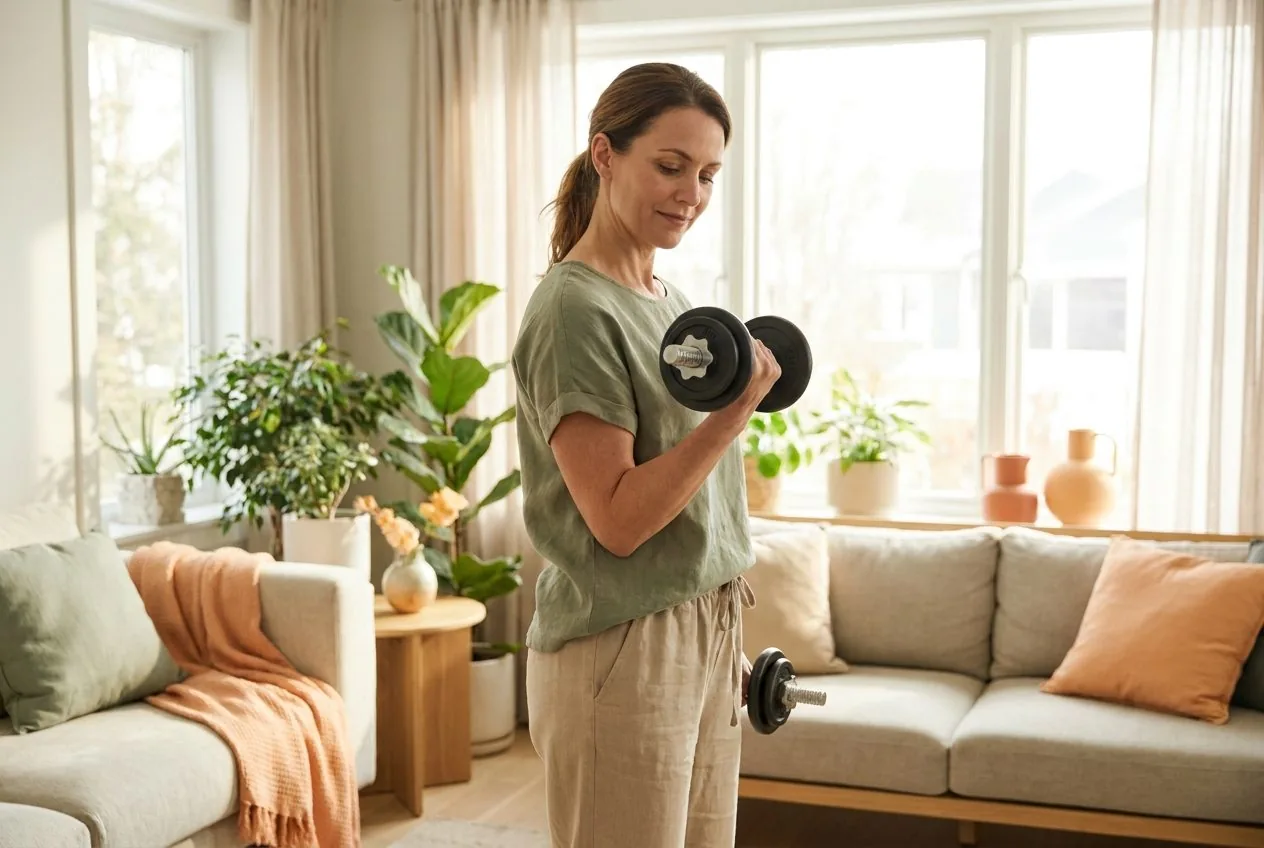
What adjustable dumbbells should a woman over 40 actually buy?
- Our pick is a profile, not a brand: a light-to-moderate dial-adjustable pair spanning roughly 5 to 25 lb per hand. 8/10.
- The light low end matters more than the top number: shoulders and small muscles need a genuinely light option for clean form.
- Dial-style changes weight in seconds but costs more; plate-style is cheaper and slower. Either works for a gentle home routine.
- Skip the upgrade if your joints want the gentlest possible entry (start with bands) or you only ever want one light fixed weight.
- This is a buyer's guide built on specs and the trade-offs between styles, not a lab test, and no dumbbell set changes your body without the habit.
If you have decided you want dumbbells at home but the wall of options has stopped you cold, this guide is for you. Adjustable dumbbells solve a real problem, one pair standing in for a whole rack, but they are also where a lot of money gets spent on more weight and more mechanism than a gentle, joint-friendly routine actually needs. So here is a clear-eyed category review: what to look for, a top pick by spec rather than hype, and an honest word on who should not bother.
This is a buyer’s guide based on the features that matter for a midlife body and the trade-offs between styles, not a lab test of a single model. Adjustable dumbbells are a crowded market, brands come and go, and prices move constantly, so we focus on the specs to look for, which stay true no matter what is in stock this month.
Our pick: a light-to-moderate dial-adjustable pair, spanning roughly 5 to 25 lb per hand. 8/10. For women over 40, the sweet spot is not the heaviest tower but a pair that starts light enough for shoulders and small muscles and has enough range to keep challenging you as you grow. Quick weight changes and a comfortable handle matter more than a big top number.
This article is for information only and is not medical advice. Talk to your healthcare provider before starting a new exercise routine, especially if you have joint injuries, heart conditions, or dizziness.
Who this is for
You do not need to be training for anything. This guide is for the woman who wants to rebuild a little strength at home, values a tidy corner over a cluttered spare room, and would happily lift light weights if choosing them were not so confusing. Adjustable dumbbells suit that person well, because one pair covers a wide range and stores neatly. If you only ever want a single light weight for gentle arm work, a fixed pair is cheaper and simpler, and that is a perfectly good choice too.
Why adjustable dumbbells suit an over-40 routine
The appeal is not glamour; it is practicality. Three things make an adjustable pair a smart fit for this reader.
One pair, many weights. As you get stronger, you will want to lift a little more for some movements and stay light for others. An adjustable pair lets you go light on lateral raises and heavier on rows without owning five separate sets, which is both cheaper over time and far tidier.
Room to progress. Muscle responds to gradual progression at any age (National Institute on Aging; NSCA), and having a range of weights in one tool means you can nudge the load up in small steps as you adapt. That built-in room to grow is exactly what keeps a routine from stalling.
They store where you live. A single compact pair tucks into a corner or under a console table, which matters more than it sounds. The equipment you can see and reach is the equipment you use, and a tidy pair by the sofa gets picked up far more than a rack hidden in a closet.
The honest limit: dumbbells load your joints with a constant weight through the whole movement, unlike bands, whose resistance is lightest at the start of a movement and builds as the band stretches. That is not a problem with light weight and good form, but it is why we always say start lighter than feels heroic. If you want the fuller trade-off, our resistance bands vs dumbbells comparison covers when each tool shines.
How we judged them
Four things separate an adjustable pair you will use daily from one that frustrates you into quitting:
- Does the weight range start light enough? A low end of around 5 pounds per hand matters as much as the top number, because shoulders and small muscles need a genuinely light option to work with good form.
- Is it quick and secure to change? A mechanism that changes in seconds and locks confidently means you will actually adjust it between exercises instead of leaving it on one weight and skipping the rest.
- Does it sit comfortably in your hand? Handle thickness, grip texture, and overall balance decide whether a set feels pleasant or awkward. Comfortable gear gets used.
- Does it fit your space and budget? Compactness, whether it comes with a stand, and price all decide whether it lives in the open where you will reach for it.
We weighed a light starting weight, quick and secure changes, and hand comfort most heavily, because those are the features that decide whether a midlife beginner keeps going.
The two styles, compared
| Feature | Dial-style adjustable | Plate-style adjustable |
|---|---|---|
| Weight change | Seconds, turn a dial | Slower, add or remove plates |
| Price | Higher | Lower |
| Shape and feel | Clean shape, can feel bulky | Often more compact |
| Best for | Quick changes between exercises | Budget and a simpler mechanism |
| Watch out for | Cost; check the locking mechanism | Time spent changing plates mid-workout |
All prices are approximate as of mid-2026. Adjustable dumbbells go on sale regularly, so check the current price before you buy.
Our top pick, by spec
For most women over 40, the pair to look for is a light-to-moderate dial-adjustable set spanning roughly 5 to 25 pounds per hand, with a comfortable handle and a locking mechanism you trust. Here is why that profile wins for this reader.
The light low end is the quiet hero. A genuinely light option lets you press, raise, and curl with clean form while your joints and small muscles build confidence, and it means the same pair works on a low-energy day as on a strong one. The moderate top end gives you room to progress your bigger muscles for months without buying anything else. And the dial mechanism means you will actually change the weight between a set of rows and a set of raises, which is the whole point of owning an adjustable pair rather than a single fixed weight.
You do not have to use the full range, and you certainly should not start there. Begin at the lightest setting that still challenges your target reps, keep your movements slow and controlled, and add the smallest increment only when the current weight feels genuinely easy (ACSM). The pair grows with you; you do not have to grow into it on day one.
Pros and cons
| Pros | Cons |
|---|---|
| One pair replaces several fixed sets and stores compactly | Costs more up front than a single fixed pair |
| Light low end suits shoulders, small muscles, and low-energy days | Load is constant through the movement, unlike bands |
| Room to progress your bigger muscles for months | Dial mechanisms can feel bulky in smaller hands |
| Quick changes mean you actually vary the weight | Best value usually needs waiting for a sale |
| Tidy footprint keeps it in reach, so it gets used | Heaviest towers are overkill for a gentle routine |
Honest criticisms
No product category is perfect, and pretending otherwise helps no one.
They are not the gentlest possible start. For very sensitive joints or a true from-scratch restart, resistance bands can feel kinder, because their resistance is lightest at the start of each movement. Many women use bands first and add dumbbells as confidence grows.
The value is real only if you use the range. If you buy an adjustable pair and leave it on one weight forever, you paid extra for a mechanism you never used, and a fixed pair would have served you better. The convenience only pays off if you actually change the weight.
Cheap mechanisms can disappoint. The locking mechanism is the part that matters most and the part budget models cut corners on. Read owner feedback on how securely a given set locks before you buy, and never lift a pair whose plates feel loose.
Who should buy, and who should skip
Buy if you want a tidy, grow-with-you strength tool at home, you value quick weight changes, and you like measuring progress by an exact number. This category serves you well.
Skip if your joints want the gentlest possible entry (start with bands), if you only ever want one light fixed weight (buy that instead and save money), or if what you are really missing is a plan rather than equipment. No dumbbell fixes a missing routine.
What we will not promise
An adjustable dumbbell set will not change your body for you, and no honest guide should pretend otherwise. What consistent, gentle strength work genuinely tends to support is steadier energy, better posture, easier daily movement, and muscle that quietly protects your metabolism over time (Current Sports Medicine Reports). Results depend on consistency, enough protein, and patience measured in months, not on any piece of equipment. Buy the tool, then let the habit do the real work.
The honest bottom line
For women over 40, the best adjustable dumbbells are not the heaviest or the flashiest; they are a light-to-moderate dial-adjustable pair, roughly 5 to 25 pounds per hand, with a comfortable handle and a lock you trust. That profile starts gentle enough to protect your joints, grows with you for months, and stores where you will actually reach for it. Start at the lightest useful weight, progress in the smallest steps, and pair the dumbbells with a little walking and enough protein.
If you would rather see how a small kit fits together, our home gym under $150 guide shows how dumbbells, bands, and a mat combine, and the rest of our gentle strength section gives you routines to put them to work.
Frequently Asked Questions
- What weight adjustable dumbbells should a woman over 40 buy?
- For most women over 40, a light-to-moderate adjustable pair that spans roughly 5 to 25 pounds per hand covers almost everything: presses, rows, curls, and gentle lower-body work. You want the low end light enough for shoulders and small muscles, and enough range at the top to keep challenging your bigger muscles as you get stronger. You do not need a 50-pound tower to start, and starting lighter protects your form and your joints.
- Are adjustable dumbbells worth it, or should I buy fixed ones?
- Adjustable dumbbells are worth it mainly for space and range. One pair replaces several fixed pairs and stores in a corner, which is a real advantage at home. Fixed dumbbells are cheaper per pair, simpler, and quicker to grab, but you need several to progress. If space is tight or you want room to grow without buying more equipment, adjustable wins. If you only ever want one light weight, a single fixed pair is cheaper.
- Dial-style or plate-style adjustable dumbbells, which is better?
- Dial-style adjustables change weight in seconds by turning a dial, which is convenient and keeps a clean shape, but they cost more and can feel bulkier in the hand. Plate-style adjustables are cheaper and often more compact, but changing weight takes longer because you add or remove plates. For a gentle home routine, either works; choose dial if quick changes matter to you, plate if budget matters more.
- Are adjustable dumbbells safe for sensitive joints?
- They can be, with light weight and good form. The key is starting lighter than feels heroic and progressing slowly, because control matters far more than load for midlife joints. Some people find bands even gentler at the very start because band resistance is lightest at the start of each movement and builds as the band stretches. If a specific joint is a concern, start very light, move slowly, and check with your provider before beginning.
- How do I know when to increase the weight?
- Increase only when your current weight feels genuinely easy for your target reps with clean form, and even then, nudge it up by the smallest increment available. There is no prize for jumping ahead. A good sign you are ready is finishing your last few reps feeling like you had two or three more in the tank. Progress that feels almost too gradual is exactly the pace that protects your joints and keeps you consistent.
Sources & references
Before you go
The 7-Day Protein-First Meal Plan for Women Over 40
A complete protein-first week, finished for you: your personal protein target, a one-page shopping list, 21 recipes at 25-35 g protein each, and a timed 90-minute prep schedule. Printable PDF, paired with a free 7-lesson email course.
Free guide
The 7-Day Protein-First Meal Plan for Women Over 40
A complete protein-first week, finished for you: your personal protein target, a one-page shopping list, 21 recipes at 25-35 g protein each, and a timed 90-minute prep schedule. Printable PDF, paired with a free 7-lesson email course.