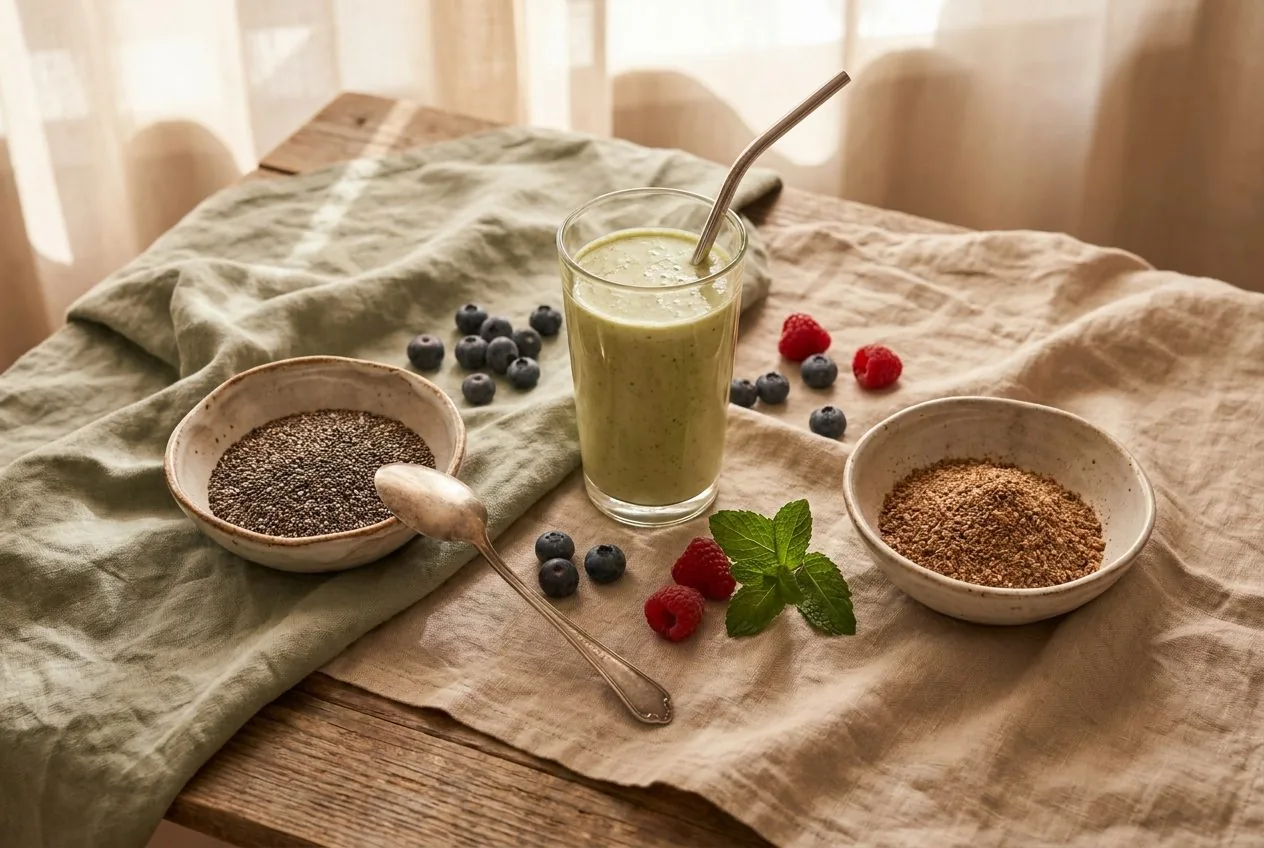
If you want your smoothies to carry a little more fiber and staying power after 40, two tiny seeds keep coming up: chia and ground flaxseed. They overlap enough to make the choice confusing, and both get marketed as some kind of superfood, which does not help you decide what to actually put in your cart. So let us settle it honestly, without pretending either one is magic. Both are good, humble additions to a balanced smoothie. They just do slightly different jobs.
Short answer for skimmers: if you want one seed and you mainly want a thicker, more filling smoothie with little change in taste, start with chia. If you want a mild, nutty note and a smooth texture, choose ground flaxseed. Most women over 40 end up keeping both and rotating them, since together they cost very little and cover slightly different needs. Whichever you pick, a single tablespoon is all it takes.
This article is for information only and is not medical advice. Talk to your healthcare provider before changing your diet or exercise routine, especially if you have a medical condition or take medication.
The quick comparison
| Feature | Chia seeds | Ground flaxseed |
|---|---|---|
| Taste | Very mild; rarely changes the taste | Mild and nutty |
| Texture effect | Swells and thickens noticeably | Blends in smoothly, little thickening |
| How to buy | Whole | Ground (or grind whole yourself) |
| Fiber | High; forms a gel in liquid | High, adds a different fiber mix |
| Healthy fat | Plant-based omega-3 (ALA) | Plant-based omega-3 (ALA) |
| Shelf life | Long; whole seeds keep well | Shorter once ground; store cold |
| Best at | Thickening thin smoothies, sneaking in fiber | A nutty flavor and a fine, even texture |
All prices are approximate as of mid-2026 and move constantly, so check current pricing before you buy.
Which should you pick? A quick decision framework
“I want to add fiber without changing the taste.” Chia, easily. Because it has almost no flavor (Harvard Health), it slips into any smoothie you already like, and you will barely notice it is there beyond a thicker, more satisfying glass.
“My smoothies come out too thin.” Chia again. A tablespoon soaks up liquid and swells, turning a watery blend into something thick and spoonable that feels more like a meal.
“I like a nutty flavor and a smooth, even texture.” Ground flaxseed. It brings a gentle nuttiness that suits berry and chocolate blends and folds in without the gel-like thickening chia gives.
“I do not want to fuss over which to buy.” Keep both and rotate. They are inexpensive, they do complementary jobs, and using a teaspoon of each is a perfectly good default. This is where most women over 40 quietly land.
The over-40 lens: what actually matters
The reason this small comparison is worth making is that most of us fall short on fiber (Harvard T.H. Chan School of Public Health). Both seeds are an easy, food-first way to add some. Here is how each suits a midlife body.
Fiber, gently. Both chia and flax add a meaningful amount of fiber (Harvard Health; Mayo Clinic), which supports steady digestion and helps a smoothie keep you full for longer. The honest caution is to build up slowly. A sudden jump in fiber can feel uncomfortable, so start with a teaspoon, drink plenty of water, and work up to a tablespoon over a week or two (Harvard T.H. Chan School of Public Health). This is about small, sustainable upgrades, not a fiber overhaul overnight.
Healthy fats. Both seeds carry a plant-based omega-3 fat called ALA, along with a little protein (Harvard Health; Mayo Clinic). That fat is part of what gives a smoothie staying power, slowing everything down so the glass feels like breakfast rather than a snack. Neither seed is a substitute for a varied diet, but both are a genuinely useful, inexpensive addition.
Freshness is the real difference. This is the practical point that decides how you store them. Chia keeps well in a cool cupboard, so one bag lasts a long time. Ground flaxseed is more delicate: once it is milled, it no longer has its hull to protect it and its shelf life is shorter, so it belongs in the fridge (Bob’s Red Mill) and is best bought in a size you will finish while it is fresh. If you would rather not think about it, chia is the lower-maintenance choice.
Everyday value. Both seeds are inexpensive and stretch a long way, since a tablespoon a day means a single bag lasts weeks. That makes either one an easy, low-cost upgrade rather than a splurge, which matters when you are building a habit you want to keep. Buy a sensible size rather than the biggest bag on the shelf, especially with flax, because a smaller bag you finish fresh beats a bargain size that turns stale at the back of the freezer. The cheapest seed is always the one you actually use up, not the one that sits forgotten.
If you want the wider pantry picture before you buy, our smoothie starter kit for women over 40 covers the handful of staples worth keeping on hand, including both seeds.
A simple way to use either one
Here is the reassuring truth: adding these seeds could not be easier, and it is nearly identical for both. You are not learning two different techniques.
- Start small. Add a teaspoon of either seed to a smoothie you already enjoy, and see how the texture and your stomach feel before you build up to a tablespoon.
- Blend it in. Chia will thicken the drink as it sits, so blend and drink it reasonably promptly, or let it sit a few minutes if you like a thicker, pudding-like glass. Flax simply disappears into the blend.
- Pair it with protein and fruit. A seed on its own does little. In a smoothie with a real protein source, some fruit, and a liquid base, it becomes a small, helpful upgrade to a balanced meal.
- Keep water alongside. Because both add fiber, a glass of water with your smoothie keeps everything comfortable, especially in the first week or two.
That is the whole method. Notice how similar the two are in practice: they train the same habit and slot into the same recipes, which is exactly why the choice is lower-stakes than it feels. You can start with one, learn how it behaves, and add the other later without changing anything else.
Both are food, not medicine
Here is the honest part a product label will not tell you: neither chia nor flaxseed will change your body on its own, and no seed is a health fix. They are small, useful additions to a balanced smoothie, valued for the fiber and plant fats they bring and the way they make a glass more filling. What that genuinely tends to support is steadier digestion, a smoothie that holds you a little longer, and a gentle nudge toward the fiber most of us miss. That is worth doing. It is just not a miracle, and any honest guide should say so plainly.
Whichever seed you choose, the amount matters far less than the habit of using it. Pair a spoonful with enough protein and some whole fruit and you have covered the fundamentals. Our guide to high-protein smoothies for women over 40 shows how the seeds fit into blends built to keep you full, and the wider smoothies and simple meal prep section gives you the rest of the week’s easy meals.
The honest bottom line
Chia and ground flaxseed are not rivals; they are teammates that happen to overlap. If you buy one thing, buy chia: it is neutral, it thickens a thin smoothie beautifully, and it keeps well with no fuss. If you want a nutty note and a smoother texture, add ground flaxseed, and store it cold so it stays fresh. And if you would rather not choose, keep both and rotate them, because together they cost very little and cover slightly different needs.
Start with a teaspoon, build up gently to about a tablespoon, and drink some water alongside. The best seed for your smoothie is the one you will actually keep reaching for, and both of these earn their small place on the shelf without pretending to be anything more than good food.
Frequently Asked Questions
- Are chia seeds or ground flaxseed better in a smoothie after 40?
- Neither is simply better; they do similar jobs with small differences. Chia seeds swell and thicken a smoothie with almost no taste, which makes them the easiest to sneak in. Ground flaxseed adds a mild, nutty flavor and blends in smoothly without changing the texture much. Both add fiber and plant-based fats. If you want one seed for its texture and neutrality, start with chia. If you want a nutty note and a slightly different fat profile, choose flax. Many women simply keep both and rotate them.
- Why does flaxseed need to be ground but chia does not?
- It comes down to the shell. Whole flaxseeds have a hard coat that may pass through you without breaking down, so grinding them is what lets your body actually reach the fiber and fats inside. Chia seeds are softer and swell in liquid, so they do their job whole, which is why you buy chia whole but flax ground. If you buy whole flax, a quick grind in a coffee or spice grinder before you use it solves the problem.
- How much chia or flaxseed should I add to a smoothie?
- About one tablespoon is the sweet spot for either one. That is enough to add a useful amount of fiber and a little healthy fat without turning your smoothie gluey or heavy. More is not better here. A big scoop of chia can make a drink thick and pudding-like, and a heavy hand of flax can taste dominant. If you are new to added fiber, start with a teaspoon, drink enough water, and build up gently so it sits comfortably.
- Do I have to choose, or can I use both?
- You can absolutely use both, and many women do. A tablespoon of chia for thickness and a tablespoon of flax for a nutty note is a fine combination, or you can rotate them day to day. They complement each other rather than compete. The only real limit is texture and how heavy you want the glass to feel, so if you use both, a teaspoon of each is plenty rather than a full tablespoon of both.
Sources & references
- Harvard Health Publishing, Chia seed benefits (opens in new tab)
- Mayo Clinic Staff (via Memorial Health System), Flaxseed: Is ground better than whole? (opens in new tab)
- Harvard T.H. Chan School of Public Health, The Nutrition Source: Fiber (opens in new tab)
- Bob's Red Mill, Does Flaxseed Go Bad? (opens in new tab)
Before you go
The 7-Day Protein-First Meal Plan for Women Over 40
A complete protein-first week, finished for you: your personal protein target, a one-page shopping list, 21 recipes at 25-35 g protein each, and a timed 90-minute prep schedule. Printable PDF, paired with a free 7-lesson email course.
Free guide
The 7-Day Protein-First Meal Plan for Women Over 40
A complete protein-first week, finished for you: your personal protein target, a one-page shopping list, 21 recipes at 25-35 g protein each, and a timed 90-minute prep schedule. Printable PDF, paired with a free 7-lesson email course.