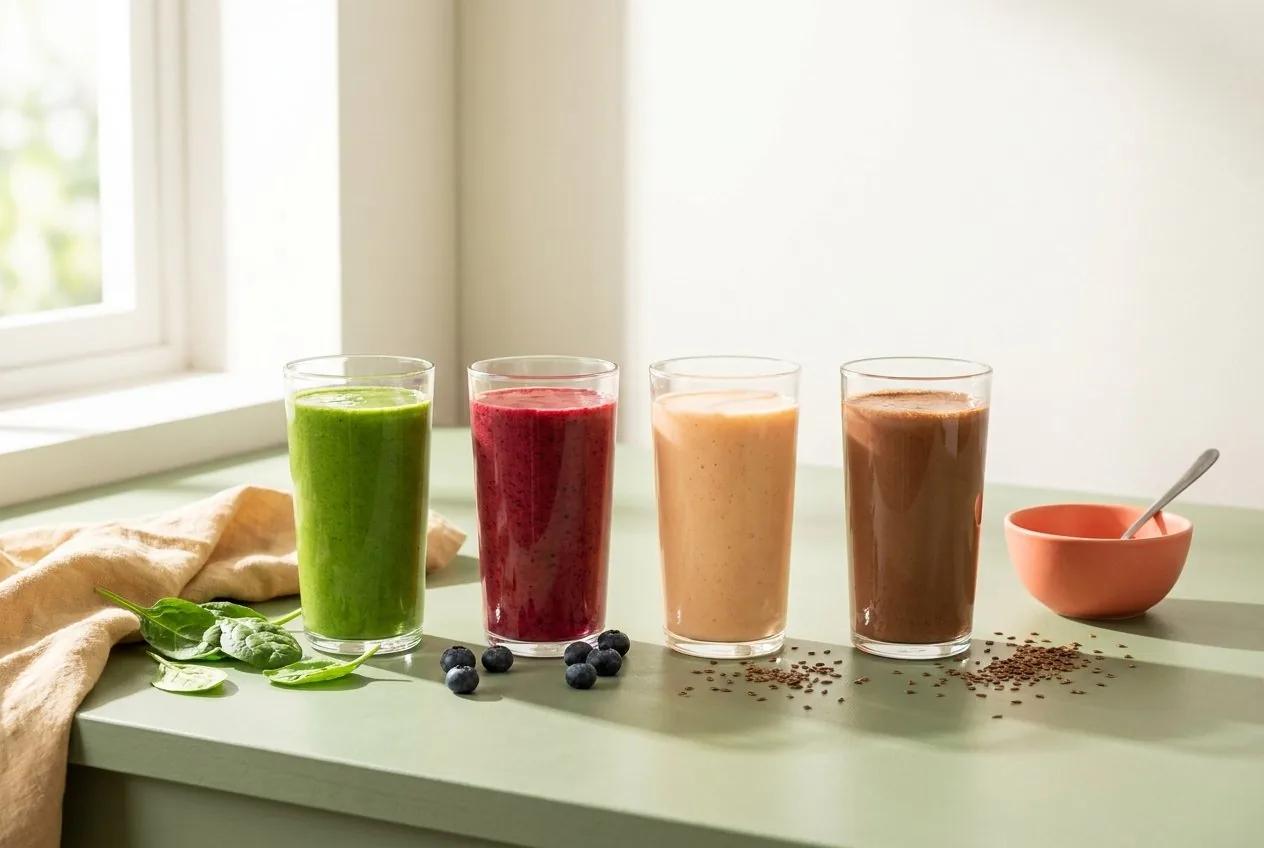
What makes a smoothie actually work for a woman over 40?
- One formula runs all 15 recipes: 25-30 g protein plus a healthy fat plus fiber-first carbs.
- That per-meal range is what muscle research on aging adults points to, and it is the easy route to the 1.0-1.5 g per kg per day the PROT-AGE study group suggests for older adults.
- Greek yogurt, cottage cheese, kefir, and protein powder are the workhorses; juice bases and fruit-only recipes are the usual failures.
- No smoothie balances your hormones; the hormone-friendly blends simply make flax, chia, walnuts, and pumpkin seeds pleasant to eat.
- A smoothie is a tool, not a rule: blending three to five mornings a week and cooking the rest is a perfectly good system.
If a smoothie has ever left you hungry again by mid-morning, nothing is wrong with you. Most smoothie recipes on the internet are fruit and juice with a splash of good intentions. They were written for someone else. They were never built for a woman over 40 who wants steady energy, a calm appetite, and enough protein to hold on to her muscle.
This list fixes that. Below are 15 smoothies that all follow the same protein-first formula, grouped by what you need most: fast breakfast keepers, hormone-friendly blends, gentle green starters, and a few that taste like dessert while still pulling their weight. Every recipe lists an approximate protein count and a prep note that makes the morning version of you a little happier. Pick two or three to rotate this week and you have a real plan, not just a pretty photo board.
The Over-40 Smoothie Formula
Every recipe here is built on one three-part skeleton:
25-30 g protein + a healthy fat + fiber-first carbs.
Here is why each part earns its place.
Protein comes first. From your 40s onward, your body gradually loses muscle unless you actively work to keep it (Current Opinion in Clinical Nutrition and Metabolic Care), and muscle is what keeps you strong, steady on your feet, and metabolically active. Research on muscle and aging points to roughly 25-30 g of protein per meal (Current Opinion in Clinical Nutrition and Metabolic Care), and expert recommendations for older adults run about 1.0-1.5 g per kilogram of body weight across the whole day (J Am Med Dir Assoc). A smoothie is one of the easiest places to hit that first number without cooking anything. Greek yogurt, cottage cheese, kefir, and a quality protein powder are the workhorses in the recipes below.
A healthy fat makes it satisfying. Nut butter, chia, ground flaxseed, hemp hearts, or a little avocado slow digestion, so the smoothie lands like a meal instead of a snack. Skip the fat and you will be staring into the fridge by 10 a.m.
Fiber-first carbs steady the ride. That means whole fruit instead of juice, plus oats and seeds. Most of us fall short of the 25 g+ of daily fiber that supports digestion and fullness (Harvard T.H. Chan School of Public Health), and a well-built smoothie can quietly close a chunk of that gap.
Why the 25-30 g target instead of a vague “add more protein”? Because that per-meal range is where research on muscle protein synthesis points, in younger and older adults alike. Noticeably less and the smoothie tends to fade on you by mid-morning. Piling far more into one glass does not buy you much extra either. Hitting the range at each meal is also the simplest path to the 1.0-1.5 g per kilogram daily total the PROT-AGE study group suggests for older adults (J Am Med Dir Assoc) without weighing food or tracking an app.
One build tip before the recipes: add liquid first, then yogurt or powder, then greens and seeds, and frozen fruit last. Your blender will thank you, and you will stop finding dry pockets of protein powder hiding at the bottom of the jar.
This article is for information only and is not medical advice. Talk to your healthcare provider before changing your diet or exercise routine, especially if you have a medical condition or take medication.
Breakfast Keepers
These four are the weekday workhorses. Familiar flavors, five minutes or less, and enough protein to carry you to lunch. If you are brand new to protein-first smoothies, start in this section; every recipe here tastes like something you already love.
1. Peanut Butter Banana Classic
The comfort-food flavor that makes a protein-first breakfast feel like a treat instead of a chore.
- 1 cup milk of choice
- 3/4 cup plain Greek yogurt
- 1 tablespoon peanut butter
- 1/2 frozen banana
- 1/4 cup rolled oats
- Ice as needed
About 29 g protein. Prep note: freeze ripe bananas in halves so you never blend a mealy one at 7 a.m.
2. Berry Yogurt Wake-Up
Bright, tangy, and loaded with the whole-fruit fiber that juice-based recipes throw away.
- 1 cup milk of choice
- 3/4 cup plain Greek yogurt
- 1 cup frozen mixed berries
- 1 tablespoon ground flaxseed
- 1 teaspoon honey, optional
About 25 g protein. Prep note: buy the big bag of frozen mixed berries; it is cheaper and always ripe.
3. Cold Brew Mocha Shake
Breakfast and coffee in one glass for the mornings when you refuse to choose.
- 3/4 cup cold brew coffee
- 1/2 cup milk of choice
- 1 scoop chocolate protein powder
- 1 tablespoon almond butter
- 1/2 frozen banana
- Ice as needed
About 27 g protein. Prep note: brew a jar of cold brew on Sunday and it keeps in the fridge all week.
4. Apple Cinnamon Oat Smoothie
Tastes like the inside of an apple crisp and holds you like a bowl of oatmeal.
- 1 cup plain kefir
- 1 scoop vanilla protein powder
- 1/2 apple, cored
- 1/4 cup rolled oats
- 1/2 teaspoon cinnamon
- Ice as needed
About 30 g protein. Prep note: no need to peel the apple; the skin is where much of the fiber lives.
Hormone-Friendly Blends
First, the honest part: no smoothie balances your hormones, and anyone who promises that is selling something. What these four recipes do offer is a pleasant, repeatable way to eat flaxseed, chia, walnuts, and pumpkin seeds, ingredients often used to support an overall eating pattern through the menopause transition. They are also rich in fiber and omega-3 fats, which your body appreciates at any age.
5. Blueberry Flax Smoothie
The simplest way we know to eat two tablespoons of ground flaxseed without noticing.
- 1 cup soy milk
- 1 scoop vanilla protein powder
- 1 cup frozen blueberries
- 2 tablespoons ground flaxseed
About 29 g protein. Prep note: buy flaxseed pre-ground or grind it yourself.
6. Cherry Chia Almond Smoothie
Deep cherry flavor with chia for fiber and a gentle thickness that makes it feel substantial.
- 1 cup milk of choice
- 3/4 cup plain Greek yogurt
- 1 cup frozen dark cherries
- 1 tablespoon chia seeds
- 1 drop almond extract
About 25 g protein. Prep note: let it sit five minutes after blending so the chia can thicken it into a spoonable treat.
7. Walnut Cocoa Smoothie
Chocolate that carries walnuts, one of the few plant foods with a meaningful dose of omega-3 fat (Harvard T.H. Chan School of Public Health).
- 1 cup milk of choice
- 1 scoop chocolate protein powder
- 2 tablespoons walnuts
- 1/2 frozen banana
- 1 teaspoon unsweetened cocoa powder
About 30 g protein. Prep note: toast a batch of walnuts once and store them in a jar; the flavor gets noticeably richer.
8. Raspberry Pumpkin Seed Smoothie
Tart raspberries plus pumpkin seeds, a small handful of which adds minerals, fat, and crunch-free protein.
- 1 cup soy milk
- 3/4 cup plain Greek yogurt
- 1 cup frozen raspberries
- 2 tablespoons pumpkin seeds
About 26 g protein. Prep note: raspberries are one of the highest-fiber fruits you can blend, so this one is a quiet fiber win.
Green Starters
New to green smoothies? Start here. These three use mild greens and enough fruit that you taste freshness, not lawn. Spinach is the gateway green; it disappears behind almost any fruit, and it adds fiber and folate for essentially zero calories. Kale can come later, or honestly, never. There is no green smoothie merit badge.
9. Gentle Green Beginner
The training-wheels green smoothie: sweet, creamy, and the spinach is essentially invisible.
- 1 cup milk of choice
- 3/4 cup plain Greek yogurt
- 1 large handful baby spinach
- 1/2 cup frozen pineapple
- Squeeze of lime
About 24 g protein. Prep note: freeze washed spinach in zip-top bags; frozen spinach blends smoother than fresh.
10. Avocado Pear Green Smoothie
Silky and barely sweet, with avocado doing the satisfying work that sugar usually fakes.
- 1 cup soy milk
- 1 scoop vanilla or unflavored protein powder
- 1/4 ripe avocado
- 1/2 ripe pear
- 1 handful baby spinach
- Ice as needed
About 28 g protein. Prep note: ripe avocado freezes well in quarters, so none of them go brown on the counter.
11. Cucumber Mint Refresher
The lightest smoothie on this list, built for hot afternoons when you want cool and clean, not heavy.
- 1 cup plain kefir
- 1 scoop vanilla protein powder
- 1/2 cucumber
- 6-8 fresh mint leaves
- 1/2 cup frozen green grapes
About 28 g protein. Prep note: freeze the grapes yourself; they double as ice cubes that never water it down.
Dessert-Tasting Smoothies That Still Pull Their Weight
Craving something sweet after dinner is human, not a failure. Fighting the craving with willpower alone usually ends at the bottom of a pint of ice cream around 9 p.m., so we would rather hand you a better answer than a lecture. These four taste like dessert and still follow the formula, so the craving gets met and the protein still shows up.
12. Chocolate Cherry Shake
Tastes like a chocolate-covered cherry, holds like a full meal.
- 1 cup milk of choice
- 1 scoop chocolate protein powder
- 1/2 cup frozen dark cherries
- 1/2 frozen banana
- 1 teaspoon unsweetened cocoa powder
About 30 g protein. Prep note: extra cocoa deepens the chocolate without adding sweetness, so adjust to taste.
13. Strawberry Cheesecake Smoothie
Cottage cheese is the secret; it blends completely smooth and brings serious protein for very few calories.
- 1/2 cup cottage cheese
- 1/2 cup milk of choice
- 1/2 scoop vanilla protein powder
- 1 cup frozen strawberries
- 1/4 teaspoon vanilla extract
- A little lemon zest
About 27 g protein. Prep note: if cottage cheese texture worries you, blend it with the milk first until silky, then add the rest.
14. Salted Date Caramel Shake
One blended date plus a pinch of salt reads as caramel, no syrup required.
- 1 cup milk of choice
- 1 scoop vanilla protein powder
- 1 pitted Medjool date
- 1 tablespoon almond butter
- Pinch of flaky salt
- Ice as needed
About 30 g protein. Prep note: soak the date in warm water for five minutes if your blender is on the budget end.
15. Mint Chocolate Chip Smoothie
The ice cream parlor flavor, rebuilt with spinach you will never taste and cacao nibs for the chip crunch.
- 1 cup milk of choice
- 3/4 cup plain Greek yogurt
- 1 handful baby spinach
- 1/8 teaspoon peppermint extract
- 1 tablespoon cacao nibs
- 1/2 frozen banana
About 24 g protein. Prep note: this one runs a little light on protein, so add a half scoop of vanilla powder if it is your whole meal.
Make Any Recipe Your Own
Once you have made a few of these, you will notice they are all the same skeleton wearing different outfits. That is on purpose. Swap within these lanes and you can invent your own recipes for years without ever breaking the formula:
- Base (pick one): milk, soy milk, kefir, cold brew coffee
- Protein (pick one or two): plain Greek yogurt, cottage cheese, protein powder, silken tofu
- Fat (pick one): peanut or almond butter, chia seeds, ground flaxseed, hemp hearts, avocado
- Fiber-first carbs (pick one or two): frozen berries, half a banana, rolled oats, half a pear, pumpkin puree
- Flavor helpers (free spins): cinnamon, cocoa, vanilla, fresh mint, lemon zest, grated ginger
One practical warning: change one thing at a time. Swapping the base, the fat, and the fruit all in the same morning is how you end up with a gray smoothie nobody wants to talk about.
Common Smoothie Mistakes (Fix These First)
Before you blame yourself for a smoothie that did not work, check these five.
Using juice as the base. Juice is fruit with the fiber stripped out. Swap in milk, soy milk, or kefir and the same recipe suddenly holds you.
Skipping the protein. Fruit plus almond milk is a snack wearing a breakfast costume. If there is no yogurt, cottage cheese, kefir, or powder in the glass, add one.
Fruit-only thinking. Three fruits and no fat or protein is a sugar wave followed by a slump. Keep it to one or two fruits and let the formula do the rest.
Portion creep. Nut butter, oats, and seeds are wonderful and also easy to overpour. Measure them with actual spoons, at least for the first few weeks.
Sipping it next to a full breakfast. These smoothies are meals, not beverages. Drinking one alongside toast and eggs doubles your breakfast without you noticing.
One more gentle reality check: a smoothie is a tool, not a rule. If you love a cooked breakfast four days a week and blend the other three, that is a perfectly good system. The formula exists to make the smoothie days work as hard as the egg days, not to replace every meal you enjoy chewing.
You will find more simple, protein-first meal ideas in our Smoothies & Simple Meal Prep section whenever you are ready to branch out.
A Quick Note on Blenders
You do not need an expensive machine to make any of these. You do need one that can handle frozen fruit daily without stalling, because a blender that fights you every morning is a habit killer. Based on our research, spec comparisons, and owner feedback, we broke down the options by budget and need in our guide to the best blenders for daily smoothies, including an honest section on who should not upgrade at all.
Want It Fully Planned for 21 Days?
Rotating a few recipes from this list is honestly enough structure for most women. But if decision fatigue is your real enemy and you want every smoothie chosen for you for three straight weeks, a structured program can help you build the habit. The best known one is a 21-day plan built around meal-replacement smoothies, priced around $27 (list price $47), check the current price (The Smoothie Diet). It is not magic, and it will not suit everyone. Replacing meals with smoothies works through a plain old calorie deficit, which is worth knowing before any sales page tells you otherwise. We dug into exactly what it can and cannot do, including who we think should skip it, in our honest Smoothie Diet review. Read that before you spend a dollar.
Either way, start with one smoothie tomorrow morning. Protein first, fat second, fiber third. That is the whole secret, and it is learnable in a week.
Sources & references
- Current Opinion in Clinical Nutrition and Metabolic Care, Muscle tissue changes with aging (opens in new tab)
- Current Opinion in Clinical Nutrition and Metabolic Care, Protein and sarcopenia (opens in new tab)
- J Am Med Dir Assoc, PROT-AGE protein recommendations for older people (opens in new tab)
- Harvard T.H. Chan School of Public Health, Fiber (opens in new tab)
- Harvard T.H. Chan School of Public Health, Omega-3 fats (opens in new tab)
- The Smoothie Diet, official sales page (opens in new tab)
Before you go
The 7-Day Protein-First Meal Plan for Women Over 40
A complete protein-first week, finished for you: your personal protein target, a one-page shopping list, 21 recipes at 25-35 g protein each, and a timed 90-minute prep schedule. Printable PDF, paired with a free 7-lesson email course.
Free guide
The 7-Day Protein-First Meal Plan for Women Over 40
A complete protein-first week, finished for you: your personal protein target, a one-page shopping list, 21 recipes at 25-35 g protein each, and a timed 90-minute prep schedule. Printable PDF, paired with a free 7-lesson email course.