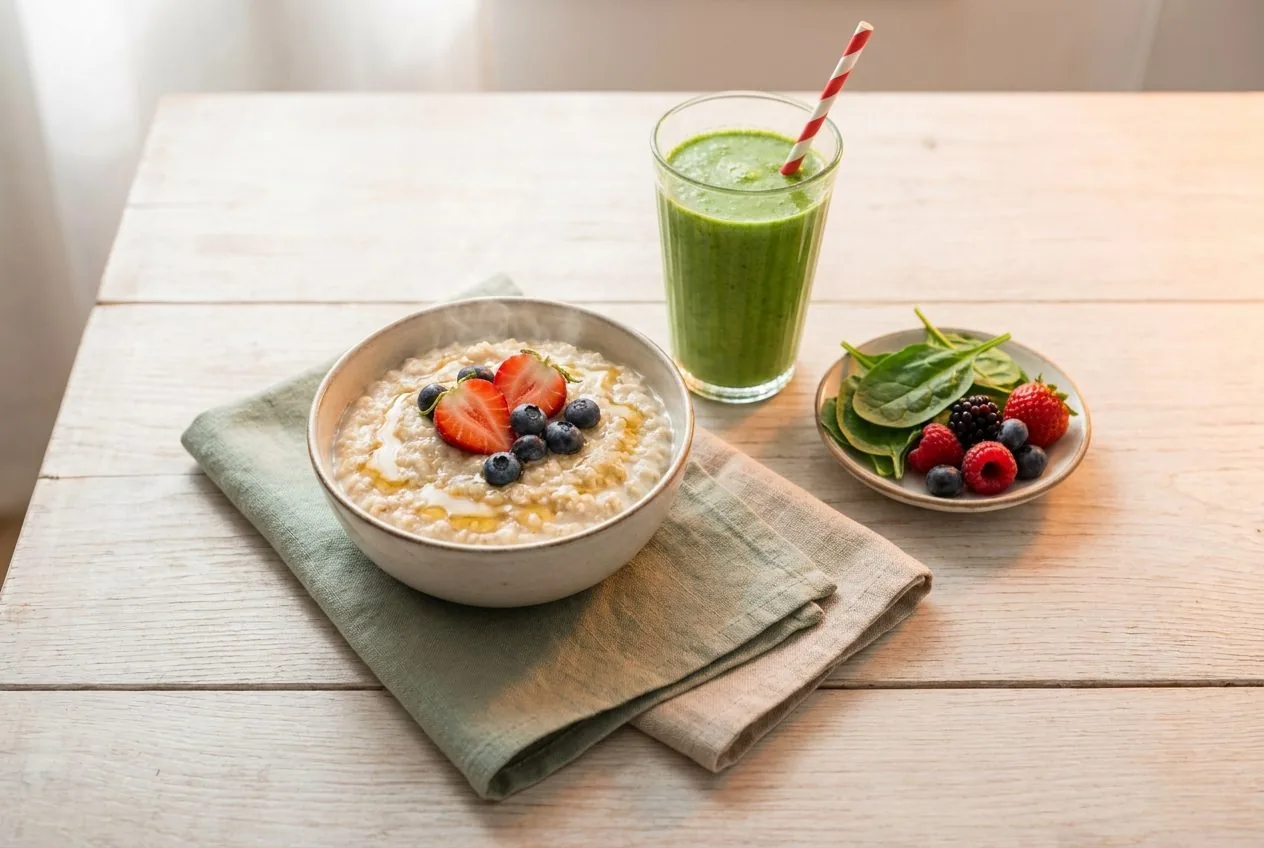
As the mornings cool, the daily breakfast question quietly changes. The cold smoothie that felt perfect in July suddenly competes with a warm bowl of oatmeal, and if you are wondering which one actually serves you better after 40, you are asking a good question. The honest answer is that neither wins outright, because both can be an excellent, steady-energy breakfast when you build them the same way. What changes is the format, and the right format is the one that fits your morning and the season.
Short answer for skimmers: choose warm oatmeal when you want comfort, warmth, and a bowl you make ahead, and choose a smoothie when you want speed, portability, and an easy way to pack in produce. Build either around a real protein source with some fiber and a little healthy fat, and both will hold you until lunch. Most women over 40 end up keeping both and choosing by the morning.
This article is for information only and is not medical advice. Talk to your healthcare provider before changing your diet or exercise routine, especially if you have a medical condition or take medication.
The quick comparison
| Feature | Warm oatmeal | Smoothie |
|---|---|---|
| Comfort | High; warm and cozy for cold mornings | Cool and refreshing, less so in fall |
| Speed in the moment | Fast with quick oats, faster made ahead | Fastest; a two-minute blend |
| Protein | From yogurt, milk, eggs, or a scoop of powder | From yogurt, milk, or a scoop of powder |
| Fiber | High, from the oats plus fruit and seeds | High, from fruit, greens, and seeds |
| Easy to pack in produce | Some fruit and seeds | Very easy; greens and fruit blend in |
| Make-ahead | Overnight oats jars keep for days | Prep bags freeze; blend fresh |
| Best for | Slow, warm mornings and batch prep | Rushed mornings and portability |
All prices are approximate as of mid-2026 and move constantly, so check current pricing before you buy.
Which should you pick? A quick decision framework
“I want warmth and comfort on a cold morning.” Oatmeal, easily. A warm bowl is the coziest breakfast of the season, and it sets a calm tone for a busy autumn day in a way a cold drink cannot.
“I have about two minutes and I am out the door.” A smoothie. Blend, pour, and go, with one container to rinse. It is the fastest genuinely balanced breakfast when a morning is truly rushed.
“I want to prep breakfast ahead for the week.” Either works, but they prep differently. Overnight oats jars sit ready in the fridge for days, and smoothie bags of pre-portioned fruit and greens wait in the freezer for a quick blend. Choose the prep style that suits you.
“I struggle to eat vegetables in the morning.” A smoothie. A handful of spinach or kale vanishes into a berry blend, which makes it the easiest way to slip some produce into breakfast without tasting it.
“I want the most filling option.” Built the same way, oatmeal has a slight edge, since solid and thicker foods tend to curb hunger more than drinks (Scientific Reports), but how you build it matters more. Both hold you well when they carry real protein and some fat; both fade fast when they are just carbs or just fruit. Build well and either one lasts until lunch.
The over-40 lens: what actually matters
The format is the fun part, but the fundamentals are what make breakfast work after 40. Whichever you choose, three things decide whether it holds you.
Protein is the piece most breakfasts miss. Plain oats and plain fruit are both light on protein, and after 40 that matters, because protein helps protect the muscle we gradually lose (Harvard Health) and is what makes a breakfast behave like a meal. Get oatmeal there with Greek yogurt, milk, a couple of eggs on the side, or a scoop of protein powder stirred in; get a smoothie there with yogurt, milk, or a scoop of powder. Aim for roughly 25 to 30 grams either way (Current Opinion in Clinical Nutrition and Metabolic Care).
Fiber comes easily to both. Oats bring fiber built in, and a smoothie gets there with fruit, greens, and a spoon of seeds. Fiber is a nutrient most of us fall short on (Harvard T.H. Chan School of Public Health), so it is a genuine point in favor of both breakfasts, as long as you build up any added seeds gradually and drink enough water.
A little fat brings staying power. A spoon of nut butter or seeds in either one slows things down and keeps the breakfast satisfying rather than sparse. This is often the missing piece when a smoothie leaves you hungry an hour later. If nut butter is your fat of choice, our guide to the best nut butters for fall snacking sorts the jars worth keeping.
Notice the pattern: the winning breakfast is not oatmeal or smoothie, it is protein plus fiber plus a little fat, in whichever format you will actually eat. If you want the wider pantry picture, our smoothie starter kit for women over 40 covers the handful of staples that make either breakfast easy, from oats and seeds to a protein powder you enjoy.
Both are tools, not rules
Here is the honest part a breakfast trend will not tell you: neither oatmeal nor a smoothie is a magic morning, and no single breakfast changes your body on its own. They are simply two good vehicles for the same steady-energy fundamentals, and the best one is the one that fits the morning in front of you. Some fall days call for a warm bowl and a slow start; others call for a blend you drink in the car. Keeping both in your rotation is not indecision, it is good sense, because variety keeps breakfast from getting boring and quietly abandoned. The same logic applies a level up: if you are weighing a full 21-day smoothie program against building your own routine, our Smoothie Diet vs DIY meal prep comparison walks through when each makes sense.
What either one genuinely tends to support, built well and eaten regularly, is more even energy through the morning and a breakfast that holds you until lunch. That depends on the protein, fiber, and fat you put in, and on eating it consistently, not on the format you pick.
A simple way to build each one
A warm oatmeal that holds you. Cook rolled oats in milk rather than water for a little built-in protein, stir in a scoop of protein powder or a spoon of Greek yogurt off the heat, and top with fruit and a tablespoon of seeds. That is a balanced, warming bowl in a few minutes. For a make-ahead version, our overnight oats jars for busy mornings after 40 turns the same idea into grab-and-go jars.
A smoothie that holds you. Blend a scoop of protein powder or a pot of Greek yogurt, a frozen banana or a handful of berries, a spoon of nut butter or seeds for fat, a handful of greens, and milk. That covers protein, fiber, and fat in one glass. Our high-protein smoothies for women over 40 has more blends built to keep you full.
Making either one work on a busy week
The real test of a breakfast is not how good it is in theory but whether you can make it on a rushed Tuesday, so a little prep decides everything. Both of these reward planning ahead, in slightly different ways.
For oatmeal, the make-ahead move is a batch of overnight oats jars or a pot of cooked oats in the fridge, so the morning job is just adding fruit and warming it through. For smoothies, the trick is pre-portioned freezer bags of fruit and greens, ready to tip into the blender with your protein and liquid. Either way, ten minutes on a Sunday buys you several fast, balanced mornings, which is what keeps a good breakfast from quietly sliding into toast and coffee on the hard days.
One honest note on cost: both are inexpensive when you keep them simple. Oats, seeds, and frozen fruit are among the cheapest staples in the shop, and a tub of protein powder or pot of yogurt stretches across many mornings. You do not need boutique ingredients for either breakfast to work; the fundamentals are humble on purpose.
The honest bottom line
Warm oatmeal and a smoothie are not rivals; they are two formats for the same good breakfast. Choose oatmeal for warmth, comfort, and make-ahead jars on a cold morning, and choose a smoothie for speed, portability, and an easy way to pack in produce when you are rushed. Build either one around a real protein source with some fiber and a little fat, aim for around 25 to 30 grams of protein, and both will steady your energy and hold you until lunch. Keep both in rotation and let the morning decide. A steady breakfast is also the natural first anchor if you are easing back into a fall routine after a loose summer. For more easy, protein-first breakfasts, browse the rest of our smoothies and simple meal prep section, where the whole approach stays the same: real food, a little planning, and no miracles required.
Frequently Asked Questions
- Is oatmeal or a smoothie better for breakfast after 40?
- Neither is simply better; they solve the same problem in different ways. A warm bowl of oatmeal is cozy, filling, and welcome on a cold morning, while a smoothie is fast, cool, and easy to pack with protein and produce. Both can be excellent when you build them the same way: around a real protein source with some fiber and a little healthy fat. Choose warmth and comfort or speed and portability based on your morning, and many women keep both in rotation. As always, this is general information and not medical advice.
- Which one has more protein?
- It depends entirely on how you build each one, not on the format itself. Plain oats and plain fruit are both light on protein, so the protein comes from what you add. Oatmeal gets there with Greek yogurt, milk, eggs on the side, or a scoop of protein powder stirred in; a smoothie gets there with yogurt, milk, or a scoop of powder. Built deliberately, either can reach the 25 to 30 grams that makes breakfast behave like a meal. The one you add protein to on purpose is the higher-protein one.
- Which is faster to make on a busy morning?
- A smoothie usually wins on pure speed, since it is a two-minute blend and drink with one container to rinse. Oatmeal is close behind if you use quick-cooking rolled oats or make overnight oats the night before, which turns it into a grab-and-go jar. Both can be fast; the difference is that a smoothie is fast in the moment, while oatmeal is fastest when you prep it ahead. Pick the one that matches how your mornings actually run.
- Can a smoothie keep me as full as oatmeal?
- It can come close when you build it to. Research suggests drinks tend to be less filling than solid food, and a thin, fruit-only blend empties quickly, but a smoothie with real protein, a spoon of seeds or nut butter for fat, and some fiber holds you far better than fruit alone. Much of the staying power comes from protein, fat, and fiber, and a thicker blend tends to fill you more than a thin one. If your smoothies leave you hungry, they usually need more protein and fat rather than a switch to oatmeal.
Sources & references
- Scientific Reports, food texture and satiety meta-analysis (opens in new tab)
- Harvard Health, Preserve your muscle mass (opens in new tab)
- Current Opinion in Clinical Nutrition and Metabolic Care, protein per meal and sarcopenia (opens in new tab)
- Harvard T.H. Chan School of Public Health, Fiber (opens in new tab)
Before you go
The 7-Day Protein-First Meal Plan for Women Over 40
A complete protein-first week, finished for you: your personal protein target, a one-page shopping list, 21 recipes at 25-35 g protein each, and a timed 90-minute prep schedule. Printable PDF, paired with a free 7-lesson email course.
Free guide
The 7-Day Protein-First Meal Plan for Women Over 40
A complete protein-first week, finished for you: your personal protein target, a one-page shopping list, 21 recipes at 25-35 g protein each, and a timed 90-minute prep schedule. Printable PDF, paired with a free 7-lesson email course.