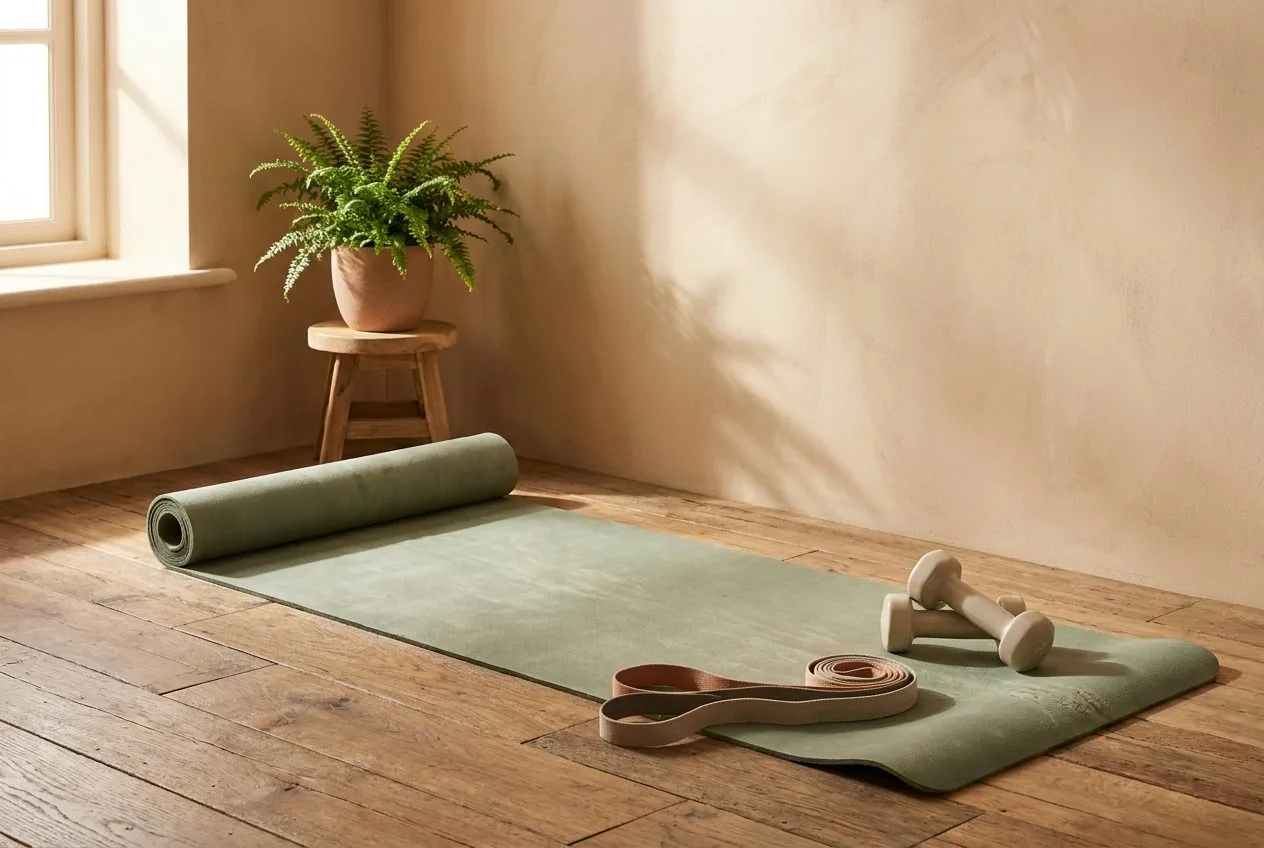
You do not need a spare room, a rack of equipment, or a four-figure budget to build real strength at home after 40. In fact, most home gyms fail for the opposite reason: people buy too much, too heavy, too soon, and the whole intimidating pile ends up as an expensive laundry rack. A small, well-chosen kit you actually reach for will always beat a big one you avoid.
So here is a lean, joint-friendly home gym you can build for around $150, aimed squarely at a midlife body that wants gentle, sustainable strength rather than a garage full of gear. This is a buyer’s guide based on the features that matter for this reader, not a lab test of specific brands, and prices move constantly, so treat every figure as approximate and check current pricing before you buy.
This article is for information only and is not medical advice. Talk to your healthcare provider before starting a new exercise routine, especially if you have joint injuries, heart conditions, or dizziness.
The idea: four tools, not forty
The trick to a home gym that lasts is buying for the exercise you will actually do, not the fantasy version of yourself. For a joint-friendly routine after 40, four categories cover almost everything: something to add resistance you can scale (bands), something to add a little more resistance you can measure (light dumbbells), something comfortable to work on (a mat), and something to help your body recover (a foam roller). Together they let you train your whole body, gently, in a corner of a room.
You do not have to buy all four at once. Below, each pick includes what it does, roughly what to spend, and what to look for, followed by an honest order to buy them in if your budget is tight.
1. A resistance band set: the cheapest, most flexible start
What it does: covers your whole body with scalable resistance. Rows, presses, curls, squats, and glute work all live here.
Roughly: a good set with a range of levels usually runs around $20 to $30. Check current pricing.
What to look for: buy a set, not a single band, with light and extra-light options so you can start gently and progress. For the upper body, tube bands with padded handles and a door anchor are the most versatile, because that one anchor unlocks rows and presses that mimic gym machines. For the lower body, fabric loop bands do not roll or pinch the way thin rubber mini-bands can. If you have a latex allergy, look specifically for latex-free or fabric options.
Bands earn their spot in midlife because their resistance is lowest at the start of a movement and builds as the band stretches. That forgiving feel is exactly what stiff or cranky joints appreciate. If you want the deeper breakdown of band types, our guide to the best resistance bands for women over 40 walks through loop, tube, and fabric options in detail.
2. A light pair of adjustable dumbbells: measurable progress
What it does: adds resistance you can measure precisely, which makes progress easy to see and repeat.
Roughly: a budget light adjustable pair often lands around $80 to $120, and a fixed pair of light dumbbells can be even cheaper. Prices vary widely by weight range and mechanism, so check current pricing.
What to look for: you do not need a heavy 50-pound tower. A light adjustable pair that spans roughly 5 to 25 pounds per hand covers most gentle strength work and saves the space of owning five separate pairs (Journal of Strength and Conditioning Research). Look for a secure, easy-to-change mechanism and a shape that sits comfortably in your hand. Dial-style adjustables are quick to change; plate-style are cheaper but slower.
Dumbbells are the natural partner to bands: bands are gentler and more portable (SAGE Open Medicine), while dumbbells make it simple to load a known weight and track it week to week. If you are torn between the two, our resistance bands vs dumbbells comparison lays out which one to buy first, and why many women end up happy with a little of both.
3. A supportive exercise mat: comfort and safety
What it does: cushions your knees, wrists, and spine, and gives you a stable, non-slip surface so nothing shifts underfoot.
Roughly: a decent mat runs around $25 to $40. Check current pricing.
What to look for: for strength and floor work, a slightly thicker mat (around 6mm or more) is kinder to knees and elbows than a thin travel yoga mat. Look for a non-slip surface and enough length for your height. A mat sounds like the least exciting purchase on this list, but it is the one that quietly removes the “the floor is too hard” excuse, and comfort is what keeps you coming back. It pairs perfectly with a gentle mobility routine like our 7-day beginner yoga plan.
4. A foam roller: the recovery piece most people skip
What it does: helps you warm up tight areas and wind down after a session, which can make the next workout feel more comfortable.
Roughly: a basic roller runs around $20 to $30. Check current pricing.
What to look for: a medium-density roller is the friendliest starting point. Very firm, knobbly rollers can be intense for a beginner, so start smoother and softer and work up if you want more. A shorter roller is easy to store; a longer one supports your whole spine when you lie back on it.
Recovery is not a luxury add-on after 40; it is part of how you stay consistent. A few gentle minutes with a roller before and after a session can help stiff areas feel looser, though the measured effects are modest (Frontiers in Physiology), and feeling looser is often the difference between doing tomorrow’s walk and skipping it.
Buy them in this order if money is tight
You do not need all four at once, and there is a smart order that gets you moving fastest for the least money:
| Priority | Buy | Roughly | Why first |
|---|---|---|---|
| 1 | Resistance band set | $20 to $30 | Cheapest, gentlest, covers the whole body |
| 2 | Exercise mat | $25 to $40 | Comfort and safety make everything else usable |
| 3 | Foam roller | $20 to $30 | Recovery keeps you consistent |
| 4 | Light adjustable dumbbells | $80 to $120 | Adds measurable progress once the habit is set |
Bands, mat, and roller together often come in under $100, which is a complete, joint-friendly setup on their own. Add the dumbbells when your routine is established and you want more precise progress, and the whole kit still lands around $150 if you shop the sales. All figures are approximate as of mid-2026; equipment like this goes on sale constantly, so check current prices before you buy.
Who should NOT rush the upgrade
An honest note, because a buyer’s guide that only says “buy more” is not being straight with you. If you already own a couple of these, do not replace working gear for the sake of a matching set. If you are brand new to strength, start with just the bands and the mat and prove the habit before spending more. And if your real barrier is not equipment but a plan, no purchase will fix that; a program or a routine will.
Common mistakes when building a home gym
Buying heavy too soon. Enthusiasm says go big. Sore joints and abandoned equipment say otherwise. Light and adjustable beats heavy and intimidating every time.
Skipping the mat and roller. They feel optional, so they get cut first, and then the floor is uncomfortable, recovery is neglected, and the habit quietly dies. They are cheap insurance for consistency.
Owning gear you never program. Equipment solves the “what with” problem, not the “what do I do” problem. Pair your kit with a plan.
Put your new kit to work
A corner of bands, dumbbells, a mat, and a roller is genuinely enough to rebuild steady strength after 40, gently and at home. The equipment is only ever half the equation, though. The other half is a simple structure that tells you what to do and when to progress. Our gentle strength routines and the 4-week summer reset both give you that structure, so your new kit becomes a routine instead of a pile.
Buy the few things that lower the bar to starting, put them where you will see them, and let the habit, not the hardware, do the real work.
Frequently Asked Questions
- Can you really build a home gym for under $150?
- Yes, if you buy the right few things instead of everything. A resistance band set, a good mat, and a foam roller together usually land well under $100, which leaves room for a light pair of adjustable dumbbells if you shop the sales. Prices move constantly, so treat every figure as approximate and check current pricing before you buy. The goal is a small, useful kit you will actually use, not a spare bedroom full of equipment gathering dust.
- What is the most important piece to buy first?
- For most women over 40, a versatile resistance band set is the best first purchase, because it is the cheapest, gentlest, and most flexible tool of the group. It covers your whole body, travels anywhere, and lets you start very light. A mat comes second for comfort and safety, and dumbbells or a foam roller follow as budget allows. Start with the one that lowers the bar to actually beginning.
- Do I need heavy weights to get stronger after 40?
- No. Muscle responds to effort and gradual progression, not to any specific heavy number. Light adjustable dumbbells and a range of resistance bands give you plenty of room to challenge yourself while keeping good form, which matters far more for midlife joints than lifting heavy too soon. Start lighter than feels heroic and add resistance only when your current level feels genuinely easy for your target reps.
- Is a small home gym enough, or do I still need classes or a gym?
- For steady, joint-friendly strength and movement at home, a small kit like this is genuinely enough for most people. Classes and gyms are wonderful for coaching, community, and heavier equipment, so keep them if you love them. But the equipment you use beats the equipment you admire, and a drawer of bands you reach for daily will do more than a membership you rarely use.
Sources & references
- Journal of Strength and Conditioning Research, Low- vs high-load resistance training meta-analysis (2017) (opens in new tab)
- SAGE Open Medicine, Elastic vs conventional resistance training meta-analysis (2019) (opens in new tab)
- Frontiers in Physiology, Foam rolling and performance and recovery meta-analysis (2019) (opens in new tab)
Before you go
The 7-Day Protein-First Meal Plan for Women Over 40
A complete protein-first week, finished for you: your personal protein target, a one-page shopping list, 21 recipes at 25-35 g protein each, and a timed 90-minute prep schedule. Printable PDF, paired with a free 7-lesson email course.
Free guide
The 7-Day Protein-First Meal Plan for Women Over 40
A complete protein-first week, finished for you: your personal protein target, a one-page shopping list, 21 recipes at 25-35 g protein each, and a timed 90-minute prep schedule. Printable PDF, paired with a free 7-lesson email course.