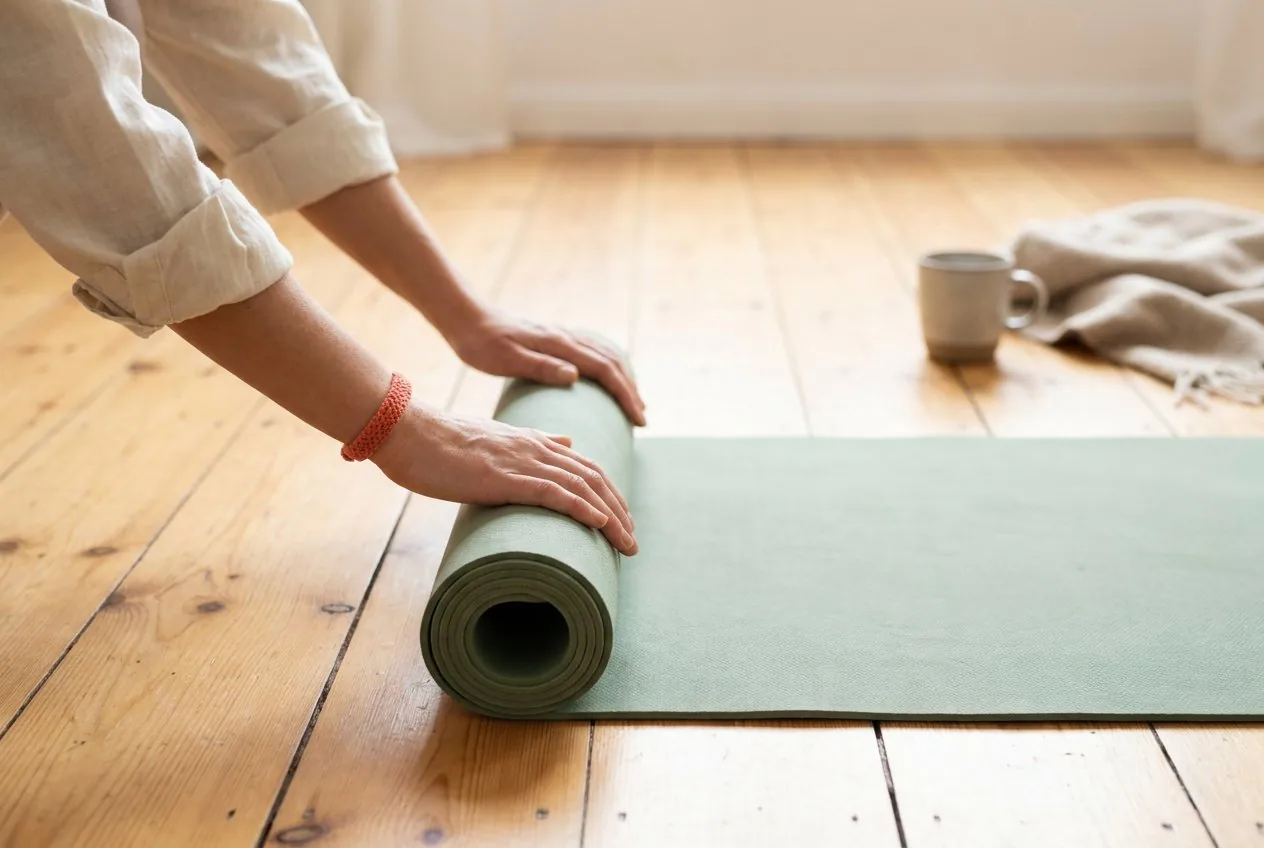
Can you start yoga after 45 if you are stiff?
- Yes: stiffness is the reason to start, not the barrier. Flexibility is the result of yoga, not the requirement for it.
- The plan is 7 days, 5 to 15 minutes a day, built on five joint-friendly poses that all have knee and wrist modifications.
- Cat-cow, supported child's pose, wall downward dog, low lunge with a cushion, and legs up the wall are the whole starter kit.
- Gentle yoga is a modest calorie burn; the real wins are stress, sleep, mobility, and a habit stiff beginners actually keep.
- Props are the smart version, not the beginner version: a cushion, a pillow, and a wall replace a studio.
“I’m too stiff for yoga.” If that sentence has kept you off the mat, you’re in good company, and you’ve got it exactly backwards. Saying you’re too stiff for yoga is like saying you’re too hungry for dinner. Stiffness isn’t the barrier; it’s the reason to start. Flexibility is the result of yoga, not the requirement for it.
Nobody is checking whether your hands reach the floor. There is no minimum bend. The poses in this article are chosen for real midlife bodies: tight hips from years of sitting, knees that have opinions, wrists that don’t love bearing weight. Every single one has a modification, and using the modification is not the beginner version. It is the smart version.
Here’s what you’ll get below: a 7-day starter plan you can do at home in 5-15 minutes a day, five joint-friendly poses with plain setup steps, and an honest section on what yoga will and will not do for your weight. The method is the promise here. Show up for seven days and you’ll know how your body responds.
This article is for information only and is not medical advice. Talk to your healthcare provider before changing your diet or exercise routine, especially if you have a medical condition or take medication. Check with your provider first if you have joint injuries, heart conditions, or dizziness.
Before day 1: three small setup decisions
You can skip straight to the plan, but these three choices make the week dramatically easier to keep.
Pick a time and anchor it. Habits stick when they attach to something you already do. After your morning coffee, before your shower, right after you close the laptop: choose one anchor and let the mat live next to it. Many women find mornings work best because stiffness is highest then and the payoff is felt all day, but an evening round is just as legitimate.
Claim a patch of floor. You need about the footprint of a bath towel, near a wall, with room to kneel. That’s all. If getting down to the floor and back up is currently hard, that’s not a disqualifier; it’s a skill this week will quietly train. Use a chair or the wall for support on the way down and up, every single time, without apology.
Decide now what a bad day looks like. Some day this week you’ll be tired, rushed, or sore. Decide in advance that the bad-day version is two minutes of cat-cow and one minute of legs up the wall. A tiny session keeps the chain intact, and the chain is what changes a body.
Your 7-day starter plan
Short and daily beats long and occasional. Ten minutes you actually do is worth more than an hour you dread. Here is the week:
| Day | Focus | Minutes |
|---|---|---|
| 1 | Learn all five poses slowly, one at a time | 10 |
| 2 | Wake-up round: cat-cow and supported child’s pose | 8 |
| 3 | Full sequence, holding each pose a little longer | 12 |
| 4 | Recovery day: legs up the wall only | 5 |
| 5 | Full sequence, plus a second round of wall downward dog | 12 |
| 6 | Slow evening round, focus on breathing out longer than in | 10 |
| 7 | Full sequence, then notice what feels different from day 1 | 15 |
Do the poses in the order they appear below; the sequence warms your spine before asking anything of your hips. Move at the speed of your breath, not the speed of a video. If something pinches or hurts, ease out and use the modification.
The 5 joint-friendly poses
You’ll do all five barefoot, on a mat or carpet. Keep a cushion, a folded blanket, and a wall within reach. That’s the whole studio.
1. Cat-cow
This is your spine’s morning coffee. It moves every segment of your back gently through its range.
- Come to hands and knees, wrists under shoulders, knees under hips.
- Inhale: let your belly soften down, lift your chest and gaze slightly. That’s cow.
- Exhale: press the floor away, round your spine up, let your head hang. That’s cat.
- Flow between the two for 8-10 slow breaths.
For knees and wrists: fold the mat double or place a folded towel under your knees. If your wrists complain, come down onto your forearms, or do the same movement seated on a chair with hands on your thighs.
2. Supported child’s pose
A resting pose that gently opens your hips and lower back while your body is fully held.
- From hands and knees, bring your big toes together and take your knees wide.
- Sit your hips back toward your heels. Only as far as comfortable.
- Lay your chest onto a pillow or two stacked in front of you. Turn one cheek down.
- Arms rest forward or alongside your body. Stay 5-10 slow breaths.
For knees and wrists: place a rolled towel behind your knees before sitting back, or keep your hips higher and pile the pillows taller. There is no weight on your wrists here, which is why it follows cat-cow.
3. Wall downward dog
All the shoulder and hamstring benefit of downward dog, with almost none of the wrist load and no head-below-heart dizziness.
- Stand facing a wall, hands flat on it at about hip height, shoulder-width apart.
- Walk your feet back until your body makes an L shape: long, flat back, ears between your arms.
- Keep your knees softly bent. Press the wall away and breathe for 3-5 breaths.
- Walk back in to stand up.
For knees and wrists: because your hands push a wall instead of the floor, wrist pressure is light. If your shoulders or hamstrings protest, place your hands higher on the wall and don’t walk back as far.
4. Low lunge with cushion
The antidote to years of chairs. This one gently opens the front of the hip, an area almost every midlife body guards.
- From kneeling, step your right foot forward so the knee stacks over the ankle.
- Slide a cushion under your back knee.
- Hands rest on your front thigh. Stay tall, then let your hips ease forward an inch.
- Hold 3-5 breaths, then switch sides.
For knees and wrists: the cushion is not optional; use a thick one. For balance, set a chair beside you and rest one hand on its back. Staying more upright makes the pose gentler; you do not need to sink deep for it to work.
5. Legs up the wall
The pose you’ll keep forever. It asks for nothing and gives back calm. Many women find it becomes their favorite part of the week.
- Sit sideways against a wall, then swing your legs up as you lie back.
- Scoot until your hips are close to the wall, whatever distance lets your legs rest easy.
- Arms open at your sides, palms up. Close your eyes.
- Stay 3-5 minutes. Breathe out longer than you breathe in.
For knees and wrists: none needed, which is the point. If your hamstrings are tight, slide your hips a little farther from the wall or keep a soft bend in your knees. A folded blanket under your hips makes it even kinder.
What yoga does (and does not do) for weight
Let’s be honest, because plenty of marketing is not. Gentle yoga is a modest calorie burn (Harvard Health Publishing). A slow 15-minute session will not move the needle much on energy balance, and anyone promising otherwise is selling something.
So why is it in a plan for women who care about their weight? Because the real wins sit one level deeper:
- Stress. Slow breathing and quiet movement help many women downshift (NCCIH), and stress is tangled up with cravings and snacking for a lot of us.
- Sleep. An evening round, especially legs up the wall, is a genuinely useful wind-down habit, and better sleep makes every other healthy choice easier.
- Mobility. Hips and a spine that move well make walking, strength work, and daily life more comfortable, which keeps you active.
- Consistency. Yoga is the rare exercise stiff beginners actually keep doing, because day one feels good instead of punishing.
Yoga also pairs well with strength work rather than replacing it. Muscle is worth protecting after 45, and broad consensus supports about two strength sessions a week (CDC) alongside whatever movement you love. A daily walk is the other half of that picture; our 30-day walking plan fits alongside this yoga week without competing with it. You’ll find more low-impact routines in our Gentle Workouts & Strength category.
Common mistakes when you’re starting stiff
Measuring yourself against photos. The people in yoga imagery have often practiced for decades, and some of them were bendy to begin with. Your only comparison is you on day 1.
Pushing into pain. A gentle stretch sensation is fine. Pinching, sharp, or electric feelings are not information to push through; they’re instructions to back off. Stiff tissue changes slowly and only when it feels safe.
Skipping the props. The cushion under the knee, the pillow in child’s pose, the wall itself: these are not training wheels. Experienced practitioners use props constantly. Props let a stiff body actually relax, and relaxing is where the change happens.
Going too long, too soon. A 60-minute class on day 2 is the fastest route to quitting by day 4. Stay with 5-15 minutes until short sessions feel easy and you miss them on rest days.
Holding your breath. If you catch yourself bracing and breath-holding, the pose is too intense for today. Ease off until you can breathe slowly. The breath is the whole workout in disguise.
When a structured program helps
A 7-day plan gets you moving. Some women then thrive on self-directed practice, mixing these five poses into their week for years. Others do better with more structure: a set schedule and a sense of progression, so the only decision left is showing up.
Remember, though, that yoga is the mobility half of the picture. The strength half matters just as much after 45, and it responds well to the same keep-it-simple philosophy. If you want a structured home option there, Old School New Body is a low-cost digital program aimed at people over 35, built around four basic exercises done with deliberate form rather than complicated routines (Old School New Body), and it carries the standard 60-day ClickBank money-back guarantee (ClickBank). Based on our research it is a sensible, unflashy companion to a gentle yoga habit, but a pair of dumbbells and our Gentle Workouts & Strength category will also get you there for free.
Gear: less than you think
Start with what you own. When you’re ready to spend a little, two things matter for a stiff beginner: a thicker mat, around 6 millimeters or more, which makes kneeling poses dramatically more comfortable than a thin travel mat, and a pair of foam blocks, which bring the floor up to meet you in lunges and seated poses. A firm couch cushion and a stack of books can stand in for both while you decide if the habit sticks.
That’s it. No special clothing, no studio membership, no minimum flexibility. Seven days, five poses, a wall, and the patience to let a stiff body wake up slowly. Day 1 is ten minutes long, and it starts whenever you unroll something soft onto the floor.
Sources & references
- ClickBank, Return and subscription cancellation policy (opens in new tab)
- Harvard Health Publishing, Calories burned in 30 minutes (opens in new tab)
- NCCIH, Yoga: What You Need To Know (opens in new tab)
- CDC, Physical activity guidelines for adults (opens in new tab)
- Old School New Body, official sales page (opens in new tab)
Before you go
The 7-Day Protein-First Meal Plan for Women Over 40
A complete protein-first week, finished for you: your personal protein target, a one-page shopping list, 21 recipes at 25-35 g protein each, and a timed 90-minute prep schedule. Printable PDF, paired with a free 7-lesson email course.
Free guide
The 7-Day Protein-First Meal Plan for Women Over 40
A complete protein-first week, finished for you: your personal protein target, a one-page shopping list, 21 recipes at 25-35 g protein each, and a timed 90-minute prep schedule. Printable PDF, paired with a free 7-lesson email course.