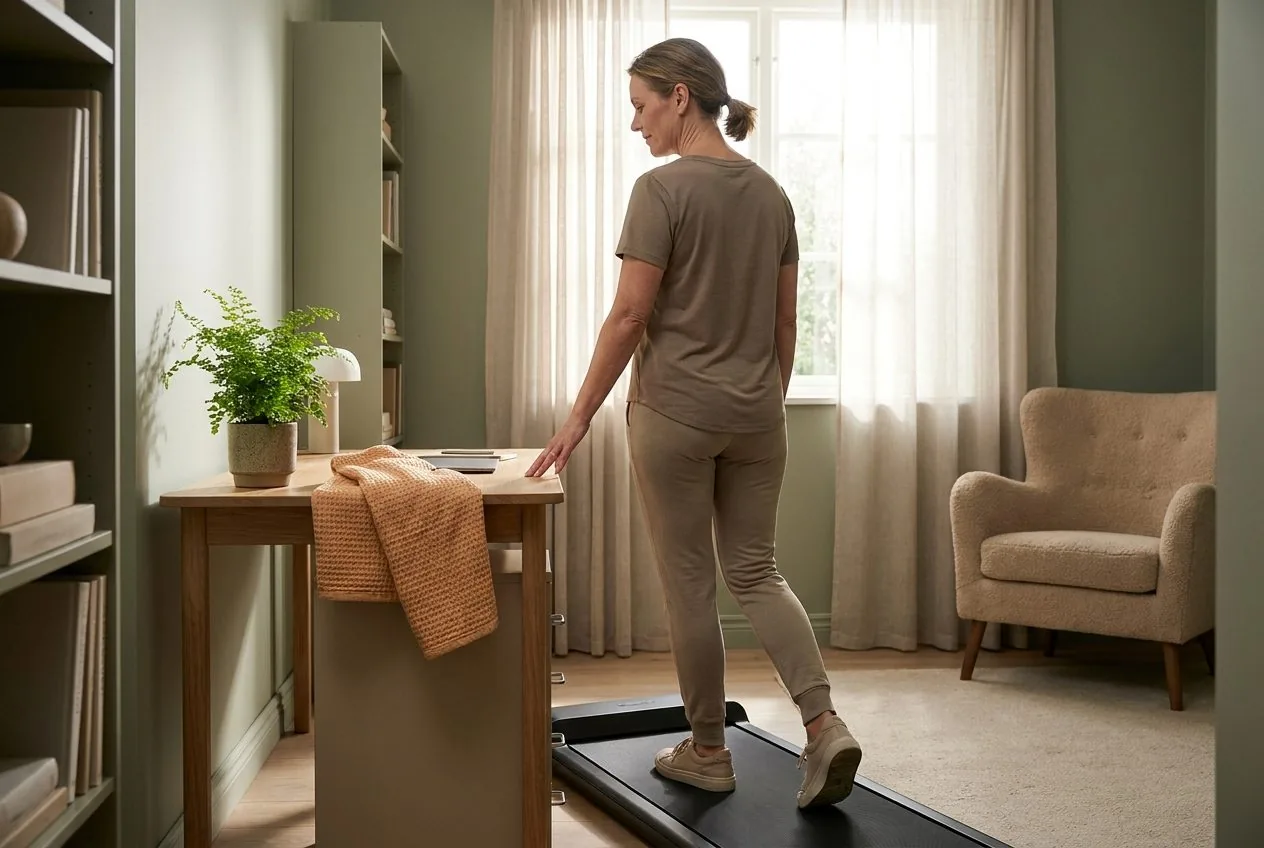
What is the best walking pad for women over 40?
- Our pick: the UREVO Strol 2E Pro, 9/10, around $260 list price, for pairing an incline of up to 12% with an included support handle.
- The handle is the quiet hero: something to hold in week one, or on any morning balance feels off, keeps the habit alive.
- Incline lets you work a little harder at a calm pace instead of walking faster, which many women find kinder to the knees.
- Runner-up PACEROCKER Auto-Incline adds automatic incline for a hands-off feel; check the current listing for its price and weight capacity.
- A walking pad removes friction; it is not a weight-loss device, and results still come down to overall habits over time.
If you want to move more but the weather, your schedule, or your knees keep talking you out of it, a walking pad is one of the most sensible pieces of home fitness gear you can own. It slides under a desk or a couch, it asks nothing of you but a pair of socks, and it turns dead time into gentle movement. The problem is that the market is now flooded with near-identical slabs, most sold on breathless promises, and it is genuinely hard to tell which ones are worth your money.
So here is a clear-eyed pick. This guide is based on our research into specs, features, and owner feedback, not a lab test, and prices move constantly, so treat every figure as approximate and check current pricing before you buy.
Our pick: UREVO Strol 2E Pro, 9/10. For women over 40, an incline walking pad with a real safety handle is the sweet spot, and the Strol 2E Pro delivers both at a fair price. It suits anyone who wants low-impact movement at home, a little incline to work slightly harder without going faster, and something to hold on the days balance feels off.
This is for information only and is not medical advice. Talk to your doctor before starting a new exercise routine, especially during perimenopause or menopause, or with joint conditions.
Who this is for
You do not need to be training for anything. This guide is for the woman who sits more than she wants to, who has tried the “just go to the gym” advice and watched it fizzle, and who would happily walk if walking were genuinely easy to reach. A walking pad lowers the bar until stepping on it takes no willpower at all, which is the whole point. If you already love your outdoor walks and only want a rainy-day backup, a simpler flat model may be all you need, and that is fine.
Why gentle incline walking suits women over 40
Walking is the most underrated tool in midlife fitness, mostly because it is the exercise people actually keep doing. There is no learning curve, no outfit, and no childcare puzzle. Our full 30-day walking plan for women over 40 makes the case in detail, and a walking pad simply moves that plan indoors so a grey afternoon cannot cancel it.
Adding a modest incline is where these pads earn their place for the over-40 body. A gentle slope lets you raise the effort a little without cranking up the speed, so you can stay at a relaxed, low-impact pace and still feel like you did something. Many women find that easier on the knees than trying to walk faster on the flat (Medicine & Science in Sports & Exercise). It is not a magic setting and it will not do the work for you, but it may support a more active routine by making “a bit more effort” feel comfortable rather than punishing.
A quick, honest word on expectations. A walking pad is a movement tool, not a treatment and not a weight-loss device. What regular gentle movement genuinely tends to support is steadier energy, easier daily activity, and a habit that survives a busy week. Muscle matters just as much in the background: from roughly 40 onward, adults tend to lose muscle each year unless movement and protein push back (Current Sports Medicine Reports), which is why we pair walking with light strength work in metabolism after 40. Movement and muscle are teammates, not rivals.
How we chose
Three things separate a walking pad you use daily from one that becomes a very flat clothes rack:
- Does it lower friction? The best pad is the one you will actually step onto. Quiet operation, a slim profile that lives where you already are, and a simple remote all matter more than a spec sheet.
- Does it feel safe? Balance and confidence deserve respect at any age. A model with a handle or support bar, a sensible speed range, and a stable deck beats a faster, flimsier one every time.
- Does it fit your body and space? Weight capacity, deck length, noise, and whether it tucks under your desk or your couch decide whether it stays in use or gets shoved in a closet.
We weighed incline, a safety handle, weight capacity, noise, and price most heavily, because those are the features that decide comfort and confidence for this reader.
The quick comparison
| Feature | #1 UREVO Strol 2E Pro | #2 PACEROCKER Auto-Incline |
|---|---|---|
| Price band | Around $260 list price | Check the listing |
| Incline | Up to 12% | Automatic incline that adjusts for you |
| Safety handle | Yes, included support handle | Support handle |
| Weight capacity | 300 lb | Check the listing |
| Noise | Quiet motor, per UREVO | Check the listing |
| Best for | Best overall value with incline and a handle | Hands-off automatic incline |
All prices are approximate list prices as of fall 2026 (UREVO). Walking pads go on sale constantly, so check the current price before you buy.
#1 Best Overall: UREVO Strol 2E Pro
Around $260 list price, check current pricing.
The Strol 2E Pro is our top pick because it combines the two features that matter most for this reader at a price that does not sting: a real incline of up to 12 percent, and an included support handle (UREVO). That handle is the quiet hero. It gives you something to hold when you first step on, when you glance at your phone, or on a morning when balance simply feels off, and it turns a slightly nervous first week into a confident one. For a low-impact routine you want to keep, that confidence is worth more than any headline spec.
The 12 percent incline is genuinely useful. It lets you follow the popular 12-3-30 style of walking, which means a 12 percent incline at around 3 miles per hour for about 30 minutes (International Journal of Exercise Science), or any gentler version of it you like. The appeal for the over-40 body is that you can raise the challenge through the slope instead of the speed, staying at a calm, controlled pace while still feeling worked. You do not have to use the full incline. Start flat, add a little when it feels easy, and let the machine grow with you.
In daily use, the features that matter are the ones you feel every day: UREVO describes the motor as very quiet, the frame folds and slides under a sofa, and the controls stay simple. On honest downsides, it costs more than UREVO’s own flat Strol 2E (UREVO), the deck is shorter than a full treadmill’s, and its 300 lb maximum load is worth checking against your own needs. None of those are flaws for the job this pad is built for. They are the trade-offs of a compact machine, and they are the right ones.
Pros and cons
| Pros | Cons |
|---|---|
| Incline up to 12% lets you work harder without walking faster | Costs more than UREVO’s flat Strol 2E |
| Included support handle adds real confidence and stability | Shorter deck than a full treadmill |
| Quiet, slim, and easy to tuck under a desk or couch | 300 lb maximum load; check it against your needs |
| Fair price for a pad that has both incline and a handle | You pay for incline even if you rarely use it |
| Simple controls, low learning curve | App and AI speed features you may not need |
#2 Runner-Up: PACEROCKER Auto-Incline
Check current pricing.
If your priorities are stability and hands-off incline, the PACEROCKER Auto-Incline is the one to look at. Check the listing for its current weight capacity and price before you buy, especially if a higher capacity is the reason you are considering it. Paired with a support handle, it is aimed at a solid, planted feel underfoot.
Its other signature feature is automatic incline. Instead of setting the slope yourself, the pad adjusts it for you across a session, which some people enjoy as a hands-off way to vary the effort. Whether that is worth the extra money over the UREVO depends on you. If you like the idea of the machine doing the thinking, compare the current prices side by side. If you would rather set your own incline, the UREVO remains the simpler choice. Either way, the same honest caveats apply: it is a walking pad, not a running machine, and it is a tool for building a habit, not a promise of a result.
How to choose: a short buyer’s guide
Incline vs flat. If you want the option to work a little harder at a gentle pace, choose incline. It is the feature most likely to keep a walk feeling worthwhile over months. If you mostly want to break up long stretches of sitting and keep things dead simple, a flat pad is cheaper and perfectly good. Neither is wrong. Match the pad to the walk you will actually do.
The 12-3-30 style, gently. The popular 12-3-30 format, a 12 percent incline at about 3 miles per hour for around 30 minutes, is a tidy target, but it is a ceiling to grow toward, not a starting line. Begin with 10 to 15 easy minutes, keep the incline low, and add a touch of slope or a few minutes only when the current version feels comfortable. The plan you can repeat beats the plan that impresses anyone. Our walking plan lays out a gentle four-week build if you want the steps mapped out.
Desk vs standalone. Under a standing desk, a walking pad becomes a way to move through emails and calls without carving out separate workout time, which is how many people rack up steps painlessly. As a standalone in the living room, it pairs beautifully with a show you already watch, so the walk rides on a habit you have anyway. Think about where in your day the pad will live before you buy, because the right spot is what turns a purchase into a routine.
A note on confidence. If balance is ever a question, favor the model with the handle and give yourself an easy first week. There is no prize for skipping the support bar, and holding on while you find your footing is exactly what it is there for.
The honest bottom line
A walking pad will not change your body for you, and no honest guide should pretend otherwise. What it can do is remove the reasons walking does not happen, so that on a cold, busy, low-energy day, gentle movement is still one step away. For women over 40, the UREVO Strol 2E Pro is our top pick because it puts incline and a safety handle within easy reach at a fair price, and those two features are exactly what make a low-impact habit feel comfortable and safe. If you want hands-off automatic incline, the PACEROCKER is worth a look once you have checked its current listing.
Whichever you choose, treat it as one tool in a bigger, gentler picture: regular walking, a little strength work twice a week, and enough protein to protect your muscle. You will find the rest of that approach, no gym required, in our Gentle Workouts & Strength section, and a good next read is how to start yoga after 45 for the strength-and-mobility half of the equation. Buy the pad that lowers the bar the most, then let the habit, not the machine, do the real work.
Frequently Asked Questions
- Are walking pads good for weight loss over 40?
- A walking pad can help you move more on days you would otherwise sit, and many women find that easier movement supports a more active routine. It is not a weight-loss device on its own. Any change still comes down to overall habits over time, and results vary from person to person. Think of it as a way to remove friction, not a shortcut.
- Is an incline walking pad better than a flat one?
- For most people over 40, a modest incline lets you work a little harder at a comfortable, low-impact pace without speeding up, which some find kinder to the knees than faster flat walking. A flat pad is simpler, cheaper, and perfectly good if you mainly want to break up long sitting. Incline is a nice-to-have, not a requirement.
- Are walking pads easy on the joints?
- Walking is low-impact by nature, and a cushioned deck can feel gentler than pavement to some users. That said, no machine is a substitute for medical advice. If you have knee, hip, or back issues, check with your provider first and start with short, slow sessions.
- How many steps a day should I aim for on a walking pad?
- There is no magic number, and the best target is one you can repeat. Many people start with 10 to 15 minutes a few times a day and build from there. Stacking short walks onto things you already do, like calls or a favorite show, tends to stick better than chasing a big daily total.
- Are walking pads quiet enough for apartments?
- Many modern walking pads are designed to run quietly, especially at walking speeds, so they can work for apartments and shared walls. A mat underneath cuts vibration further. If you have downstairs neighbors, walk at gentler speeds and check the noise rating on the listing before you buy.
Sources & references
- UREVO, Strol 2E Pro product page (opens in new tab)
- UREVO, Strol 2E product page (opens in new tab)
- Medicine & Science in Sports & Exercise, Inclined treadmill walking in obese adults (opens in new tab)
- International Journal of Exercise Science, The 12-3-30 treadmill workout (opens in new tab)
- Current Sports Medicine Reports, Resistance training is medicine (opens in new tab)
Before you go
The 7-Day Protein-First Meal Plan for Women Over 40
A complete protein-first week, finished for you: your personal protein target, a one-page shopping list, 21 recipes at 25-35 g protein each, and a timed 90-minute prep schedule. Printable PDF, paired with a free 7-lesson email course.
Free guide
The 7-Day Protein-First Meal Plan for Women Over 40
A complete protein-first week, finished for you: your personal protein target, a one-page shopping list, 21 recipes at 25-35 g protein each, and a timed 90-minute prep schedule. Printable PDF, paired with a free 7-lesson email course.