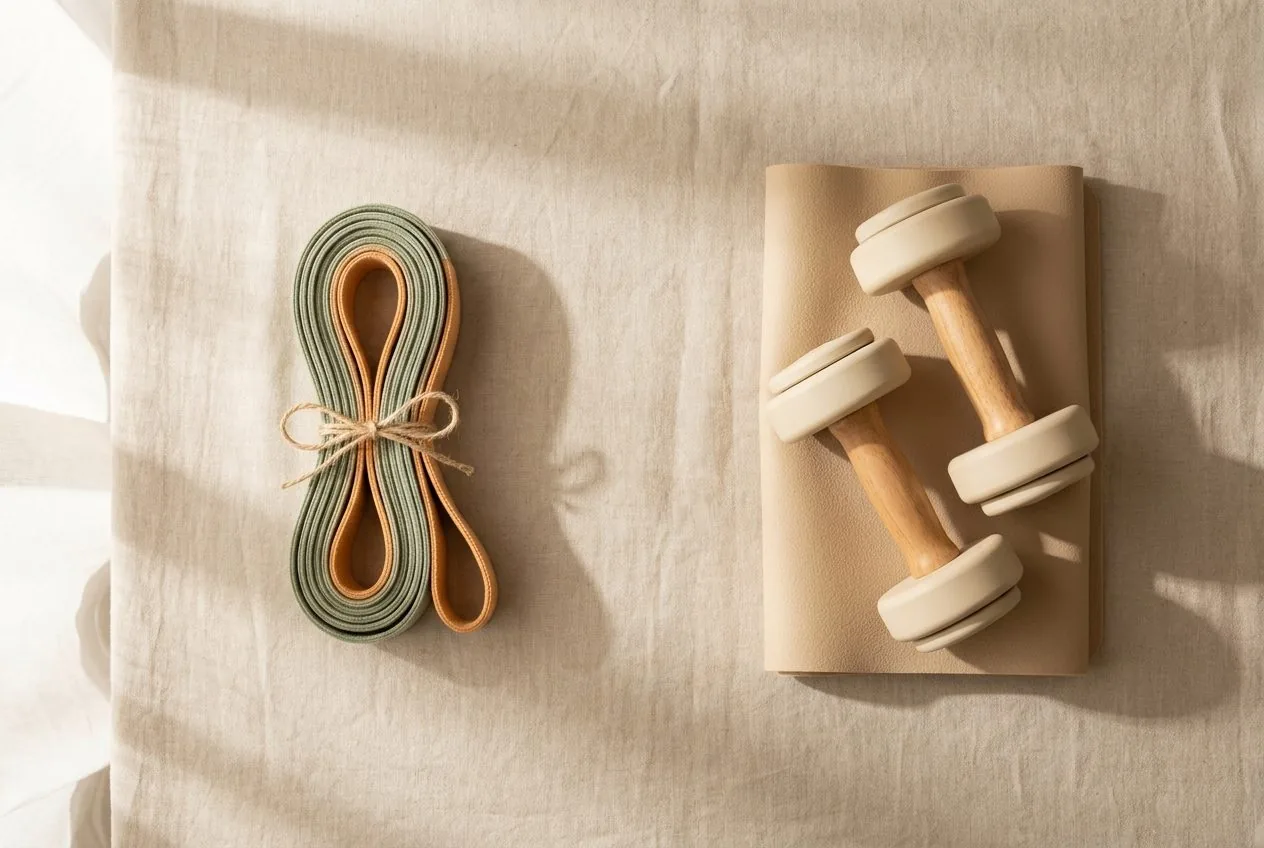
If you want to build strength at home after 40 without a gym membership, two tools come up again and again: resistance bands and dumbbells. They are both excellent, both affordable, and both joint-friendly when used well, which is exactly why the choice can feel confusing. So let us settle it honestly, without pretending one is a miracle and the other is useless.
Short answer for skimmers: if you can only buy one to start, choose a versatile resistance band set. It is cheaper, gentler, more portable, and lets you start very light. Add a light pair of adjustable dumbbells when you want to load a known weight and track progress precisely. Most women over 40 end up happiest owning both, and together they cost less than most single pieces of gym equipment.
This article is for information only and is not medical advice. Talk to your healthcare provider before starting a new exercise routine, especially if you have joint injuries, heart conditions, or dizziness.
The quick comparison
| Feature | Resistance bands | Light dumbbells |
|---|---|---|
| Cost to start | Lowest, around $20 to $30 | Higher, a light adjustable pair around $80 to $120 |
| Joint feel | Very gentle; resistance starts light and builds as the band stretches | Gentle with light weight; load is constant |
| Portability | Fits in a drawer or suitcase | Heavier, stays put at home |
| Measuring progress | By band level and range; less precise | By exact weight; very precise |
| Heavy strength ceiling | Limited at the very top end | Higher, easier to load heavy |
| Best at | Control, higher reps, warm-ups, travel | Trackable strength, simple loading |
All prices are approximate as of mid-2026 and move constantly, so check current pricing before you buy.
Which should you pick? A quick decision framework
“I want the cheapest, gentlest start.” Bands. A good set costs less than a takeaway dinner for two, weighs less than a water bottle, and lets you start lighter than any dumbbell. If joints are a worry or you are rebuilding after a long break, this is your entry point.
“I like seeing exact progress.” Dumbbells. There is a real satisfaction in moving from a known weight to a slightly heavier one, and that clarity keeps some people far more motivated than “the next band up.” If you are the type who likes numbers, light adjustables are worth it.
“I travel, or space is tight.” Bands, easily. They disappear into a drawer or a carry-on, so your routine follows you to a hotel or a relative’s spare room. A treadmill becomes a clothes rack; a band set becomes a habit.
“I want neither the hassle of choosing nor the ceiling of one tool.” Own both, and keep the price sensible by choosing a mid-range band set and a light adjustable dumbbell pair. This is the setup most women over 40 quietly settle into, and for good reason.
The over-40 lens: what actually matters
The reason this comparison matters at all is muscle. From roughly age 40 onward, research suggests adults tend to lose muscle each year unless movement and protein push back, and the pace can pick up around menopause (Journal of Clinical Medicine). Strength work is how you push back, and both tools do that job. Here is how each one suits a midlife body.
Joints first. A band’s resistance is lowest at the start of a movement and builds as the band stretches. That ascending feel is forgiving, which is why bands are such a comfortable re-entry point for stiff shoulders or cranky knees. Light dumbbells are gentle too, especially with good form, but the load stays constant through the whole range, so you feel it from the very start of each rep. Start light with either.
Progression, honestly. Muscle responds to progressive resistance at any age, and both tools provide it (SAGE Open Medicine). The difference is precision. Dumbbells let you add a small, exact amount of weight, which makes progress easy to see and repeat. Bands progress in bigger, less exact jumps between levels, which is fine but harder to fine-tune. Neither is a barrier to getting stronger; they just track it differently.
Sustainability. The best tool is the one you will actually use on a busy, low-energy week. For many women that is bands, purely because they are always within reach and never intimidating. For others it is dumbbells, because a quick, familiar set of curls and presses feels more like “real” training. Be honest about which one you will pick up when motivation is low, because consistency beats every spec on the table.
If you want the tool-by-tool detail on band types before deciding, our best resistance bands for women over 40 guide breaks down loop, tube, and fabric options. And if you would rather build a small kit with both, our home gym under $150 piece shows how to prioritize on a budget.
A gentle full-body session you can do with either
Here is the reassuring truth: the movements barely change between the two tools, so you are not learning two different routines. A simple, joint-friendly full-body session looks almost identical whether you hold a band or a dumbbell.
- Squats. Hold a dumbbell at your chest, or stand on a band and hold the handles at your shoulders. Sit down between your hips with your chest up, then stand through your whole foot.
- Rows. Anchor a band in a door and pull the handles to your ribs, or hinge forward and row a dumbbell to your side. Squeeze your shoulder blades and go slow.
- Overhead press. Press dumbbells or band handles up from your shoulders, keeping your ribs down and core braced. Lower with control.
- Glute work. Loop a fabric band above your knees for side steps, or rest a dumbbell on your hips for a glute bridge. Drive through your heels.
Aim for around 8 to 12 slow, controlled repetitions of each, two or three times a week, resting a day between sessions (ACSM). Notice that the band version and the dumbbell version train the same muscles in nearly the same way. That is exactly why the choice is less high-stakes than it feels: you can start with either, learn the movements, and add the other later without relearning anything. If you want the moves mapped into a plan, our summer arms workout for women over 40 leans on bands, and adapts to light dumbbells just as easily.
Both are tools, not magic
Here is the honest part a sales page will not tell you: neither bands nor dumbbells will change your body on their own. They are levers, and the result depends on how consistently you pull them, how well you eat to support your muscle, and how patient you are over months rather than days. What regular strength work genuinely tends to support is steadier energy, better posture, easier daily movement, and muscle that quietly protects your metabolism. That is worth doing. It is just not a miracle, and any honest guide should say so.
Whichever tool you choose, the numbers on the band or the dumbbell matter far less than the fact that you showed up. Pair your strength work with enough protein and a little walking, and you have covered the fundamentals. Our metabolism after 40 explainer covers how muscle, movement, and protein fit together, and the rest of our gentle strength section gives you routines to run with whichever tool you land on.
The honest bottom line
Resistance bands and dumbbells are not rivals; they are teammates that happen to overlap. If you buy one thing, buy a versatile band set: it is the cheapest, gentlest, most portable way to start, and it will carry most women a long way. If you love measurable progress or you want a higher strength ceiling, add a light pair of adjustable dumbbells. And if you can stretch to both, that small, affordable pairing covers nearly everything you would want to do at home, gently and for years.
Start lighter than your ego suggests with either one, add resistance only when you have earned it, and give the habit enough weeks to show what it can do. The best strength tool is the one that lowers the bar to starting, and then quietly grows with you as you get stronger.
Frequently Asked Questions
- Are resistance bands or dumbbells better for women over 40?
- Neither is simply better; they do slightly different jobs. Bands are gentler on the joints, more portable, and great for control and higher-rep work. Dumbbells are easier to load to a known weight and to measure progress precisely. Many women over 40 do best with both: bands for warm-ups, travel, and joint-friendly volume, and a light pair of dumbbells for straightforward, trackable strength. If you can only start with one, a versatile band set is the cheaper, lower-risk entry point.
- Can resistance bands build real strength, or only tone?
- Bands build real strength within reason. Muscle responds to progressive resistance at any age, and a good band set provides plenty of it. The main limit is at the very heavy end, where dedicated lifters out-grow most bands. For the goals of most women over 40, steadier strength, better posture, and joint-friendly movement, bands are more than capable. There is no separate mechanism called toning; there is only building or maintaining muscle, and bands do build it.
- Which is safer for cranky knees, shoulders, or wrists?
- Bands tend to feel gentler because their resistance is lowest at the start of a movement and builds as the band stretches. That forgiving feel suits sensitive joints well. Dumbbells can be perfectly safe too, especially light ones with good form, but the load is constant throughout the movement. If a specific joint is a concern, start with bands and lighter dumbbells, and check with your provider before beginning.
- Do I have to choose, or should I own both?
- You do not have to choose, and owning both is the setup many women over 40 are happiest with. It is also affordable: a band set and a light pair of dumbbells together usually cost less than most single pieces of gym equipment. Use bands for gentle volume, warm-ups, and travel, and dumbbells when you want to load a known weight and track it. They complement each other rather than compete.
- How do I keep making progress with either one?
- Progress comes from gradually asking a little more of your muscles over time. With bands, move to a heavier band or a longer range once your current level feels easy for your target reps. With dumbbells, nudge the weight up a small amount or add a rep or two. The principle is identical for both: take your sets close to genuine effort with good form, then increase the challenge slowly as you adapt.
Sources & references
Before you go
The 7-Day Protein-First Meal Plan for Women Over 40
A complete protein-first week, finished for you: your personal protein target, a one-page shopping list, 21 recipes at 25-35 g protein each, and a timed 90-minute prep schedule. Printable PDF, paired with a free 7-lesson email course.
Free guide
The 7-Day Protein-First Meal Plan for Women Over 40
A complete protein-first week, finished for you: your personal protein target, a one-page shopping list, 21 recipes at 25-35 g protein each, and a timed 90-minute prep schedule. Printable PDF, paired with a free 7-lesson email course.