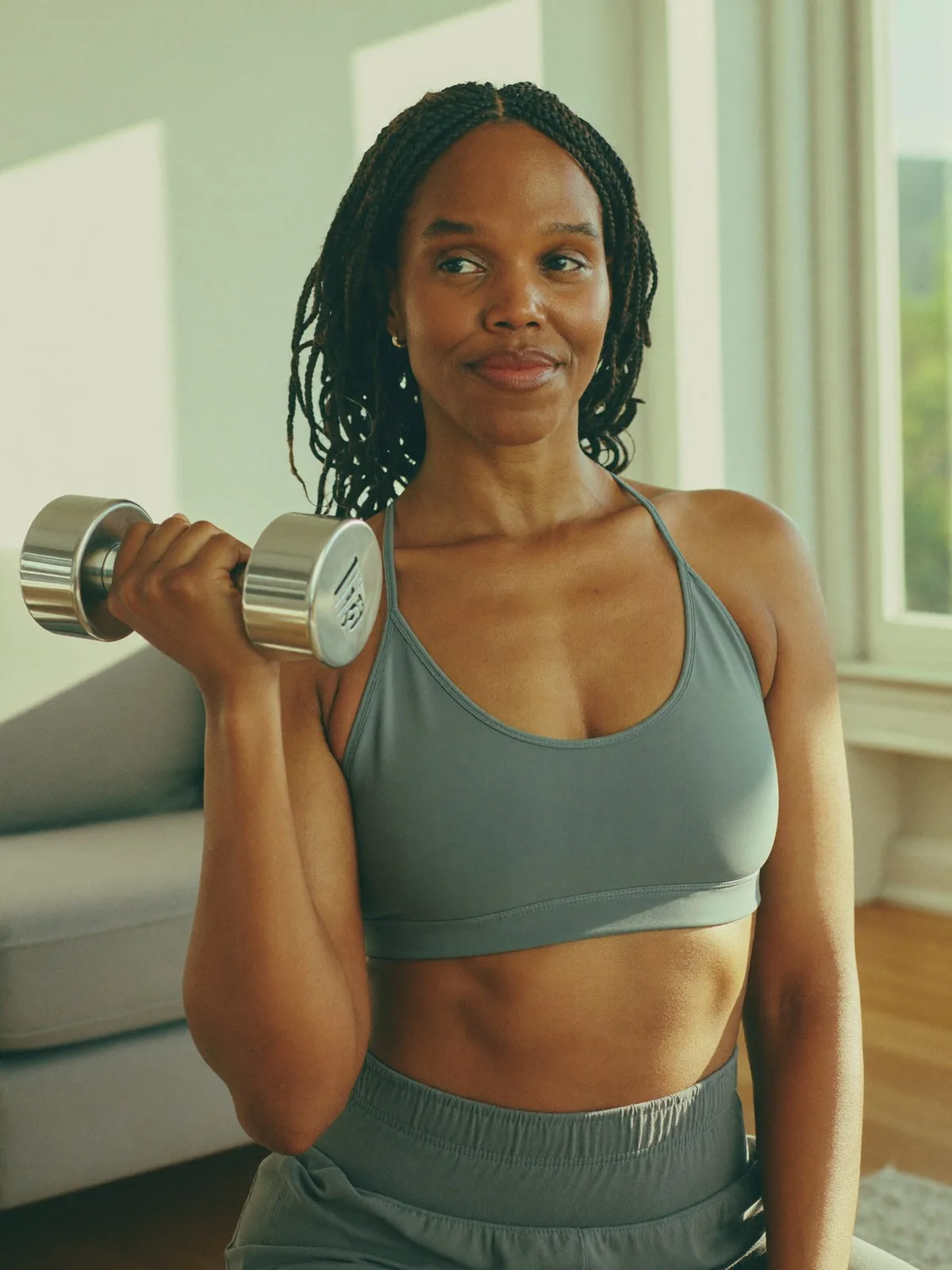
If summer has you eyeing your arms with a little more attention than usual, you are in good company, and you have not done anything wrong. Arms feel different in our 40s and 50s, and the fix everyone reaches for, endless triceps kickbacks with a soup can, is not quite it. The honest answer is simpler and kinder: gentle progressive strength work two or three times a week, using light dumbbells or resistance bands, paired with enough protein to protect your muscle. That is the whole method. Everything below is just the how.
You will not be promised a specific look by a specific date here. You will be given a plan you can actually keep, because the plan you keep is the only one that works.
This article is for information only and is not medical advice. Talk to your healthcare provider before changing your diet or exercise routine, especially if you have a medical condition or take medication. Check with your provider first if you have joint injuries, heart conditions, or dizziness.
Why arms change after 40 (and why that is normal)
Nothing is wrong with you. Two ordinary things are happening at once. First, from roughly our 40s onward, adults gradually lose muscle each year unless movement and protein give the body a reason to keep it, a process called sarcopenia (Current Sports Medicine Reports). Less muscle under the skin reads as softer, less defined arms. Second, estrogen declines through perimenopause and menopause, and many women notice muscle loss and thinner skin in this stage (National Institute on Aging), so the change can feel like it arrives faster than you expected. We walk through the bigger picture in our plain-English guide to what actually changes in your metabolism after 40.
Here is the encouraging part. Muscle is remarkably willing to come back when you ask for it, at any age. The research on strength training in midlife and beyond is consistently good: give the muscle a gentle, progressive challenge and it responds (Medicine & Science in Sports & Exercise). Your arms are not a lost cause. They are a muscle waiting for a reason.
The method in one paragraph
Train your arms, shoulders, and back two or three times a week with light dumbbells or resistance bands. Choose a load that makes the last two or three reps of each set feel genuinely challenging while your form stays clean. Add a little over the weeks, a heavier band, an extra rep, or a slower lowering phase. Eat enough protein, aiming for a palm-sized portion at each meal, to give the muscle its raw material. Rest at least a day between sessions. That is it. The rest is detail that helps you stick with it.
The weekly plan
Two sessions is the minimum that works, in line with the guideline of at least 2 days of muscle-strengthening activity a week (CDC); three is the comfortable sweet spot if your week allows. Keep sessions short so they survive a busy day.
| Day | Session | Time |
|---|---|---|
| Monday | Arms and shoulders (the routine below) | 25 min |
| Tuesday | Walk, easy | 20-30 min |
| Wednesday | Rest or gentle yoga | 15 min |
| Thursday | Arms and back (the routine below) | 25 min |
| Friday | Walk, easy | 20-30 min |
| Saturday | Optional third strength session | 20 min |
| Sunday | Rest | Rest is training too |
Pairing strength with regular walking is deliberate. Walking builds the daily habit and steadies energy, while strength protects the muscle underneath. If you want the walking half mapped out, our 30-day walking plan for women over 40 slots in beside this without competing for time.
The routine (6 gentle moves)
Do 2 to 3 sets of 10 to 12 reps of each, resting about 45 to 60 seconds between sets. Start with the lightest option and only add load when the last reps stop feeling like work. Slow and controlled beats fast and swingy every time, especially for midlife joints.
- Dumbbell biceps curl. Stand tall, elbows tucked to your sides, and curl both weights up without letting your elbows drift forward. Lower slowly, taking a full three seconds down, which keeps the movement controlled.
- Overhead press. Press two light dumbbells from shoulder height to overhead, keeping your ribs down and your core gently braced. If your shoulders complain overhead, press at a slight forward angle instead, which many women find kinder.
- Triceps kickback. Hinge forward slightly, upper arms parallel to the floor, and straighten your elbows behind you. This is the classic back-of-the-arm move, and doing it slowly with a light weight beats rushing a heavier one.
- Banded row. Anchor a resistance band at chest height, or loop it around a sturdy post, and pull your elbows back, squeezing your shoulder blades together. Rows build the upper back that makes your whole posture, and your arms, look and feel stronger.
- Lateral raise. With very light dumbbells, raise your arms out to the sides to shoulder height, leading with your elbows, then lower slowly. Go lighter than you think here; this small muscle is easily overloaded.
- Banded biceps curl. Stand on the middle of a resistance band and curl the handles up. Bands add tension at the top of the movement where dumbbells go easy, so this is a useful finisher when your arms are already a little tired.
If you are still building confidence with strength moves, a gentle mobility practice makes everything here feel smoother. Our 7-day beginner yoga plan for stiff midlife bodies is a good companion on your rest days.
Common mistakes that stall arm progress
Going too light forever. A common mistake is staying comfortable. If you can breeze through 15 reps, the muscle has no reason to change. The last couple of reps should feel like real effort. Add a little, then a little more.
Only training the front. Endless biceps curls ignore the triceps, shoulders, and upper back that make up most of the arm and the posture around it. The routine above is balanced on purpose. Train the whole neighborhood, not one house.
Skipping protein. Strength work without enough protein is like watering a plant with no soil. Aim for a palm-sized portion at each meal. Our guide to hitting 30g of protein per meal after 40 makes this genuinely easy.
Expecting the mirror before the strength. Strength shows up first, appearance later. If you judge week three by the mirror, you will quit right before the good part. Judge it by the weights feeling easier and the grocery bags feeling lighter.
Chasing intensity over consistency. A punishing session you dread and skip loses to a modest one you actually repeat. Twenty focused minutes, twice a week, for three months will do far more than a heroic week followed by silence.
When a structured program helps
Some people thrive on figuring it out themselves, and if that is you, the routine above is all you need. Others do better when someone tells them exactly what to do, how much, and when to progress, so they can stop deciding and start doing. If that is you, a structured strength program built around gentle, joint-friendly resistance can be worth it.
Old School New Body is one such program, built around brief resistance sessions rather than long punishing workouts (Old School New Body), which suits a midlife body and a busy schedule. As with any program, treat its marketing with a healthy dose of realism, keep your own expectations grounded in the honest timelines above, and check with your provider before you start. It is a tool for structure and accountability, not a magic wand, and it works only to the degree you keep showing up.
The gear you actually need
Very little. A set of light dumbbells in two or three weights, so you can go heavier on presses and rows than on lateral raises, and a set of resistance bands for tension and travel. That is the whole kit. If you want help choosing bands that suit midlife joints, we compared the formats in the best resistance bands for women over 40. You will find more joint-friendly routines in our Gentle Workouts & Strength section.
Realistic expectations, honestly
Here is what steady arm work can give many women who keep it up: arms that feel and function stronger, easier lifting and carrying in daily life, better posture, and the quiet confidence that comes from getting stronger on purpose. Visible change is real too, but it is slower, it varies from person to person, and it depends on the rest of your life, food, sleep, stress, and where you started.
What it will not do is tighten skin, spot-reduce fat from one area (Journal of Strength and Conditioning Research), or transform your arms in a week. Any plan that promises those things is selling you something. This one is offering you a method: gentle, progressive, repeatable, and kind to the body you are actually in. Start with the Monday session this week, keep the weights honest, and let the strength arrive first. The rest tends to follow.
Frequently Asked Questions
- How can I tone my arms after 40?
- The reliable route is gentle progressive strength work two or three times a week, using light dumbbells or resistance bands, paired with enough protein to protect the muscle you have. Tone is just muscle you can see once it is a little stronger and the skin over it is supported by regular movement. There is no cream, wrap, or single miracle move for it, and results build over weeks, not days. Aim for consistency you can keep rather than intensity you dread.
- How long does it take to see stronger arms over 40?
- Many women feel stronger within a few weeks of steady twice-weekly work, meaning the weights feel easier and daily lifting and carrying gets more comfortable. Visible change tends to take longer, often a few months, and varies a lot from person to person depending on starting point, protein, sleep, and consistency. The honest headline is that strength arrives before appearance does, and the strength is the part worth chasing.
- Do I need heavy weights to work my arms after 40?
- No. Light to moderate dumbbells and resistance bands are plenty when you take each set close to genuine effort and add a little over time. Very heavy loads are not required and can be harder on midlife wrists, elbows, and shoulders. What matters is progressive overload, which simply means asking your muscles for slightly more over the weeks, whether through a heavier band, an extra rep, or a slower lowering phase.
- Can I firm up arm skin that feels loose after 40?
- Strength work builds the muscle underneath, which can make the arm look firmer and more supported, but it cannot tighten skin itself, and no exercise removes loose skin. Skin firmness is mostly down to genetics, age, sun history, and collagen, which naturally declines around menopause. Building the muscle is the part you control, so focus there and let go of the parts you cannot change.
- How often should women over 40 train their arms?
- Two or three short sessions a week is the sweet spot, with at least a day of rest between sessions so the muscle can recover and adapt. Arms also get worked during most upper-body and full-body movements, so you rarely need a dedicated arm day. Twenty to thirty minutes, two or three times a week, layered onto your walks, is a realistic and effective rhythm.
Sources & references
- Current Sports Medicine Reports, Resistance training is medicine (opens in new tab)
- National Institute on Aging, What is menopause? (opens in new tab)
- CDC, Physical activity guidelines for adults (opens in new tab)
- Medicine & Science in Sports & Exercise, ACSM position stand on resistance training (2026) (opens in new tab)
- Journal of Strength and Conditioning Research, Regional fat changes with localized training (opens in new tab)
- Old School New Body, official sales page (opens in new tab)
Before you go
The 7-Day Protein-First Meal Plan for Women Over 40
A complete protein-first week, finished for you: your personal protein target, a one-page shopping list, 21 recipes at 25-35 g protein each, and a timed 90-minute prep schedule. Printable PDF, paired with a free 7-lesson email course.
Free guide
The 7-Day Protein-First Meal Plan for Women Over 40
A complete protein-first week, finished for you: your personal protein target, a one-page shopping list, 21 recipes at 25-35 g protein each, and a timed 90-minute prep schedule. Printable PDF, paired with a free 7-lesson email course.