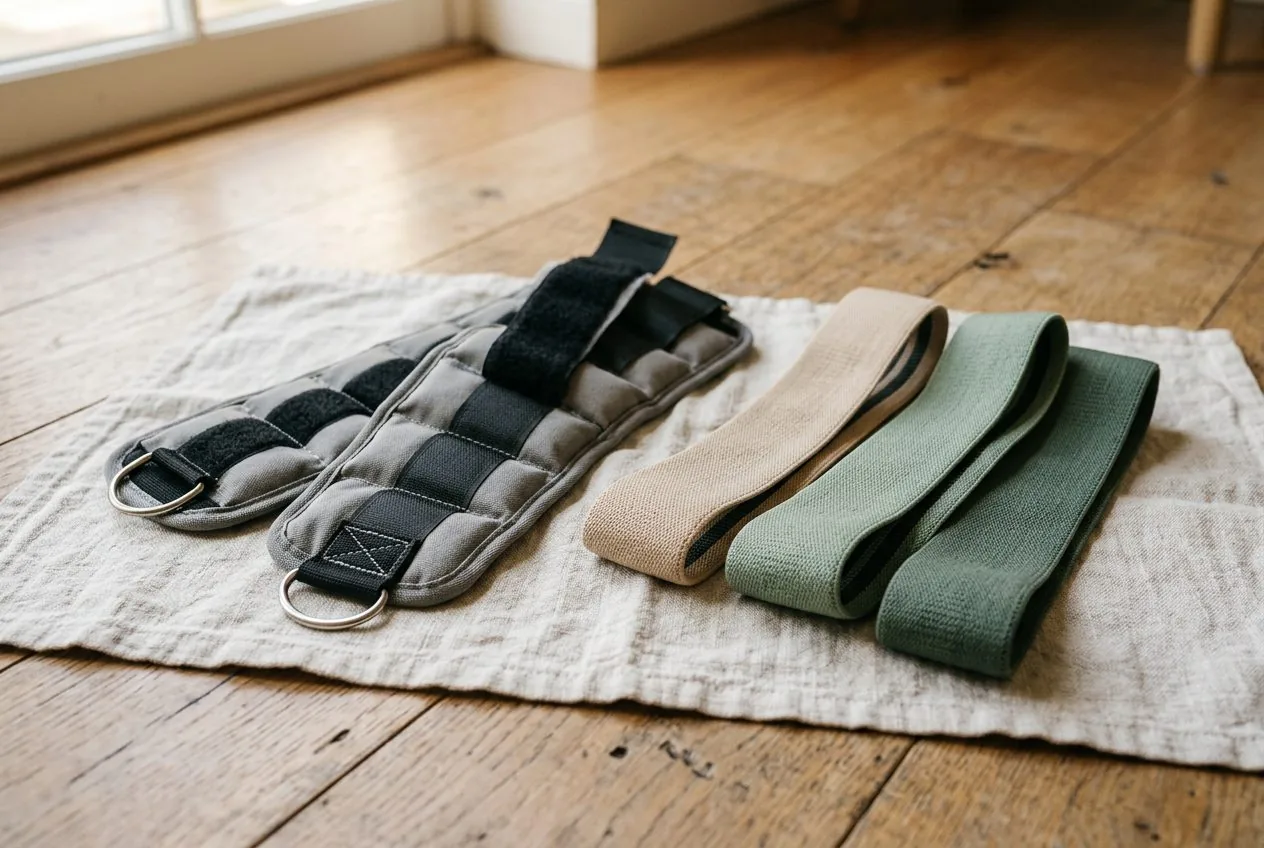
If you want to strengthen your hips and legs at home after 40 without a gym, two small, cheap tools keep coming up: ankle weights and glute bands. They overlap enough to make the choice confusing, and both are marketed as the one thing you need, which does not help. So let us settle it honestly, without pretending one is a miracle and the other is useless. Both are good. They just do slightly different jobs.
Short answer for skimmers: if you can only buy one to start, choose a fabric glute band set. It is gentler on the joints, targets the side-hip muscles that steady your walking, and is very hard to get wrong. Add a light pair of ankle weights when you want to load leg raises and kickbacks a little more. Owning both is a sensible setup, and together they cost less than a single piece of gym equipment.
This article is for information only and is not medical advice. Talk to your healthcare provider before starting a new exercise routine, especially if you have joint injuries, heart conditions, or dizziness.
The quick comparison
| Feature | Glute bands | Ankle weights |
|---|---|---|
| Cost to start | Lowest | Low for a light adjustable pair |
| Joint feel | Very gentle; resistance lightest at the start of a move | Gentle when light and slow; load sits on a long lever |
| Best target | Side-hip muscles, pelvic stability, walking | Leg raises and kickbacks, front and back of the hip |
| Measuring progress | By band level; less precise | By exact weight added; more precise |
| Risk if rushed | Low; the band just slides | Higher; fast swings strain the knee |
| Best at | Gentle entry, warm-ups, everyday steadiness | Adding load once bands feel easy |
Prices move constantly, so check current pricing before you buy.
Which should you pick? A quick decision framework
“I want the gentlest, most foolproof start.” Glute bands. They are the kinder entry point, they are almost impossible to use dangerously, and they go straight after the side-hip muscles most women over 40 want to strengthen. If your knees are cranky or you are rebuilding after a long break, start here.
“I like adding an exact, measurable challenge.” Ankle weights. There is a satisfying clarity in moving from one pound to two, and that precise progression keeps some people more motivated than the bigger jumps between band levels. Just respect the extra care they need.
“I mainly want steadier walking and standing.” Glute bands, easily. Side steps, bridges, and clamshells train the muscles that keep your pelvis level, which is the direct route to feeling steadier on your feet.
“I want neither the fuss of choosing nor the ceiling of one tool.” Own both, and keep it affordable with a fabric band set and a light adjustable pair of ankle weights. Use the band for gentle work and the weights to progress.
The over-40 lens: what actually matters
The reason this comparison matters at all is that the muscles around the hips fade quietly with age unless you give them a reason to stay. Muscle mass declines by roughly 3 to 8 percent per decade after age 30 (Current Opinion in Clinical Nutrition and Metabolic Care), and resistance training is a powerful way to counter that loss (NSCA). Both tools help you push back, gently. Here is how each suits a midlife body.
Joints first. A band’s resistance is lowest at the start of a movement and highest as the band stretches. That ascending feel is forgiving. An ankle weight, by contrast, adds a constant load at the end of a long lever, so a fast or swinging leg raise can tug at the knee (WebMD). Used light and slow, ankle weights are fine, but the band is the more naturally gentle of the two. Start light with either.
Progression, honestly. Both tools provide progressive resistance, just differently. Bands step up in bigger jumps between levels, which is simple but less precise. Adjustable ankle weights let you add a small, exact amount, which makes progress easy to see (UNC Center for Aging and Health). Neither is a barrier to getting stronger; they track it differently, and the band’s gentler learning curve is often the better first step.
Sustainability. The best tool is the one you actually use on a busy, low-energy week. For many women that is the band, because it is effortless to grab and impossible to overdo. Ankle weights ask a little more attention to form, which is fine once the habit is established but can feel like friction at the very start. Be honest about which one you will reach for when motivation is low, because consistency beats every spec on this table.
If you want the tool-by-tool detail on choosing a band before deciding, our best glute bands for stronger hips guide breaks down fabric versus rubber and resistance levels. And if you land on ankle weights, our ankle weight moves for steady legs how-to shows exactly how to use them gently.
These don’t have to look clinical
If your mental image of ankle weights is a pair of gray sandbags from a physical therapy office, it is worth updating. The current crop comes in solid colors and slim, soft fabric shells that sit under leggings or against bare skin without announcing themselves. Some are cut more like a small accessory you would not mind leaving by the front door than a piece of medical equipment.
That is not a trivial detail. A tool you like the look of is a tool you actually reach for, and one you are quietly self-conscious about tends to end up at the back of a drawer. If part of what has kept you from trying ankle weights is picturing clinical gray straps, look for a pair built more like a lifestyle accessory: a color you like, a slim profile, fabric that holds up to regular wear. The muscles do not know the difference, but you might be more likely to keep using them if you do.
A gentle lower-body session you can do with either
The hip moves themselves are shared. In EMG research, standing hip abduction with elastic resistance at the ankle and side-lying hip abduction are among the exercises that activate the gluteus medius most, while clamshells also work it well (Int J Sports Phys Ther). Those are leg lifts you can load with a band or with an ankle weight, so the session below works with either.
- Side steps. Loop a band above your knees, or wear ankle weights, and step slowly side to side with soft knees, keeping tension the whole time. Feel the outside of your hips working.
- Glute bridge. Lie on your back with knees bent, band above the knees or weights on your ankles, and drive your hips up by squeezing your glutes. Lower with control.
- Standing kickback. Hold a wall or chair, and press one leg slowly back and down, squeezing the glute. Switch sides. Keep it slow and controlled, never swung.
- Clamshell. Lie on your side with knees bent, band above the knees, and open your top knee like a clam without rolling your hips back. This one is a band favorite.
Aim for around 10 to 15 slow, controlled repetitions of each, two or three times a week, resting a day between sessions. Notice how similar the band and ankle-weight versions are: they train the same muscles in nearly the same way. That is exactly why the choice is lower-stakes than it feels. You can start with either, learn the moves, and add the other later without relearning anything.
Both are tools, not magic
The evidence behind both tools is real but specific. A meta-analysis found elastic resistance training produces strength gains similar to conventional weights and machines (SAGE Open Medicine), and a 2025 review in older adults found elastic band training may improve lower-limb strength and balance (Frontiers in Sports and Active Living). Adjustable ankle weights are the load used for leg strengthening in the Otago fall-prevention program, where they add intensity without adding impact on the joints (UNC Center for Aging and Health). Neither tool changes your body on its own; the results come from using it regularly.
For either tool, the National Institute on Aging suggests strength work at least two days a week, without working the same muscle group two days in a row, and notes that one set of 8 to 12 repetitions is effective (National Institute on Aging). Our metabolism after 40 explainer covers how muscle, movement, and protein fit together, and the rest of our gentle strength section gives you routines to run with whichever tool you land on.
The honest bottom line
Ankle weights and glute bands are not rivals; they are teammates that happen to overlap. If you buy one thing, buy a fabric glute band set: it is the gentlest, most foolproof way to strengthen the muscles that steady your walking, and it will carry most women a long way. If you love a measurable challenge or you want to progress leg raises further, add a light pair of adjustable ankle weights and use them slowly. And if you can stretch to both, that small, affordable pairing covers nearly everything you would want to do for your hips and legs at home, gently and for years.
With bands, start on the lightest loop. With ankle weights, start at the lowest setting: adjustable sets go from as little as half a pound up to 20 pounds, so you can increase the load gradually as your knee and hip muscles get stronger (UNC Center for Aging and Health).
Frequently Asked Questions
- Are ankle weights or glute bands better for women over 40?
- Neither is simply better; they suit slightly different goals. Glute bands are gentler and target the muscles around your hips for steadier walking and standing, which makes them the kinder starting point for most women over 40. Ankle weights add a small, constant load to leg raises and kickbacks, which can build lower-body strength a little further once your joints are ready. Owning both works well: bands for gentle hip work and warm-ups, ankle weights for progressing leg moves. If you start with one, start with a band set.
- Are ankle weights safe for knees after 40?
- They can be, with light weight and good form, but they deserve more care than bands. Because an ankle weight sits at the end of a long lever, your leg, it puts more strain on the knee joint during fast or swinging movements. The safe way to use them is light, slow, and controlled, mainly for floor and standing leg raises rather than jumping or high-impact moves. If your knees are sensitive, start with a glute band, add ankle weights later, and check with your provider before beginning.
- Which one builds stronger hips, ankle weights or glute bands?
- Both strengthen the hips, but they emphasize different things. A glute band works the side-hip muscles that steady your pelvis, which is exactly the weak link many women over 40 want to shore up. Ankle weights add resistance to the front and back of the hip during leg raises and kickbacks, which can extend the challenge once bands feel easy. For steadier everyday movement, bands are the direct route; for a bit more load on those same patterns later, ankle weights help.
- Do I have to choose, or should I own both?
- You do not have to choose, and owning both is an affordable, sensible setup. Together a fabric glute band set and a light pair of ankle weights usually cost less than a single piece of gym equipment. Use the band for gentle, joint-friendly hip work and warm-ups, and the ankle weights to add a little load to leg raises and kickbacks once your form is solid. They complement each other rather than compete, and starting with the band keeps the entry gentle.
- How much should ankle weights weigh for a beginner over 40?
- Start at the lowest setting that still lets you do slow, clean repetitions, and progress slowly from there. The muscles you target with ankle weights are small, and a load that feels trivial standing still becomes plenty once your leg is extended and moving slowly. Adjustable ankle weights are ideal: the sets used in the Otago fall-prevention program start from as little as half a pound, so you can nudge the challenge up in gentle steps as you adapt, rather than jumping to a weight your knees are not ready for.
Sources & references
- Current Opinion in Clinical Nutrition and Metabolic Care, Muscle changes with aging (opens in new tab)
- NSCA, Resistance training for older adults (opens in new tab)
- SAGE Open Medicine, Elastic vs conventional resistance (opens in new tab)
- Frontiers in Sports and Active Living, Elastic band training in older adults (opens in new tab)
- Int J Sports Phys Ther, Gluteal activity in hip abduction exercise (opens in new tab)
- UNC Center for Aging and Health, Adjustable ankle weights (Otago) (opens in new tab)
- National Institute on Aging, Three types of exercise (opens in new tab)
- WebMD, What to know about wearable weights (opens in new tab)
Before you go
The 7-Day Protein-First Meal Plan for Women Over 40
A complete protein-first week, finished for you: your personal protein target, a one-page shopping list, 21 recipes at 25-35 g protein each, and a timed 90-minute prep schedule. Printable PDF, paired with a free 7-lesson email course.
Free guide
The 7-Day Protein-First Meal Plan for Women Over 40
A complete protein-first week, finished for you: your personal protein target, a one-page shopping list, 21 recipes at 25-35 g protein each, and a timed 90-minute prep schedule. Printable PDF, paired with a free 7-lesson email course.