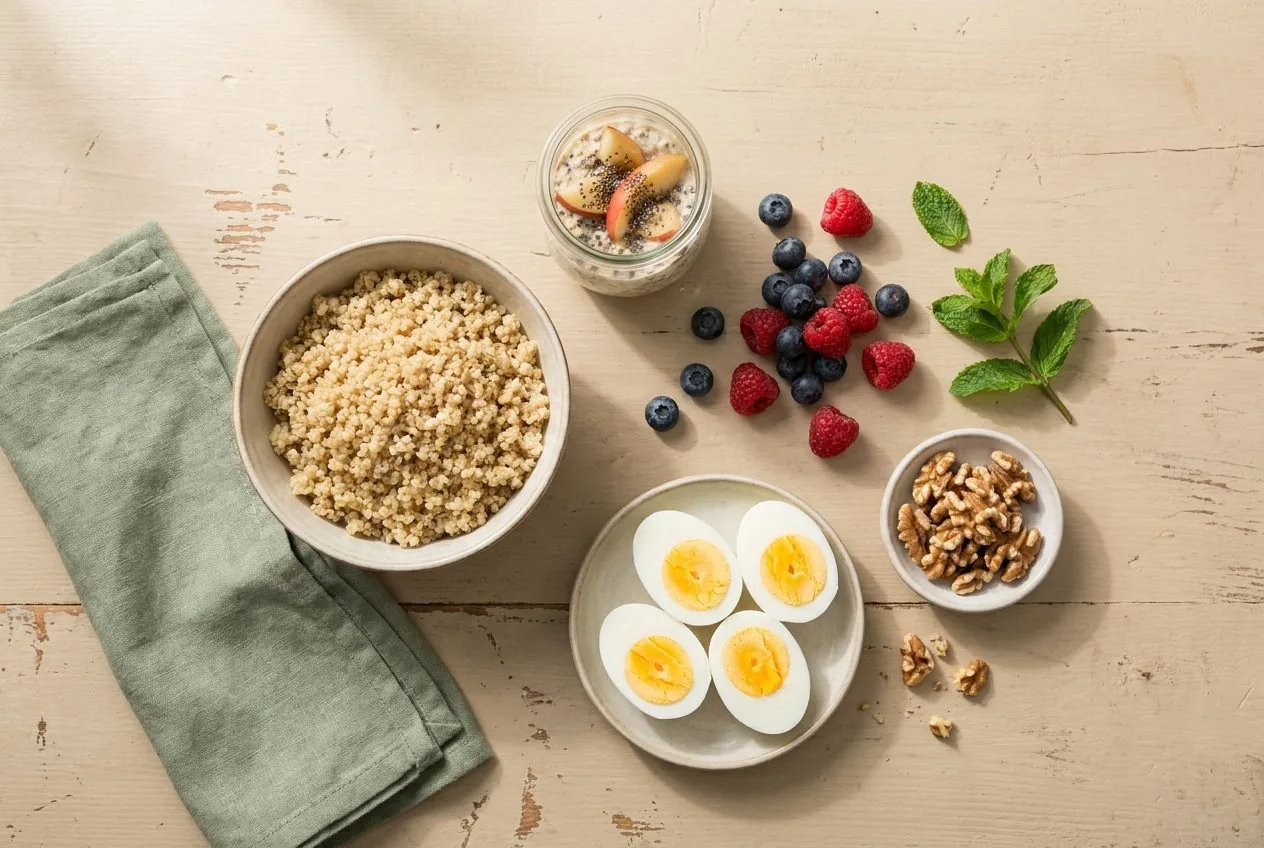
If your old approach to “getting back on track” was to eat as little as possible and hope, you have probably noticed it stops working somewhere in your 40s. It does not just fail; it often backfires, because aggressive dieting tends to cost you the muscle that keeps your metabolism steady. A food-first reset takes the opposite path. Instead of subtracting until you are miserable, you add the few things a midlife body actually runs better on, and you let those crowd out the rest.
Short answer: For four weeks, build every meal around protein, add fiber on purpose, prep a little so the healthy option is the easy one, and keep meals on a regular rhythm. No banned foods, no cleanse, no crash. Here is exactly how, week by week.
This article is for information only and is not medical advice. Talk to your healthcare provider before changing your diet or exercise routine, especially if you have a medical condition or take medication.
Why food-first, and why “reset” instead of “diet”
A diet is something you endure and then stop. A reset is a short, structured return to the habits that reliably help, run long enough to feel normal again. After 40, the terrain shifts: muscle becomes easier to lose (Journal of Clinical Medicine), appetite signals get noisier, and sleep and stress start pulling harder on your eating. Our plain-English guide to metabolism after 40 walks through what actually changes without the fear.
Working with that terrain means feeding your body better, not starving it. Protein protects muscle, fiber keeps you full and supports digestion, and a regular meal rhythm steadies the energy swings that drive snacking. None of it is glamorous, and all of it works better than the next cleanse. If you want the movement-and-sleep companion to this food plan, our gentle 4-week reset for perimenopause covers the strength and rest side; this guide is the kitchen half.
The three food-first rules
Everything in the plan rests on three simple rules. Master these and the details barely matter.
- Protein at every meal. A palm-sized portion, roughly 25 to 30 grams. It protects muscle and keeps you fuller, which quiets appetite through the day (American Journal of Clinical Nutrition). A scoop of plain protein powder in a smoothie or with yogurt is the easiest way to hit it when cooking is not happening.
- Fiber on purpose. Aim for 25 grams or more a day from vegetables, whole fruit, beans, and seeds (American Journal of Lifestyle Medicine). A spoonful of chia or ground flaxseed stirred into oats, yogurt, or a smoothie is a two-second upgrade that adds fiber and a little healthy fat.
- A regular rhythm. Eat at roughly consistent times rather than skipping breakfast and grazing at night. Predictable meals make protein and fiber targets far easier to hit and steady your energy.
The 4-week plan
Each week adds one layer. Repeat any week that feels hard rather than pushing on; the calendar is a tool, not a boss.
| Week | Protein | Fiber | Prep habit |
|---|---|---|---|
| 1: Anchor breakfast | 25-30g at breakfast | Add one fruit or veg to breakfast | Stock protein powder, chia, oats, eggs |
| 2: Add lunch | 25-30g at 2 meals | Beans or greens at lunch | Batch one grain and one protein |
| 3: Full days | 25-30g at all 3 meals | 25g+ across the day | Pre-portion 3 grab-and-go breakfasts |
| 4: Make it normal | Protein on autopilot | Fiber a non-event | Keep the two or three preps that stuck |
Notice the plan never asks you to eat less for its own sake. When you get enough protein and fiber, portions tend to settle on their own, because you are genuinely full rather than white-knuckling it. That food-first fullness is the honest version of what the supplement aisle keeps promising; our look at natural GLP-1 alternatives for women over 40 explains why protein and fiber beat the pills.
Making protein the easy default
Protein is the habit most women find hardest, almost always at breakfast. Toast, fruit, or a milky coffee will not get you close, and starting the day low makes the target nearly impossible to catch up on. A couple of eggs, Greek yogurt with seeds, or a protein smoothie changes the entire day.
The smoothie route is the lowest-friction option on a busy morning. Blend a scoop of plain protein powder with frozen fruit, a handful of spinach, a spoon of chia seeds, and a liquid base, and you have 25-plus grams of protein and a good dose of fiber in two minutes. Our high-protein smoothies for women over 40 and our guide to 30 grams of protein per meal give you a rotation so you never stare at the blender wondering what to make.
The fiber layer most resets skip
Fiber rarely gets top billing, but it quietly does a lot: it slows digestion so you stay full, feeds a healthier gut, and helps with the sluggish, heavy feeling many women report in midlife. The trick is to make it invisible. Stir chia or ground flaxseed into oatmeal, yogurt, or your smoothie. Add beans to a salad or soup. Keep the skins on fruit and vegetables. None of it requires a special product or a new recipe, just a small default you repeat.
If bloating is your particular struggle, ramp fiber up gradually and drink enough water, because a sudden jump can backfire (MedlinePlus). Our meal prep guide for after 40 shows how to build fiber-rich, protein-forward containers once and coast for days.
Common mistakes that derail a food reset
Turning it into a crash diet. The instinct to slash calories is strong and counterproductive. Under-eating costs you muscle and energy, the two things the reset is trying to build. Eat enough to feel steady.
Banning foods you love. Restriction breeds rebound. Crowd out the less helpful stuff with protein and fiber rather than drawing up a forbidden list you will resent by week two.
Ignoring breakfast. A low-protein breakfast quietly sets up the whole day to fall short. Fix breakfast first and the rest gets much easier.
Judging it by the scale. Metabolism change is slow and noisy, and weekly weigh-ins mostly measure water and stress. Judge the reset by energy, fullness, and how consistently you are eating, which respond far faster.
What four food-first weeks can and cannot do
Here is the honest bottom line. Four weeks of eating this way can give the women who keep it steadier energy, fewer crashes and cravings, and a protein-and-fiber habit that finally feels automatic. That is a genuinely valuable outcome, and it is the foundation everything else stands on.
What four weeks cannot do is transform your body or override midlife biology, and no food fixes a metabolism the way marketing promises. Visible change is slower, varies from person to person, and depends on the months that follow. So treat this reset as the on-ramp, not the destination. Start with breakfast tomorrow, keep the preps that stuck, and let the momentum carry you through the rest of the summer. Browse our Smoothies & Simple Meal Prep section for the recipes to fill it in.
Frequently Asked Questions
- Can a 4-week reset actually change your metabolism after 40?
- A reset does not rewire your metabolism, and any product promising that is overselling. What four food-first weeks can do is rebuild the habits that support a steadier metabolism: enough protein to protect muscle, fiber for fullness and digestion, and regular meals instead of skipping and grazing. Those habits are the real levers. Visible change is slower and builds over months, and results vary from person to person.
- How much protein should this reset include?
- Aim for a palm-sized protein source at each meal, roughly 25 to 30 grams, which lands many midlife women near the 1.0 to 1.5 grams per kilogram of body weight a day that the PROT-AGE study group suggests for older adults. Protein protects muscle while steadying appetite, and hitting it at breakfast makes the rest of the day far easier. A dietitian can set a precise number for your body and any medical needs.
- Do I have to cut carbs or sugar to reset my metabolism?
- No. There is no single required diet after 40, and cutting whole food groups is not what makes a reset work. This plan adds protein and fiber and gets meals into a regular rhythm rather than banning anything. Some women feel good lowering refined carbs, others do fine simply crowding them out with more protein and vegetables. The best plan is the one you can follow without misery.
- What if I miss a day or fall off the plan?
- You just start the next meal. A reset run at 80 percent for four weeks beats a flawless week followed by a collapse. Missing a day is not failure; abandoning the plan because you missed a day is the only real way to lose the momentum. Keep the streak of returning, not the streak of perfection.
Sources & references
- Journal of Clinical Medicine, Menopausal transition and loss of muscle mass (2020) (opens in new tab)
- American Journal of Clinical Nutrition, The role of protein in weight loss and maintenance (2015) (opens in new tab)
- American Journal of Lifestyle Medicine, Closing America's Fiber Intake Gap (opens in new tab)
- MedlinePlus, Fiber (opens in new tab)
- J Am Med Dir Assoc, PROT-AGE protein recommendations for older people (opens in new tab)
Before you go
The 7-Day Protein-First Meal Plan for Women Over 40
A complete protein-first week, finished for you: your personal protein target, a one-page shopping list, 21 recipes at 25-35 g protein each, and a timed 90-minute prep schedule. Printable PDF, paired with a free 7-lesson email course.
Free guide
The 7-Day Protein-First Meal Plan for Women Over 40
A complete protein-first week, finished for you: your personal protein target, a one-page shopping list, 21 recipes at 25-35 g protein each, and a timed 90-minute prep schedule. Printable PDF, paired with a free 7-lesson email course.