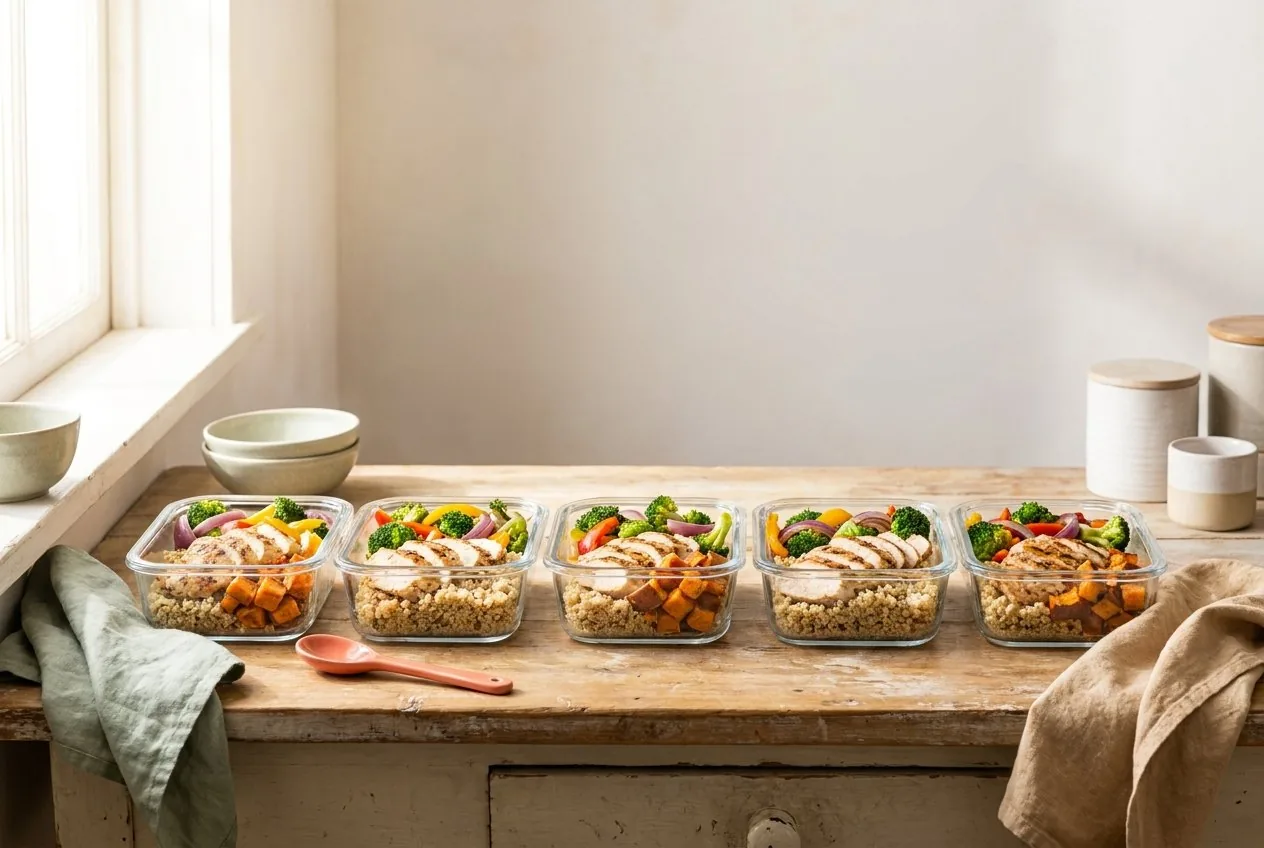
How do you meal prep for the week without losing a whole Sunday?
- Cook components, not plated meals: 2 proteins, 2 grains, 3 vegetables, and 1 sauce in about 90 minutes covers Monday to Friday.
- The mix-and-match matrix turns those 8 components into 5 distinct meals, so Thursday never tastes like a rerun of Monday.
- Portion with your hand, not a scale: 1 palm of chicken or fish per meal lands most women near the useful 25-30 gram range.
- Prep for 3-4 days, not 7: most cooked food fades after day four, so freeze a backup portion or two for Friday.
- A 45-minute half prep (one protein, one grain, one pan of vegetables, one sauce) still beats a week of improvising.
If meal prep makes you picture six hours in the kitchen and fourteen identical containers of sad chicken, take a breath. You are not wrong to resist that. You don’t have a free Sunday afternoon, and a system that demands one is a system you’ll quit by week two. That is not a willpower problem. That is a design problem.
Here’s the good news: you don’t need hours. Real meal prep takes about 90 minutes, and it doesn’t require recipes at all. You cook a small set of building blocks, then mix and match them into different meals all week. No repetition, no rigid plan, and no cooking at 6 p.m. when you’re tired, hungry, and the snack cabinet is calling your name.
This article walks you through the whole system: what to cook, in what order, and how to portion it without counting a single calorie. It is not a diet. It’s a way to make the healthy choice the easy choice, five days in a row.
This article is for information only and is not medical advice. Talk to your healthcare provider before changing your diet or exercise routine, especially if you have a medical condition or take medication.
Why meal prep pulls extra weight after 40
You could meal prep at any age. After 40, it earns its keep in two specific ways.
First, protein. From our 40s on, we slowly lose muscle unless we actively feed and use it. Research suggests that spreading protein through the day, roughly 25-30 grams per meal, supports muscle better than saving it all for dinner (Journal of Nutrition). That is hard to pull off when lunch is whatever you can grab. It is easy when a container with chicken or lentils is already sitting in the fridge.
Second, decision fatigue. By late afternoon you have already made countless decisions, and hormones in midlife can make hunger louder and patience shorter (Menopause Review). Many women find that the meals they improvise at 6 p.m. are the ones that undermine them, not because they lack knowledge, but because they are out of decisions. Prep moves the decision to Sunday morning, when you still have some to spare.
You’ll find more simple, protein-first ideas in our Smoothies & Simple Meal Prep category, but the system below is the backbone.
The 90-minute Sunday system: 2 proteins, 2 grains, 3 vegetables, 1 sauce
Forget recipes. You are cooking components. Every week you make:
- 2 proteins (one poultry or fish, one plant or egg based, for variety)
- 2 grains or starches (cooked in a pot or rice cooker while the oven works)
- 3 vegetables (two roasted, one fresh or quick-prepped)
- 1 sauce (this is what keeps the week from getting boring)
That’s eight things. They combine into far more than eight meals.
The mix-and-match matrix
Pick one item from each column and you have a meal. Swap any single column and you have a different meal.
| Proteins (pick 2 to cook) | Grains (pick 2) | Vegetables (pick 3) | Sauce (pick 1) |
|---|---|---|---|
| Sheet-pan chicken thighs | Quinoa | Roasted broccoli | Lemon-tahini |
| Baked salmon or white fish | Brown rice | Roasted peppers and onions | Yogurt-herb |
| Hard-boiled eggs | Sweet potatoes | Crunchy cabbage slaw | Peanut-lime |
| Seasoned lentils | Farro | Cherry tomatoes and cucumber | Salsa verde |
| Ground turkey, taco spiced | Whole-wheat couscous | Steamed green beans | Balsamic vinaigrette |
| Canned chickpeas, roasted | Barley | Baby spinach (raw, dressed later) | Chimichurri |
Choose your eight, write them on the fridge, and you’re done planning for the week.
A few tips for choosing well. Pick one protein you can cook on a sheet pan and one that cooks in a pot or needs no cooking at all, so they don’t compete for the oven. Make one of your three vegetables something you eat raw, because a fresh, crunchy element keeps day-four meals from feeling like leftovers. And choose the sauce last, as the thing that ties your other picks together: tahini leans Mediterranean, peanut-lime leans Asian-inspired, salsa verde says taco night.
The 90-minute timeline
Here is how the whole thing fits into an hour and a half. The oven does most of the work while you stand at the counter with a podcast on.
| Time | What you’re doing |
|---|---|
| 0:00-0:10 | Preheat oven to 425 F. Line two sheet pans. Start grain #1 in a pot. |
| 0:10-0:25 | Chop vegetables. Load pan 1 with protein #1, pan 2 with two vegetables. Both into the oven. |
| 0:25-0:35 | Start grain #2. Whisk the sauce in a jar. Set eggs or lentils cooking if that’s protein #2. |
| 0:35-0:50 | Prep the fresh vegetable (slaw, cucumbers, washed greens). Wipe the counter. Breathe. |
| 0:50-1:05 | Pull the roasted pans. Check proteins are cooked through with a food thermometer (FDA). Let everything cool a bit. |
| 1:05-1:20 | Portion into containers or store components in larger containers to assemble later. |
| 1:20-1:30 | Label anything for later in the week, load the dishwasher, admire the fridge. |
Your first week may run long. By week three, 90 minutes should feel realistic.
A week of combos from one prep
Same eight components, five distinct meals. Nothing repeats exactly.
| Day | The meal |
|---|---|
| Monday | Chicken thighs + quinoa + roasted broccoli + lemon-tahini |
| Tuesday | Lentils + sweet potato + slaw + lemon-tahini, handful of spinach |
| Wednesday | Chicken tacos: turkey or chicken + slaw + salsa, quinoa on the side |
| Thursday | Grain bowl: farro + roasted peppers + chickpeas + yogurt-herb sauce |
| Friday | Big salad: spinach + leftover protein + cucumber + whatever sauce is left |
Breakfast can stay even simpler. A protein-forward smoothie covers the morning without touching your prepped containers; our roundup of high-protein smoothies for women over 40 is an easy shortcut to pair with this system.
Portions without counting: the palm guide
You do not need a food scale or an app. Your hand scales with your body, travels with you, and never needs charging. At each prepped meal, aim for:
| Food | Your measure | How much per meal |
|---|---|---|
| Protein | Your palm (thickness included) | 1 palm, up to 1.5 if you’re taller or very active |
| Vegetables | Your fist | 1-2 fists, more is fine |
| Grains and starches | Your cupped hand | 1 cupped hand, adjust to your hunger and activity |
| Fats (sauce, oil, nuts) | Your thumb | 1-2 thumbs |
A palm of chicken or salmon lands most women in that useful 25-30 gram protein range without any math. If you’re hungrier some days, add vegetables and a bit more protein first, not more sauce. This is not about restriction. It’s about making sure the plate is anchored by the foods that keep you full and protect your muscle.
Two notes that save people from overthinking this. First, the palm guide is a starting point, not a rule you can break. If you’re consistently hungry an hour after eating, your meals probably need more protein or fiber, so scale the palm and the fists up before you blame yourself. Second, hunger is allowed to vary. A day with a long walk or a strength session earns a bigger cupped hand of grains. Listening to that is not falling off a plan; it is the plan.
Store it so Thursday tastes like Monday
A little storage strategy keeps the week’s food appealing instead of just edible.
- Cool before you close. Let roasted food come down from oven-hot before sealing the lids, so nothing steams itself soggy, but get it into the fridge within two hours of cooking (FDA).
- Keep sauce separate. Dress meals when you eat them, not when you pack them. A small jar of sauce in the fridge door keeps everything else crisp.
- Store greens dry. Wash spinach or lettuce, spin or pat it dry, and keep it with a paper towel in the container. Wet greens quit by Wednesday.
- Front-load the fish. Eat seafood in the first two days, then poultry, then the legumes and eggs, which hold up longest.
- Reheat with intent. A splash of water before microwaving grains brings them back to life. Roasted vegetables revive best in a hot pan or air fryer for a few minutes.
Common meal prep mistakes
Most meal prep failures come from the same handful of missteps. Skip these and the system holds.
Prepping full plated meals instead of components. Five identical containers of chicken, rice, and broccoli sounds efficient. By Wednesday you’d rather order pizza. Components stay interesting because the combinations change.
Skipping the sauce. The sauce is not a garnish; it is the retention strategy. One good jar of lemon-tahini or chimichurri makes plain roasted food taste intentional. Never skip it.
Under-prepping protein. If one component runs out first, make it the grain, never the protein. When the protein is gone, meals collapse into snacks, and snacks rarely keep you full.
Prepping too far ahead. Most cooked food is at its best for 3-4 days in the fridge (FDA). Prep for Monday through Thursday, and freeze a backup portion or two for Friday. Better a smaller prep you finish than a heroic one you throw away.
Treating one skipped Sunday as failure. Life happens. A 45-minute half prep (one protein, one grain, one pan of vegetables, one sauce) still beats a week of improvising. The system bends; it doesn’t have to break.
The gear that earns its counter space
You need less than the meal prep aisle suggests. Three things do almost all the work:
- Glass containers with locking lids. A set of 8-10 in two sizes. Glass lets you see what’s inside, reheats without worry, and survives years of dishwasher cycles. Divided containers help if you assemble full meals; plain ones are better for components.
- Two heavy sheet pans. Half-sheet size, light colored, sturdy enough not to warp at 425 F. Two pans running at once is the engine of the 90-minute timeline.
- A good chef’s knife. An 8-inch knife that feels comfortable in your hand, kept sharp. Nothing slows prep down like sawing at a sweet potato with a dull blade.
Nice but optional: a rice cooker for hands-off grains, a jar with a tight lid for shaking sauces, and painter’s tape plus a marker for dating containers.
Grab the printable prep checklist
If you’d like this whole system on one page, the printable prep checklist (the matrix, the timeline, and a fill-in shopping list) comes with the newsletter signup below. Stick it on the fridge, circle your eight components, and Sunday runs itself.
Start smaller than you think
You do not have to nail the full matrix this Sunday. Cook one protein, one grain, one pan of vegetables, and one sauce. That’s maybe 50 minutes, and it will change how Monday through Wednesday feels.
Then next week, add the second protein. The week after, the third vegetable. Meal prep after 40 is not about being impressive on Sunday. It’s about being kind to the version of you who walks in the door on Tuesday at 6 p.m., tired and hungry, and finds dinner already waiting.
Sources & references
Before you go
The 7-Day Protein-First Meal Plan for Women Over 40
A complete protein-first week, finished for you: your personal protein target, a one-page shopping list, 21 recipes at 25-35 g protein each, and a timed 90-minute prep schedule. Printable PDF, paired with a free 7-lesson email course.
Free guide
The 7-Day Protein-First Meal Plan for Women Over 40
A complete protein-first week, finished for you: your personal protein target, a one-page shopping list, 21 recipes at 25-35 g protein each, and a timed 90-minute prep schedule. Printable PDF, paired with a free 7-lesson email course.