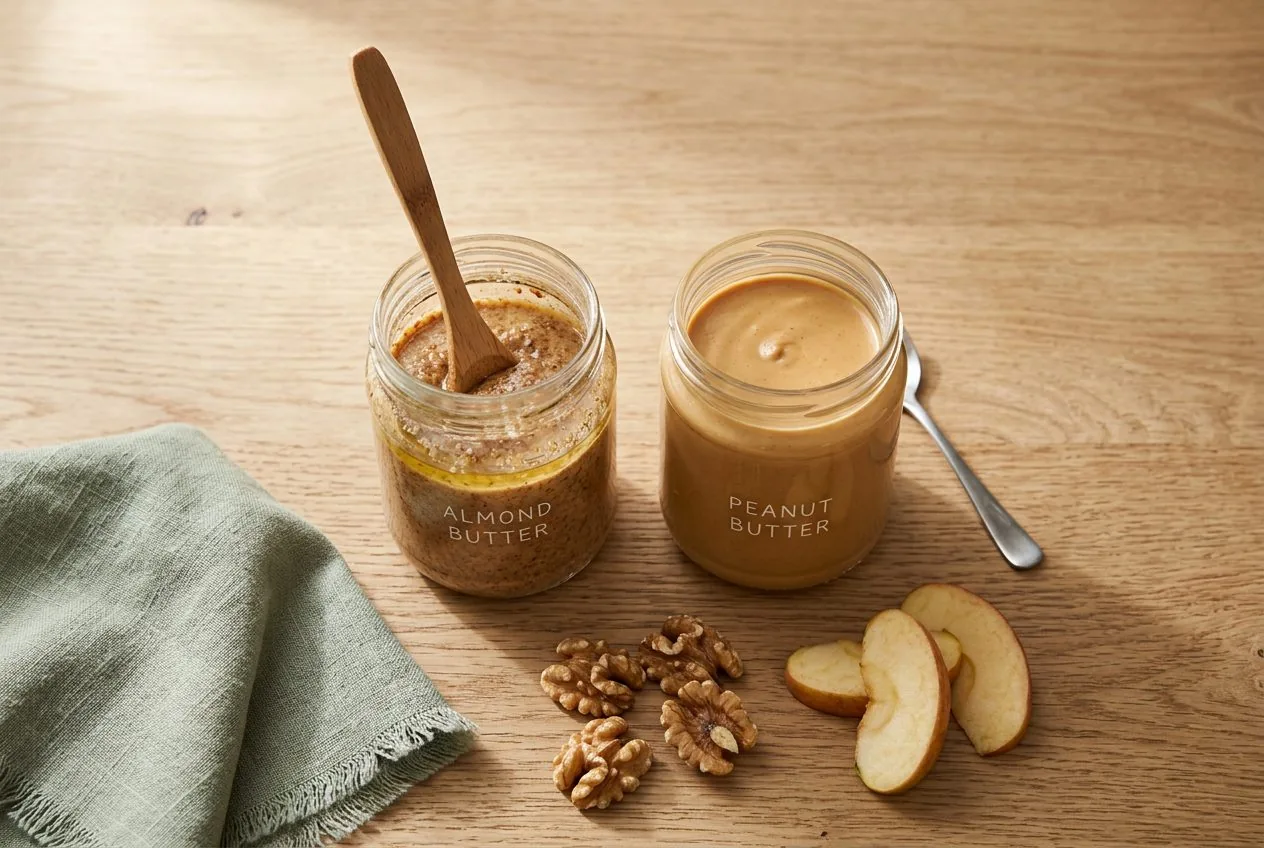
Usually, yes: a natural nut butter, the kind whose label reads nuts and maybe a little salt, is worth the modest extra cost over the conventional jar beside it, because what you are paying for is what gets left out: added sugar and stabilizing oils. The honest caveat is that the upgrade matters most when nut butter is a genuine habit. If a jar lasts you two months and gets spread thinly on the occasional slice of toast, any decent jar does the job, and nobody should tell you otherwise. This guide walks through what the label difference really is, what the extra money buys, and when the plain conventional jar is the sensible call.
This is a category review based on the qualities that matter for a midlife snack, not a lab test of one branded jar. Nut butter is a crowded, fast-moving market where flavors and prices change constantly, so we focus on the things that stay true no matter what is on the shelf this month.
Our verdict: the natural jar, nuts and a little salt only, is worth the modest upgrade for an everyday snack habit, and the boutique jars beyond it mostly are not. 8/10. For women over 40, the winner is not the jar with the boldest wellness claims but the honest two-ingredient one you like the taste of. A jar you finish beats a bargain tub full of extras and an artisan jar you ration.
This article is for information only and is not medical advice. Talk to your healthcare provider before changing your diet or exercise routine, especially if you have a medical condition or take medication.
Who this question is for
This guide is for the woman who stands in the nut butter aisle wondering whether the natural jar justifies its higher price, who wants a satisfying afternoon snack that holds her until dinner, and who finds the sheer number of jars and claims more confusing than it should be. If you already keep a plain two-ingredient jar you love and pair it sensibly, you may not need to change a thing, and that is a perfectly good place to be.
What “natural” actually means on the label
The word natural on the front of a jar is marketing; the ingredient list on the back is the truth. A genuinely natural nut butter lists nuts and maybe salt, full stop. A conventional jar typically adds a sweetener and a stabilizing oil such as fully hydrogenated vegetable oil, which together can make up no more than 10 percent of a product labeled peanut butter (eCFR, 21 CFR 164.150). Those extras are what keep it uniform and spreadable at room temperature and give it that faint dessert sweetness.
That short list explains the one quirk people dislike about natural jars: separation. Without added stabilizers, the nut oil rises (National Peanut Board), so the jar needs a good stir on opening and does best in the fridge afterward. It is mildly inconvenient and completely harmless, and it is the visible proof that nothing extra is in there.
What the extra dollars actually buy
Three real differences sit between the natural jar and the conventional one, and they are worth naming plainly.
Less added sugar. A standard conventional peanut butter carries about 3 grams of sugar per two-tablespoon serving, compared with about 1 gram in a peanuts-only jar (National Peanut Board). The natural jar tastes nuttier and plainer, and it lets the apple or the oats bring the sweetness instead. If the snack is a daily one, that difference adds up across a season.
No added oils or fillers. The stabilizing oils in conventional jars are there for texture and shelf life, not for you. The natural jar trades that convenience for a simpler recipe, and the stir is the whole price you pay.
A flavor that reads as nuts. Roasted peanuts or almonds ground into butter taste distinctly of themselves. Many women find that once they adjust to the plainer flavor, the sweetened jars start tasting like frosting, which makes the sensible portion easier to keep.
What the extra dollars do not buy: more protein, magic, or a health transformation. A natural jar is the same food with a shorter ingredient list, and honest expectations are part of the deal.
The price reality, jar for jar
In most stores the natural jar costs a little more than the conventional one beside it, and the small-batch boutique jars can cost considerably more. All prices are approximate as of mid-2026 and move constantly, so check the shelf in front of you before deciding anything.
Here is the honest math for a snack habit. If you go through a jar or two a month, the natural upgrade costs you a little extra each month for a cleaner everyday staple, which we think is one of the easiest good trades in the grocery store. The boutique tier is a different question: at that price you are paying for branding, packaging, and small-batch romance, and the food inside is rarely meaningfully different from the everyday natural jar. Enjoy one as a gift or a treat, but it is not the upgrade that matters.
When the upgrade matters, and when any jar is fine
The natural jar earns its price if nut butter is a regular part of your week: on apples in the afternoon, stirred into oats, dolloped on yogurt. Daily habits are exactly where added sugar and oils accumulate quietly, and where a cleaner staple pays off.
Any jar is honestly fine if nut butter is an occasional pleasure in your kitchen, a thin spread on weekend toast or a spoonful in a once-a-week smoothie (our blenders for smoothies review covers the machine that makes that spoonful worth adding). At that frequency, the ingredient differences barely register across your month, and the right call is simply the jar you enjoy at the price you like.
The main types, compared
Whichever side of the natural question you land on, the nut itself is mostly personal taste.
| Type | Flavor | Texture | Best for | Watch out for |
|---|---|---|---|---|
| Peanut butter | Rich, familiar, crowd-pleasing | Smooth or crunchy | An everyday, affordable staple | The sugary, oil-added tubs |
| Almond butter | Mild, slightly sweet, nutty | Creamy, spreads well | A gentler flavor on fruit and toast | A higher price than peanut |
| Cashew butter | Soft, buttery, mellow | Very smooth | Stirring into oats and yogurt | Often pricier, sometimes thinner |
| Mixed-nut butter | Varied, well-rounded | Usually smooth | Variety in one jar | Check the label for added oils |
Any of these works beautifully in a fall snack. The type of nut matters far less than the ingredient list and the portion, so choose the flavor you look forward to and keep the extras out.
Putting the jar to work this fall
A good jar earns its price fastest in the season it suits best. Nut butter belongs to fall: on a crisp apple, stirred into warm oatmeal, dolloped on a baked pear, rolled into no-bake balls for the week. Its healthy fat slows a snack down, so it holds you far better than a quick carbohydrate that spikes and fades, and on a long autumn afternoon that difference is the whole point. Our 9 fall foods for steady energy covers the apples, oats, and pears it pairs best with.
One pairing note that matters after 40: on its own, nut butter is mostly fat with modest protein, so partner it with Greek yogurt, milk, or a dusting of protein powder when a snack needs to carry you further. That pairing is where it earns its place, since protein intake tends to drop with age and many older adults fall short of even the basic recommendation (The Journal of Nutrition, Health and Aging). For seven ready-made ways to build the pairing, our high-protein nut-butter snacks after 40 guide does the assembling for you. And if you like upgrading the same bowls further, a spoon of seeds does for fiber what nut butter does for fat; our chia vs ground flaxseed comparison covers which to reach for.
Pros and cons
| Pros | Cons |
|---|---|
| Two-ingredient label keeps added sugar and oils out | Costs a little more than the conventional jar |
| Healthy fat gives real staying power on a long afternoon | Separates and needs a stir, firms up in the fridge |
| Plainer flavor makes sensible portions easier to keep | Mostly fat, so pair it with protein for a balanced snack |
| Peanut, almond, cashew, and mixed all come in natural versions | Calorie-dense, so portion matters more than with most foods |
| Turns simple fall foods into cozy, satisfying snacks | Boutique jars charge far more for little real difference |
Honest criticisms
No snack food is perfect, and pretending otherwise helps no one.
It is easy to over-serve. Nut butter is rich and calorie-dense, natural or not, and eating it by the spoon straight from the jar runs generous fast. The fix is simple, one to two tablespoons measured with a spoon, but it takes a little attention.
The marketing oversells both tiers. Words like superfood and protein-packed sell jars at every price point, but the honest truth is that nut butter is mostly healthy fat with modest protein (National Peanut Board). Read it as a fat-and-flavor base, not a protein source, and pair it accordingly.
The stir is a genuine chore. A fresh natural jar can put oil on your countertop and resistance in your wrist, and some people simply hate it. If the stir is what stands between you and the snack, a conventional jar you actually use beats a natural jar you avoid.
Who should upgrade, and who should skip
Upgrade to the natural jar if nut butter is a steady habit in your afternoons, you want the added sugar and oils out of an everyday staple, and you do not mind a stir and a fridge shelf. It is a small price for a cleaner default, all season long.
Skip the upgrade if nut butter is an occasional treat in your kitchen, if the plainer taste means the jar goes unfinished, or if what draws you to the pricier shelf is the boutique branding rather than the food. An honest conventional peanut butter, enjoyed and finished, beats a virtuous jar that sits.
What we will not promise
A natural nut butter will not change your body or steady your energy on its own, and no honest guide should pretend otherwise. What it genuinely tends to support, paired with a little protein and some fruit or vegetables, is a snack that satisfies you and holds you between meals rather than leaving you hunting for more an hour later. That outcome depends on the whole snack and the portion, not the label on the jar. Buy the simplest one you enjoy, pair it well, keep the serving sensible, and let it be the small, honest pleasure it is.
The honest bottom line
Is natural nut butter worth the extra cost after 40? For a real snack habit, yes: the modest upgrade buys a two-ingredient label, less background sugar, and a staple you can feel unambiguous about all fall. For an occasional treat, no: any decent jar you enjoy does the job, and the boutique tier is rarely worth it for anyone. Keep the portion to a tablespoon or two, pair it with protein and some fruit, and you have a cozy, satisfying snack for the whole season. For ready-made ways to use it, our high-protein nut-butter snacks after 40 guide has seven easy pairings, and the rest of our smoothies and simple meal prep section keeps the season’s snacking easy.
Frequently Asked Questions
- What counts as a natural nut butter?
- A jar whose ingredient list reads nuts and maybe a little salt, and nothing else. No added sugar, no palm or hydrogenated oils, no fillers. That short list is the entire difference between natural and conventional jars, and it is why natural versions separate: without added stabilizing oils, the nut's own oil rises to the top. A quick stir fixes it, and the separation itself is a good sign that nothing extra is in there.
- Is natural peanut butter actually worth the extra money?
- For an everyday snack, usually yes. The modest extra cost buys the absence of added sugar and stabilizing oils, which matters most when the jar is a daily habit rather than an occasional treat. If nut butter appears in your afternoons most days of the week, the natural jar is the better default. If you go through a jar every couple of months and spread it thin, the difference across your week is small, and a conventional jar you enjoy is honestly fine.
- Why does natural nut butter separate, and is that a problem?
- It separates because there are no added stabilizers, so the nut oil rises to the top of the jar. Give it a good stir when you first open it, then store it in the fridge to keep it mixed and fresh for longer. It firms up when cold, so let it sit out for a few minutes before spreading, or stir it into warm oats and yogurt where firmness does not matter. The separation is a mark of a simple recipe, not a flaw, and a jar you keep fresh is a jar you finish.
- Is nut butter a good protein source?
- Not as good as many people assume. Nut butter is mostly healthy fat, which gives it real staying power, with a smaller amount of protein along for the ride. That is why we treat it as a fat-and-flavor base rather than a protein source, and pair it with Greek yogurt, milk, or a dusting of protein powder when a snack needs more protein. Built that way, it becomes a balanced snack rather than a spoonful of fat.
- How much nut butter is a sensible serving?
- About one to two tablespoons is the sweet spot for a snack. Nut butter is calorie-dense, so it is easy to turn a balanced snack into a very rich one with a heavy hand, and a level tablespoon spread thinly usually satisfies more than it looks like it will. Measure it with a spoon rather than a knife straight from the jar the first few times, since eyeballing tends to run generous. The fat is the point, but a little goes a long way.
- Are the low-fat or reduced-fat versions better?
- Usually not. The fat in nut butter is exactly what gives it staying power and makes a snack satisfying. A simple natural nut butter, just nuts and salt, in a sensible portion is the better choice. Skip the diet-labeled jars and control the amount instead.
Sources & references
- eCFR, 21 CFR 164.150 Peanut butter standard of identity (opens in new tab)
- National Peanut Board, Natural vs regular peanut butter (opens in new tab)
- National Peanut Board, Oil in peanut butter (opens in new tab)
- The Journal of Nutrition, Health and Aging, Low protein intakes in older US adults (opens in new tab)
Before you go
The 7-Day Protein-First Meal Plan for Women Over 40
A complete protein-first week, finished for you: your personal protein target, a one-page shopping list, 21 recipes at 25-35 g protein each, and a timed 90-minute prep schedule. Printable PDF, paired with a free 7-lesson email course.
Free guide
The 7-Day Protein-First Meal Plan for Women Over 40
A complete protein-first week, finished for you: your personal protein target, a one-page shopping list, 21 recipes at 25-35 g protein each, and a timed 90-minute prep schedule. Printable PDF, paired with a free 7-lesson email course.