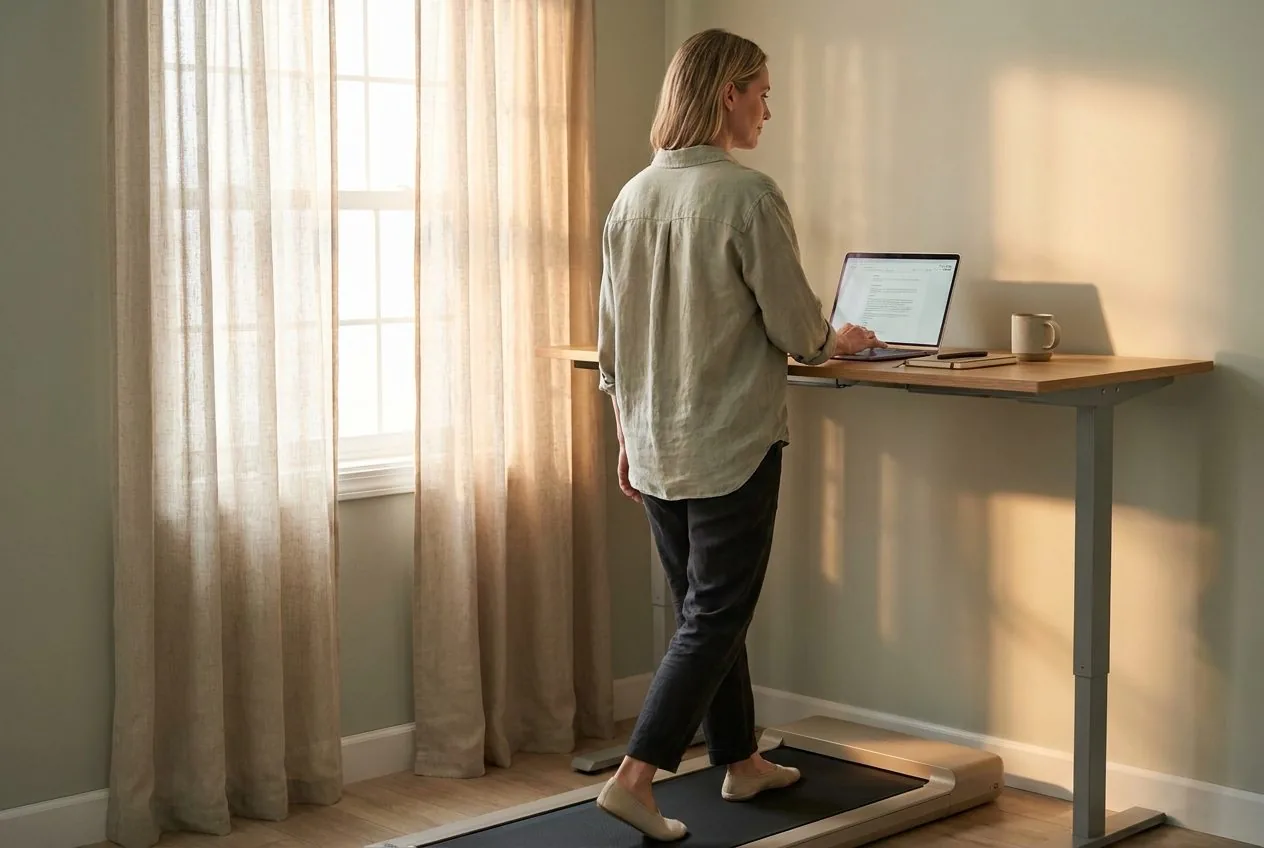
If you keep meaning to move more but the day fills up before you get the chance, the problem is almost never willpower. It is friction. Changing clothes, driving somewhere, carving out a clean 45-minute block that never seems to exist. A walking pad removes almost all of that, and a good routine removes the rest.
Short answer: Do not try to “do a workout.” Instead, stack three tiny walks onto things you already do at your desk or on your couch, keep the pace slow enough to feel boring, and let the total quietly add up. Below is a routine built for a real, over-scheduled week, plus the mistakes that quietly sink most people.
This article is for information only and is not medical advice. Talk to your doctor before starting a new exercise routine, especially during perimenopause or menopause, or with any joint condition.
Why “stacking” beats scheduling after 40
Most fitness advice tells you to schedule exercise like a meeting. That works right up until a real meeting, a sick kid, or a bad night’s sleep eats the slot, and once you miss two or three, the whole plan feels broken. Habit stacking flips the logic. Instead of finding new time, you attach a short walk to a trigger that already happens every day: your first coffee, your 10 a.m. call, the show you watch after dinner.
This suits a midlife body and a midlife schedule for two reasons. First, gentle movement spread across the day tends to feel sustainable in a way one punishing session does not. Second, walking is the exercise people actually keep doing, because there is no learning curve and no recovery cost. Our 30-day walking plan for women over 40 makes the broader case, and a walking pad simply moves that plan indoors so weather and daylight stop having a vote.
A quick, honest note on expectations. A walking pad is a movement tool, not a treatment and not a weight-loss device. What regular gentle movement genuinely tends to support is steadier energy, easier daily activity, and a habit that survives a busy week. Any change still comes down to overall habits over time, and results vary from person to person.
The core routine: three small walks
The whole routine rests on one idea: three short, easy blocks beat one heroic one. Here is the default week.
| Block | When | Length | Pace | Pair it with |
|---|---|---|---|---|
| Morning | First coffee or first email | 10 min | Very slow | Clearing your inbox |
| Midday | A call or a meeting you only listen to | 10 min | Slow, steady | Audio-only work |
| Evening | While a favorite show plays | 10 min | Comfortable | Something you would watch anyway |
Thirty minutes, split into pieces so small that no single one is worth skipping (CDC). On a good day, extend any block to 15 or 20 minutes. On a terrible day, do one block and call it a win, because keeping the streak of returning matters more than any daily total.
Week-by-week build
Ramp gently. The calendar is a tool, not a boss, so repeat any week that feels hard rather than pushing on.
| Week | Blocks per day | Length each | Notes |
|---|---|---|---|
| 1 | 2 | 10 min | Just prove the pad gets used |
| 2 | 3 | 10 min | Add the midday block |
| 3 | 3 | 12-15 min | Nudge length, not speed |
| 4 | 3 | 15 min + one longer weekend walk | Make it your normal |
Notice what never changes: the pace stays gentle. The goal over 40 is to raise the total volume of movement, not to turn a calm walk into a sweaty ordeal. If you want a little more challenge without going faster, a modest incline lets you work slightly harder at the same relaxed pace, which many women find kinder to the knees.
Setting up so you actually step on
The single biggest predictor of whether a walking pad gets used is where it lives. A pad folded in a closet is a very expensive shelf. Keep it visible and reachable: under a standing desk, or slid against the couch where you can pull it out in five seconds. If getting started takes more than one small motion, the friction you were trying to remove creeps back in.
A few practical setup notes:
- Match the task to the pace. Calls, reading, and video meetings pair beautifully with slow walking. Detailed typing does not, so keep sit-down tasks for sitting.
- Wear real shoes. Socks feel casual, but supportive shoes make longer blocks comfortable and steadier, which matters more as balance changes.
- Favor a handle if balance is ever a question. There is no prize for skipping the support bar. Holding on while you find your footing in week one is exactly what it is there for.
- Put a mat underneath. It cuts vibration and noise, which keeps you (and any downstairs neighbors) happy enough to keep going.
For a full breakdown of which features matter most for this reader, our best walking pad guide for women over 40 walks through incline, safety handles, weight capacity, and noise, and explains why its top pick is the UREVO Strol 2E Pro, while the plain Strol 2E covered here offers its included fold-down handle and shock-absorbing deck at a fair price (UREVO).
Common mistakes that quietly sink the habit
Going too fast, too soon. The instinct to prove yourself with speed backfires. Fast walking turns a relaxed background habit into a chore you start dreading, and dread is what kills streaks. Keep it slow enough that you could hold a conversation (CDC).
Chasing a big daily step number. A giant target you hit twice and then abandon is worse than a small one you hit daily. Let the total build from repeatable blocks rather than a number that impresses anyone.
Treating walking as the whole plan. This is the big one after 40. Walking protects your energy and mood, but it does not protect muscle, and muscle is the quiet engine of midlife metabolism. Pair the pad with two short strength sessions a week (CDC). Our summer arms workout for women over 40 and the routines in our Gentle Workouts & Strength section give you joint-friendly options you can do at home.
Weighing yourself to judge the habit. Body change in midlife is slow and noisy, and daily weigh-ins mostly measure water and stress. Judge this routine by whether you stepped on the pad and how your energy feels, because those respond far faster than the scale.
When a walking pad is worth it (and when it isn’t)
A walking pad earns its place if you sit more than you want to, the weather or your schedule keeps talking you out of walks, and you would happily move if moving were genuinely easy to reach. It lowers the bar until stepping on takes no real willpower, which is the entire point.
If you already love your outdoor walks and only want a rainy-day backup, a simpler flat model may be all you need, and that is completely fine. Buy the least fancy pad that removes your specific excuse, then let the habit, not the machine, do the real work.
Your first week, starting today
Keep it almost embarrassingly small. This week, put the pad somewhere you cannot ignore it, and do two 10-minute blocks a day at a slow, boring pace, paired with your coffee and your evening show. That is the whole assignment. Next week, add the midday block. The point of the first week is not fitness. It is proof, to yourself, that the pad gets used, because a routine you keep at 80 percent for months beats a perfect plan you abandon in ten days.
For the strength half of the picture, start with how to start yoga after 45 or a pair of light dumbbells. Movement and muscle are teammates, not rivals, and together they are what carry a strong, steady body into the next decade.
Frequently Asked Questions
- How long should I walk on a walking pad each day?
- There is no perfect number, and the best amount is the one you will repeat. Many busy women start with three short blocks of 10 minutes spread through the workday, which adds up to a gentle 30 minutes without ever feeling like a workout. Build from there only when the current version feels easy. Consistency over months matters far more than any single big day, and results vary from person to person.
- Can I really use a walking pad while I work?
- At a slow pace, yes, for tasks that do not need fine motor control: reading email, taking calls, listening to meetings, or watching a training video. Typing detailed spreadsheets or writing carefully is harder while moving, so save those for sitting. The trick is to match the task to the pace rather than trying to do everything at full speed. Slow and boring is exactly what makes the habit stick.
- Is a walking pad enough exercise on its own after 40?
- Walking is wonderful for daily movement, energy, and mood, but it is not a complete program by itself. From roughly 40 onward, protecting muscle with a little strength work twice a week matters just as much, and no amount of walking replaces it. Think of the walking pad as your movement base and two short strength sessions as the other half. Together they are far more than either alone.
- Will a walking pad hurt my knees or hips?
- Walking is low-impact by nature, and a cushioned deck can feel gentler than pavement to many people. That said, no article can clear you medically. If you have knee, hip, or back issues, start with short, slow sessions, hold the handle if your pad has one, and check with your doctor first, especially during perimenopause or menopause or with any joint condition.
Sources & references
Before you go
The 7-Day Protein-First Meal Plan for Women Over 40
A complete protein-first week, finished for you: your personal protein target, a one-page shopping list, 21 recipes at 25-35 g protein each, and a timed 90-minute prep schedule. Printable PDF, paired with a free 7-lesson email course.
Free guide
The 7-Day Protein-First Meal Plan for Women Over 40
A complete protein-first week, finished for you: your personal protein target, a one-page shopping list, 21 recipes at 25-35 g protein each, and a timed 90-minute prep schedule. Printable PDF, paired with a free 7-lesson email course.