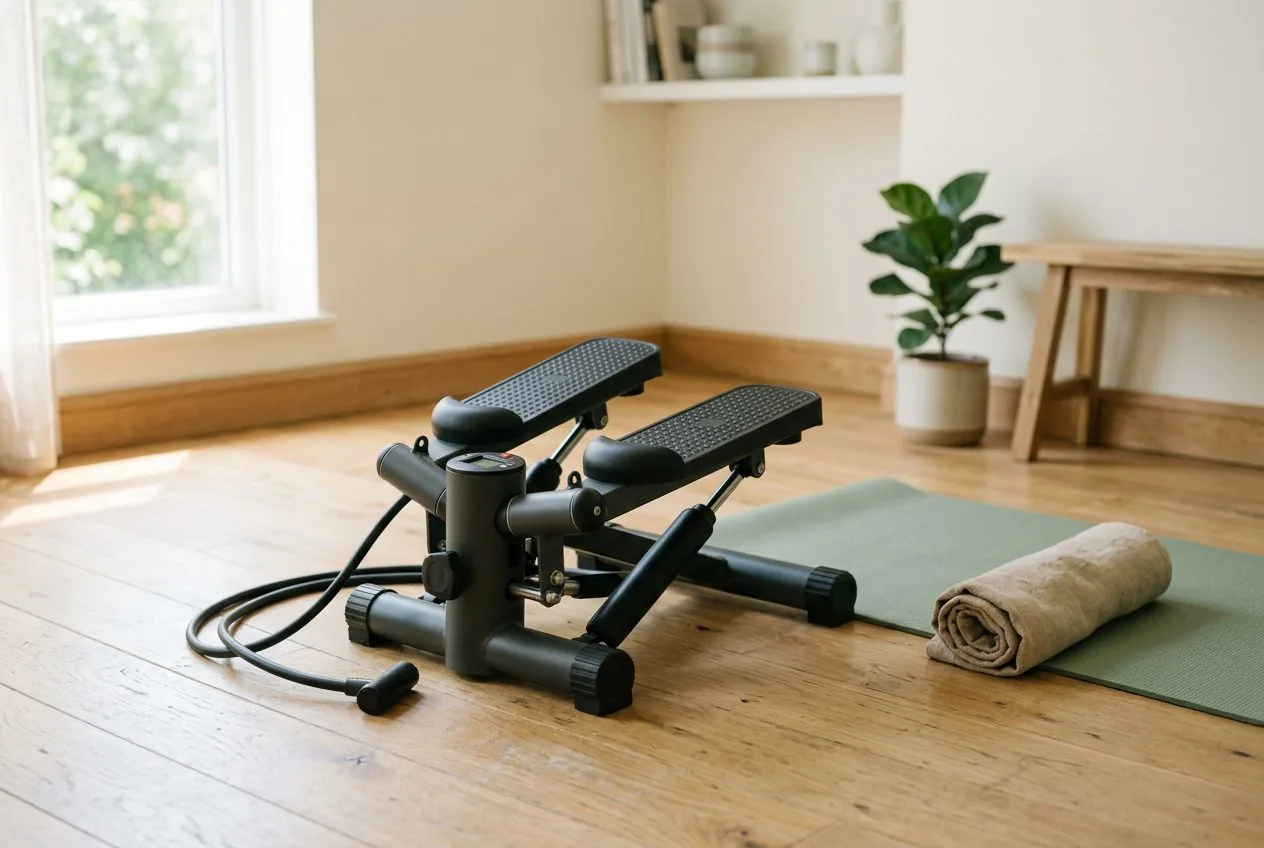
If you want a bit more gentle cardio but the weather, the schedule, or the sheer size of a treadmill keeps getting in the way, a mini stepper is one of the smallest and cheapest ways to add movement indoors. It is the compact, two-pedal device you step on in place, tucked-away-under-the-sofa small, and it promises easy cardio in the corner of any room. It is also a category where the difference between a pleasant little habit and a wobbly, squeaky frustration comes down to a few specs. So here is a clear-eyed buyer’s guide: what actually matters for a midlife body, a top pick by spec rather than hype, and an honest word on who can happily skip it.
This is a category review based on the features that matter for a woman over 40, not a lab test of one branded model. Mini steppers are a crowded, fast-changing market and prices move constantly, so we focus on the specs that stay true no matter what is in stock this month.
Our pick: a hydraulic mini stepper with a wide, stable base, a low step height, and a quiet cylinder. 7/10. For women over 40, the best stepper is the stable, quiet one you feel safe using, not the cheapest or the one with the most gadgets. It is a modest tool that earns its keep for short, frequent bursts of gentle cardio, and it loses a point because stability and noise vary so much across the category.
This article is for information only and is not medical advice. Talk to your healthcare provider before starting a new exercise routine, especially if you have joint injuries, heart conditions, dizziness, or balance concerns.
Who this is for
You do not need to be an exerciser already to want one. This guide is for the woman who wants to add a little gentle cardio without leaving the house, who has limited space and no interest in a big machine, and who would happily step for a few minutes while the news plays. A mini stepper suits that person well, because it asks almost nothing of your space or your budget and turns spare minutes into movement. If you already walk plenty or have cardio you enjoy, you may not need to add one at all.
Why a mini stepper suits an over-40 routine
The appeal is convenience and gentleness, not intensity. Three things make one a sensible fit for this reader.
It is low-impact and familiar. Stepping is a natural motion your body already knows, and a stepper spares your joints the pounding of running or jumping; hydraulic models are built for low-impact stepping (Sunny Health & Fitness). For a midlife body that does better with gentle, repeatable movement, that is exactly the right kind of cardio.
It fits anywhere and any schedule. It slides under a sofa, weighs little, and needs no setup, so you can step for five minutes here and ten minutes there without carving out a workout. Movement you can do in spare moments is movement that actually happens.
It lowers the bar to cardio. A stepper sitting in the corner, ready to go, turns “I should get moving” into something you do while an episode plays. That kind of low-effort, tucked-into-the-day habit is the sort that lasts.
The honest limit: a mini stepper is a modest tool, not a whole plan. It adds gentle activity; it does not build much strength or replace varied movement. For most women that is fine, as long as you know what it is for. If you want to weigh it against a seated option, our under-desk elliptical vs mini stepper comparison lays out which suits which person, and if a walking pad is the other contender, our walking pad vs mini stepper comparison settles that match-up.
How we judged them
Five things separate a mini stepper you will reach for weekly from one that squeaks its way into a cupboard:
- How stable is the base? The single most important feature. A wide, non-slip base that stays planted is what makes stepping feel safe. A narrow, skittish one is a hazard you will avoid.
- How low is the step height? A low, comfortable step is kinder to knees and hips and easier to balance through. A tall, deep step turns gentle cardio into a strain.
- How quiet is it? Hydraulic steppers are designed for a smoother, quieter stepping cadence (Sunny Health & Fitness). A stepper you can use in front of the television without a squeak is a stepper you will actually use.
- Is the motion smooth? A smooth hydraulic cylinder gives even, controlled steps. A jerky action feels unpleasant and can throw off your balance.
- Does it show basic feedback? A simple display of time and step count is a small motivator that helps you keep short sessions consistent. Nothing fancy required.
We weighed stability and a low step height most heavily, because those two features decide whether a midlife beginner feels safe enough to keep stepping or gives up after a wobbly, jarring first try.
The specs that actually matter
| Feature | What to look for | Why it matters after 40 |
|---|---|---|
| Base | Wide, non-slip, stays planted | Stepping in place must feel secure |
| Step height | Low and comfortable | Kinder to knees, hips, and balance |
| Mechanism | Hydraulic cylinder | Built for a smoother, quieter step |
| Noise | Quiet enough for the sofa | You only use what you can use anywhere |
| Motion | Smooth, even resistance | Jerky steps unsettle your balance |
| Display | Simple time and step count | A small, steady motivator |
All prices are approximate as of mid-2026 and move constantly, so check current pricing before you buy.
Our top pick, by spec
For most women over 40, the stepper to look for is a hydraulic model with a wide, stable base, a low step height, and a quiet cylinder, priced in the sensible middle rather than the bargain bottom. Here is why that profile wins.
The stability and the quiet are the quiet heroes. A wide, planted base means you can step without feeling like the thing might scoot out from under you, which is the entire difference between a tool you trust and one you avoid. A hydraulic cylinder is designed for a smooth, quiet stepping action, so you can actually use it in the living room. And a low step height keeps the motion gentle on your knees and easy to balance through, which matters most for this reader.
You do not need the fanciest model with the most gadgets, and the elastic arm cords that come bundled with many steppers are a minor extra rather than a reason to buy. Set the stepper on a firm floor rather than carpet, keep a wall or sturdy chair within reach while you learn the motion, and start with a slow, comfortable pace in short bursts. Build up gradually, keep it gentle enough that you could still hold a conversation, which the CDC’s talk test puts at about moderate intensity (CDC), and stop if your knees, hips, or balance object. For more ways to fit gentle cardio into a busy day, our gentle cardio steps for a busy day has ideas beyond the stepper.
Pros and cons
| Pros | Cons |
|---|---|
| Compact, cheap, and tucks away easily | A modest tool, not a whole fitness plan |
| Low-impact, gentle cardio in spare minutes | Cheap models are wobbly and squeaky |
| Familiar stepping motion, easy to learn | Asks you to balance while you move |
| Hydraulic models run quiet and smooth | Bundled arm cords do very little |
| No setup, works in any small space | Tall users may find the step limiting |
Honest criticisms
No product category is perfect, and pretending otherwise helps no one.
The cheap ones wobble and squeak. Some low-priced mini steppers pair a narrow base with a noisy action, which feels unstable and unpleasant, exactly what puts people off. If your budget only reaches the bottom, check the base width and look for hydraulic before anything else.
It asks you to balance. Unlike a seated pedal, a stepper has you moving and balancing at once, and without handlebars that balance is on you (Sunny Health & Fitness), so it needs a stable setup and support nearby, especially early on. That is not a reason to avoid it, but it is a reason to use it thoughtfully and keep a hand near a wall or chair. If steadier footing is something you would like to train directly, our balance trainer review covers a tool built for exactly that.
It does not do everything. A stepper adds gentle cardio, but it builds little strength and does not replace varied movement. Treat it as one convenient piece of an active day, alongside walking and a little strength work, rather than the whole picture. Our gentle standing strength moves pair naturally with a stepper session and need no extra gear.
Who should buy, and who should skip
Buy if you want easy, low-impact cardio you can do indoors in a small space, you like the idea of stepping for a few minutes while you watch something, and you will use it in short, frequent bursts. This category serves that reader well.
Skip if you already walk plenty or have cardio you enjoy, if you have significant balance concerns and no safe way to steady yourself, or if you are very tall and likely to find the short step limiting. Gear that duplicates what you already do, or that you would use with worry, is gear worth pausing on.
What we will not promise
A mini stepper will not transform your fitness on its own, and no honest guide should pretend otherwise. What gentle, regular stepping genuinely tends to support is a little more daily movement, gently active legs and hips, and an easier way to break up long stretches of sitting, in line with federal guidance to move more, sit less, and count any amount of activity (HHS). Results depend on using it consistently and pairing it with the fundamentals: regular walking, some strength work, enough protein, and decent sleep. Buy it for the convenient, gentle movement it adds, and let the basics carry the real weight.
The honest bottom line
For women over 40, the best mini stepper is not the cheapest or the most gadget-laden; it is a hydraulic model with a wide, stable base, a low step height, and a quiet cylinder. That profile feels safe under your feet, runs quietly enough for the living room, and keeps the motion gentle on your knees, which is what turns a stepper into a habit rather than a squeaky regret. Set it on a firm floor, keep support within reach while you learn, and step in short, comfortable bursts.
If you are weighing it against a seated option, our under-desk elliptical vs mini stepper comparison lays out which fits which person. Choosing between the two larger desk options instead? Our walking pad vs under-desk elliptical comparison covers that decision, and our plain-English guide to metabolism after 40 covers how gentle movement fits the bigger picture.
Frequently Asked Questions
- Is a mini stepper good exercise for women over 40?
- It can be a genuinely useful piece of gentle, low-impact cardio for a midlife body, especially if you want movement you can do indoors in a small space. Stepping is a natural, familiar motion that raises your heart rate a little and works your legs and hips without the pounding of running. The honest caveat is that a mini stepper is a modest tool, not a whole fitness plan; it suits short, frequent sessions and adds gentle activity to your day. Paired with walking and a little strength work, it earns its place, but on its own it is a supplement to movement rather than the main event.
- Are mini steppers safe and stable enough after 40?
- The better ones are, but stability varies a lot, so it matters what you buy and how you use it. Look for a wide, non-slip base and a low step height, set it on a firm floor rather than carpet, and keep a wall, counter, or sturdy chair within reach to steady yourself, especially while you learn the motion. Start slow, hold on as much as you need, and never rush the pace. If you have balance concerns, dizziness, or joint problems, check with your provider first, since a stepper asks you to balance and move at the same time.
- What is the difference between a mini stepper and an under-desk elliptical?
- They move your legs differently and suit different goals. A mini stepper uses an up-and-down stepping motion that works your legs and hips and is done standing, so it also gently challenges your balance. An under-desk elliptical uses a smooth, seated pedaling motion, which is lower-impact still and can be done at a desk while you work. If you want standing, weight-bearing movement in short bursts, a stepper fits; if you want effortless seated motion while you do other things, the elliptical fits. Our full comparison walks through which suits which person.
- How long should I use a mini stepper each day?
- Short and frequent works better than long and rare, so a few sessions of five to fifteen minutes across the day is a sensible rhythm. Because it is standing, gentle cardio, you can slot it in while the news plays or the kettle boils, and several small bouts add up to meaningful daily movement. Build up gradually rather than starting with a long session, keep the pace comfortable enough that you could still hold a conversation, and stop if your knees, hips, or balance object. Consistency across the week matters far more than any single long stint.
- Do the resistance bands on a mini stepper actually do anything?
- The elastic cords that come with many mini steppers add a light upper-body pull to the stepping motion, which can make a session feel a bit more full-body, but they are a modest extra rather than a serious strength tool. They are fine for gentle arm engagement and a little variety, and there is no harm in using them. Just do not buy a stepper mainly for the cords, and do not expect them to replace real strength work. If building arm and back strength is a goal, dedicated resistance bands or light weights will do far more than the cords bundled with a stepper.
Sources & references
Before you go
The 7-Day Protein-First Meal Plan for Women Over 40
A complete protein-first week, finished for you: your personal protein target, a one-page shopping list, 21 recipes at 25-35 g protein each, and a timed 90-minute prep schedule. Printable PDF, paired with a free 7-lesson email course.
Free guide
The 7-Day Protein-First Meal Plan for Women Over 40
A complete protein-first week, finished for you: your personal protein target, a one-page shopping list, 21 recipes at 25-35 g protein each, and a timed 90-minute prep schedule. Printable PDF, paired with a free 7-lesson email course.