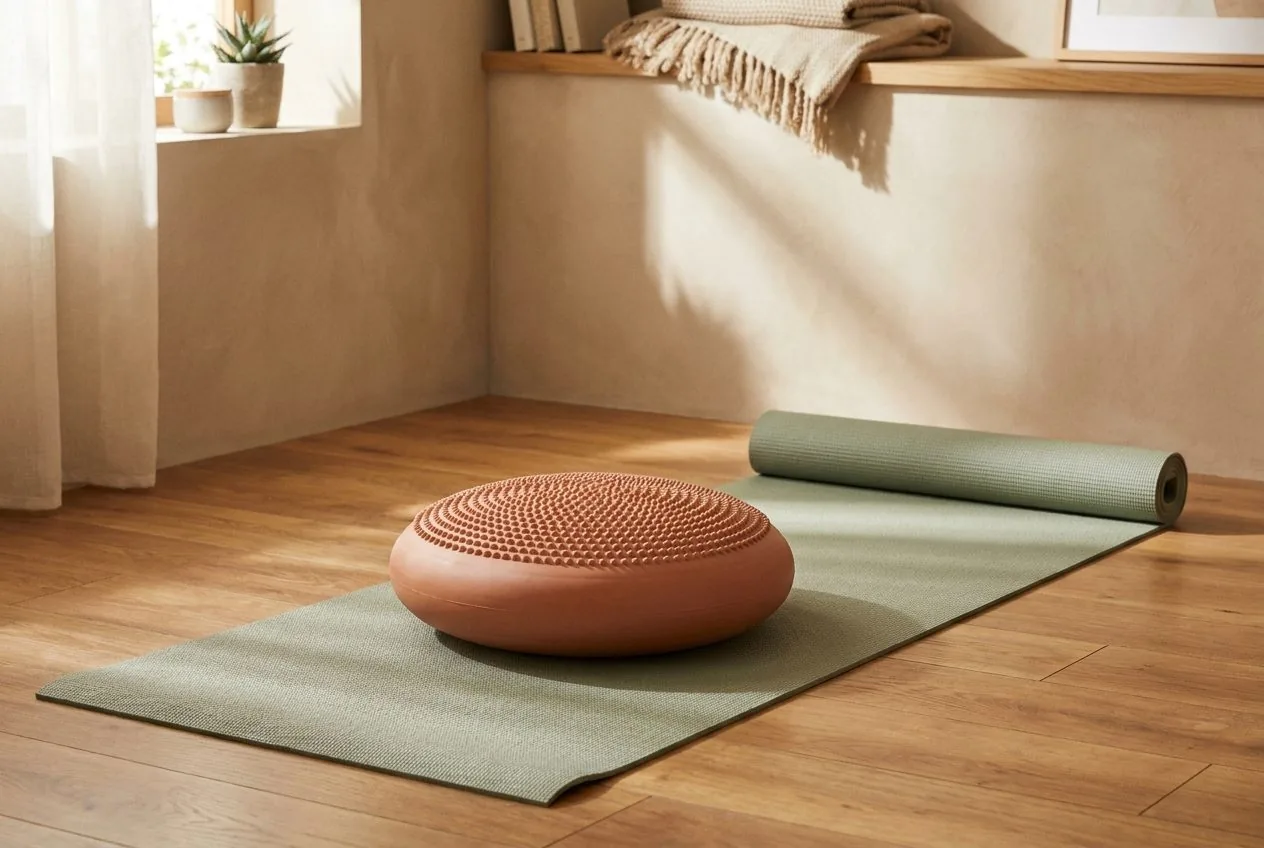
If you have noticed yourself reaching for the wall a little more often, or you simply want to feel more sure on your feet, a balance trainer is one of the gentlest tools for the job. It is the domed, cushioned platform you have probably seen in physical-therapy clinics and gym corners: you stand, kneel, or step on it, it wobbles, and your body quietly learns to keep you steady. This is a clear-eyed buyer’s guide to choosing one after 40: what actually matters, a top pick by spec rather than hype, and an honest word on who can happily skip it.
This is a category review based on the features that matter for a midlife body, not a lab test of one branded model. Balance trainers are a crowded market and prices move constantly, so we focus on the specs that stay true no matter what is in stock this month.
Our pick: a medium-firm, adjustable dome on a stable, non-slip base, sized to your height. 8/10. For women over 40, the best balance trainer is not the wobbliest or the cheapest, but the one that feels secure enough to use often, with a firmness you can dial to your confidence. Steady progress beats an alarming wobble every time.
This article is for information only and is not medical advice. Talk to your healthcare provider before starting a new exercise routine, especially if you have joint injuries, a history of falls, dizziness, or any balance concerns.
Who this is for
You do not need to be frail or unsteady to benefit from one. This guide is for the woman who wants to keep her balance sharp rather than wait for it to fade, who likes the idea of a low-effort habit she can do beside the kitchen counter, and who would happily spend a few gentle minutes a week feeling steadier on her feet. A balance trainer suits that person beautifully, because it asks almost nothing of your schedule and trains something genuinely worth protecting. If you already feel rock-steady and get plenty of varied movement, you may not need to add one at all.
Why a balance trainer suits an over-40 routine
The appeal is that it trains steadiness directly, which few other tools do. Three things make one a sensible fit for this reader.
It targets the right muscles. Standing or kneeling on an unstable surface asks the small stabilizers around your ankles, hips, and trunk to work constantly, which is exactly how you nudge balance to improve. Walking and strength work help indirectly; the balance trainer trains the skill head-on. If you would like to work the trunk piece on solid ground first, our standing core moves for a steadier middle trains the same stabilizers without the wobble.
It is gentle and low-impact. There is no jumping, no pounding, and no heavy load. You control every movement, and the cushioned surface is kind to knees and hips. Used low and supported, it is one of the gentlest ways to challenge your body.
It lowers the bar to practicing. Balance improves with regular practice, and the National Institute on Aging suggests about three balance sessions a week (NIA); a trainer left by a counter invites a couple of minutes while the kettle boils. That kind of effortless, tucked-into-the-day habit is the sort that actually lasts.
The honest limit: a balance trainer trains steadiness; it does not build much strength or do the deeper work of conditioning. For most women that is fine, as long as you know it is a practice tool rather than a whole workout. If you want to see how it stacks up against a gentle strength option, our pilates ring vs balance trainer comparison weighs the two side by side.
How we judged them
Five things separate a balance trainer you will use weekly from one that ends up in a cupboard:
- How stable is the base? The dome should wobble; the base should not. A firm, non-slip base that stays put on your floor is what makes the whole thing feel safe enough to keep using.
- Can you adjust the firmness? An inflatable model you can firm up or soften lets you start easy and progress as your confidence grows, which beats being stuck with one fixed wobble.
- Is it the right size? Too small and it feels precarious; too large and it is awkward to store. A dome sized sensibly to your height and foot gives you room to stand with confidence.
- Is the surface grippy? A textured, non-slip top keeps bare or socked feet secure. A slick surface is the last thing you want under an unstable dome.
- Is it easy to store and move? One you can tuck into a corner or slide against a wall is one you will keep out and use, rather than pack away and forget.
We weighed base stability and adjustable firmness most heavily, because those two features decide whether a cautious midlife beginner feels safe enough to keep practicing or gives up after one nervous try.
The specs that actually matter
| Feature | What to look for | Why it matters after 40 |
|---|---|---|
| Base | Firm, wide, non-slip, stays put | The dome wobbles so the base must not |
| Firmness | Adjustable, medium to start | Start easy, progress as confidence grows |
| Size | Matched to your height and foot | Room to stand securely, not precariously |
| Surface | Textured, non-slip top | Keeps feet secure on an unstable dome |
| Weight rating | Comfortably above your weight | Confidence that it will hold steady |
| Storage | Tucks into a corner easily | Kept out means actually used |
All prices are approximate as of mid-2026 and move constantly; name-brand BOSU home trainers list at roughly $130 to $190 (BOSU), and the NexGen Home model is rated to 300 lb (BOSU), so check current pricing and weight ratings before you buy.
Our top pick, by spec
For most women over 40, the trainer to look for is a medium-firm, adjustable-air dome on a wide, non-slip base, sized to your height, priced in the sensible middle rather than the bargain bottom. Here is why that profile wins.
The adjustable firmness is the quiet hero. Starting firm makes the dome feel secure enough that a nervous beginner will actually stand on it, and letting a little air out later, as your steadiness grows, keeps the challenge just right without buying a second tool. The wide, non-slip base is what makes it safe to use at all, since a base that skates across the floor turns a good idea into a hazard. And a textured top keeps your feet planted whether you are barefoot or in socks.
You do not need the softest, wobbliest model on the shelf, and you should not start there. Set it up beside a sturdy chair or counter, stand on it with both feet, and simply find your steadiness before you try anything more. Progress to slow weight shifts and supported movements only as your confidence builds, and treat a wobble as a signal to hold on, not to push through. If you want another gentle way to train steadiness, our standing kettlebell moves for balance covers moves you can do on solid ground, as do our no-equipment gentle standing strength moves.
Pros and cons
| Pros | Cons |
|---|---|
| Trains steadiness directly and gently | A practice tool, not a treatment or cure |
| Adjustable firmness grows with you | Instability means it needs careful setup |
| Low-impact and kind to joints | Not for anyone who feels genuinely unsafe on it |
| Compact and easy to store | Cheap models can have unstable, sliding bases |
| Invites short, frequent practice | Builds little strength on its own |
Honest criticisms
No product category is perfect, and pretending otherwise helps no one.
The cheap ones can be genuinely unsafe. The lowest-priced trainers sometimes pair a wobbly dome with a base that slides on hard floors, which is the opposite of what you want under an unstable surface. If your budget only reaches the very bottom, check that the base is wide and non-slip before anything else.
It asks for respect. A balance trainer is unstable by design, so it needs thoughtful setup: support within reach, a slow start, and gradual progression. Used carelessly, standing tall with nothing to hold, it is a fall risk. That is not a reason to avoid it, but it is a reason to set it up properly every single time.
It does not replace the basics. Training on a dome helps your steadiness, but regular walking, some gentle strength work, and enough protein are what genuinely keep you strong and mobile. Treat the trainer as one useful piece, not the whole plan.
Who should buy, and who should skip
Buy if you want to keep your balance sharp, you like the idea of a gentle habit you can do beside the counter, and you will use a few supported minutes a couple of times a week. This tool serves that reader well.
Skip if you already feel completely steady and get plenty of varied movement, if you have nowhere safe to set up with support nearby, or if unsteadiness is new or worsening and you have not yet spoken to your provider. Balance changes can have causes worth checking, and a clinician who knows your history beats any dome, ours included.
What we will not promise
A balance trainer will not prevent falls on its own, fix a medical cause of unsteadiness, or guarantee anything, and no honest guide should pretend otherwise. What gentle, regular, sensible practice genuinely tends to support is steadier feet, more confident everyday movement, and stabilizing muscles that stay switched on. Results depend on using it often, using it safely, and pairing it with the fundamentals of walking, light strength work, and enough protein. Buy it for the steadiness it helps you practice, and let the basics do the deeper work.
The honest bottom line
For women over 40, the best balance trainer is not the wobbliest or the cheapest; it is a medium-firm, adjustable dome on a wide, non-slip base, sized to your height. That profile feels secure enough to keep using, grows with your confidence, and gives you an easy, low-impact way to train the steadiness that quietly matters more each year. Set it up beside a chair or counter, start with both feet and slow movements, and build up gently over the weeks.
If you are weighing it against a gentle strength tool instead, our pilates ring vs balance trainer comparison lays out which fits which goal, our verdict on whether a pilates ring is worth it for core strength answers the ring side honestly, and the rest of our gentle strength section gives you joint-friendly routines to build on.
Frequently Asked Questions
- What is a balance trainer and how does it help after 40?
- A balance trainer is a domed, cushioned platform, often a rubber half-ball on a firm base, that gives you a gently unstable surface to stand, kneel, or step on. Because it wobbles, the small stabilizing muscles around your ankles, hips, and trunk have to keep switching on to hold you steady. That is exactly the kind of gentle challenge that tends to support better balance over time. After 40, when steadiness quietly becomes more worth tending, a few short, supported sessions a week are a simple way to train the muscles that keep you sure on your feet; the National Institute on Aging lists wobble-board work among balance exercises, which help prevent falls.
- Are balance trainers safe for women over 40?
- They can be, with sensible setup and a slow start, but they deserve respect because instability is the whole point. Always set one up beside a wall, a sturdy chair, or a kitchen counter so you have something to hold, as the National Institute on Aging advises for balance work, keep both feet on it and stay low to begin with, and progress only as your steadiness grows. Avoid it entirely if you feel genuinely unsafe standing on an unstable surface. And if unsteadiness is new or getting worse, see your provider first, since balance changes can have causes worth checking before you train them.
- How firm should a balance trainer be?
- Firmer domes feel more stable and are friendlier for a nervous beginner, while softer, squishier ones wobble more and ask more of your stabilizers. For most women over 40 starting out, a medium firmness is the sweet spot: unstable enough to be worth using, forgiving enough not to feel alarming. Many inflatable models let you adjust the firmness by adding or releasing air, which is genuinely useful, because you can start firm and easy, then let a little air out as your confidence grows. Adjustability beats guessing the perfect firmness up front.
- How often should I use a balance trainer?
- A few short sessions a week is a sensible start; the National Institute on Aging suggests aiming for about three sessions of balance exercises a week. Two or three sessions of five to ten minutes, always with support nearby, are easier to keep up than one exhausting session. Treat it like a habit you slot into the day, a couple of minutes while the kettle boils, rather than a workout you have to schedule. Keep every move slow and controlled, and stop the moment anything feels genuinely unsteady rather than pleasantly challenging.
- Can a balance trainer really improve my balance, or is it a gimmick?
- Used regularly and sensibly, training on an unstable surface tends to support steadier, more confident movement, because you are asking the exact muscles that keep you upright to work more often. Be clear-eyed about the limits, though: it is a practice tool, not a treatment, and it will not fix a medical cause of unsteadiness or guarantee anything on its own. Think of it as one gentle way to keep your stabilizers active, paired with regular walking and a little strength work, rather than a cure for balance problems in a box.
Sources & references
Before you go
The 7-Day Protein-First Meal Plan for Women Over 40
A complete protein-first week, finished for you: your personal protein target, a one-page shopping list, 21 recipes at 25-35 g protein each, and a timed 90-minute prep schedule. Printable PDF, paired with a free 7-lesson email course.
Free guide
The 7-Day Protein-First Meal Plan for Women Over 40
A complete protein-first week, finished for you: your personal protein target, a one-page shopping list, 21 recipes at 25-35 g protein each, and a timed 90-minute prep schedule. Printable PDF, paired with a free 7-lesson email course.