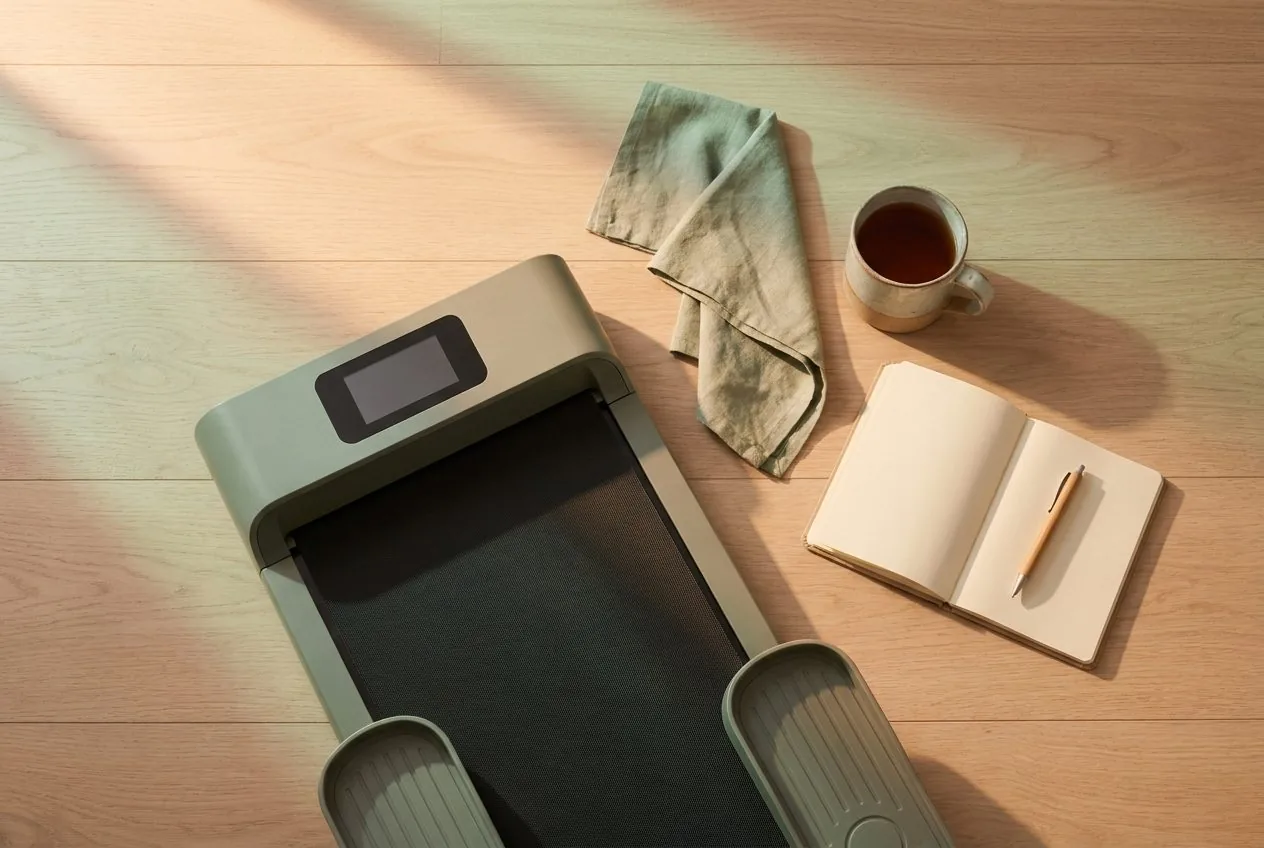
Here’s a concept worth knowing before you look at specs: NEAT, or non-exercise activity thermogenesis, is the energy your body uses for everything that isn’t sleeping, eating, or sports-like exercise, like pacing on a call, tidying the kitchen, or stepping instead of sitting (Proceedings of the Nutrition Society). It’s one of the quiet reasons that small, repeatable movement stacked through the day is worth taking seriously. It’s also part of the appeal of compact home cardio: a small deskside machine costs less and takes far less room than a full-size treadmill. That gap in price and space is exactly why so many busy homes are comparing small, deskside machines instead of clearing a room for treadmill-sized equipment.
The two machines in this comparison are built very differently. The UREVO Strol 2E is a folding walking pad that runs from 0.6 to 4.0 mph with its handrail folded down, or up to 6.2 mph with the handrail raised, and it supports up to 265 pounds (UREVO). A compact under-desk elliptical is far smaller: the one tested in a published feasibility study needed only 12 by 20 inches of floor space, ran quietly, and needed no electrical outlet (Journal of Science and Medicine in Sport).
Short answer for skimmers: if you have a little floor space and want the most natural, slightly more active movement, especially paired with a standing desk, choose a walking pad. If your space is tight, your budget is smaller, or you sit for focused work and want the most effortless movement possible, choose an under-desk elliptical. Neither is a weight-loss device; both are simple ways to remove the friction that keeps movement from happening.
This article is for information only and is not medical advice. Talk to your healthcare provider before starting a new exercise routine, especially if you have joint injuries, heart conditions, or dizziness.
The quick comparison
| Feature | Walking pad | Under-desk elliptical |
|---|---|---|
| Price band | Higher | Lower |
| How you use it | Standing, walking | Seated, hands free |
| Motion | Natural walking, familiar | Smooth circular stride, no impact |
| Effort | Moderate; easy to sustain longer | Light by nature; very gentle |
| Footprint | Slim but needs floor space to use | Tiny; lives under a desk |
| Best paired with | A standing desk, calls, a show | Seated, focused work |
All prices are approximate as of mid-2026 and move constantly, so check current pricing before you buy.
Which should you pick? A quick decision framework
“I have a standing desk, or room to walk.” Walking pad. Sliding one under a standing desk turns calls and email into gentle steps, and walking is a motion your body already knows, so there is no learning curve and nothing to talk yourself into.
“I sit for focused work and want to move without stopping.” Under-desk elliptical, easily. You use it seated with your hands free, so it strides along under your desk through deep-focus hours without asking you to stand up or break concentration.
“My space or budget is tight.” Under-desk elliptical. It is smaller and cheaper, tucks under a desk, and still adds real movement. For a small home or a first, low-commitment try, it is hard to argue with.
“I want the gentlest possible motion for my knees.” Under-desk elliptical, in most cases. The seated, no-impact stride takes weight off the joints, which tends to feel softer than a standing walk for sensitive knees. A walking pad is still gentle, so if you prefer walking, start slow and short.
“I want slightly more movement I can sustain for longer.” Walking pad. Standing and walking is more active than seated pedaling and easier to keep up for a longer stretch, so it edges ahead when you want a bit more from your time.
The over-40 lens: comfort and consistency
The two machines also ask different amounts of you. In that study, 32 inactive adults aged 25 to 65 burned a median of about 179 calories an hour on a compact elliptical, roughly 88 more than sitting still (Journal of Science and Medicine in Sport). A walking pad keeps you standing and walking instead, at whatever slow pace you choose; the Strol 2E starts at 0.6 mph (UREVO).
On the joints. Both are low-impact, with none of the pounding of running. The under-desk elliptical tends to feel the gentler of the two, because the seated, circular motion keeps weight off the knees and hips. A walking pad is still easy on the body, and a cushioned deck softens each step, but it is a standing, weight-bearing motion. If your knees are sensitive, that difference is worth weighing, and either way you start slow.
On sustainability. The best machine is the one that lowers the bar the most for you specifically. For someone with a standing desk and a little floor space, that is often a walking pad, because stepping onto it takes no willpower and it pairs with things they already do. For someone in a small space who sits for focused work, it is an under-desk elliptical they never have to stand up for. Be honest about your room and your habits, because the machine you will actually reach for beats the one that looks better on paper.
On what it can and cannot do. Neither machine covers strength: adults also need muscle-strengthening activity at least 2 days a week (HHS), which is why gentle movement lands best inside the broader habits in our metabolism after 40 section. What both do well is cut into sitting time, and the first key guideline for adults is to move more and sit less (HHS).
If a walking pad is where you are leaning, our full guide to the best walking pad for women over 40 covers what to look for. If the elliptical has your attention, our review of the best under-desk elliptical for women over 40 does the same for that side, and our guide to using an under-desk elliptical well covers the setup details that make it stick.
A realistic first two weeks with either
Short sessions count on either machine. The current federal guidelines dropped the old rule that only bouts of 10 minutes or more count toward weekly activity (HHS), so a few easy minutes is a real start.
- Days 1 to 3. Start at the bottom of the range: the Strol 2E’s slowest speed is 0.6 mph (UREVO), and the elliptical belongs at its lightest resistance. Pair each session with something you already do; in the elliptical study, participants were most interested in pedaling while watching TV or working at a computer, and least interested during office meetings (Journal of Science and Medicine in Sport).
- Days 4 to 7. Use the talk test to keep the effort in range: at moderate intensity you can talk but not sing (CDC). If you cannot hold a conversation, slow the belt or ease off the pedals.
- Week 2. Once it feels automatic to start, let sessions grow naturally. A little more time, a slightly firmer pace on the walking pad, or a touch more resistance on the elliptical. Add only what still feels comfortable.
Plan where each machine lives between sessions. The Strol 2E weighs about 47 pounds, has built-in wheels, and its handrail folds down (UREVO), so it can roll out of the way after use, while a compact elliptical with a 12 by 20 inch footprint can stay under the desk (Journal of Science and Medicine in Sport).
Both are tools, not magic
Neither machine covers the full weekly picture on its own. Federal guidelines call for 150 to 300 minutes of moderate aerobic activity a week plus muscle-strengthening on at least 2 days (HHS). A walking pad or an under-desk elliptical can chip away at the aerobic side during hours you would otherwise sit through; the strength side still needs its own time.
The honest bottom line
For most busy women over 40, the walking pad is the more natural, slightly more active choice, especially if you have a standing desk or a little floor space to spare. It costs more and needs room, but the standing walk is easy to sustain and easy to love. If you land on that side and get down to models, our UREVO Strol 2E vs PACEROCKER face-off compares two popular pads head to head. The under-desk elliptical wins when space or budget is the deciding factor, when you sit for focused work, or when your knees want the gentlest possible motion, and it is a genuinely useful, low-commitment way to add movement to a sitting day.
Before you buy, check the specs that decide fit: the Strol 2E lists a 265-pound maximum user weight and a 40.2 by 15 inch belt (UREVO), while the compact elliptical in the study above took up just 12 by 20 inches (Journal of Science and Medicine in Sport). Prices for both move often, so compare current listings before you order.
Frequently Asked Questions
- Is a walking pad or an under-desk elliptical better for women over 40?
- Neither is simply better; they fit different homes and habits. A walking pad gives you a natural, standing walk and a bit more movement, but it needs floor space and costs more. An under-desk elliptical is smaller, cheaper, and used seated, so it is the more effortless option for a desk-bound day. Match the machine to whether you have room to walk and want more movement, or want the tiniest, easiest way to move while you sit.
- Which is easier on the knees, a walking pad or an under-desk elliptical?
- Both are low-impact and gentle. An under-desk elliptical takes weight off the joints because you use it seated, with a smooth circular motion and no impact, which many find very kind to sensitive knees. A walking pad is also gentle, and a cushioned deck helps, but it is a standing, weight-bearing motion. If your knees are the main concern, the seated elliptical is often the softer start; either way, begin slow and short.
- Which gives you more of a workout?
- A walking pad, generally, because you are standing and walking, which is more active than seated pedaling and easier to sustain for longer. An under-desk elliptical is lighter by design, since it is meant for easy movement while you work. If you want your heart rate to climb a bit more, the walking pad has the edge; if you want the most effortless movement through a sitting day, the elliptical wins.
- Which is better for a small home?
- An under-desk elliptical is the smaller of the two and lives neatly under a desk, so it suits the tightest spaces. A walking pad is slim but still needs floor space to use and somewhere to slide it away between sessions. If square footage is your tightest constraint, the elliptical fits more easily. If you have room to leave a slim pad out or under a desk, its more natural movement may be worth the space.
- Can I use either one while working?
- Yes, and that is part of the appeal of both. An under-desk elliptical is ideal for seated, focused work because your hands stay free and you never stand up. A walking pad pairs best with a standing desk and the parts of your day that do not need deep concentration, like calls and email. Both let you stack movement onto work you already do, which is the real point; match the motion to the task.
Sources & references
- Proceedings of the Nutrition Society, Non-exercise activity thermogenesis (opens in new tab)
- UREVO, Strol 2E vs CyberPad (opens in new tab)
- Journal of Science and Medicine in Sport, Compact elliptical device during sedentary activities (opens in new tab)
- U.S. Department of Health and Human Services, Physical Activity Guidelines: Top 10 Things to Know (opens in new tab)
- CDC, How to Measure Physical Activity Intensity (opens in new tab)
Before you go
The 7-Day Protein-First Meal Plan for Women Over 40
A complete protein-first week, finished for you: your personal protein target, a one-page shopping list, 21 recipes at 25-35 g protein each, and a timed 90-minute prep schedule. Printable PDF, paired with a free 7-lesson email course.
Free guide
The 7-Day Protein-First Meal Plan for Women Over 40
A complete protein-first week, finished for you: your personal protein target, a one-page shopping list, 21 recipes at 25-35 g protein each, and a timed 90-minute prep schedule. Printable PDF, paired with a free 7-lesson email course.