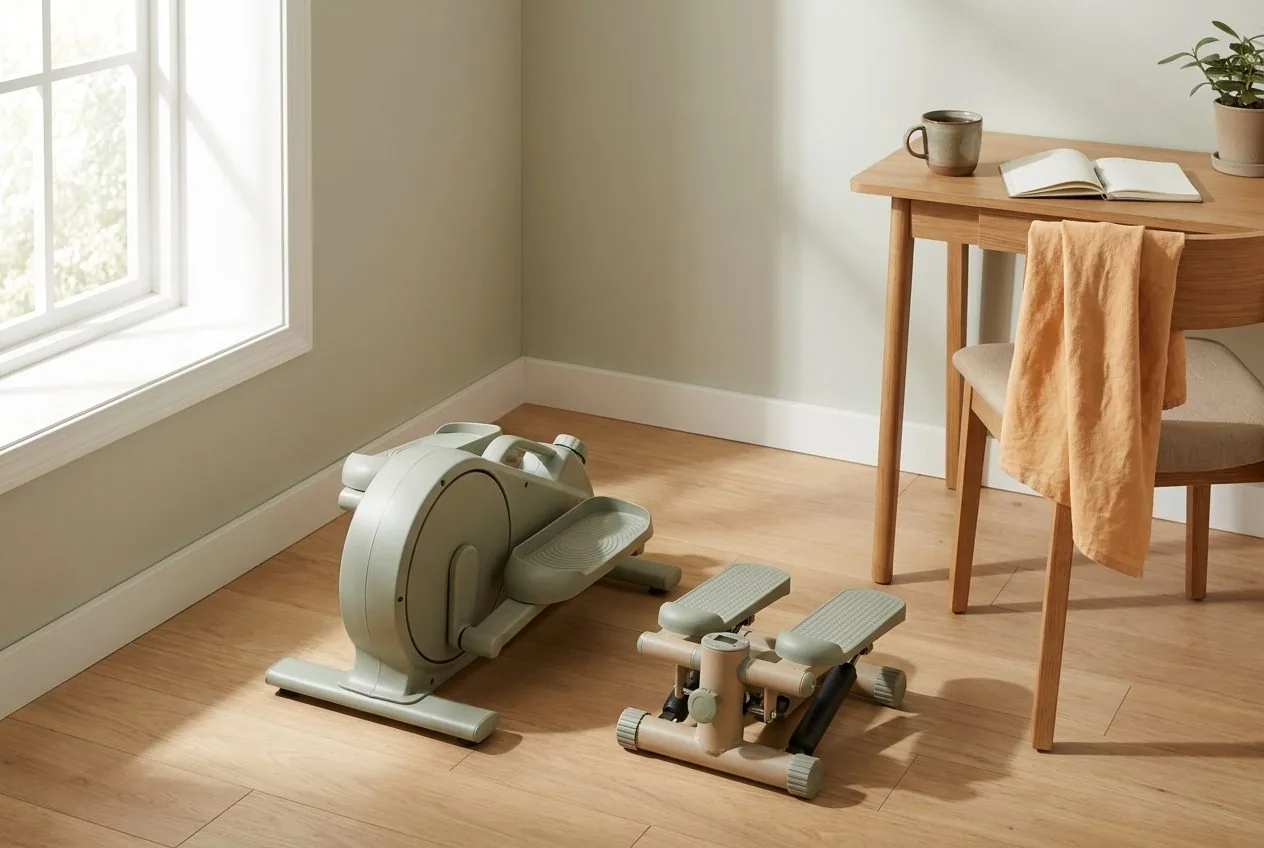
When you want to move more at home but a full workout feels like too much to summon, a small piece of cardio gear can quietly change the math. Two of the tiniest, cheapest options are the under-desk elliptical and the mini stepper. Both are low-impact, both fit into a normal home, and both turn sitting or standing time into gentle movement, so the choice comes down to how you want to move and what your knees prefer.
Short answer for skimmers: if you sit for work and want effortless movement with your hands free, choose an under-desk elliptical. If you want a quick standing burst of effort in front of the TV and something that stores completely out of sight, choose a mini stepper. Neither is a weight-loss device; both are simple ways to remove the friction that keeps movement from happening.
This article is for information only and is not medical advice. Talk to your healthcare provider before starting a new exercise routine, especially if you have joint injuries, heart conditions, or dizziness.
The quick comparison
| Feature | Under-desk elliptical | Mini stepper |
|---|---|---|
| Price band | Lower | Lowest |
| How you use it | Seated, hands free | Standing, needs balance |
| Motion | Smooth circular stride, no impact | Stepping; asks more of the knees |
| Effort | Light by nature; easy to sustain | Higher per minute; short bursts |
| Footprint | Lives under a desk | Tucks into a closet or under a bed |
| Best paired with | Calls, emails, a workday | A favorite show, quick bursts |
Prices move constantly, so check current pricing before you buy.
Which should you pick? A quick decision framework
“I sit for work and want to move without stopping.” Under-desk elliptical, easily. You use it seated with your hands free, so it strides along on calls and emails without asking you to pause what you are doing. That is the most painless way to add movement to a desk-bound day.
“I want the gentlest possible motion for my knees.” Under-desk elliptical. The smooth, seated, circular stride has no impact and keeps load off the joints, which tends to feel kinder than the standing, bent-knee motion of a stepper. If sensitive knees are your main concern, start here.
“I want a quick burst of real effort, not all-day drifting.” Mini stepper. Because you stand and lift your body weight with each step, effort climbs fast, so even a few minutes feels like something. Just be honest that stepping is harder to sustain, so plan for short sessions rather than long ones.
“I need it to vanish completely when I am done.” Mini stepper. It is a fraction of the size, tucks under a bed or into a closet, and weighs almost nothing, which makes it the obvious pick when storage is your tightest constraint.
“I want the quietest option for calls and shared walls.” Under-desk elliptical, usually. A magnetic model runs at a soft whir you can use on a call without anyone noticing, and seated pedaling makes no floor noise. A mini stepper is generally quiet too, but the standing motion and the occasional creak make it a little more noticeable, so check owner feedback on noise before you buy if walls are thin.
The over-40 lens: comfort and consistency
The two machines differ most in how they fit your day. Seated under-desk pedaling is light-intensity activity, and in one randomized lab study adherence to it stayed above 95% while participants typed, read, reasoned, and took phone calls (Medicine & Science in Sports & Exercise). A stepper asks you to stop and stand, so it suits planned short bursts rather than work hours.
On the joints. Both are low-impact, with none of the pounding of running. The under-desk elliptical tends to feel the gentler of the two, because the seated, circular motion takes weight off the knees and hips. A mini stepper is still easy in the sense that there is no jarring, but standing and stepping asks more of the knees and your balance, so it can feel like more work. If your joints are a concern, that difference is worth weighing, and either way you start slow and short.
On sustainability. The best machine is the one that lowers the bar the most for you specifically. For many women who sit all day, that is an under-desk elliptical, because moving takes no willpower when your feet are already on the pedals. For others, it is a stepper they can pull out for five focused minutes during a show. Be honest about how you actually spend your day, because the machine you will reach for beats the one that looks more impressive.
On what it can and cannot do. Neither device is a treatment or a weight-loss machine. Their real job is cutting into sitting time: the ACSM notes health benefits from reducing total sedentary time and from breaking it up with frequent, short bouts of standing and activity (ACSM). An under-desk elliptical does that while you stay seated; a stepper does it by getting you on your feet. Muscle matters just as much in the background, which is why we always pair cardio with a little strength work, and why gentle movement lands best inside the broader habits in our metabolism after 40 section.
If the elliptical is where you are leaning, our full guide to the best under-desk elliptical for women over 40 covers the specs that matter, and our roundup of gentle cardio steps for a busy day shows how to slot either machine into a packed schedule.
A realistic first two weeks with either
Two weeks is only the start: in habit research, a daily behavior took around 66 days on average to feel automatic, with considerable variation between people (British Journal of General Practice). Treat the first fortnight with either machine as a gentle trial, and start smaller than feels necessary.
- Days 1 to 3. Use it for just 5 to 10 easy minutes, stacked onto something you already do: gentle pedaling on the elliptical during a call, a few minutes on the stepper during a show. Keep the effort light enough to talk comfortably.
- Days 4 to 7. On the elliptical, keep the resistance low: in the same lab study, participants rated a lighter 17-watt pedaling rate more comfortable than 25 watts, and their work performance held steady at both (Medicine & Science in Sports & Exercise). On the stepper, stretch one session by a few minutes rather than adding speed.
- Week 2. Once stepping on feels automatic, let sessions grow naturally. A little more time on the elliptical, or a slightly firmer pace on the stepper. Add only what still feels comfortable.
Habits form when an action is repeated in the same context, after the same cue, and simpler actions become habitual faster (British Journal of General Practice). For an under-desk elliptical, that cue can be your first call of the day; for a mini stepper, one evening show. Keep the routine on either machine small and tied to that cue.
Both are tools, not magic
Here is the honest part. Seated under-desk pedaling counts as light-intensity activity (Medicine & Science in Sports & Exercise), so an elliptical adds gentle movement to sitting time rather than a workout. Neither machine covers the two days a week of muscle-strengthening activity adults are advised to do (CDC). Go in expecting a gentle, repeatable habit rather than a transformation.
The honest bottom line
For most busy women over 40, the under-desk elliptical is the more comfortable, more effortless choice, especially if you sit for work and want to move without pausing. It is quiet, seated, and gentle on the knees, which is what makes it easy to keep using. The mini stepper wins when you want a short burst of real effort or need something that stores completely out of sight, and it is a genuinely useful, low-commitment way to add standing movement.
Pick the elliptical if your movement has to happen at your desk and the stepper if it can happen in short standing bursts. Adults who sit less and do any amount of moderate activity gain some health benefits (CDC), so either machine is a reasonable start alongside a little strength work.
Frequently Asked Questions
- Is an under-desk elliptical or a mini stepper better for women over 40?
- Neither is simply better; they suit different bodies and habits. An under-desk elliptical is used seated, so it is the gentler, more effortless option and pairs with desk work. A mini stepper is used standing and asks more of your legs and balance, so it feels like more of a workout in short bursts. If you want easy movement while you sit, choose the elliptical. If you want a quick standing effort in front of the TV, choose the stepper.
- Which is easier on the knees, an under-desk elliptical or a mini stepper?
- For most people the under-desk elliptical feels gentler, because the smooth circular motion has no impact and you are seated, which takes load off the joints. A mini stepper is still low-impact, with no pounding, but the standing, bent-knee stepping motion asks more of the knees and can feel like more work. If your knees are sensitive, start with the elliptical, keep the effort light, and check with your provider first.
- Do mini steppers give you a better workout than under-desk ellipticals?
- In terms of effort per minute, usually yes, because you stand and lift your own body weight with each step, so your heart rate climbs faster. The trade-off is that stepping is harder to sustain and takes more attention, so sessions tend to be short. An under-desk elliptical is easier and quieter but lighter in intensity. Match the tool to whether you want gentle all-day movement or a short, focused burst.
- Which is better for a small space?
- Both are small, but the mini stepper usually wins on pure storage, since it tucks under a bed or into a closet and weighs very little. An under-desk elliptical is compact too but is designed to live under a desk where you can reach it with your feet. If you want something that disappears completely between uses, the stepper is smaller. If you want something always ready under your desk, the elliptical fits that better.
- Can I use either one while working or watching TV?
- An under-desk elliptical is ideal for working, because you use it seated with your hands free, so it rides along on calls and emails. A mini stepper needs you standing and paying a little more attention, which suits a show more than focused work. Both let you stack movement onto something you already do, which is the real point; just match the motion to the moment.
Sources & references
Before you go
The 7-Day Protein-First Meal Plan for Women Over 40
A complete protein-first week, finished for you: your personal protein target, a one-page shopping list, 21 recipes at 25-35 g protein each, and a timed 90-minute prep schedule. Printable PDF, paired with a free 7-lesson email course.
Free guide
The 7-Day Protein-First Meal Plan for Women Over 40
A complete protein-first week, finished for you: your personal protein target, a one-page shopping list, 21 recipes at 25-35 g protein each, and a timed 90-minute prep schedule. Printable PDF, paired with a free 7-lesson email course.