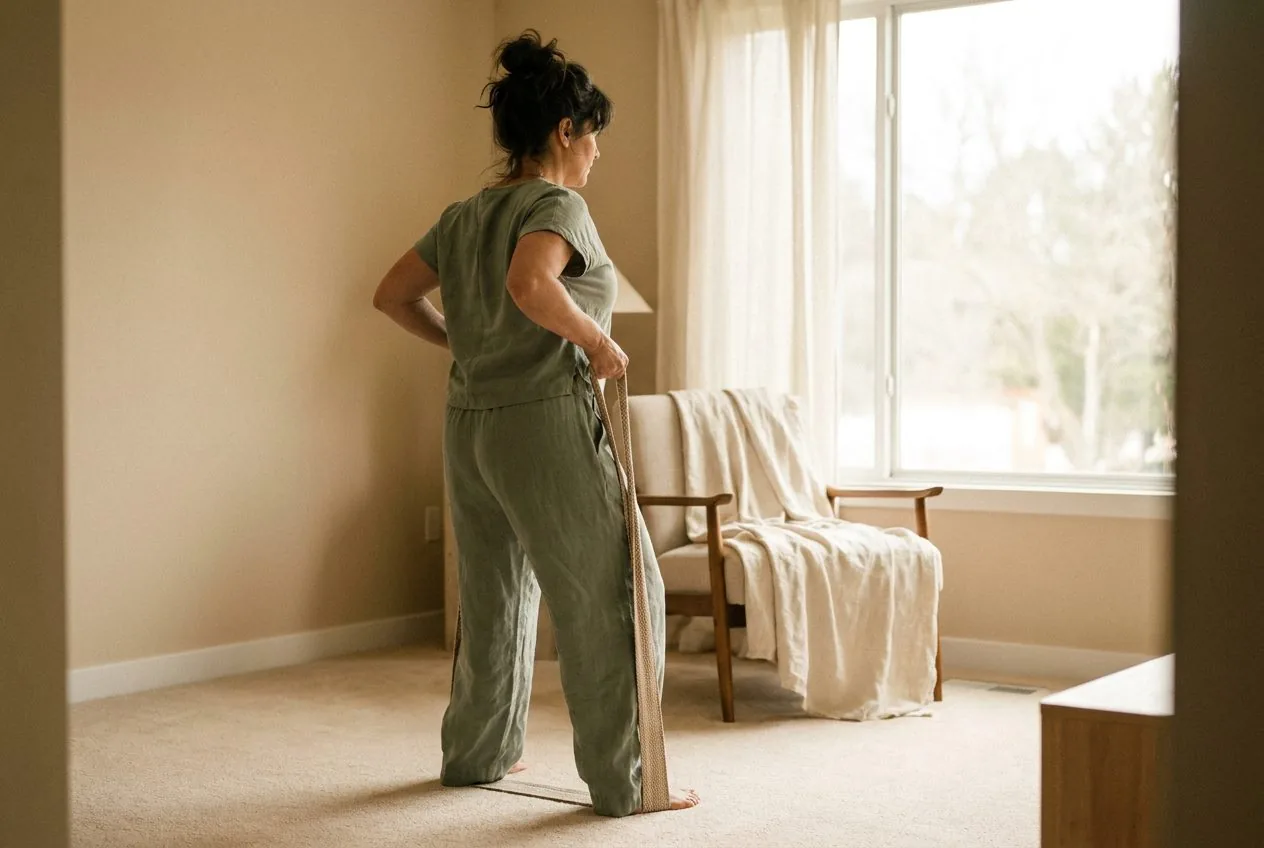
Some of the most useful strength you can own is the kind you use standing up, and the good news is that you can train nearly all of it on your feet, anywhere, with little or no equipment. No floor to get down to, no gym to travel to, no waiting for gear to arrive. A hotel room, a kitchen, a corner of the bedroom, all of them work. The moves below load your legs, hips, back, and shoulders in the patterns daily life actually asks of you, which is exactly what keeps stairs, shopping bags, and reaching for a high shelf feeling easy after 40. You can do every one with just your body, and add a light resistance band whenever you want a little more.
Below are six gentle standing strength moves you can do almost anywhere. Do them slowly, keep a counter or sturdy chair within reach for balance, and treat any wobble or strain as a signal to lighten up, not to push on.
This article is for information only and is not medical advice. Talk to your healthcare provider before starting a new exercise routine, especially if you have joint injuries, heart conditions, or dizziness.
The simple idea behind all six
Strength improves when your muscles are asked to work against a load in a controlled way and then given time to recover between sessions (NIA). Standing moves supply that load through your own body weight and, if you like, a light band, without any impact or speed. Two principles run through every move here: keep the pace slow enough that your muscle does the work instead of momentum, and keep support nearby for anything that challenges your balance. Control first, load second, always. When a move gets easy, slow it down further or loop in a band before you chase more repetitions.
The 6 moves
Start with your body weight alone. Aim for around 8 to 12 slow repetitions of each, or a short hold where noted, and rest as needed. Keep a counter or sturdy chair within reach.
1. Sit-to-stand squat
Why it helps: builds the leg and hip strength behind every stair, chair, and getting-up. Stand in front of a sturdy chair, push your hips back, and lower slowly until you lightly touch the seat, then stand tall through your whole foot. Keep your knees tracking over your toes and your chest up. Use the chair as a depth target, and only lower as far as stays comfortable.
2. Wall push-up
Why it helps: trains the chest, shoulders, and arms gently, with no strain on the wrists or floor. Face a wall with hands a little wider than your shoulders, bend your elbows to bring your chest toward the wall, and press slowly back to the start. Keep your body in one gentle line from head to heels. The further your feet are from the wall, the more work it becomes.
3. Standing band pull-apart
Why it helps: wakes up the upper back and supports the posture that tends to slump after 40. Hold a light band in front of you at chest height with straight arms, then draw your hands slowly apart, squeezing your shoulder blades together, and return with control. No band handy? Do the same motion with a firm squeeze of the shoulder blades to switch on the same muscles.
4. Standing hip hinge
Why it helps: teaches the safe bending pattern that protects your back every day. Stand tall, soften your knees, and push your hips back to lower your chest toward the floor with a flat back, feeling a gentle stretch behind your thighs, then squeeze your glutes to stand tall again. Keep the movement in your hips, not your lower back. Loop a band under your feet and hold the ends to add gentle load.
5. Standing calf raise
Why it helps: strengthens the lower legs and ankles that keep you steady on your feet. Hold a counter for balance, rise slowly onto the balls of both feet, pause at the top, and lower with control. Keep it smooth rather than bouncy. Once both feet feel easy, try shifting a little more weight onto one leg while keeping the other for light support.
6. Standing banded side steps
Why it helps: strengthens the side hips that steady every step and keep you sure on your feet. Loop a light band around your legs above the knees, soften into a small squat, and step slowly out to the side against the band, then bring the other foot in with control. Take a few steps each way. No band? Lift each leg slowly out to the side instead, holding a counter for balance.
Group them by where you are today
If you are new or feel unsteady: stick with the sit-to-stand, wall push-up, and calf raise for a couple of weeks, all with support nearby. They build the base of strength and control that makes everything else easier.
If you already move a bit: add the standing hip hinge and pull-apart for a fuller session that covers your back and posture too.
When those feel easy: bring in the banded side steps and start adding a light band to the hinge and pull-apart. There is no rush to progress, and keeping the band light is a strength, not a weakness. From there, our standing core moves for a steadier middle brings your midsection into the same stay-on-your-feet approach.
Warm up before you load up
Cold, stiff joints make everything feel harder and wobblier than it needs to, so give yourself a minute or two to loosen up before the first squat. A few slow marches, some gentle arm circles, a handful of easy weight shifts from foot to foot, and a couple of shallow, unloaded squats wake up the exact muscles you are about to ask to work. Warming up is not wasted time; it is the difference between a session that feels smooth and one that feels like a fight against a body that has not woken up yet.
Fit them into your week
Standing strength rewards consistency more than length, so short and often beats long and rare. You do not need a dedicated workout slot. Fold the whole set into a gentle 10 to 15 minute session two or three times a week, which meets the CDC’s advice to do muscle-strengthening activity on 2 or more days a week (CDC), and sprinkle the easiest moves, a set of calf raises while the kettle boils, a few sit-to-stands every time you get up from your desk, into odd moments through the day. Two or three minutes here and there adds up quickly, and that scattered approach is easier to keep up than one long session you have to schedule and dread. Keep every rep slow, keep support nearby, and let the frequency, not the intensity, do the work.
Common mistakes to sidestep
Rushing the reps. Speed lets momentum do the work your muscles should be doing, and it can add strain. Slow the lift, slow the lower even more, and an easy-looking move becomes a genuinely useful one.
Going too deep or too hard, too soon. A squat below what is comfortable or a band that is too stiff does not speed anything up; it just wrecks your form. Keep the range comfortable and the band light, and let both grow over weeks.
Ditching the support too soon. Keeping a hand near a counter is not cheating. It lets you challenge your strength and balance safely, which means you can keep practicing.
Holding your breath. Bracing your middle is good; freezing your breath is not. Keep breathing steadily through every rep so you stay relaxed and stable.
Want to add a band that lasts?
These moves work beautifully with just your body, but a good set of resistance bands is the natural next step when you want to keep progressing. If you are ready to add one, our best resistance bands for women over 40 review helps you pick a set that holds its tension and suits gentle work, and our bodyweight moves for gentle strength how-to gives you a no-equipment routine to pair with these standing moves. If core work is the main reason you want a band, our pilates ring vs resistance bands comparison weighs the two gentle props side by side. You will find more joint-friendly routines throughout our gentle strength section.
The honest bottom line
Standing strength moves will not transform your body on their own, and no honest guide should pretend otherwise. What consistent, gentle work with them genuinely tends to support is easier stairs, steadier standing, and the everyday strength that quietly protects you as the years add up. Keep the pace slow, keep support nearby, and practice them two or three times a week. Start with your body weight, earn the light band slowly, and pair the sessions with enough protein and a little walking. Then let steady, unglamorous practice do the real work.
Frequently Asked Questions
- Can I build strength with just standing moves after 40?
- Yes, especially for the everyday strength that matters most. Standing moves like squats, hinges, and presses train the exact patterns you use to stand up, carry, and reach, the everyday tasks the National Institute on Aging says strength work makes easier, and they load your legs, hips, back, and shoulders in the way daily life actually asks. Because you stay on your feet and in control, they are gentle on the joints and easy to keep slow. As they get easy, you make them harder by slowing them down, adding a pause, or looping a light resistance band into the mix. It is not the only way to train, but it is a genuinely effective one.
- Do I need resistance bands for these standing moves?
- No. Every move here works with nothing but your body, and you can build a real habit before buying anything. A light resistance band simply adds gentle, adjustable load to the pressing, pulling, and stepping moves once your bodyweight version feels easy, which is a handy way to keep progressing without weights; in a 2025 review of 25 trials, elastic band training improved leg strength and balance in older adults. If you decide to add one, a set with a few tension levels lets you nudge the challenge up in small steps. Start with no band, prove your form stays clean, and add light tension only when you want the next step up.
- How often should I do standing strength moves?
- Two or three short sessions a week is plenty for most people, with at least a day of rest between them so your muscles can recover and adapt; the National Institute on Aging advises not working the same muscle group on any two days in a row. Because these moves are gentle and need no setup, you can also sprinkle a few, a set of squats here, some calf raises there, into odd moments through the day. A gentle 10 to 15 minute session done consistently is easier to sustain than an occasional long, tiring one, so let frequency and recovery, not intensity, do the work.
- Are standing strength moves safe for sensitive knees?
- They often are, with a shallow range and slow, controlled movement, and standing work lets you limit how far you go. For the squat, use a chair as a target and only lower as far as stays comfortable, keep your knees tracking over your toes, and press through your whole foot. Favor the hinge and calf raise if squats bother you, and stop any move that causes sharp pain. If your knees are a real concern, keep the range small, start with no band, and check with your provider before progressing.
Sources & references
Before you go
The 7-Day Protein-First Meal Plan for Women Over 40
A complete protein-first week, finished for you: your personal protein target, a one-page shopping list, 21 recipes at 25-35 g protein each, and a timed 90-minute prep schedule. Printable PDF, paired with a free 7-lesson email course.
Free guide
The 7-Day Protein-First Meal Plan for Women Over 40
A complete protein-first week, finished for you: your personal protein target, a one-page shopping list, 21 recipes at 25-35 g protein each, and a timed 90-minute prep schedule. Printable PDF, paired with a free 7-lesson email course.