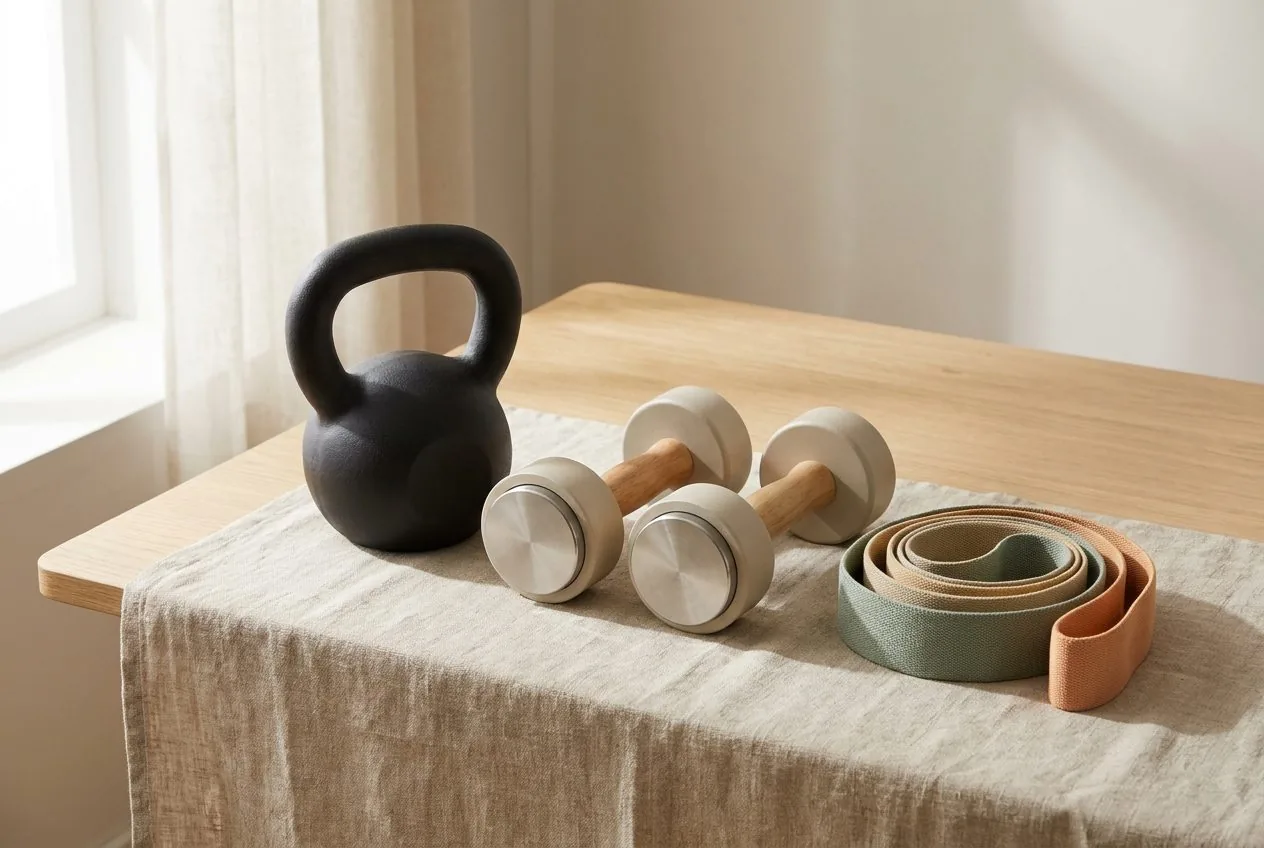
If you want to start strength training at home after 40 and you are standing in the metaphorical aisle trying to choose your first tool, three options dominate the shelf: a kettlebell, a pair of adjustable dumbbells, and a set of resistance bands. Each is marketed as the one thing you need, which is exactly why the choice feels harder than it should. They overlap a great deal, they all build gentle strength, and honestly, you could get strong with any of them. But they are not identical, and the right first buy depends on your joints, your budget, your space, and how you like to see progress.
So let us settle it plainly, without pretending one is a miracle and the other two are useless. This is a three-way comparison written through an over-40 lens, aimed at one practical question: which single tool should you buy first, and what should you add later.
Short answer for skimmers: if you want the gentlest, cheapest, lowest-risk start, buy a set of resistance bands. If you can spend a little more and want the most versatile, precisely progressible all-rounder, buy adjustable dumbbells. Add a kettlebell later, once your habit is set and you want swings and carries in the mix, because its learning curve makes it a better second or third tool than a first one.
This article is for information only and is not medical advice. Talk to your healthcare provider before starting a new exercise routine, especially if you have joint injuries, heart conditions, or dizziness.
The quick comparison
| Feature | Resistance bands | Adjustable dumbbells | Kettlebell |
|---|---|---|---|
| Cost to start | Lowest of the three | Higher, one compact investment | Moderate, per bell or adjustable set |
| Joint feel | Gentlest; tension builds gradually | Very controllable when slow | Gentle once the hinge is learned |
| Learning curve | Lowest; forgiving | Low; familiar movements | Moderate; the swing takes practice |
| Versatility | Wide; press, row, squat, pull | Widest; precise strength work | Great for swings, carries, squats |
| Measuring progress | Less precise; graded strengths | Precise, small weight jumps | Bigger increments |
| Space | Rolls into a drawer | Compact pair replaces a rack | Smallest footprint; one bell |
| Best as | The gentlest first buy | The all-round first buy | A brilliant second or third tool |
All prices are approximate as of mid-2026 and move constantly, so check current pricing before you buy.
Which should you pick? A quick decision framework
“I want the gentlest, lowest-risk start.” Resistance bands. They are kind to sensitive joints, almost impossible to use dangerously, and cheap enough that trying them costs you very little. If you are rebuilding after a long break or feeling cautious, start here and see whether the habit takes.
“I want the most versatile all-rounder and I can spend a bit more.” Adjustable dumbbells. They cover the widest range of gentle exercises, let you keep every rep slow and controlled, and step up in small, precise amounts so you can watch yourself getting stronger. For many women they are the single best first weighted tool.
“I have the tightest space or no storage at all.” Resistance bands, easily. A full set hangs on a hook or rolls into a drawer. If you want something a bit more substantial that still tucks away, a single adjustable kettlebell has the smallest footprint of any weight.
“I want whole-body, functional moves and better grip.” A kettlebell, but as your second tool. Swings, carries, and goblet squats train your body the way daily life does, and the off-center weight builds grip. Just respect the small learning curve the swing asks for, and get comfortable with the basics first.
“I want measurable progress I can track week to week.” Adjustable dumbbells. Their small, exact weight jumps make progress easy to see, which keeps many people motivated in a way graded bands do not quite match.
The over-40 lens: what actually matters
The reason this comparison matters is that muscle fades with age: after 30, adults can lose as much as 3% to 5% of their muscle mass per decade, and progressive resistance training is the best means to build it back at any age (Harvard Health). All three tools give you that resistance, gently. Here is how each suits a midlife body.
Joints first. This is where bands shine: the tension is lightest at the start of a movement and builds gradually as the band stretches, so there is little to jerk or strain. Dumbbells are reassuringly controllable when you keep everything slow. A kettlebell is just as kind for goblet squats and carries, but a swing done with a rounded back is not, which is why it asks for a little technique before you load it. Start light with any of them and learn the movement before you add resistance.
Progression, honestly. All three give you progressive resistance in different ways. Bands come in graded strengths, so you move up a band as you get stronger, though the jumps are less precise. Adjustable dumbbells step up in small, exact amounts, which makes progress easy to track. A kettlebell tends to jump in bigger increments. None of these is a barrier to getting stronger; the difference is how finely you can measure it, and finer steps are often the gentler path at the very start.
Sustainability. The best tool is the one you actually reach for on a busy, low-energy week. For many women that is bands, because they are right there, weightless to pick up, and impossible to feel intimidated by. For others it is dumbbells, because the moves are familiar and satisfying. Be honest about which you will use when motivation is low, because consistency beats every spec on this table.
If you want the tool-by-tool detail before deciding, our adjustable dumbbells vs kettlebells comparison weighs those two in depth, and our resistance bands vs dumbbells guide covers the gentler pairing head to head. And if core work is what draws you to bands, our pilates ring vs resistance bands comparison looks at the small-prop route too.
A gentle session you can do with any of them
The National Institute on Aging’s list of major muscle groups to work, legs, hips, chest, back, abdomen, shoulders, and arms (NIA), can be covered by four basic moves with any of these tools, so you are not committing to three different routines.
- Squat. Hold a band under your feet, one dumbbell at your chest, or the kettlebell in a goblet position, and sit down between your hips with your chest up. Around 8 to 12 slow reps.
- Row. Anchor the band and pull to your ribs, or hinge forward and row the weight, squeezing your shoulder blades. Slow and controlled, around 8 to 12 reps.
- Overhead press. Press the band, a dumbbell, or the bell up from your shoulders with your ribs down, lowering with control, around 8 to 10 reps. With a band, anchor it securely under your feet and never let it snap toward your face, as TheraBand’s safety guidance warns (TheraBand).
- Carry or hold. Walk tall and slow holding a weight at your side, or hold a strong band at tension. This one is a kettlebell favorite, and it builds grip and posture beautifully.
Aim for a slow, controlled round or two on two or three days a week, which meets the CDC’s advice to do muscle-strengthening activity on 2 or more days a week (CDC), and avoid working the same muscles on two days in a row so they can recover (NIA). The four moves stay the same whichever tool you own, so adding a second tool later means no new routine to learn.
All three are tools, not magic
No band, dumbbell, or kettlebell changes your body on its own; the evidence is for the training, not the gear. In older adults, elastic band training improved leg strength and balance across 25 trials, but the strength gains took at least 8 to 12 weeks of regular sessions (Frontiers in Sports and Active Living), and the NIA notes that strength work helps slow the loss of muscle mass and prevent falls (NIA). Whichever tool you buy, plan on months, not days. If you would rather follow a structured plan than improvise, our comparison of The Smoothie Diet vs Old School New Body weighs a nutrition-first program against a lifting-first one through the same over-40 lens.
Whichever tool you choose, pair it with enough protein: Harvard Health notes that older adults doing resistance training need about 1 to 1.3 grams of protein per kilogram of body weight a day (Harvard Health). Our metabolism after 40 explainer covers how muscle, movement, and protein fit together, and the rest of our gentle strength section gives you routines to run with whichever tool you land on.
The honest bottom line
Kettlebells, dumbbells, and resistance bands are not rivals; they are three doors into the same room. If you want the gentlest, cheapest, lowest-risk first buy, start with resistance bands: they are kind to joints, impossible to fumble dangerously, and cost almost nothing to try. If you can spend a bit more and want the most versatile, precisely progressible all-rounder, buy adjustable dumbbells. And add a kettlebell later, once your habit is set and you want swings and carries, because it rewards the technique you will have built by then.
Start lighter than your ego suggests with any of them, learn the movement before you load it, and give the habit enough weeks to show what it can do. The best first tool is simply the one you will pick up on an ordinary week, and then quietly grow with as you get stronger. When you are ready to see how a first tool grows into a proper corner of the house, our home gym setups for every budget walks through three sensible builds.
Frequently Asked Questions
- What should I buy first for strength after 40: a kettlebell, dumbbells, or bands?
- For most women over 40 starting out, resistance bands are the gentlest and cheapest first buy, and adjustable dumbbells are the best all-round first buy if your budget allows. Bands are almost impossible to use dangerously, kind to cranky joints, and cost very little, which makes them a low-risk way to find out whether you will stick with strength work. Adjustable dumbbells give you more precise, measurable progress and cover the widest range of exercises. A kettlebell is a wonderful third piece for swings and carries, but its learning curve makes it a better second or third purchase than a first one.
- Which is gentlest on the joints?
- Resistance bands are the gentlest, because the tension builds gradually as the band stretches, and there is no fixed weight to jerk or drop. Adjustable dumbbells are close behind when used slowly and controlled, which suits cautious knees, hips, and backs. A kettlebell is joint-friendly too for goblet squats and carries, but the swing must be driven by the hips rather than the back, so it asks for a little technique first. If your joints are sensitive, start with bands or light dumbbells and save kettlebell swings for when your hip hinge is solid.
- Which saves the most space?
- Resistance bands win outright, since a full set rolls up into a drawer or hangs on a hook. A single adjustable kettlebell is next, replacing several fixed bells with one unit. A pair of adjustable dumbbells is also very space-efficient, standing in for a whole rack, but it is two units on a stand or shelf. For the tightest corner or a home with no storage at all, bands are unbeatable; for a compact but permanent setup, adjustable dumbbells or one kettlebell both tuck away neatly.
- Do I need all three eventually?
- No, though many women happily end up with two. Any one of the three can anchor a full gentle routine, and they overlap enough that you are never stuck. A common and sensible path is to start with bands, add adjustable dumbbells when you want more precise progress and pressing power, and add a kettlebell later if swings and carries appeal. Buy for the next step you will actually take, not for a complete home gym on day one. Owning fewer tools you use often beats owning three that gather dust.
- Can I get real strength results with just resistance bands?
- Yes. Bands provide genuine progressive resistance, come in graded strengths so you can move up as you get stronger, and cover pressing, rowing, squatting, and pulling movements. For a beginner or anyone rebuilding after a long break, a good set of bands is more than enough to build meaningful gentle strength; in a 2025 review of 25 trials, elastic band training improved leg strength and balance in older adults. The main honest limit is that measuring progress is less precise than with dumbbells, and very strong lifters eventually want heavier loads. For most women over 40, though, bands alone can carry you a long and useful way.
Sources & references
- Harvard Health, preserve your muscle mass (opens in new tab)
- National Institute on Aging, four types of exercise (opens in new tab)
- CDC, adult activity: an overview (opens in new tab)
- Frontiers in Sports and Active Living, elastic band training in older adults (2025) (opens in new tab)
- TheraBand, care and safety (opens in new tab)
Before you go
The 7-Day Protein-First Meal Plan for Women Over 40
A complete protein-first week, finished for you: your personal protein target, a one-page shopping list, 21 recipes at 25-35 g protein each, and a timed 90-minute prep schedule. Printable PDF, paired with a free 7-lesson email course.
Free guide
The 7-Day Protein-First Meal Plan for Women Over 40
A complete protein-first week, finished for you: your personal protein target, a one-page shopping list, 21 recipes at 25-35 g protein each, and a timed 90-minute prep schedule. Printable PDF, paired with a free 7-lesson email course.