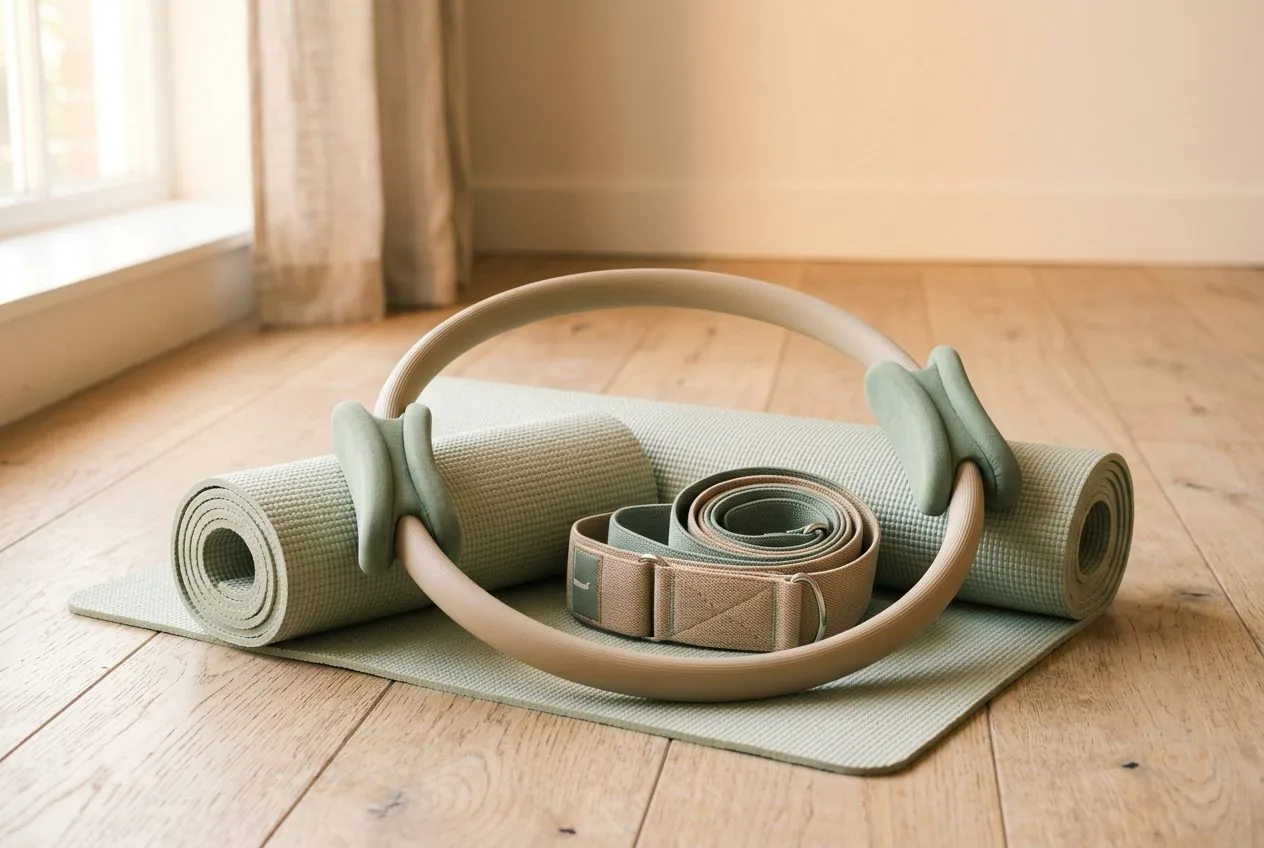
If you want to add gentle core work at home after 40 without heavy weights, two small, affordable tools come up again and again: the Pilates ring and the resistance band. They look nothing alike, and honestly they earn their keep in different ways, but both get sold as a simple do-everything answer, which muddies the choice. So let us sort it out plainly, without pretending either is a miracle. Both are genuinely useful for a midlife body. They just answer slightly different questions, one about the simplest possible gentle squeeze, the other about versatile whole-body strength that includes the core.
Short answer for skimmers: if you want a cheap, tiny, foolproof tool for gentle core and inner-thigh work, choose a Pilates ring. If you want one versatile tool that trains your core along with your back, arms, and legs, choose a set of resistance bands. They complement each other, so some women add the second later, but start with the one that matches your main goal.
This article is for information only and is not medical advice. Talk to your healthcare provider before starting a new exercise routine, especially if you have joint injuries, heart conditions, or dizziness.
The quick comparison
| Feature | Pilates ring | Resistance bands |
|---|---|---|
| Cost to start | Low, around $20 to $35 | Low; varies by set |
| What it does | Gentle squeeze resistance for core, thighs, arms | Pull, press, row, and anchor for whole-body work |
| Core role | Bracing against a squeeze | Anti-twist chops, presses, and pulls |
| Versatility | Limited to squeezing moves | Broad; covers most muscle groups |
| Joint feel | Very gentle; you control the squeeze | Gentle; needs a secure grip and setup |
| Storage | Tiny; slides under a sofa | Tiny; rolls into a drawer |
| Best at | The simplest gentle core and thigh work | One flexible tool for a whole routine |
All prices are approximate as of mid-2026 and move constantly, so check current pricing before you buy.
Which should you pick? A quick decision framework
“I want the simplest possible tool for gentle core work.” Pilates ring. Squeezing the ring between your knees or palms while you brace your middle is about as foolproof as core work gets, and there is nothing to set up or slip. If you like the idea of quiet, low-effort sessions on the sofa, start here.
“I want one tool that trains more than my core.” Resistance bands. Because you can pull, press, row, and anchor them, a single set covers your back, arms, hips, and core, which makes them the better value if you want a whole routine from one small purchase.
“My budget and my storage space are both tiny.” Either, honestly, since both are cheap and both disappear into a drawer. Choose the ring if you want the absolute simplest tool, or bands if you want the most from one buy.
“I want gentle core work but also want to build broader strength.” Resistance bands. They give your core the anti-twist and anti-lean work it thrives on while also letting you train the rest of your body, so one tool does double duty.
“I already do some strength work and just want a gentle core add-on.” Pilates ring. If your bands or weights already cover the big moves, a ring is a pleasant, cheap way to add squeezing variety for the core and inner thighs.
The over-40 lens: what actually matters
The reason this comparison matters is that both tools are genuinely gentle and genuinely useful, so the right one is simply the one that fits your goal and that you will actually use. Here is how each suits a midlife body.
Match the tool to the breadth you want. A Pilates ring is a specialist. It does gentle squeezing resistance for the core, inner thighs, and arms, and it does it simply and well, but that is most of its range. A resistance band is a generalist. It trains your core through chops, presses, and anti-twist holds while also handling rows, pull-aparts, and hip work, so one band becomes a near-complete gentle gym. Buying the ring hoping for a whole routine, or expecting the band to feel as effortless as a squeeze, is how people end up disappointed. Pick for the breadth you actually want.
Care and safety, honestly. The ring is about as low-risk as exercise gear gets; the resistance only exists while you squeeze, and the worst that happens is you clench a bit too hard and ease off. Bands are also very gentle, but they carry one extra care point: a band under tension can snap back if it slips off a hand or foot, so a secure grip and a sensible anchor matter (TheraBand). Used thoughtfully, both are kind to the joints and well suited to a midlife body.
Sustainability. Strength from either tool builds slowly. A 2025 review of 25 trials in older adults found elastic band training improved leg strength and balance, but the strength gains took at least 8 to 12 weeks of regular training (Frontiers in Sports and Active Living). Pick the tool you will still be using three months from now. If bands appeal, our best resistance bands for women over 40 review helps you pick a set that lasts.
A gentle session with either one
Whichever you pick, check the gear first. TheraBand advises inspecting a band before and after each use, not using one that is torn, punctured, or nicked, and never stretching it past three times its resting length (TheraBand). Then go slow, brace your middle, and keep breathing.
With a Pilates ring, try:
- Inner-thigh squeeze. Sit or lie with the ring between your knees and squeeze slowly while gently bracing your middle, then release with control. A 15-inch ring, the standard size from Balanced Body, sits comfortably between the knees for this one (Balanced Body).
- Seated core squeeze. Sit tall with the ring between your knees, brace your middle, and squeeze as you exhale, feeling the core switch on alongside the thighs.
- Chest press. Press the ring’s two padded handles inward between your palms at chest height, slowly, then ease off. Rings such as Gaiam’s 15-inch model are built with two non-slip padded handles for exactly this grip (Gaiam).
With a resistance band, try:
- Standing pull-apart. Hold the band in front of you and draw your hands apart slowly, squeezing your shoulder blades, then return with control. Gentle for the upper back and posture.
- Anti-twist hold. Anchor the band at chest height, hold it at your chest with both hands, step out to tension, and resist the pull without twisting. This is core work at its most useful.
- Standing chop. With the band anchored high, draw it slowly down and across toward the opposite hip, letting your braced middle control the movement, then switch sides.
Keep every rep slow, and treat any wobble or strain as a signal to lighten up, not to push through. If you want a broader gentle base to build on, our bodyweight moves for gentle strength how-to shows how to make short sessions stick with no equipment at all.
Both are tools, not magic
Neither a Pilates ring nor a resistance band will transform your body or hand you a flat middle on its own. For bands, the research points to steady, practical gains: across 25 trials, older adults who trained with elastic bands improved on chair-stand, leg-strength, and balance tests compared with controls (Frontiers in Sports and Active Living). For rings, even the makers pitch them modestly, with Gaiam describing its ring as a way to work the legs and core during Pilates moves (Gaiam). Neither replaces regular movement, some strength work, and enough protein, and neither is a medical treatment.
Whichever you choose, the CDC’s baseline still applies: muscle-strengthening activity on 2 or more days a week that works the legs, hips, back, abdomen, chest, shoulders, and arms (CDC). A band set can cover most of that list on its own, while a ring mainly reaches the core, inner thighs, chest, and arms. Our gentle strength section has joint-friendly routines that fit alongside either tool.
The honest bottom line
Pilates rings and resistance bands are not really rivals; they answer different questions. If you want the simplest, most foolproof tool for gentle core and inner-thigh work, buy a Pilates ring: it is tiny, controllable, and almost impossible to use wrong. If you want one versatile tool that trains your core along with the rest of your body, buy a set of resistance bands and keep a secure grip and a sensible setup. Both are genuinely useful, and if you want both the utter simplicity of a squeeze and the range of a band, the pair complements each other nicely.
Either way, the buy-in is small. Gaiam’s 15-inch ring sells for about $20 (Gaiam) and Balanced Body’s studio Ultra-Fit Circle for $35 (Balanced Body); with bands, plan to replace any band that shows nicks or tears (TheraBand). If you want the deeper look at the ring itself, our best Pilates ring for gentle core strength review covers the features that matter.
Frequently Asked Questions
- Is a Pilates ring or a resistance band better for core after 40?
- Neither is simply better; they work your core in different ways. A Pilates ring adds gentle, squeezable resistance that brings your core into play when you brace against the squeeze, and it is cheap, tiny, and almost impossible to use wrong. Resistance bands are far more versatile, letting you pull, press, and anchor for a wider range of core and whole-body moves. If you want the simplest, most foolproof tool for gentle core and inner-thigh work, start with the ring. If you want one tool that trains your core and the rest of your body too, start with bands.
- Which is more versatile, a Pilates ring or resistance bands?
- Resistance bands, by a wide margin. A ring does one thing beautifully, gentle squeezing resistance between your knees, palms, or ankles, but that is most of what it does. Bands let you pull them apart, press them overhead, row them toward you, anchor them to a door for chops and presses, and loop them around your legs for hip work, which covers core, back, arms, and legs. If you want a single small tool that can build a broad routine, bands are the more flexible choice. The ring trades versatility for being utterly simple and hard to get wrong.
- Are resistance bands or Pilates rings easier on the joints?
- Both are among the gentlest tools you can pick, and neither adds impact or a heavy load. The ring is arguably the more foolproof of the two, since the resistance only exists while you squeeze and there is nothing to lose control of. Bands are also very joint-friendly, but a band under tension can snap back if it slips off a hand or foot, so they ask for a little more care in setup and grip. Used sensibly, both are kind to knees, wrists, and shoulders, which is a big part of why they suit a midlife routine so well.
- Should I buy both, or just one to start?
- One is plenty to start, and which one depends on your goal. If you want a cheap, simple tool for gentle core and inner-thigh squeezes, begin with the Pilates ring. If you want one versatile tool that trains your core and your whole body, begin with a set of resistance bands. They do complement each other, so some women add the ring later for a bit of squeezing variety, but there is no need to buy both at once. Pick the one that matches your main goal, use it for a few weeks, and you will know whether you want the other.
Sources & references
- Gaiam, Pilates Ring product page (opens in new tab)
- Balanced Body, Ultra-Fit Circle product page (opens in new tab)
- Balanced Body, rings and circles collection (opens in new tab)
- TheraBand, care and safety (opens in new tab)
- Frontiers in Sports and Active Living, elastic band training in older adults (2025) (opens in new tab)
- CDC, adult activity: an overview (opens in new tab)
Before you go
The 7-Day Protein-First Meal Plan for Women Over 40
A complete protein-first week, finished for you: your personal protein target, a one-page shopping list, 21 recipes at 25-35 g protein each, and a timed 90-minute prep schedule. Printable PDF, paired with a free 7-lesson email course.
Free guide
The 7-Day Protein-First Meal Plan for Women Over 40
A complete protein-first week, finished for you: your personal protein target, a one-page shopping list, 21 recipes at 25-35 g protein each, and a timed 90-minute prep schedule. Printable PDF, paired with a free 7-lesson email course.