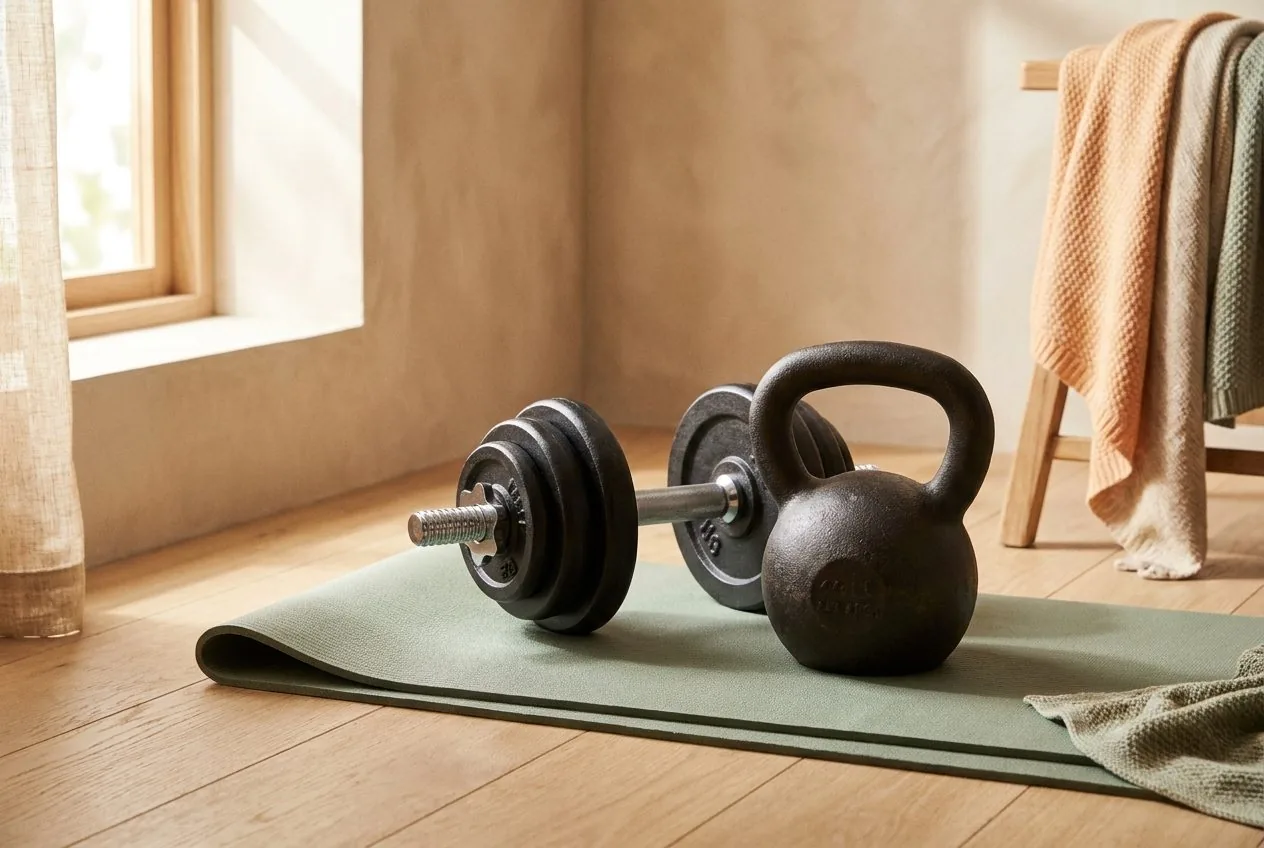
If you are kitting out a small home gym after 40 and want one weighted tool to start, two options keep coming up: a pair of adjustable dumbbells and an adjustable kettlebell. They overlap enough to make the choice genuinely confusing, and each is marketed as the one thing you need, which does not help. So let us settle it honestly, without pretending one is a miracle and the other is useless. Both are excellent. They just do slightly different jobs.
Short answer for skimmers: if you can only buy one to start, choose a light pair of adjustable dumbbells. They are the more familiar, more precise, and more forgiving tool, and they cover the widest range of gentle exercises with the least learning. Add an adjustable kettlebell later when you want swings, carries, and goblet squats in the mix. Most women over 40 are perfectly well served by one to begin, and can happily own both once the habit is set.
This article is for information only and is not medical advice. Talk to your healthcare provider before starting a new exercise routine, especially if you have joint injuries, heart conditions, or dizziness.
The quick comparison
| Feature | Adjustable dumbbells | Adjustable kettlebell |
|---|---|---|
| Best target | Presses, rows, curls, precise strength work | Swings, goblet squats, carries, grip |
| Joint feel | Very controllable, easy to keep slow | Gentle once the hip hinge is learned |
| Learning curve | Low; familiar movements | Moderate; the swing takes practice |
| Measuring progress | Precise, small weight jumps | Steps up in bigger increments |
| Space | One compact pair replaces a rack | Smallest footprint; one bell |
| Best at | The widest range of gentle exercises | Whole-body, functional patterns |
All prices for gear like this are approximate as of mid-2026 and move constantly, so check current pricing before you buy.
Which should you pick? A quick decision framework
“I want the gentlest, most foolproof start.” Adjustable dumbbells. The movements are familiar, they are easy to keep slow and controlled, and there is no swing to learn. If you are rebuilding after a long break or your joints are cautious, start here.
“I like precise, measurable progress.” Adjustable dumbbells again. Small, exact weight jumps make it easy to see yourself getting stronger week to week, which keeps many people motivated. That clarity is one of the dumbbell’s quiet strengths.
“I want whole-body, functional moves and better grip.” An adjustable kettlebell. Swings, carries, and goblet squats train your body the way daily life does, lifting, standing, and carrying, and the off-center weight builds grip along the way. Just respect the small learning curve the swing asks for.
“I have the tightest possible corner.” A single adjustable kettlebell has the smallest footprint of all, since one bell does the work of several. If space is your hardest limit, it is a strong pick, provided you are happy to learn the hinge.
The over-40 lens: what actually matters
The two tools answer two different age-related needs. Grip strength, which kettlebell carries and swings put to work, declines from midlife onward in both women and men (PLOS ONE), while adjustable dumbbells make it easy to add weight gradually, the kind of slow progression the CDC says brings added benefit at any age (CDC). Here is how each suits a midlife body.
Joints first. Dumbbells let you keep every rep slow and fully controlled, which is reassuring for sensitive knees, hips, or backs. A kettlebell is just as kind once you have learned to hinge from the hips, but a swing done with a rounded back is not, so the kettlebell asks for a little more technique up front. Start light with either, and learn the movement before you load it.
Progression, honestly. Both tools give you progressive resistance, just differently. Adjustable dumbbells step up in small, precise amounts, which makes progress easy to track. A kettlebell tends to jump in bigger increments, which is simple but less granular. Neither is a barrier to getting stronger; the dumbbell’s finer steps are often the gentler path at the very start.
Sustainability. The best tool is the one you actually reach for on a busy, low-energy week. For many women that is the dumbbells, because the moves are familiar and need no warm-up learning. A kettlebell rewards a little patience early, and then becomes just as grab-and-go. Be honest about which one you will use when motivation is low, because consistency beats every spec on this table.
If you want the tool-by-tool detail before deciding, our best adjustable dumbbells for women over 40 guide breaks down mechanisms and weight ranges, and our best adjustable kettlebell for a compact home gym review covers the handle, base, and starting weight that matter.
A gentle session you can do with either
Here is the reassuring truth: a simple, joint-friendly strength session looks very similar whichever tool you own, so you are not committing to two different routines.
- Goblet squat. Hold one dumbbell or the kettlebell at your chest and sit down between your hips with your chest up, standing through your whole foot. Around 8 to 12 slow reps.
- Row. Hinge forward with a soft back and pull the weight to your ribs, squeezing your shoulder blades. Slow and controlled, around 8 to 12 reps per side.
- Overhead press. Press the weight up from your shoulders with your ribs down and core braced, lowering with control. Around 8 to 10 reps.
- Carry. Hold the weight at your side, or the kettlebell in one hand, and walk tall and slow across the room and back. This one is a kettlebell favorite, and it builds grip and posture beautifully.
Aim for a slow, controlled round or two, two or three times a week, resting a day between sessions. Notice how little the routine changes between the tools. That is exactly why the choice is lower-stakes than it feels: start with either, learn the moves, and add the other later without relearning anything.
Both are tools, not magic
The practical difference sits in the hardware itself. Bowflex’s SelectTech 552 dumbbells, for example, cover 5 to 52 pounds across 15 settings, while its SelectTech 840 kettlebell covers 8 to 40 pounds across 6 settings (Bowflex), which is why the dumbbell is the finer-grained tool for small, steady jumps. Neither will change your body on its own; the result depends on using the one you own consistently.
The four-move session above, done two or three times a week, works your legs, hips, back, shoulders, arms, and core, which covers most of the major muscle groups the CDC asks adults to strengthen on 2 or more days a week (CDC). Our metabolism after 40 explainer covers how muscle, movement, and protein fit together, and the rest of our gentle strength section gives you routines to run with whichever tool you land on.
The honest bottom line
Adjustable dumbbells and kettlebells are not rivals; they are teammates that happen to overlap. If you buy one thing, buy a light pair of adjustable dumbbells: they are the most familiar, most precise, and most forgiving way to build gentle strength, and they will carry most women over 40 a long way. If you want functional swings and carries, or you have the very tightest corner, an adjustable kettlebell is a superb pick once you have learned the hinge. And if you can stretch to both later, that small pairing covers nearly everything you would want to do at home. For the rest of the shopping list around your weights, our home gym essentials under $250 rounds out the picture piece by piece.
Start lighter than your ego suggests with either one, learn the movement before you load it, and give the habit enough weeks to show what it can do. The best weighted tool is simply the one you will pick up on an ordinary week, and then quietly grow with as you get stronger.
Frequently Asked Questions
- Are adjustable dumbbells or kettlebells better for women over 40?
- Neither is simply better; they suit slightly different goals. Adjustable dumbbells are the more familiar, more precise tool for curls, presses, rows, and steady progress you can measure, which makes them the easier starting point for most women over 40. A kettlebell shines for swings, goblet squats, and carries that build grip and whole-body coordination. If you want one foolproof first buy, start with adjustable dumbbells. Many women eventually enjoy owning both, one for precise strength work and one for functional patterns.
- Which one is gentler on the joints?
- Both are gentle when used light and slow, but dumbbells give you more room to keep everything controlled, which suits cautious joints. A kettlebell swing is joint-friendly too, but only once you have learned to drive it with your hips rather than your back. If your knees, hips, or back are sensitive, start with dumbbells and slow kettlebell moves like goblet squats and carries, save swings for when your hinge is solid, and check with your provider before beginning.
- Which saves more space in a small home gym?
- A single adjustable kettlebell has the smallest footprint of all, since one bell replaces several fixed ones. A pair of adjustable dumbbells is also very space-efficient, replacing a whole rack with one compact set, but it is two units rather than one. For the very tightest corner, a kettlebell wins on pure footprint; for versatility per inch, adjustable dumbbells are close behind and cover more exercises. Either beats a wall of fixed weights.
- Do I need to own both dumbbells and a kettlebell?
- No, and most women do well starting with just one. They overlap enough that either can anchor a full gentle routine. Buy both only once your habit is established and you want the extra variety: dumbbells for precise pressing, rowing, and curling, a kettlebell for swings, carries, and goblet squats. Starting with one keeps the cost and the learning curve low, and you can always add the other later without relearning your whole routine.
Sources & references
Before you go
The 7-Day Protein-First Meal Plan for Women Over 40
A complete protein-first week, finished for you: your personal protein target, a one-page shopping list, 21 recipes at 25-35 g protein each, and a timed 90-minute prep schedule. Printable PDF, paired with a free 7-lesson email course.
Free guide
The 7-Day Protein-First Meal Plan for Women Over 40
A complete protein-first week, finished for you: your personal protein target, a one-page shopping list, 21 recipes at 25-35 g protein each, and a timed 90-minute prep schedule. Printable PDF, paired with a free 7-lesson email course.