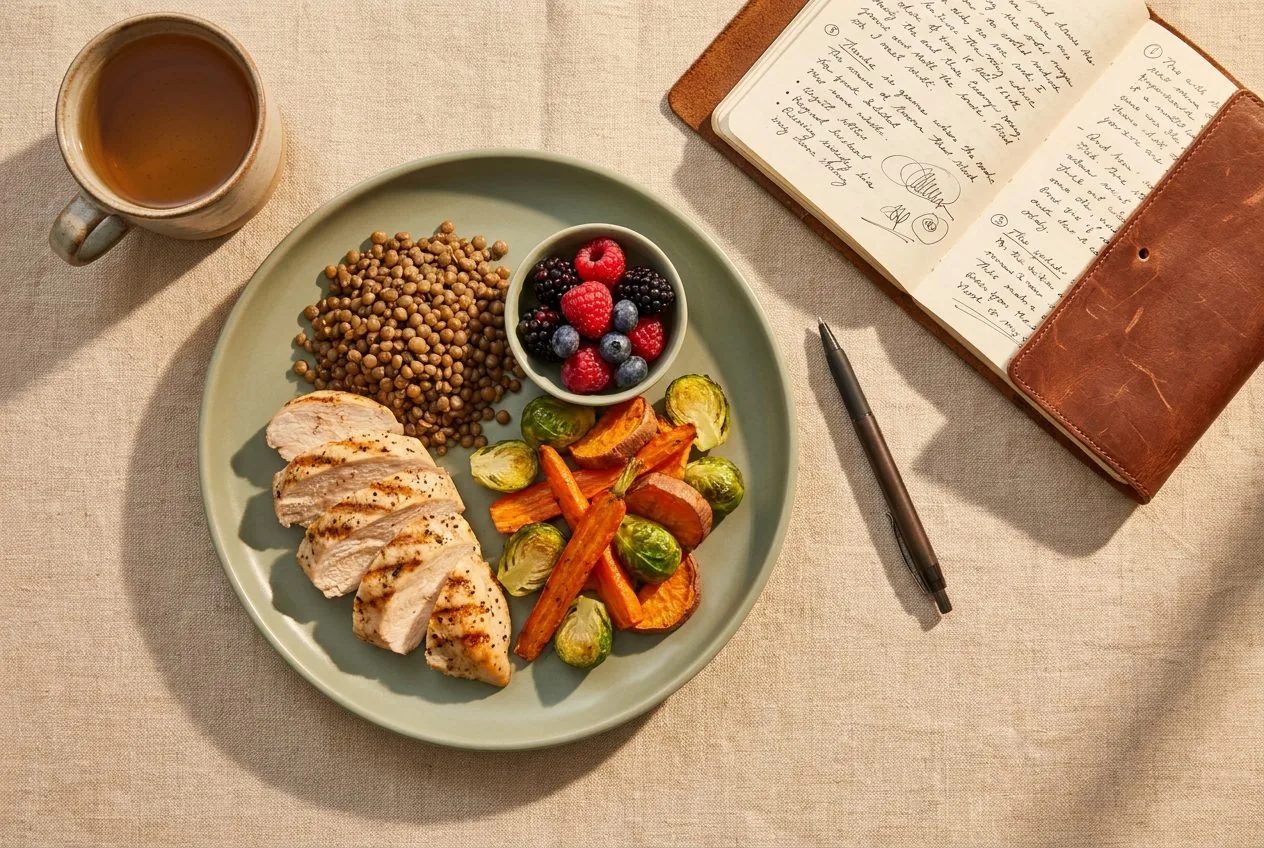
If your energy feels uneven as the season turns, the fix is probably simpler and gentler than the internet suggests. You do not need a cleanse, a supplement stack, or a strict new diet. You need a handful of steady, food-first habits, the ordinary fundamentals of enough protein, enough fiber, regular meals, and enough water, that quietly hold your energy level through a busy autumn day. After 40 those fundamentals matter a little more than they used to, not because anything is wrong with you, but because our energy is less forgiving of skipped meals and ragged eating than it once was.
The method, in one line: anchor every meal to protein, add fiber to every plate, eat a real breakfast, keep a steady eating rhythm, cook a warm base ahead for busy days, keep drinking water as it cools, and change just one habit at a time. Build these gently, one by one, and steady energy tends to follow.
This article is for information only and is not medical advice. Talk to your healthcare provider before changing your diet or exercise routine, especially if you have a medical condition or take medication.
Why food-first beats the quick fixes after 40
There is a whole industry built on selling you a shortcut to steady energy, and most of it misses the point. Supplements and cleanses promise a reset, but the thing that actually keeps your energy even is far less exciting: eating enough protein and fiber on a regular rhythm, and staying hydrated. It is not a secret, and it does not photograph well, which is exactly why it gets buried under louder promises.
The good news is that food-first habits are within reach on any budget and any schedule, because they use ordinary food you already know. They are also kinder, because there is nothing to fail at, no forbidden list, no all-or-nothing rule that one hard week can break. You are simply nudging your daily eating toward a steadier pattern, one small habit at a time.
The 7 habits, one at a time
Here is the whole approach, in seven habits. You do not adopt them all at once. You pick one, let it become automatic, and add the next when you are ready.
- Anchor every meal to protein. Decide the protein first, before anything else on the plate. Eggs, Greek yogurt, beans, lentils, fish, or a scoop of protein powder all count, and building each meal around one is the single habit that does the most for steady energy after 40, because protein intake tends to drop with age, many older adults fall short of even the basic recommendation (The Journal of Nutrition, Health and Aging), and protein is what helps a meal actually hold us.
- Add a fiber-rich food to every plate. Alongside the protein, include a fruit, a vegetable, a whole grain, or a spoon of seeds. Fiber slows everything down for a gentler energy curve, and most of us miss it. Build it up gradually and drink water alongside (Harvard T.H. Chan School of Public Health), so the change sits comfortably rather than overwhelming your stomach.
- Eat a real breakfast within an hour or two of waking. Skipping breakfast to save time can backfire into an energy dip and a ravenous afternoon. A protein-forward breakfast, warm oats with yogurt, eggs, or a quick smoothie, puts a floor under your energy from the start of the day. Torn between the warm bowl and the blender? Our warm oatmeal vs smoothie breakfast comparison settles which fits which morning.
- Keep a steady eating rhythm. Going too many hours without food leaves you frazzled and starving by evening, which is when good intentions unravel. Aim for regular meals and a planned snack so you never hit that ravenous, decisions-are-hard state. An apple with nut butter is the classic planned snack, and our best nut butters for fall guide helps you pick a jar that earns its place.
- Batch-cook a warm base for the week. A pot of oats, a soup, a batch of beans, or a tray of roasted vegetables means a balanced, warming meal is mostly ready when a busy day hits. Cooking once and eating several times is the habit that keeps the other habits alive on hard weeks.
- Keep hydrating as the weather cools. In cooler weather you feel less thirsty (Nutrients), so it is easy to drift into mild dehydration, which can show up as fatigue and low energy (The Journal of Nutrition). Keep water in view and sip through the day, even when you do not feel like it.
- Change one habit at a time. This is the meta-habit that makes the rest work. Adopt a single change, let it become second nature over a week or two, then add the next. Stacking small wins one by one builds a pattern that survives an ordinary week, which an all-at-once overhaul never does.
Where a scoop of protein powder earns its place
Most of these habits rely only on ordinary food, and that is the point. But one tool genuinely lowers the bar on a rushed morning, and that is a simple protein powder. When breakfast is a two-minute smoothie or a bowl of oats you barely have time for, a scoop is the fastest, most reliable way to hit your protein without cooking. Treat it as concentrated food rather than a supplement with special powers, use it when whole foods are not practical, and lean on yogurt, eggs, and beans the rest of the time.
If you are weighing which tub to buy, our honest best protein powder for smoothies over 40 guide walks through what to look for and who can skip it entirely, so you spend on the right one or save your money.
What a steady fall day can look like
None of this needs to be complicated, so here is one example of how the habits fit together across a day. It is not a rule to follow to the letter, just a picture of the pattern in action, and you should adjust every part of it to your own tastes and schedule.
| Time | A balanced option | The habits at work |
|---|---|---|
| Morning | Warm oats with milk, a scoop of powder, and berries | A real breakfast, protein anchor, fiber |
| Midday | A bowl of lentil soup with greens and whole-grain bread | Protein anchor, fiber, a warm base you cooked ahead |
| Afternoon | An apple with a tablespoon of nut butter | Steady rhythm, protein and fat to hold you |
| Evening | Fish or beans, roasted squash, and a side salad | Protein anchor, fiber, water alongside |
See how the same few habits repeat without any strict counting? Each meal starts with a protein, carries some fiber, and lands on a regular rhythm, with water through the day and a warm base doing quiet work at lunch. That repetition is the whole point. You are not memorizing a menu; you are building a pattern flexible enough to survive a real, busy autumn week. For seasonal ingredients to fill that pattern, our 9 fall foods for steady energy leans into the produce already in season.
Common mistakes that undo steady energy
A few easy missteps sabotage even good habits. Watch for these and the seven above do their quiet work.
Trying to adopt all seven at once. The classic error is a total eating overhaul that feels motivating for three days and impossible by the weekend. Pick one habit, let it settle, then add the next. Slow is what makes it stick.
Skipping meals to save time or calories. Going without leaves you ravenous later and undoes the steady rhythm entirely. A regular pattern of meals is half the whole strategy.
Making breakfast all carbs. Toast or plain oatmeal with nothing else fades fast. Add a protein, and the same breakfast holds you for hours instead.
Chasing a supplement instead of the habit. No pill or powder resets your energy the way a steady eating pattern does. Build the fundamentals first; a protein powder is a convenience within that, not a replacement for it.
The honest bottom line
Steady energy this fall does not come from a cleanse, a supplement, or a strict diet. It comes from a handful of gentle, food-first habits: anchor every meal to protein, add fiber to every plate, eat a real breakfast, keep a steady eating rhythm, cook a warm base ahead, keep drinking water, and change one habit at a time. What that pattern genuinely tends to support is more even energy through a busy day and meals that actually hold you, not any dramatic transformation. Start with just the first habit this week, keep it small enough to repeat, and let it become automatic before you add the next. When the afternoon slump asks for something more than fruit, our seven high-protein nut-butter snacks keep the protein anchor going between meals. For the month-long version of this approach, our 4-week food-first metabolism reset for women over 40 puts these habits into a gentle, no-shame plan.
Frequently Asked Questions
- What does food-first mean for steady energy after 40?
- Food-first means starting with what is on your plate rather than reaching for a supplement, a cleanse, or a strict diet to steady your energy. It is about a simple, repeatable pattern: enough protein, enough fiber, regular meals, and enough water. After 40 that pattern tends to matter a little more, because our energy is less forgiving of skipped meals and ragged eating. The appeal is that none of it requires anything exotic, just ordinary food eaten on a steady rhythm. As always, this is general information and not medical advice.
- How much protein should I aim for at each meal?
- Many women over 40 do well aiming for roughly 25 to 30 grams of protein per meal, spread across the day rather than saved for dinner. That amount helps a meal actually hold you and supports the muscle we gradually lose with age, especially alongside a little strength work. You do not need to weigh and track everything; anchoring each plate to a real protein source, eggs, yogurt, beans, fish, or a scoop of powder, gets most people close without the math.
- Do these habits work if I am really busy?
- Yes, and they are designed for busy weeks. The point of batch-cooking a warm base, keeping breakfast simple, and having a protein powder on hand is that a balanced meal takes minimal thought when time is short. Start with just one habit, the one that fits your life most easily, and let it become automatic before adding another. A few small habits you keep will do far more than an ambitious plan you abandon by Friday.
- Will food-first habits reset my metabolism?
- No honest habit resets your metabolism, and any product promising that is overselling. What steady, food-first eating genuinely tends to support is more even energy through the day, meals that hold you, and a foundation that makes a little strength work more effective over time. Think of these habits as steadying and supportive rather than transformative. They are the quiet fundamentals, not a switch you flip.
Sources & references
- The Journal of Nutrition, Health and Aging, Low protein intakes in older US adults (opens in new tab)
- Harvard T.H. Chan School of Public Health, Fiber (opens in new tab)
- Nutrients, Hydration of workers in thermal environments (opens in new tab)
- The Journal of Nutrition, Mild dehydration affects mood in healthy young women (opens in new tab)
Before you go
The 7-Day Protein-First Meal Plan for Women Over 40
A complete protein-first week, finished for you: your personal protein target, a one-page shopping list, 21 recipes at 25-35 g protein each, and a timed 90-minute prep schedule. Printable PDF, paired with a free 7-lesson email course.
Free guide
The 7-Day Protein-First Meal Plan for Women Over 40
A complete protein-first week, finished for you: your personal protein target, a one-page shopping list, 21 recipes at 25-35 g protein each, and a timed 90-minute prep schedule. Printable PDF, paired with a free 7-lesson email course.