If you have spent years half-remembering that you should “eat more protein,” adding a scoop of powder here and an extra egg there, and still felt like you were guessing at a moving target, here is some validation: the target itself just moved. The newly released 2025-2030 Dietary Guidelines for Americans revised the standard protein recommendation upward (American Family Physician), and the new range is noticeably higher than the number most of us grew up with, one that stood essentially unchanged for more than 70 years (Advances in Nutrition). You were not doing it wrong. The bar moved, and nobody sent out a memo.
This article walks through what actually changed, why it matters more in your 40s and beyond, and exactly how many grams that means for your body weight, with a simple chart you can use today. No supplements to buy, no tracking app required, just an updated number and a plain explanation of where it came from.
This article is for information only and is not medical advice. Talk to your healthcare provider before changing your diet or exercise routine, especially if you have a medical condition or take medication.
What the New Guidelines Actually Changed
For decades, the reference number for protein was 0.8 grams per kilogram of body weight per day. That figure has shown up in general dietary advice for so long that most people assume it is the “right” amount to aim for. It was never designed to be a target. It was designed as a floor, an estimate of the minimum protein healthy adults need to avoid losing body nitrogen (Advances in Nutrition).
The updated framework in the 2025-2030 Dietary Guidelines for Americans moves the conversation away from that bare-minimum number. For many adults, and particularly for midlife and older adults working to maintain muscle, the guidance now points toward a meaningfully higher range: roughly 1.2 to 1.6 grams of protein per kilogram of body weight per day (American Family Physician). That is up to double the old figure, not a rounding error.
If your mental math still runs in pounds, here is the quick version: divide your body weight in pounds by 2.2 to get kilograms, then multiply by 1.2 and by 1.6 to get your daily range in grams. We have done that math for you below.
This is not a fringe opinion tucked into a footnote. Researchers who study aging and muscle health have been pointing toward a higher protein range for midlife and older adults for years (Harvard Health), and the updated guidelines catching up to that consensus is exactly why it counts as news rather than a fad. It applies broadly, to everyday women managing a household and a job, not only to athletes and bodybuilders, which is the group most old protein advice was quietly written for in the first place.
Why the Old Number Was Basically a Floor
It helps to understand what 0.8 grams per kilogram was actually built for. Researchers set that number using nitrogen balance studies designed to find the smallest amount of protein that prevents your body from breaking down its own tissue (Advances in Nutrition). It answers the question “what keeps you from getting sick,” not “what helps you build or keep muscle, feel satisfied after meals, or age well.” Most people can technically hit 0.8 while eating far less protein than their body would genuinely benefit from.
That gap matters more after 40. As we cover in our guide to what actually changes in your metabolism after 40, most adults are already slowly losing muscle by this age, as much as 3 to 5 percent per decade after 30, unless they actively work to keep it (Harvard Health). On top of that, aging muscle becomes somewhat less efficient at using the protein you feed it, a pattern researchers call anabolic resistance (Frontiers in Physiology). In plain terms: your muscles need more raw material than they used to, just to do the same job of holding steady.
A higher daily protein range, spread across your meals rather than loaded at dinner, gives your body the supply it needs to work against that quiet decline. It will not reverse muscle loss on its own, but paired with regular strength work, it is one of the most useful, least complicated habits you have available.
Here is the mechanism in plain terms, without the biochemistry lecture. Eating protein triggers a process called muscle protein synthesis, essentially your body’s signal to build and repair muscle tissue. In a younger body, a modest amount of protein is enough to flip that switch. In an older or midlife body, the same modest amount often is not, so the muscle-building signal stays quieter than it should (Current Opinion in Clinical Nutrition and Metabolic Care). A larger dose of protein per meal appears to help clear that higher threshold. That is the whole reason the guidance moved from bare-minimum, prevent-deficiency territory to a number built around what muscle actually needs to keep functioning.
Your New Daily Protein Target, By Body Weight
Here is the range translated into real numbers, so you are not doing kilogram math at the grocery store.
| Your Body Weight | Daily Protein Target (1.2-1.6 g/kg, 2025-2030 Dietary Guidelines) |
|---|---|
| 110 lb (50 kg) | 60-80 g |
| 130 lb (59 kg) | 71-94 g |
| 150 lb (68 kg) | 82-109 g |
| 160 lb (73 kg) | 87-116 g |
| 170 lb (77 kg) | 93-123 g |
| 180 lb (82 kg) | 98-131 g |
| 200 lb (91 kg) | 109-145 g |
| 220 lb (100 kg) | 120-160 g |
If you are not currently strength training, mostly sedentary, or new to eating more protein, the lower end of your row is a sensible place to start. If you strength train regularly, are actively working to build or protect muscle, or are recovering from an injury, the higher end tends to fit better. There is nothing wrong with landing anywhere in between; this is a range to aim into, not a number to hit exactly.
Where in the Range Should You Actually Aim?
A range this wide is only useful once you know which end fits you. A few honest signposts:
- Lean toward the lower end if you are brand new to eating more protein, mostly sedentary, or easing in gradually to avoid digestive discomfort.
- Lean toward the higher end if you strength train two or more times a week, are actively trying to build muscle, or are recovering from surgery, illness, or an injury, when protein needs genuinely rise.
- Start in the middle if none of that describes you clearly. It is a perfectly reasonable default, and you can adjust once you see how your appetite and energy respond.
- Increase gradually either way. Jumping from a low-protein pattern straight to the top of the range in one day is more likely to upset your stomach than to help your muscles.
What This Number Looks Like On a Plate
A daily target is only useful if you can translate it into meals, so here is the simple version: aim for roughly 25-35 grams of protein at each of three meals. Spreading it out works better than saving it all for dinner, because your muscles use protein most efficiently in smaller, steady doses through the day rather than one large one (Current Opinion in Clinical Nutrition and Metabolic Care).
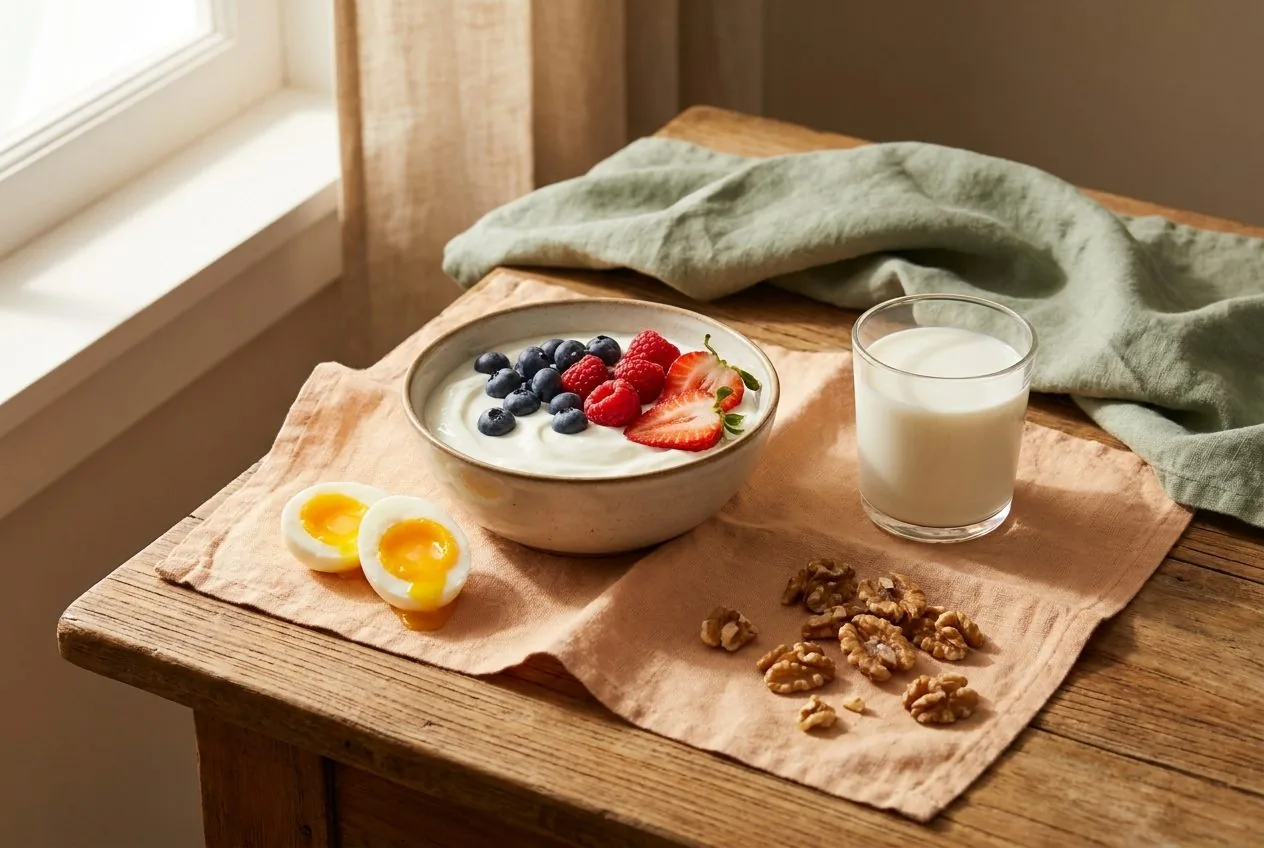
In real food, that looks like about 4 ounces of cooked chicken or fish, a cup of Greek yogurt with a spoon of protein powder stirred in, three eggs plus a serving of cottage cheese, or a protein-forward smoothie built around milk or yogurt. Small add-ins close the gap between meals too: a handful of edamame, a hard-boiled egg kept in the fridge, a spoon of cottage cheese on the side, or a splash of unflavored protein powder in your coffee or oatmeal all count toward the daily total without becoming their own production.
We break the exact math down meal by meal in how to hit 30g of protein per meal after 40, and if mornings are your weak point, how to eat more protein at breakfast after 40 gives you a no-math formula for the meal most women fall short on. If smoothies are already part of your routine, our high-protein smoothie recipes for women over 40 make hitting the target close to automatic.
Three Mistakes That Quietly Undercut the Number
Even with a clear target, a few habits keep women from actually reaching it:
- Loading protein at dinner only. A big steak at 7 p.m. does not make up for a carb-only breakfast and a skipped lunch. Muscle appears to use protein most efficiently in smaller, steady doses spread through the day, not one large one.
- Underestimating portion sizes. The 4-ounce portion used in protein math is smaller than most people picture. When in doubt, weigh a few meals once just to recalibrate your eye.
- Assuming a bar or shake alone is enough. Some protein bars and flavored shakes carry well under the 25-35 gram meal target this guide is built around. They can help close a gap, but check the label instead of assuming “protein” on the wrapper means “enough.”
What This Guideline Change Does Not Mean
It is worth being honest about what this update is not. It is not a mandate to eat as much protein as physically possible, and going far beyond your range does not add extra benefit for most people, it just adds calories. It is not a weight-loss number either; protein supports steadier appetite and helps protect the muscle that keeps your metabolism working well, but no gram target on its own causes anything to happen without the rest of your habits alongside it.
It also is not one-size-fits-all. If you live with kidney disease or another condition that affects how your body handles protein, this range may not apply to you, and higher intake without medical guidance can be genuinely unwise. If you are curious how protein connects to appetite hormones and the broader conversation around GLP-1, we cover that honestly in our guide to natural GLP-1 alternatives for women over 40, including where food-based approaches end and medical care begins.
When to Ask Your Doctor
Bring this topic to your next appointment, rather than guessing on your own, if any of the following apply: you have kidney disease or a history of kidney problems, you take medication that affects protein or kidney function, you have a history of disordered eating and a new number could become another thing to obsess over, or you simply want a target tailored to your labs and health history rather than a general range from an article. None of that means the guidance above is wrong for most people. It means your body’s full picture belongs in the conversation, and your provider is the one equipped to have it with you.
The Honest Bottom Line
The protein target moved because the old one was never built for what midlife bodies actually need. Aim for roughly the 2025-2030 Dietary Guidelines range of 1.2 to 1.6 grams per kilogram of your body weight each day, spread across your meals in 25-35 gram doses, and let the chart above do the math instead of a tracking app. That is genuinely the whole update, no supplement or overhaul required.
If building meals from scratch every day sounds exhausting some weeks, a structured, protein-forward plan can remove the daily decision-making; our honest Smoothie Diet review walks through what one such plan actually delivers and where it falls short. And for the rest of the science behind why your 40s change the rules on muscle and metabolism, our Metabolism & Hormones After 40 library goes deeper on every piece of this picture.
Frequently Asked Questions
- How much protein do women over 40 actually need now?
- The updated framework in the 2025-2030 Dietary Guidelines for Americans points many midlife adults toward roughly 1.2 to 1.6 grams of protein per kilogram of body weight per day, well above the old general minimum of 0.8 grams per kilogram. For a woman who weighs 150 pounds (about 68 kilograms), that works out to roughly 82 to 109 grams a day. Where you land in that range depends on your activity level, muscle mass, and health, so treat it as a target range rather than a strict rule, and check with your provider if you have a medical condition.
- Why did the protein recommendation go up?
- The old 0.8 gram figure was built to prevent deficiency in a general, mostly younger population, not to help an aging body hold onto muscle. As we age, muscle becomes harder to maintain and slightly less responsive to the protein you eat, a pattern researchers sometimes call anabolic resistance. A higher daily target, spread across meals, gives midlife muscle enough raw material to keep up with that shift.
- What was the old protein recommendation, exactly?
- For decades, the standard reference intake was 0.8 grams of protein per kilogram of body weight per day. That number was designed as a floor to prevent deficiency in most healthy adults, not an optimal target for muscle maintenance, appetite, or aging bodies. Plenty of people technically met it while still eating far less protein than their muscles and metabolism benefit from in midlife.
- Is more protein always better after 40?
- No. Protein needs plateau once you are meeting your body's real demand, and eating far beyond the recommended range does not add extra benefit for most people. If you have kidney disease or another condition affecting protein metabolism, a higher intake can be inappropriate, so this range assumes typical kidney function and is not a substitute for your doctor's guidance. More is not automatically better; enough, consistently, is the actual goal.
- What does this target look like in real food?
- Aiming for roughly 25 to 35 grams of protein at each of three meals gets most women into the daily range without any tracking app. That is about 4 ounces of chicken or fish, a cup of Greek yogurt with a scoop of protein powder, three eggs with cottage cheese, or a protein-forward smoothie. Spreading it across the day works better than saving it all for dinner.
- Do I need a protein supplement to hit this target?
- No. Whole foods, eggs, Greek yogurt, chicken, fish, tofu, lentils, and beans can get most women to this range on their own. Protein powder is a convenience tool for busy mornings or smoothies, not a requirement, and it is worth comparing options before you buy one.
Sources & references
- American Family Physician, Dietary Guidelines 2025-2030 (opens in new tab)
- Advances in Nutrition, Optimizing protein intake in adults (opens in new tab)
- Harvard Health, Preserve your muscle mass (opens in new tab)
- Frontiers in Physiology, Age-related anabolic resistance meta-analysis (opens in new tab)
- Current Opinion in Clinical Nutrition and Metabolic Care, protein per meal and sarcopenia (opens in new tab)
Before you go
The 7-Day Protein-First Meal Plan for Women Over 40
A complete protein-first week, finished for you: your personal protein target, a one-page shopping list, 21 recipes at 25-35 g protein each, and a timed 90-minute prep schedule. Printable PDF, paired with a free 7-lesson email course.
Free guide
The 7-Day Protein-First Meal Plan for Women Over 40
A complete protein-first week, finished for you: your personal protein target, a one-page shopping list, 21 recipes at 25-35 g protein each, and a timed 90-minute prep schedule. Printable PDF, paired with a free 7-lesson email course.