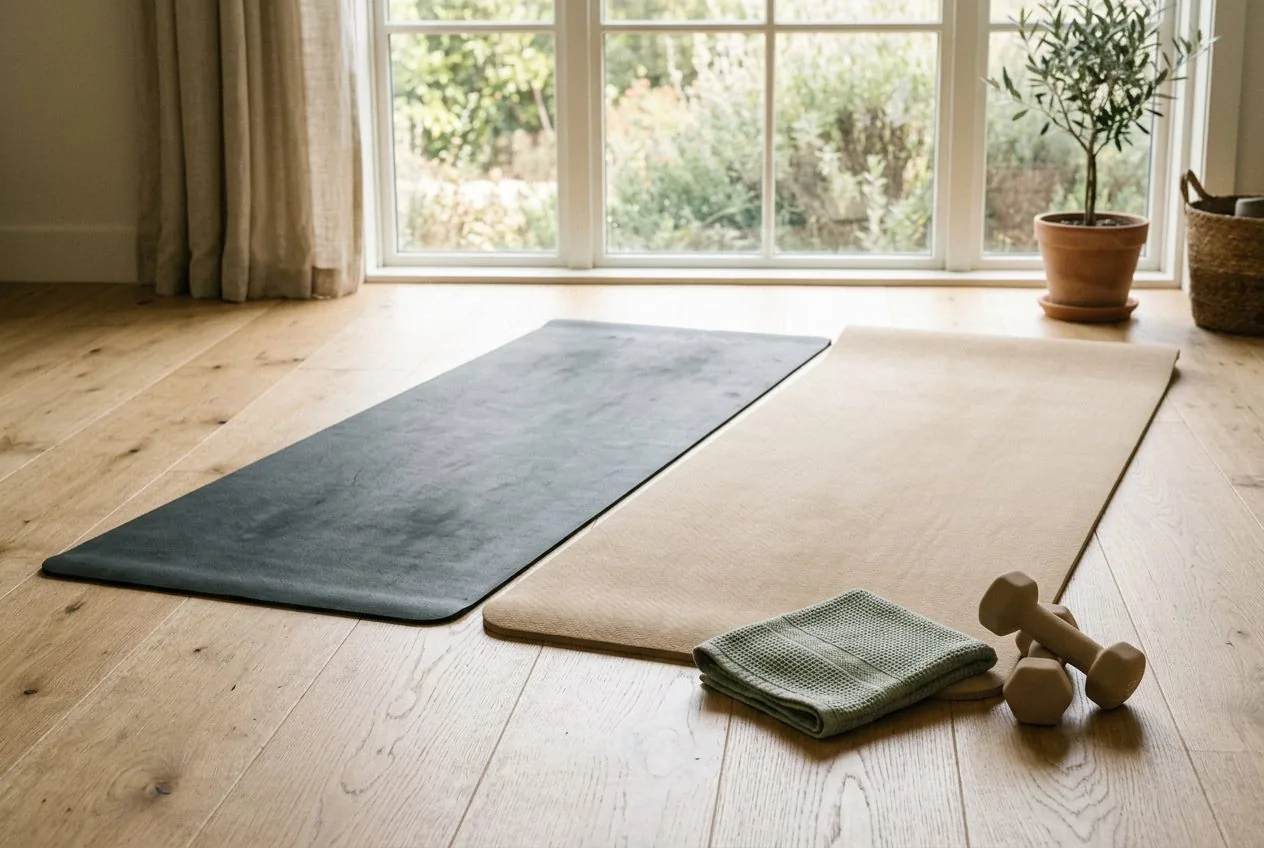
Is a thick or a thin yoga mat kinder to your knees after 40? For kneeling and floor work, thick wins: a mat around 8 mm or more cushions knees, hips, and wrists noticeably better than the standard 4 to 6 mm (Manduka). But the moment you stand up, the trade flips, because thick, squishy foam lets your feet sink and wobble just when balance work wants a firm base. For the mixed gentle routines most women over 40 actually do, the sweet spot is the middle: around 6 mm, about 1/4 inch, with a folded towel under the knees for the poses that want more. Here is the honest trade-off in both directions, a verdict by use case, and what to look for when you buy.
Short answer for skimmers: mostly floor work and stretching? Go thick, 8 mm or more, and enjoy the cushioning. Standing and balance poses in the mix? Stay around 4 to 6 mm and give your feet a stable base. A gentle blend of both, like most routines at this age? Pick roughly 6 mm and pad your knees pose by pose. And whatever thickness you land on, grip matters more, so never trade a secure surface for extra foam.
This article is for information only and is not medical advice. Talk to your healthcare provider before starting a new exercise routine, especially if you have joint injuries, back problems, or balance concerns.
The quick comparison
| Feature | Thin to standard (4 to 6 mm) | Thick (8 mm and up) |
|---|---|---|
| Kneeling comfort | Firmer; can feel hard under knees and hips | Noticeably kinder for kneeling and floor work |
| Standing stability | Steady, planted footing | Feet sink; balance poses wobble |
| Ground feel | Clear feedback through hands and feet | Muted; harder to sense your footing |
| Wrist comfort in hands-down poses | Adequate with good form | More forgiving padding |
| Carrying and storage | Lighter, rolls tight | Bulkier and heavier to roll |
| Best for | Standing poses, balance work, flowing practice | Kneeling, stretching, restorative floor work |
Which thickness fits your practice? A quick decision framework
“My practice is mostly floor work and stretching.” Thick, happily. If your sessions live on your knees, hips, and back, a mat of 8 mm or more turns floor time from a small negotiation with the hard ground into something you can relax into. You give up some standing stability, but if you rarely stand on the mat, that cost barely shows up.
“I love standing and balance poses.” Thin to standard, around 4 to 6 mm. Balance work is where thick foam hurts most, because a sinking foot has to keep correcting itself. A firmer mat lets you feel the floor and settle into a pose instead of wobbling above it.
“I do a gentle mix, like most routines.” The 6 mm middle. It pads your knees for floor work and stays firm enough for a steady standing pose, which is the trade-off the thinnest and the squishiest mats both get wrong. This is the thickness most women over 40 quietly end up happiest with.
“My knees are the whole reason I am shopping.” Start at the 6 mm middle rather than jumping to the thickest mat on the shelf, and add a folded towel or a small kneeling pad for the specific poses that want more. You protect your knees where it matters without carrying wobble through the rest of the session.
The over-40 lens: knees, wrists, and steadiness
Two things change the calculus after 40. The first is that kneeling comfort stops being optional. Wrists, knees, and hips take your weight in a lot of gentle movement, and a thin, hard mat makes every kneeling pose a small negotiation with discomfort. A bit of cushioning turns that into something you can actually relax into, which quietly decides whether the habit survives.
The second is that steadiness deserves more respect, not less. Gentle balance work is one of the most useful things you can practice at this age, and it feels far safer and more pleasant on a surface that lets your feet sense the floor. If you want to train that steadiness deliberately, our balance trainer review covers a tool made for exactly that job. That is the honest case against simply buying the thickest mat: the same softness that comforts your knees muddles the feedback your feet rely on; a study of older women found that standing on foam significantly increased body sway compared with a firm surface (PLoS One). Kindness to your knees and kindness to your balance pull in opposite directions, and the right mat is the one that respects your practice’s actual mix.
Grip belongs in this lens too. A mat that lets your hands slide in a forward fold is unpleasant at any thickness, and feeling planted rather than skiddy is what lets you settle into a stretch instead of bracing against a slow slide. Whatever thickness you choose, a matte, textured surface with strong dry grip comes first.
When thick helps, and when it gets in the way
The case for thick is real and specific: kneeling poses, hands-and-knees work, hip stretches, and anything restorative where you lie on the floor for a while. If a hard surface is what talks you out of floor work, an 8 mm mat removes that excuse for a few extra dollars, and that alone can be worth it.
The case against is just as specific. Beyond balance poses, very thick mats are bulkier to roll and carry, and soft foam tends to compress faster than denser material, so the plush feel of week one is not always the feel of month six. One caution at the far end: the extra-thick cushions sold as exercise mats are built for lying-down floor exercise, not for standing practice, and they make even a simple standing stretch feel like soft sand. If your routine includes any standing at all, they are the wrong buy.
Neither thickness fixes a bad mat, though. A slick, flimsy surface is a false economy at 4 mm and at 10 mm alike, so let thickness pick your comfort and let grip and material quality pick the actual mat.
What to buy once you know your thickness
With the thickness question settled by your practice, the rest of the checklist is the same for everyone.
| Feature | What to look for | Why it matters after 40 |
|---|---|---|
| Grip | Strong dry grip, matte texture | Keeps hands and feet from sliding |
| Thickness | Matched to your practice; around 6 mm for a mix | Cushions joints without wobbling |
| Firmness | Cushioned but stable | Lets balance work feel secure |
| Material | Durable rubber or quality TPE | Holds grip and padding for years |
| Size | Long and wide enough to move | Room to stretch without hanging off |
| Weight | Light enough to roll and carry | Easy to store means kept in use |
A sensible mid-range mat covers all of this. The very cheapest mats tend to be thin, slippery, and quick to flatten, which is exactly what makes gentle movement uncomfortable, while premium studio prices mostly buy durability you can get for less. What the middle of the range should deliver is a surface that grips, cushioning that does not pack down flat within a few months, and a size that lets you move freely. All prices move constantly, so check current pricing before you buy.
A little care keeps whichever mat you choose working: wipe it down with a damp cloth after sweaty sessions, skip harsh cleaners and soaps unless your mat’s maker recommends one, let it dry before rolling it, and keep natural rubber out of direct sunlight (JadeYoga; Manduka). Gentle care is what preserves the grip you paid for.
Neither mat does the work
Here is the honest part a product page will not tell you: no thickness of foam stretches, strengthens, or steadies anything on its own. A mat is a surface, and the benefit comes from the movement you do on it. The right thickness simply removes the small discomforts, achy knees or wobbly feet, that quietly talk you out of showing up. Treat the mat as the thing that lowers the bar to starting, not the thing that gets you there. If you are new to this and want a place to begin, our how to start yoga after 45 guide walks you in gently. And when your mat work asks for a first strength tool, our kettlebell vs dumbbells vs bands comparison settles that first buy.
The honest bottom line
Thick and thin mats are not rivals so much as tools for different jobs. Thick, 8 mm and up, is genuinely kinder to knees, hips, and wrists during floor work, and if that is where your practice lives, buy it without guilt. Thin to standard, 4 to 6 mm, keeps your feet planted for standing and balance work, where thick foam quietly works against you. For the mixed, gentle routines most women over 40 actually do, a mat around 6 mm with strong dry grip and durable material is the answer that respects both your knees and your steadiness, with a folded towel on standby for the poses that want more padding.
Roll it out where you will see it, keep it clean so the grip lasts, and let its comfort do its quiet job of getting you onto the floor. For calm sequences to use on it, our gentle mat moves for mobility gives you a friendly place to start, and the rest of our gentle strength section offers joint-friendly routines for whichever mat you choose. A mat also pairs naturally with small props; our verdict on whether a pilates ring is worth it for core strength looks at the gentlest of them.
Frequently Asked Questions
- Is a thick or thin yoga mat better after 40?
- It depends on where your practice lives. If most of your time is spent kneeling or lying down, a thicker mat around 8 mm or more is kinder to knees, hips, and wrists. If you do much standing or balance work, a thinner, firmer mat around 4 to 6 mm keeps your feet planted and your poses steady. For the mixed gentle routines most women over 40 actually do, the middle wins: a mat around 6 mm, about 1/4 inch, pads the joints without turning balance poses wobbly.
- How thick should a yoga mat be for sensitive knees?
- Around 6 mm, about 1/4 inch, suits most sensitive knees. The thinnest studio mats, around 3 to 4 mm, are fine for standing work but can feel hard under knees, wrists, and hips during floor poses. A 6 mm mat gives noticeably more cushioning for kneeling without becoming so soft that standing poses feel unstable. If your knees want even more for a particular pose, fold a towel or place a small pad under them for that pose only, rather than carrying extra-thick foam through the whole session.
- Is a thicker mat always better for bad knees?
- More cushioning helps sore knees, but there is a trade-off, so thicker is not always better. A very thick, squishy mat is gentle for kneeling but makes standing balance poses harder, because your feet sink and wobble. For most women over 40 with cranky knees, a mat around 1/4 inch is the sweet spot: enough padding to protect the joints, firm enough to stand steadily. If your knees need even more, it is often better to fold a towel or add a small pad under them for kneeling work than to buy a mat so thick it undermines your balance the rest of the time.
- Does a thick yoga mat make balance poses harder?
- Yes, noticeably. In a balance pose your body steadies itself through your feet, and a thick, squishy surface muddles that feedback: your foot sinks, wobbles, and has to keep correcting. That is why very thick mats can feel less secure for standing work even though they feel wonderful for kneeling. If balance practice matters to you, keep the mat around 6 mm or under and add padding under your knees only when a pose calls for it.
- What matters besides thickness when choosing a yoga mat?
- Grip, above almost everything. A mat that lets your hands slide forward in a gentle fold is unpleasant at any thickness, so look for a matte, textured surface with strong dry grip; natural rubber and good-quality TPE tend to hold well, while cheap slick PVC does not. After grip comes durability, because the cheapest mats flatten and turn slick within months, and then size and weight, so the mat is roomy enough to move on and light enough to roll up and keep in reach. A sensible mid-range mat covers all of this without a premium studio price.
Sources & references
Before you go
The 7-Day Protein-First Meal Plan for Women Over 40
A complete protein-first week, finished for you: your personal protein target, a one-page shopping list, 21 recipes at 25-35 g protein each, and a timed 90-minute prep schedule. Printable PDF, paired with a free 7-lesson email course.
Free guide
The 7-Day Protein-First Meal Plan for Women Over 40
A complete protein-first week, finished for you: your personal protein target, a one-page shopping list, 21 recipes at 25-35 g protein each, and a timed 90-minute prep schedule. Printable PDF, paired with a free 7-lesson email course.