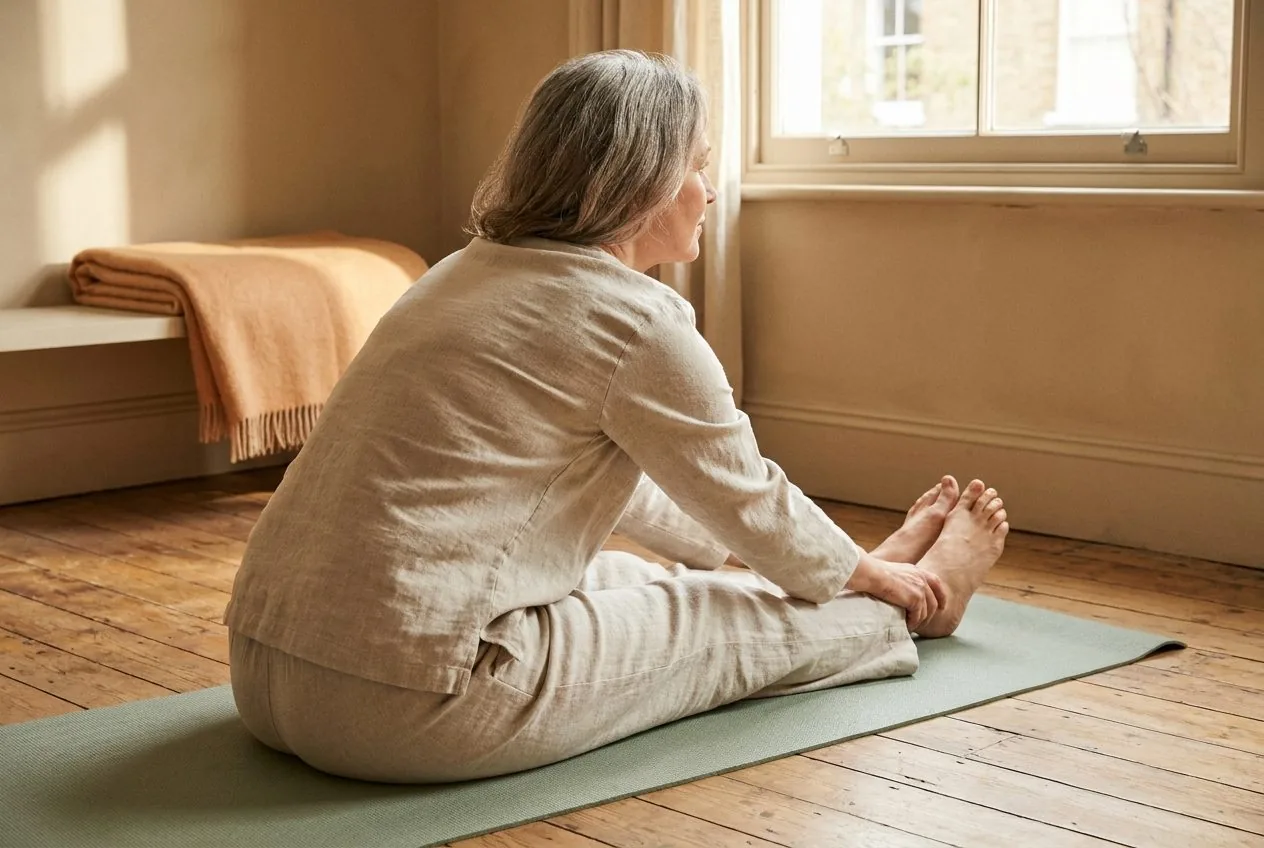
Some days your body just feels stiff, a little tight through the hips, a little locked through the back, a little braced from a busy week, and what it wants is not a hard workout but a few gentle minutes of movement. That is exactly what a short mat sequence gives you. Moving slowly through a handful of easy shapes helps your joints and muscles feel looser, tends to leave you steadier and more comfortable, and can have a quietly calming effect (NCCIH). You do not need to be flexible, and you certainly do not need to be a yoga person. You just need a comfortable mat, a bit of floor, and permission to go slow.
Below are six gentle mat moves that ease stiffness and settle the body. Do them slowly, breathe easily, and only ever move as far as feels comfortable. Stiffness is normal; sharp pain is a signal to ease off.
This article is for information only and is not medical advice. Talk to your healthcare provider before starting a new exercise routine, especially if you have joint injuries, osteoporosis, or any condition that affects movement or balance.
The simple idea behind all six
Mobility and calm both respond to the same thing: slow, gentle movement through a comfortable range, repeated often. You are not stretching hard or holding uncomfortable positions; you are simply taking each area through an easy range so it remembers how to move freely, and letting your breath slow as you go. Two principles run through every move here: keep it gentle enough that you could hold a conversation (CDC), and never chase a deeper position with force. Ease, not effort, is the whole point.
The 6 moves
Set up on a cushioned, non-slip mat so your knees, hips, and hands are comfortable. Move slowly, breathe through your nose if you can, and spend around 30 to 60 seconds, or five to eight slow repetitions, on each move. Keep something sturdy nearby if getting down and up is hard.
1. Cat-cow
Why it helps: gently mobilizes the whole spine, easing back and neck stiffness. On your hands and knees, slowly drop your belly and lift your gaze as you breathe in, then round your back and tuck your chin as you breathe out. Let the movement flow with your breath, small and comfortable. This is one of the kindest ways to wake up a stiff back.
2. Child’s pose
Why it helps: opens the hips and lower back while calming the whole body. From your hands and knees, sit your hips back toward your heels and let your arms rest forward, resting your forehead on the mat or a cushion. Breathe slowly into your back. Widen your knees if your hips feel tight. Stay as long as it feels good.
3. Supine spinal twist
Why it helps: eases the lower back and hips and releases tension through the trunk. Lie on your back, hug one knee in, then let it cross gently over your body toward the floor as you turn your gaze the other way. Keep both shoulders soft on the mat. Breathe, then switch sides. Let gravity do the work rather than forcing the knee down.
4. Glute bridge
Why it helps: gently strengthens the hips and back that support steady, upright movement. Lie on your back with knees bent and feet flat, and slowly lift your hips by squeezing your glutes, then lower with control. Keep it smooth and unrushed. This gentle strengthener wakes up the muscles that keep you steady on your feet.
5. Bird-dog
Why it helps: builds gentle core and back steadiness with a light balance challenge. On your hands and knees, slowly reach one arm forward and the opposite leg back, keeping your hips level and your middle braced, then return with control and switch sides. Move slowly and keep it small. This trains the quiet steadiness that supports your back all day.
6. Knee-to-chest hug
Why it helps: releases the lower back and hips and makes a soothing, calming finish. Lie on your back and draw both knees gently toward your chest, holding lightly and letting your lower back soften into the mat. Rock a touch side to side if it feels nice. Breathe slowly and let everything settle. This is a lovely way to end the sequence feeling calm.
Group them by what you need today
If you want to ease morning stiffness: start with cat-cow, child’s pose, and the supine twist. They gently free the spine and hips that feel most locked after sleep.
If you want a little gentle strength too: add the glute bridge and bird-dog. They wake up the muscles that keep you steady without any strain.
If you want to wind down and calm: finish with child’s pose and the knee-to-chest hug, breathing slowly. A few quiet minutes here settles both body and mind.
Make it a gentle daily habit
The magic of a sequence like this is not intensity; it is that it is easy enough to do often. Mobility and calm both come from gentle, repeated practice, so a few minutes most days is a better bet than one ambitious session you dread and skip (HHS). Roll out the mat when you wake, before bed, or in any small gap in the day, and run through as many of the six as you have time for. Because none of it is tiring, there is no recovery to schedule around and no reason not to return tomorrow. Keep it slow, keep it comfortable, and let the frequency, not the effort, do the work.
Common mistakes to sidestep
Forcing a deeper position. These moves work through comfort, not strain. If you are gritting your teeth to go further, ease back to where you can breathe easily.
Rushing through. Speed empties these moves of their benefit. Slow down, match the movement to your breath, and let each shape unfold gently.
Skipping the mat. A hard floor makes floor work miserable and gives you an easy excuse to quit. A cushioned, non-slip mat removes that barrier and protects your joints.
Holding your breath. Tension creeps in when you stop breathing. Keep your breath slow and steady, and the calming effect comes along for free.
The gear you actually need
Almost nothing. A cushioned, non-slip yoga mat so the floor is kind to your knees, hips, and hands is really the only thing that matters, and a cushion for under your head or forehead is a nice extra. That is the whole kit. A good mat is an inexpensive way to make sure you actually get down and move, which is the entire battle.
Want to build a little strength alongside?
Gentle mobility work pairs beautifully with gentle strength, and the two support each other, looser joints make strength work more comfortable, and stronger muscles make everyday movement steadier. If you would like to add some easy strength to your week, our strength habit at home how-to shows how to make short, joint-friendly sessions stick, and you will find plenty more in our gentle strength section.
The honest bottom line
A few gentle mat moves will not transform your body, and no honest guide should pretend otherwise. What slow, regular movement genuinely tends to support is looser joints, less everyday stiffness, steadier movement, and a calmer, more settled feeling that carries into the rest of your day (NCCIH). Roll out a comfortable mat, move slowly through as many of the six as you have time for, and never force a shape. Do it most days, keep it kind, and let the quiet, unglamorous habit do the real work.
Frequently Asked Questions
- Can gentle mat moves really improve my mobility after 40?
- Regular, gentle movement through a comfortable range tends to support how mobile and loose your joints and muscles feel, which can mean less morning stiffness and easier everyday movement. It is not a medical treatment and it will not fix a joint problem on its own, but moving gently and often is one of the most sensible, well-supported things you can do for a midlife body. If you have a specific joint issue or pain that lingers, check with your provider so your routine fits what your body needs.
- How often should I do these mat moves?
- A few minutes most days does more for mobility and calm than one long session a week, because both respond well to gentle, frequent practice. You can run through the whole sequence in the morning to ease overnight stiffness, or unwind with it in the evening. Even a couple of moves while you wait for the kettle counts. Little and often, kept slow and comfortable, is the rhythm that builds ease that lasts, so aim for consistency rather than intensity.
- Do I need a yoga mat for floor moves after 40?
- You do not strictly need one, but a good mat makes floor work far more comfortable, which makes you far more likely to do it. A cushioned, non-slip mat protects knees, hips, and elbows from a hard floor and stops your hands and feet sliding during the moves, both of which matter more as joints get less forgiving. It is an inexpensive bit of gear that quietly removes a real barrier to getting down and moving gently, so for most people it is well worth having.
- Are these moves safe if I am stiff or new to exercise?
- They are designed to be gentle and beginner-friendly, moving each joint through a comfortable range rather than forcing anything, which suits a stiff or new body well. Move slowly, only go as far as feels easy, and never push into sharp pain. Use a mat for cushioning, keep something sturdy nearby if getting up and down is hard, and stop anything that does not feel right. If you have injuries or a health condition, check with your provider first so you can adapt the moves to your needs.
Sources & references
Before you go
The 7-Day Protein-First Meal Plan for Women Over 40
A complete protein-first week, finished for you: your personal protein target, a one-page shopping list, 21 recipes at 25-35 g protein each, and a timed 90-minute prep schedule. Printable PDF, paired with a free 7-lesson email course.
Free guide
The 7-Day Protein-First Meal Plan for Women Over 40
A complete protein-first week, finished for you: your personal protein target, a one-page shopping list, 21 recipes at 25-35 g protein each, and a timed 90-minute prep schedule. Printable PDF, paired with a free 7-lesson email course.