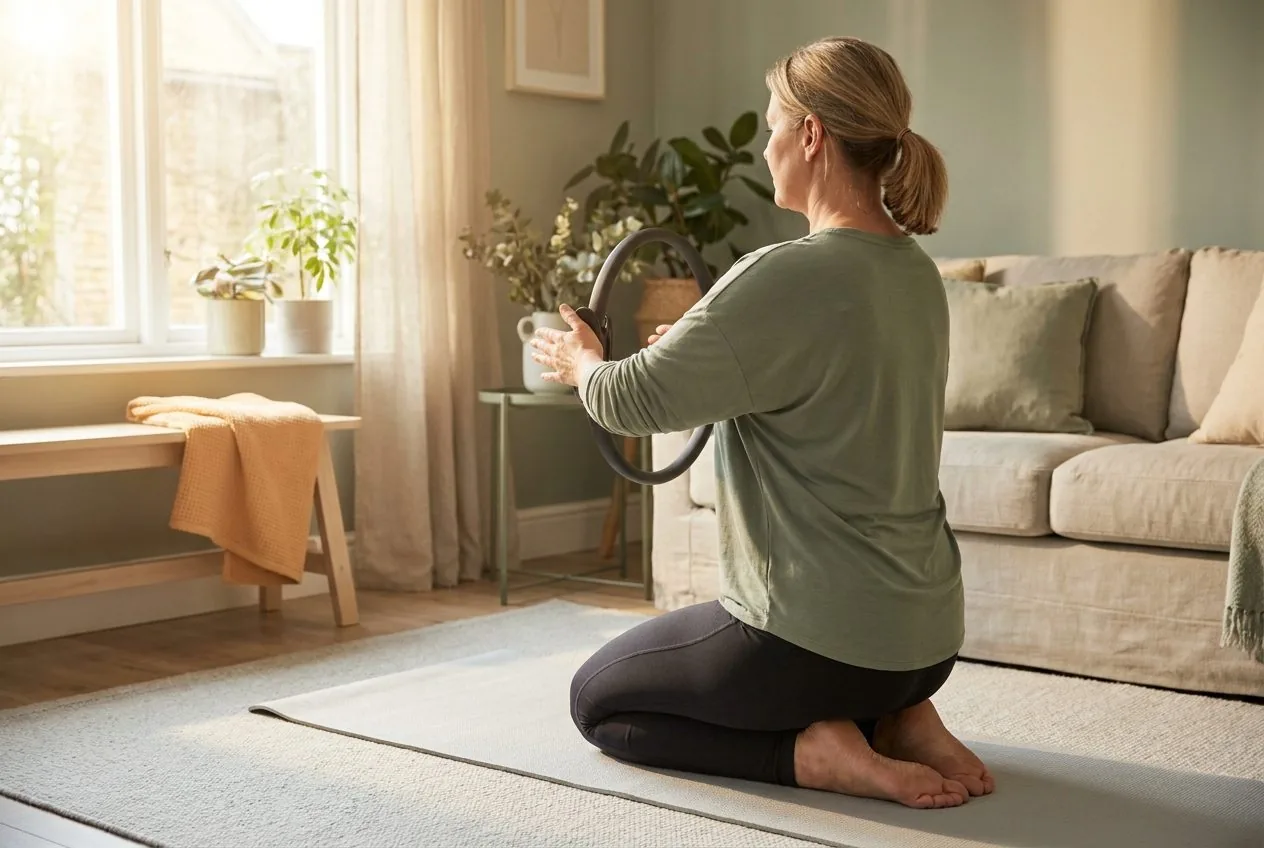
For most women over 40 who want gentle, joint-friendly core work, yes: a Pilates ring is worth it. It costs about as much as a takeout dinner, adds real, controllable resistance to core and inner-thigh moves that mat-only work leaves light, and it is one of the hardest tools in fitness to use badly. The honest caveats sit right beside that verdict: a ring is an accessory rather than a complete strength plan, and if you already own resistance bands you enjoy, you can reach most of the same goals without it. This guide walks through exactly what the ring adds, who gets real value from one, who can happily skip it, and what to look for if you decide to buy.
This verdict comes from a category review: we judged the features that decide whether a ring suits a woman over 40, not a lab test of one branded model. Rings are a crowded, fast-changing market and prices move constantly, so we focus on what stays true no matter which model is in stock this month.
Our verdict: worth it for most, as a standard 12 to 15 inch ring with padded grips on both sides and both ends, and a smooth, springy medium resistance. 8/10. A Pilates ring earns its small price by adding gentle, fully controllable resistance to core and inner-thigh work. It loses points only for what it is not: a complete strength tool. Comfort and a smooth resistance beat every extra feature.
This article is for information only and is not medical advice. Talk to your healthcare provider before starting a new exercise routine, especially if you have joint injuries, heart conditions, or dizziness.
What a ring adds over mat-only core work
The honest case for the ring is simple: it turns plain core moves into resisted ones, in the gentlest possible way. A padded ring you squeeze between your knees, palms, or ankles gives a body-weight move something to work against, and that small change is where the value lives. Three things carry it.
You control every ounce of effort. The ring only pushes back as hard as you squeeze it, so there is no fixed load to be too much on a tired day. That makes it genuinely gentle, and it means you can dial the effort up or down move by move without changing anything but your intent.
It reaches muscles that mat work neglects. Squeezing the ring between your knees targets the inner thighs, and bracing your middle as you squeeze brings the core into gentle play. Body-weight floor work touches these areas only lightly, and plain walking barely at all, so a little focused resistance goes a long way.
It removes the barriers to starting. No floor, no heavy weight, no setup. You can keep the ring by the sofa and do a few slow squeezes during an evening, which is exactly the kind of low-friction habit that actually sticks.
The honest limit sits right beside the value: a Pilates ring is a light accessory, not a complete strength tool. It adds gentle resistance to core, thigh, and arm work, but it will not build the whole-body strength that squats, hinges, and rows do. For most women over 40 that is fine, because it is meant to complement a broader routine, not replace it. If you want the fuller trade-off between the two most popular gentle tools, our Pilates ring vs resistance bands comparison covers when each shines.
Why it suits an over-40 body
Joint-friendliness is where the ring quietly outclasses most gear. There is no weight to drop, no unstable surface to wobble on, and the resistance disappears the moment you stop squeezing, so nothing keeps loading a joint that has had enough. You can use it sitting on a chair or the sofa, which spares your wrists and knees the floor time that puts many women off core work in the first place.
That control matters more in midlife, when a tired day and a strong day can feel very different. With a fixed weight, the tool decides the load; with a ring, you do. Squeeze slowly, hold for a second or two, and release with control, breathing the whole time. The ring rewards gentle, deliberate effort far more than force, and you certainly should not turn every rep into a grimace.
Who gets real value from one
Buy if you like the idea of gentle, low-impact core and inner-thigh work, you want a tool you can use on a chair or sofa without getting on the floor, and you value cheap, tiny gear that grows into a quiet daily habit. For that reader, the ring is an easy yes: the cost is small, the learning curve is nearly flat, and the habit it supports is one you can keep for years.
Who can happily skip it
Skip if you already own resistance bands you enjoy and a routine that works, if what you are really missing is a complete plan rather than an accessory, or if you want a single tool to build whole-body strength, in which case a band or a light weight is a better first buy and a ring can come later; our adjustable dumbbells review for women over 40 covers the pick that grows with you there. There is no gap in your routine that only a ring can fill; it is a pleasant way to add resistance, not the only way.
What to look for if you decide to buy
Four things separate a Pilates ring you will keep reaching for from one that gathers dust.
- Is the resistance smooth and controllable? The best rings give a springy, even push-back that lets you squeeze slowly and hold. Avoid ones that feel flimsy, where there is barely anything to work against, or brutally stiff, where the squeeze becomes a strain.
- Are the grips comfortable and well-placed? You want padded grips on both flat sides, for squeezing between the palms, and on both ends, for pressing between the knees or ankles. Bare or hard grips dig in and end sessions early.
- Is it the right size and weight? A standard 12 to 15 inch ring (Balanced Body) sits comfortably between the knees and in the hands. It should feel light and easy to position, not bulky or awkward to hold in place.
- Is it durable and low-maintenance? A good ring keeps its springiness for years and wipes clean. Cheaper ones can lose their tension or crack at the grips, so a sturdy build is worth a dollar or two more.
Weigh the first two most heavily, because a smooth, controllable resistance and comfortable grips decide whether the ring feels gentle and pleasant or awkward and easy to abandon. Expect to pay somewhere around 20 to 35 dollars, from about $20 for a mass-market ring (Gaiam) to $35 for a studio brand (Balanced Body); this is not a category where spending more buys much more, and prices move constantly, so check current pricing before you buy.
Pros and cons
| Pros | Cons |
|---|---|
| Cheap, light, and almost impossible to use dangerously | A light accessory, not a complete strength tool |
| Resistance is fully controlled by how hard you squeeze | Cheap models can feel flimsy or lose their springiness |
| Reaches inner thighs and core that walking neglects | Hard or bare grips dig into the knees and palms |
| Slides under a sofa; no floor or setup needed | Limited range of moves compared with a band |
| Gentle on the joints and friendly for true beginners | Not made for building whole-body strength |
Honest criticisms
No product category is perfect, and pretending otherwise helps no one.
The cheap ones can disappoint. Budget rings sometimes have thin, hard grips or a resistance that feels flimsy on day one and floppy within months. If comfort and durability matter to you, read grip and longevity reviews closely before buying the very cheapest option.
A ring is not a whole routine. It adds gentle resistance to core, thigh, and arm work beautifully, but a complete plan still wants some standing strength, walking, and enough protein. It is one pleasant tool, not the entire toolbox.
It is easy to overdo the grip. Because squeezing feels like effort, some people clench hard and hold their breath, which turns a gentle move into a tense one. The fix is simple: squeeze slowly, keep breathing, and treat control, not force, as the goal.
What we will not promise
A Pilates ring will not transform your body or flatten your middle, and no honest guide should pretend otherwise. What consistent, gentle ring work genuinely tends to support is light core and inner-thigh strength and a nicer sense of control in your middle, as one part of a broader habit. Results depend on using it regularly alongside the fundamentals, and on giving it months rather than days. Buy the tool, then let the habit do the real work.
The honest bottom line
So, is a Pilates ring worth it for core strength after 40? For the woman who wants gentle, low-impact core and inner-thigh work she can do from a chair or sofa, yes, comfortably. The right buy is not the stiffest or the fanciest ring; it is the standard-sized one with comfortable padded grips and a smooth, controllable resistance you can keep gentle. It costs very little, asks almost nothing of your schedule, and slides out of sight when you are done. Squeeze slowly, keep breathing, and use it as a pleasant complement to walking and some standing strength rather than as a standalone fix.
If you are weighing a ring against a set of resistance bands for your first gentle tool, our Pilates ring vs resistance bands comparison lays out which fits which goal, and our earlier Pilates ring vs balance trainer comparison helps if steadiness is also on your mind. The rest of our gentle strength section gives you routines to put your ring to work.
Frequently Asked Questions
- Is a Pilates ring worth it for core strength after 40?
- For most women who want gentle, low-impact core work, yes. A ring costs roughly 20 to 35 dollars, adds a light, controllable resistance to core, inner-thigh, and arm moves, and is about as joint-friendly as exercise gear gets. It earns its place if you will actually use it a few times a week and you do not already own a tool that covers the same ground. It is an accessory rather than a complete plan, so treat it as a pleasant addition to walking and some standing strength, not a substitute for them.
- What does a Pilates ring add over mat-only core work?
- Resistance you control, and feedback you can feel. Mat-only core work relies on your own body weight, which is a fine start but leaves the inner thighs lightly challenged and gives you little to press against. Squeezing a padded ring between your knees or palms adds a gentle load exactly where you want it, and the push-back tells you instantly whether you are working or drifting. Because the resistance only exists while you squeeze, it stays as gentle as you need on any given day.
- Are Pilates rings safe for beginners over 40?
- About as safe as exercise gear gets. There is no weight to drop, no unstable surface, and the resistance only exists while you actively squeeze, so the worst that tends to happen is you squeeze a little too enthusiastically and ease off. The main care points are simple: keep your squeezes slow and controlled rather than sharp, do not grip so hard that you hold your breath, and stop any move that causes joint pain. If you have a wrist, knee, or hip issue, keep the pressure light and check with your provider before starting.
- Do I need a Pilates ring if I already have resistance bands?
- Not necessarily. Bands and rings overlap, and you can do gentle core work with either. A ring shines for squeezing moves between the knees, palms, or ankles, where its steady inward resistance is easy to control and hard to get wrong. Bands are more versatile overall, since you can pull, press, and anchor them for a wider range of moves. If you already own bands and enjoy using them, a ring is a nice, cheap addition rather than a must-buy. Our comparison below lays out which tool fits which goal.
- What should I look for if I decide to buy a Pilates ring?
- A standard 12 to 15 inch ring with padded grips on both flat sides and both ends, and a resistance that feels smooth and springy rather than flimsy or brutally stiff. Comfortable grips matter most, because bare or hard edges dig into the knees and palms and end sessions early. Expect to pay roughly 20 to 35 dollars; paying more rarely buys much more. Prices move constantly, so check current pricing before you buy, but this is not a category where you need to spend much to get a ring that lasts for years.
Sources & references
Before you go
The 7-Day Protein-First Meal Plan for Women Over 40
A complete protein-first week, finished for you: your personal protein target, a one-page shopping list, 21 recipes at 25-35 g protein each, and a timed 90-minute prep schedule. Printable PDF, paired with a free 7-lesson email course.
Free guide
The 7-Day Protein-First Meal Plan for Women Over 40
A complete protein-first week, finished for you: your personal protein target, a one-page shopping list, 21 recipes at 25-35 g protein each, and a timed 90-minute prep schedule. Printable PDF, paired with a free 7-lesson email course.