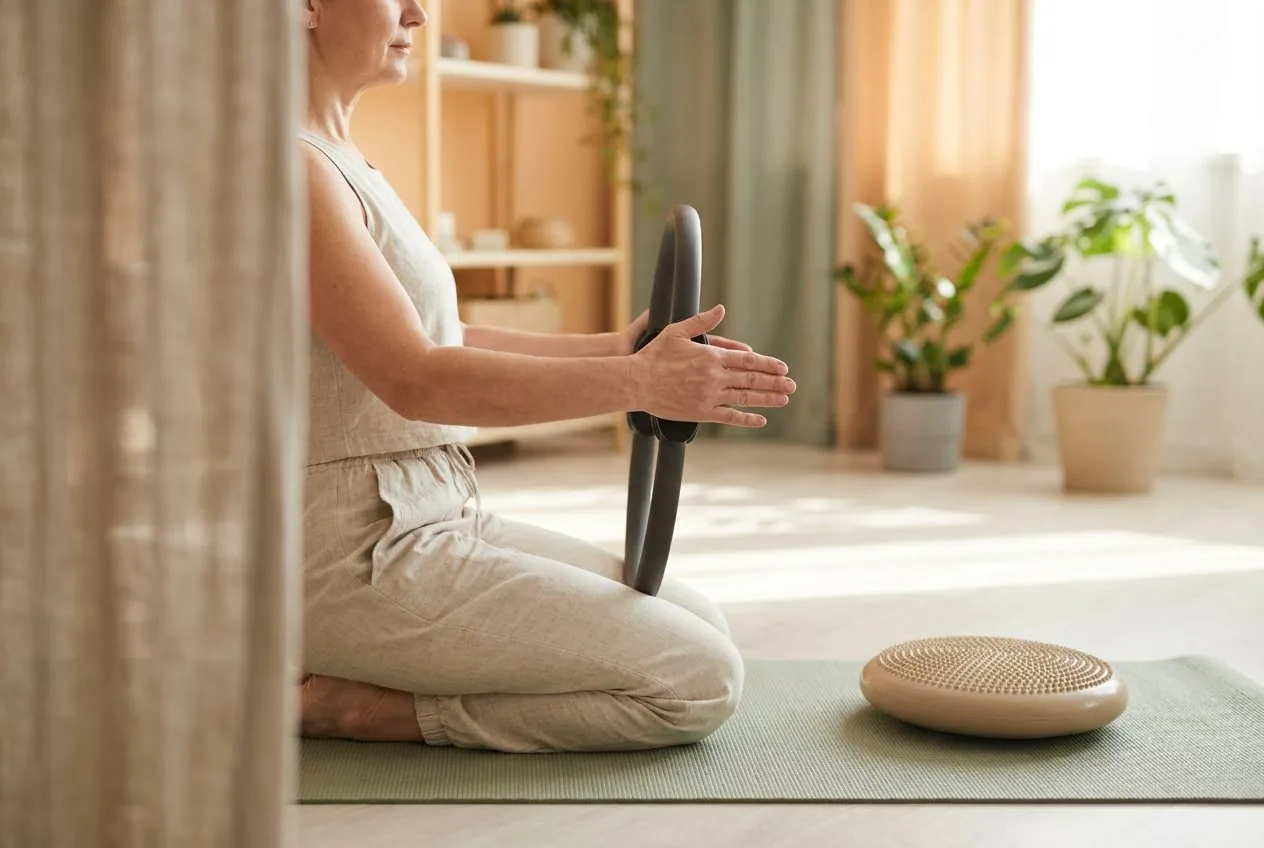
Perimenopause quietly changes something that matters more than it gets credit for: bone density. For many women, osteoporosis begins to develop a year or two before menopause, and low estrogen after menopause raises the risk (NIAMS), which makes a stumble carry higher stakes than it once did. That is not a reason for alarm, but it is a reason steadiness training stops being optional and starts being worth building into a routine, alongside the gentle strength work that keeps the rest of the body resilient. It is exactly why this comparison, between a tool that steadies you and one that strengthens you, matters more after 40 than it might have a decade ago.
If you want to add gentle strength or feel steadier on your feet at home after 40, two small, affordable tools come up again and again: the Pilates ring and the balance trainer. They look nothing alike and, honestly, they do different jobs, but both get sold as a do-everything solution, which muddies the choice. So let us sort it out plainly, without pretending either is a miracle. Both are genuinely useful. They simply answer different questions, one about gentle strength, the other about steadiness.
Short answer for skimmers: if your goal is gentle core, inner-thigh, and arm strength on a tiny budget, choose a Pilates ring. It is light, cheap, and almost impossible to use wrong. If your goal is feeling steadier and more confident on your feet, choose a balance trainer, which trains that steadiness directly on an unstable surface. They complement each other, so some women add the second later, but start with the one that matches your main goal.
This article is for information only and is not medical advice. Talk to your healthcare provider before starting a new exercise routine, especially if you have joint injuries, a history of falls, dizziness, or balance concerns.
The quick comparison
| Feature | Pilates ring | Balance trainer |
|---|---|---|
| Cost to start | Lowest | Low to moderate |
| What it does | Gentle squeeze resistance for core, thighs, arms | An unstable surface to train steadiness |
| Best target | Core, inner and outer thighs, arms | Ankles, hips, and trunk stabilizers |
| Joint feel | Very gentle; you control the squeeze | Gentle if used low and supported |
| Storage | Tiny; slides under a sofa | Bulkier; needs a corner |
| Risk if rushed | Very low | Higher; the whole point is instability |
| Best at | Gentle strength and toning | Feeling steadier on your feet |
All prices are approximate as of mid-2026 and move constantly, so check current pricing before you buy.
Which should you pick? A quick decision framework
“I want gentle strength and toning.” Pilates ring. Squeezing the ring between your knees, palms, or ankles gives your core, inner thighs, and arms a light, controllable challenge that is easy to keep gentle. If you like the idea of quiet, low-impact strength work, start here.
“I want to feel steadier on my feet.” Balance trainer. Standing or kneeling on an unstable surface trains the exact stabilizing muscles that keep you sure-footed, which is the most direct route to that goal. Keep a wall or chair within reach and start low.
“My budget and my storage space are both tiny.” Pilates ring. It costs the least and slides under a sofa, while a balance trainer needs a corner and a little more money.
“I like a bit of a challenge and have somewhere to hold on.” Balance trainer. If you have a sturdy chair or counter beside you, the gentle wobble is engaging and satisfying to improve at over time.
“I want both gentle strength and steadier feet.” Own both, and they pair well, since a stronger core makes balance work easier. Start with whichever goal matters more today and add the other when you are ready.
The over-40 lens: what actually matters
The reason this comparison matters is that both gentle strength and steadiness quietly become more worth tending after 40, and the right tool is the one that fits your goal and you will actually use. Here is how each suits a midlife body.
Match the tool to the goal. A Pilates ring is a strength tool. It adds light resistance you control by how hard you squeeze, which makes it a gentle way to work the core and inner thighs that often get neglected. A balance trainer is a steadiness tool. Its instability asks your stabilizers to switch on and keep you upright, which is precisely how you nudge balance to improve (Cochrane). Buying the ring hoping for better balance, or the trainer hoping for toned arms, is how people end up disappointed. Pick for the job you actually want done.
Care and safety, honestly. The ring is about as low-risk as exercise gear gets; the worst that happens is you squeeze a bit too enthusiastically. The balance trainer needs more respect, because instability is its purpose. Used sensibly, low to the ground, with support nearby, and progressed slowly, it is gentle and rewarding. Used carelessly, standing tall on it with nothing to hold, it is a fall risk. The trainer is wonderful; it simply asks you to set up thoughtfully and build up gradually.
Sustainability. The best tool is the one you keep reaching for. A ring by the sofa invites a few gentle squeezes during an evening; a balance trainer in a corner invites a couple of minutes of steadiness practice while the kettle boils. Be honest about which fits your life and your goal, because the tool you use twice a week beats the cleverer one that gathers dust. If steadiness is your aim, our standing kettlebell moves for balance shows another gentle way to train it.
A gentle session with either one
Whichever you pick, the same principles keep it comfortable and safe: go slow, stay in control, and keep support nearby for anything that challenges your balance.
With a Pilates ring, try:
- Inner-thigh squeeze. Sit or lie with the ring between your knees and squeeze slowly for a couple of seconds, then release with control. Feel the inner thighs work.
- Chest press. Hold the ring between your palms at chest height and press inward slowly, then ease off. Gentle on the arms and chest.
- Seated core squeeze. Place the ring between your knees while sitting tall, and squeeze as you gently brace your middle, breathing steadily.
With a balance trainer, try:
- Two-foot stand. Stand on it with both feet, a chair beside you, and simply find your steadiness for 20 to 30 seconds, holding on as much as you need.
- Supported weight shift. Shift your weight slowly from foot to foot, keeping a hand near your support, letting your stabilizers do the work.
- Low, supported squat. With a hand on a chair, sit back into a shallow squat and stand again, slow and controlled, staying steady throughout.
Keep every rep or hold slow, and treat a wobble as a signal to hold on or go gentler, not to push through. If you want a broader gentle-strength base to build on, our strength habit at home how-to shows how to make short sessions stick.
Both are tools, not magic
Here is the honest part a product page will not tell you: neither a Pilates ring nor a balance trainer will transform your body or fix a balance problem on its own. They are gentle tools, and the value comes from using them regularly toward the right goal. What consistent ring work tends to support is gentle core and inner-thigh strength and a nicer sense of control in your middle. What consistent, sensible balance work tends to support is steadier feet and more confident everyday movement. Neither replaces the fundamentals of regular movement, some strength work, and enough protein, and neither is a medical treatment. Used well, both earn their place; they are just not miracles, and any honest guide should say so.
Whichever you choose, the tool matters far less than showing up gently and often. Pair it with regular walking and a little strength work and you have the fundamentals covered (HHS). Our gentle strength section has joint-friendly routines that fit alongside either tool.
The honest bottom line
Pilates rings and balance trainers are not rivals; they answer different questions. If you want gentle strength on the smallest budget and in the smallest space, buy a Pilates ring: it is cheap, tiny, and foolproof. If you want to feel steadier and more confident on your feet, buy a balance trainer and use it low, supported, and slow. Both are genuinely useful, and if you want both gentle strength and steadier feet, the pair complements each other nicely, with the ring building the core that makes balance work easier.
Start gentle with either one, keep support nearby for anything that tests your steadiness, and use it often enough to make it a habit. The best tool is simply the one that matches your goal and lowers the bar to starting, and then quietly grows with you as you get stronger.
Frequently Asked Questions
- Is a Pilates ring or a balance trainer better for women over 40?
- Neither is simply better; they do different jobs. A Pilates ring adds gentle, squeezable resistance for core, inner-thigh, and arm work, and it is cheap, light, and almost impossible to use dangerously. A balance trainer gives you an unstable surface to train steadiness on, which targets the small stabilizing muscles that keep you sure on your feet. If your goal is gentle strength and toning, start with the ring. If your goal is feeling steadier and more confident on your feet, the balance trainer is the more direct route.
- Are balance trainers safe for women over 40?
- They can be, with sensible setup and a slow start, but they deserve more care than a Pilates ring because their whole point is to be unstable. Set one up beside a wall, a sturdy chair, or a kitchen counter so you always have something to hold, keep both feet on it and stay low to begin with, and progress only as your steadiness grows. Avoid it entirely if you feel genuinely unsafe standing on an unstable surface, and if unsteadiness is new or worsening, see your provider first, since balance changes can have causes worth checking.
- Which one helps my balance more, a Pilates ring or a balance trainer?
- The balance trainer, directly. Standing or kneeling on an unstable surface asks the small muscles around your ankles, hips, and trunk to work constantly to keep you steady, which is exactly the kind of gentle challenge that tends to support better balance. A Pilates ring is wonderful for gentle core and inner-thigh strength, and a strong core does help steadiness indirectly, but if feeling surer on your feet is your main aim, the balance trainer trains it head-on while the ring supports it from the side.
- Should I buy both, or just one to start?
- One is plenty to start, and which one depends on your goal. If you want gentle strength and a low-cost, foolproof tool, begin with the Pilates ring. If steadiness on your feet is what you are after, begin with the balance trainer. They do complement each other, a strong core makes balance work easier, so some women add the second later, but there is no need to buy both at once. Pick the one that matches your main goal, use it for a few weeks, and you will know whether you want the other.
Sources & references
Before you go
The 7-Day Protein-First Meal Plan for Women Over 40
A complete protein-first week, finished for you: your personal protein target, a one-page shopping list, 21 recipes at 25-35 g protein each, and a timed 90-minute prep schedule. Printable PDF, paired with a free 7-lesson email course.
Free guide
The 7-Day Protein-First Meal Plan for Women Over 40
A complete protein-first week, finished for you: your personal protein target, a one-page shopping list, 21 recipes at 25-35 g protein each, and a timed 90-minute prep schedule. Printable PDF, paired with a free 7-lesson email course.