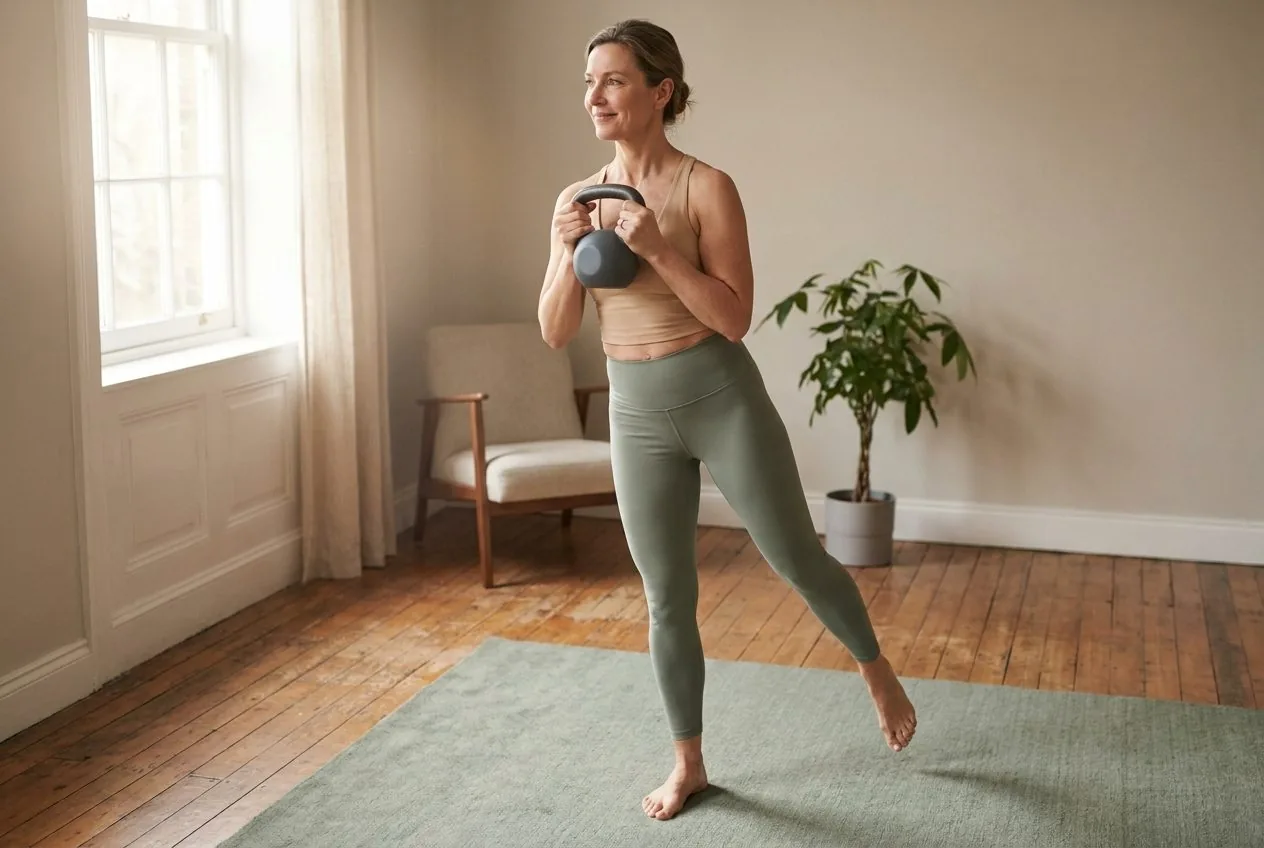
Balance is one of those quiet things you rarely think about until it wavers, and it tends to change with age, partly because muscle mass gradually declines from as early as your 30s (Current Opinion in Clinical Nutrition and Metabolic Care) and age-related muscle loss is a recognized risk factor for falls (National Institute on Aging). The good news is that muscles respond well to being asked to work (NSCA), and a single kettlebell is a surprisingly good way to ask. Holding a weight while you move, or shifting it around your body, gives your stabilizers a gentle reason to switch on and keep you steady. You do not need to swing anything or balance on one leg like a gymnast. You just need a light bell, a bit of wall to reach for, and slow, deliberate movement.
Below are seven standing kettlebell moves that build balance and strength together. Do them slowly, keep a wall or sturdy chair within reach, and treat any wobble as a signal to go lighter, not to push on.
This article is for information only and is not medical advice. Talk to your healthcare provider before starting a new exercise routine, especially if you have joint injuries, heart conditions, dizziness, or a history of falls.
The simple idea behind all seven
Balance improves when your stabilizing muscles are challenged in a controlled, slightly uncomfortable way and then given time to adapt. Adding a light weight raises that challenge without adding impact or speed, which is exactly what a midlife body wants. Two principles run through every move here: keep the bell light enough that you stay in control, and keep both feet on the floor until the basics feel easy before trying anything narrower or single-leg. Control first, load second, always.
The 7 moves
Start with a light bell for the two-hand moves and an even lighter one for anything single-sided. Aim for around 8 to 10 slow repetitions of each, or a short hold where noted, and rest as needed.
1. Kettlebell suitcase hold
Why it helps: teaches your trunk to resist leaning, the foundation of standing steadiness. Hold the bell at one side like a suitcase and simply stand tall for 20 to 30 seconds, refusing to let it pull you sideways. Keep your shoulders level and your ribs down. Switch sides. It looks like nothing and works a surprising amount.
2. Goblet squat to stand
Why it helps: strengthens the legs and hips that power every steady step and stair. Hold the bell close to your chest with both hands, sit down between your hips with your chest up and heels down, then stand tall through your whole foot. Slow and controlled, feet planted. This is the strength base your balance stands on.
3. Kettlebell halo
Why it helps: challenges your trunk to stay still while the load moves around you. Hold the bell by the horns and circle it slowly around your head, close and controlled, while your body stays quiet and upright. Reverse direction each rep. Keep your feet planted and your core gently braced so only the bell moves.
4. Standing weight shift
Why it helps: rehearses the controlled shifting of weight that steady walking depends on. Hold the bell at your chest and slowly shift your weight onto one foot, letting the other foot stay lightly touching the floor, then shift smoothly to the other side. Move like honey, not water. This is a gentle bridge toward single-leg work.
5. Kettlebell around-the-body pass
Why it helps: trains your stabilizers to keep you centered as the load travels off to one side. Pass the bell slowly around your waist from one hand to the other, standing tall and still, sending it behind your back and around the front. Keep your hips quiet and let only your arms work. Reverse direction halfway through.
6. Split-stance shoulder press
Why it helps: narrows your base and adds an overhead load, gently raising the balance demand. Stand with one foot a step ahead of the other, hold the bell at one shoulder, and press it slowly overhead, keeping your ribs down and core braced. Lower with control. Switch the front foot and the pressing arm. Keep support nearby.
7. Supported single-leg deadlift
Why it helps: the strongest balance builder here, once the earlier moves feel easy. Rest one hand on a wall or chair, hold the bell in the other, and hinge slowly forward at the hips, letting one leg float back behind you as the bell lowers toward the floor. Keep a flat back. Rise by squeezing your glute. Keep the support until you are genuinely steady, and switch sides.
Group them by where you are today
If you are new or feel unsteady: stick with moves 1 through 4, all feet-planted, for a couple of weeks. They build the strength and control that make the later moves safe.
If your balance already feels decent: add moves 5 and 6 for a bigger challenge, keeping a wall within reach.
When the rest feel easy: bring in the supported single-leg deadlift, and only let go of the wall once you are truly steady. There is no rush to progress, and staying supported is a strength, not a weakness.
Warm up before you challenge your balance
Cold, stiff joints make everything feel wobblier than it needs to, so give yourself a minute or two to loosen up before you pick up the bell. A few slow ankle circles, some gentle weight shifts from foot to foot, and a handful of easy bodyweight squats wake up the exact muscles you are about to ask to steady you. A light resistance band is lovely here too, for a few pull-aparts and some banded side steps to switch on the hips. Warming up is not wasted time; it is the difference between practicing balance safely and fighting a body that has not woken up yet.
Fit them into your week
The National Institute on Aging suggests aiming for about three sessions of balance exercises a week (National Institute on Aging), and short sessions count. You do not need a dedicated balance day. Instead, fold two or three of these moves into your regular strength sessions, and sprinkle a couple of the feet-planted ones, the suitcase hold or the standing weight shift, into odd moments while the kettle boils or the toast browns. Two or three minutes here and there adds up quickly, and that scattered approach is easier to keep up than one long session you have to schedule and dread. Keep every rep slow, keep support nearby, and let the frequency, not the intensity, do the work.
Common mistakes to sidestep
Going too heavy. A bell that is fine for a squat can wreck your balance in a halo or a press. Lighten up whenever a move gets wobbly; control is the whole point.
Ditching the wall too soon. Support is not cheating. Keeping a hand near a wall or chair (National Institute on Aging) lets you challenge your balance safely, which means you practice more and progress faster.
Rushing the reps. Balance is built in slow, deliberate movement, not speed. If you cannot do a move slowly, it is too heavy or too advanced for today.
Holding your breath. Bracing is good; freezing your breath is not (National Institute on Aging). Keep breathing steadily through every rep so you stay relaxed and stable.
Want the full kettlebell foundation?
These standing moves pair beautifully with a complete gentle routine. If you are new to the bell, our kettlebell basics for gentle strength after 40 walks through the hip hinge and a full-body sequence, so your balance work sits on a solid foundation of strength. You will find more joint-friendly routines throughout our gentle strength section.
The honest bottom line
A kettlebell will not hand you perfect balance, and no honest guide should pretend otherwise. What consistent, gentle standing work genuinely tends to support is steadier feet, more confident everyday movement, and the stabilizing strength that makes stairs, uneven ground, and getting up from the floor feel easier. Keep the bell light, keep a wall within reach, and practice a few of these moves most days. Start with the feet-planted moves, earn the harder ones slowly, and let steady, unglamorous practice do the real work.
Frequently Asked Questions
- Can a kettlebell really help my balance after 40?
- Holding a weight while you move asks the small stabilizing muscles around your ankles, hips, and trunk to work harder to keep you steady, which is exactly the kind of gentle challenge that tends to support better balance and more confident everyday movement. It is not a medical treatment and it will not fix a balance problem on its own, but strengthening those muscles is a sensible, well-supported thing to do. If you have had falls or feel dizzy, talk to your provider first and keep a wall or chair within reach.
- What size kettlebell should I use for standing balance moves?
- Lighter than you would use for swings. Because these moves add a balance challenge, control matters far more than load, so choose a light bell for holds and presses, and an even lighter one for anything single-leg. Start light enough that you can move slowly and stay steady, and only add weight once your balance and form feel solid. A wobble is a sign to go lighter, not to push through.
- Are standing kettlebell moves safe if I feel unsteady?
- They can be, with a light bell, slow movements, and support nearby. Set up beside a wall, a sturdy chair, or a kitchen counter so you always have something to reach for, and keep both feet on the floor until the basic moves feel easy before trying anything single-leg. Move slowly, stop any movement that feels genuinely unsafe, and build up gradually. If unsteadiness is new or worsening, see your provider before continuing, since balance changes can have causes worth checking.
- How often should I do these balance moves?
- The National Institute on Aging suggests aiming for about three sessions of balance exercises a week, and short sessions count. You can fold two or three of these moves into a strength session two or three times a week, or do a short standing set on other days while the kettle boils. Little and often, kept slow and controlled with support nearby, is an easy rhythm to keep up.
Sources & references
- National Institute on Aging, Three types of exercise (opens in new tab)
- National Institute on Aging, Falls and fractures in older adults (opens in new tab)
- Current Opinion in Clinical Nutrition and Metabolic Care, Muscle changes with aging (opens in new tab)
- NSCA, Resistance training for older adults (opens in new tab)
Before you go
The 7-Day Protein-First Meal Plan for Women Over 40
A complete protein-first week, finished for you: your personal protein target, a one-page shopping list, 21 recipes at 25-35 g protein each, and a timed 90-minute prep schedule. Printable PDF, paired with a free 7-lesson email course.
Free guide
The 7-Day Protein-First Meal Plan for Women Over 40
A complete protein-first week, finished for you: your personal protein target, a one-page shopping list, 21 recipes at 25-35 g protein each, and a timed 90-minute prep schedule. Printable PDF, paired with a free 7-lesson email course.