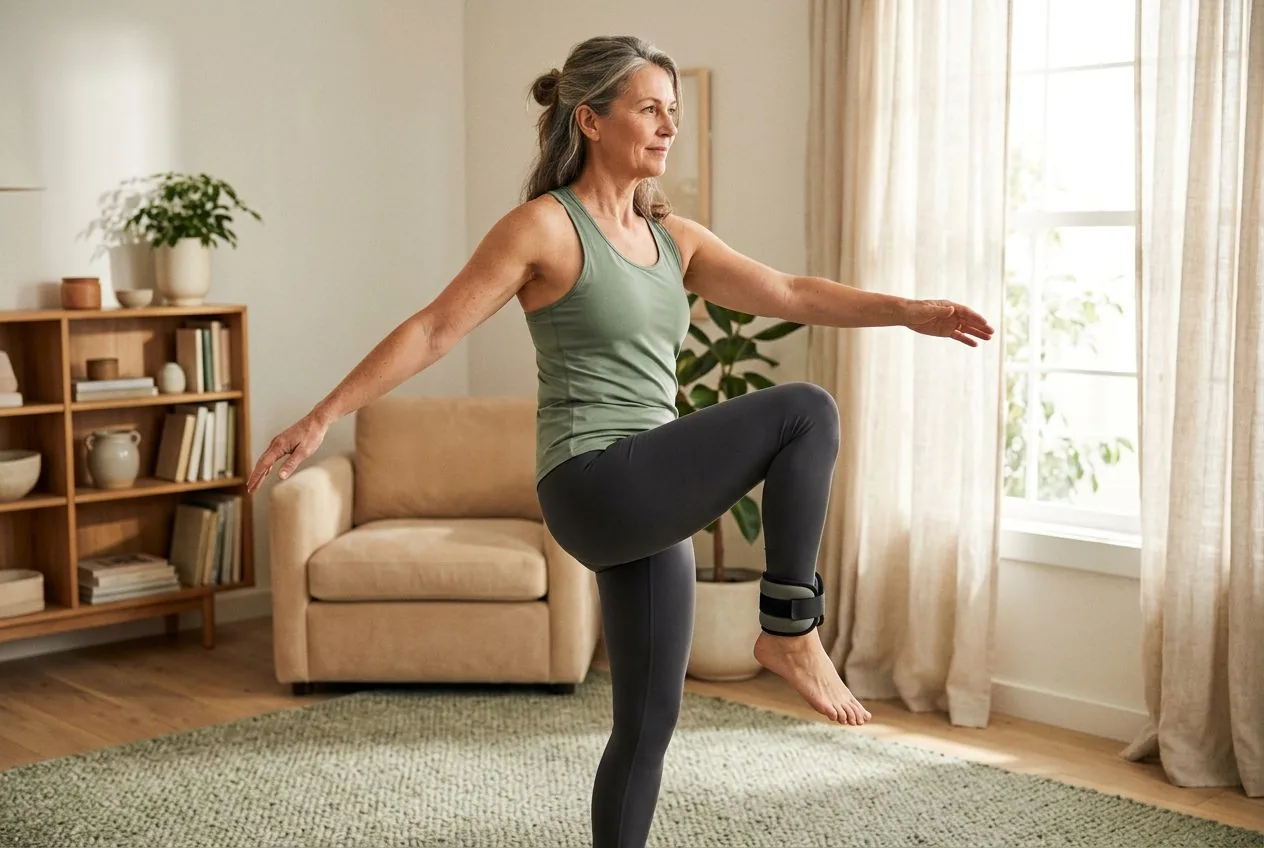
If getting down to the floor for crunches feels like more trouble than it is worth, or your neck complains before your abs do, here is some good news: you can train your core standing up. A steady middle is less about how many crunches you can grind out and more about how well the muscles around your trunk keep you upright and stable while the rest of you moves. That is exactly what standing core work trains. It is gentle on the neck and back, it needs no floor, and with a light pair of ankle weights you can nudge the challenge up whenever you are ready.
The method, in one line: move slowly through a short standing sequence two or three times a week, brace your middle before every limb moves, and add light ankle weights to the leg-lift moves only once your bodyweight form stays clean.
This article is for information only and is not medical advice. Talk to your healthcare provider before starting a new exercise routine, especially if you have joint injuries, a back condition, or dizziness.
Why standing core work suits a midlife body
The core you actually use is the one that keeps you steady on your feet. Three things make this approach a smart fit after 40.
It is kind to the neck and back. Standing core moves skip the repeated neck flexion of crunches and the pressure of pushing a curved spine against the floor, which is part of why sit-ups and crunches can be hard on the back (Harvard Health). You stay upright and in control, which many women find far more comfortable.
It trains the core’s real job. Your core’s everyday job is to stabilize your body so you can move without losing your balance (Harvard Health), stopping you from tipping, twisting, or arching. Standing marches, wood chops, and single-leg reaches all give it that anti-movement job, which is the kind of gentle challenge that tends to support a steadier middle.
It fits anywhere. No mat, no getting down and up, no equipment required to start. You can do the whole set beside the kitchen counter, which makes it far likelier to happen on a busy day. And on days when the floor does appeal, our gentle mat moves for mobility and calm makes getting down there worth the trip.
The one rule: brace, then move
The move that makes every other move work is the brace. Before you lift a knee or reach across your body, gently draw your middle in as if someone is about to poke you, and keep breathing. That brace is what turns a leg lift into core work, because your trunk has to stay still and steady while your limb moves. Move slowly, keep the range comfortable rather than forcing it big, and treat a lost brace, a leaning-back torso or an arched lower back, as the signal to slow down or go lighter.
The 8 moves
Here is a joint-friendly standing sequence you can do in 12 to 15 minutes. Move slowly, breathe, and stop any movement that causes sharp pain. Aim for around 8 to 12 slow repetitions of each, or a short hold where noted. Keep a counter or sturdy chair nearby for the balance moves.
- Tall standing brace. Feet hip-width, ribs stacked over hips, gently draw your middle in and hold for a few slow breaths. This is the foundation for everything below.
- Standing march. Brace and lift one knee slowly toward hip height without leaning back, then lower and switch sides. Light ankle weights add a gentle load to the deep core.
- Standing knee-to-elbow. Bring one knee up and across toward the opposite elbow, gently rounding your middle to meet it, then return slowly and switch sides. Slow and controlled works the obliques.
- Standing side bend. Lean slowly to one side, sliding your hand down your thigh, then return through your braced middle. Keep it small; feel the side of your waist work on the way up.
- Standing front leg lift. Hold a counter, brace, and lift one straight leg slowly forward to a comfortable height, then lower and switch sides. Ankle weights make this a gentle lower-core move.
- Standing back leg lift. Hold a counter and press one leg slowly back and slightly down, squeezing the glute without arching your back, then lower and switch sides. Your braced middle keeps your spine still.
- Standing wood chop. Clasp your hands, reach up to one side, then draw them slowly down and across toward the opposite hip, letting your middle control the movement. Return slowly, then switch sides.
- Supported single-leg reach. Hand on a counter, shift onto one foot, and slowly reach the other foot behind and to the side while staying tall, then return. Your deep core resists the twist. Switch sides.
Do the sequence once through as a gentle start, and add a second round of your favorites as you get comfortable. Two or three sessions a week is plenty, in line with the CDC’s advice to do muscle-strengthening activity on 2 or more days a week (CDC), and you can sprinkle the standing brace and march into odd moments any day.
A note on the ankle weights
Ankle weights are the one optional tool here, and they earn their place on the leg-lift moves, the march, the front lift, and the back lift, where a little load at the ankle gives your core a bit more to stabilize against. The important word is light. Because the weight sits at the end of a long lever, your leg, a pair that feels like nothing in your hand becomes plenty once your leg is extended and moving slowly. Start around a pound per ankle, keep every rep slow and braced, and never wear them for anything with impact, since walking or running in them can strain the ankle and raise injury risk for the hips, back, and knees (WebMD). If you want the full case for using them well, our ankle weight moves for steady legs how-to covers how to pick a weight and progress gently.
Fit them into your week
A steady middle rewards frequency more than length, so short and often beats long and rare. You do not need a dedicated core day. Fold two or three of these moves into your regular strength sessions two or three times a week, and sprinkle the standing brace, the march, and the wood chop into odd moments while the kettle boils or you wait for the toast. Two or three minutes here and there adds up quickly, and because core muscles do not need much recovery between sessions, that scattered approach is easier to keep up than one long session you have to schedule and dread. Keep every rep slow and braced, keep support nearby for the balance moves, and let the frequency do the work. If you would like a no-equipment routine to pair with this one, our bodyweight moves for gentle strength how-to covers the whole body in a single short session.
Common mistakes to sidestep
Leaning back to lift higher. Arching your lower back to raise a leg or knee takes the work out of your core and puts it into your spine. Keep your torso tall and lift only as high as your brace allows.
Rushing the reps. Momentum does the work instead of your muscles, and it makes the balance moves wobbly. Slow every repetition down, especially the return.
Forcing the range. A deeper side bend or a higher leg is not better if your form falls apart. Keep every move comfortable and controlled, and let the range grow on its own over weeks.
Forgetting to breathe. Bracing is good; holding your breath is not. Breathe steadily through every rep so you stay relaxed and stable.
Grab the printable sequence
If you would like these eight moves as a simple one-page checklist to keep by the kitchen counter, join our newsletter and we will send you our gentle-strength starter guide, plus honest reviews and protein-first recipes, with no shame and no miracle promises. It is the easiest way to remember the order and the form cues while the moves are still new.
The gear you actually need
Almost nothing. A bit of counter or a sturdy chair for balance, and, if you want the leg-lift moves to work harder, a light adjustable pair of ankle weights so you can add small amounts as you get stronger. That is the whole kit, and you can build a real habit before you buy anything at all. If you later fancy a small prop to progress your core work, our pilates ring vs balance trainer comparison weighs the two gentlest options.
The honest bottom line
Standing core work will not hand you a steady middle overnight, and no honest guide should pretend otherwise. What consistent, gentle practice genuinely tends to support is a steadier trunk, more confident everyday movement, and a core that helps you stay upright and stable as the years add up. Keep every move slow, brace before you move, and practice a few of these most days. Start with no weight, earn the light ankle weights slowly, and let steady, unglamorous repetition do the real work. You will find more joint-friendly routines throughout our gentle strength section.
Frequently Asked Questions
- Do I need ankle weights for standing core moves?
- Not at all. Every move here works with nothing but your own body, and the brace, the wood chop, and the knee-to-elbow do not use weights in any case. Light ankle weights simply add a gentle extra load to the leg-lift moves, which is handy once your bodyweight version feels easy and you want a little more challenge without getting on the floor. Start with no weight, prove your form is clean and your middle stays braced, and add a light pair only when you want the next small step up.
- Can standing core moves really work my core after 40?
- Yes. Your core is not only the muscles you feel in a crunch; it runs from the lower rib cage to the buttocks and includes the abdominal, back, gluteal, and pelvic muscles that keep you upright and steady. Standing marches, wood chops, and single-leg reaches all ask your deep core to keep you stable while your arms and legs move, which is exactly the kind of gentle challenge that tends to support a steadier middle and more confident everyday movement. It is different work from floor crunches, and for many women over 40 it is friendlier on the neck and back.
- Are standing core moves safe if I have a sensitive back?
- They are often gentler on the back than floor crunches, because you stay upright and in control, but they still deserve care. Keep every move slow, brace your middle before you move a limb, and avoid leaning back or arching to force a bigger range. Keep the side bend and wood chop small and comfortable rather than deep. If you have a back condition or any move causes sharp pain, stop and check with your provider before continuing.
- How often should I do standing core work?
- A few minutes most days suits a steady middle well, because core muscles do not need much recovery and can be worked daily. You can fold two or three of these moves into a strength session two or three times a week, or do a short standing set on other days while the kettle boils. Little and often, kept slow and braced, is the rhythm that builds steadiness that lasts.
Sources & references
Before you go
The 7-Day Protein-First Meal Plan for Women Over 40
A complete protein-first week, finished for you: your personal protein target, a one-page shopping list, 21 recipes at 25-35 g protein each, and a timed 90-minute prep schedule. Printable PDF, paired with a free 7-lesson email course.
Free guide
The 7-Day Protein-First Meal Plan for Women Over 40
A complete protein-first week, finished for you: your personal protein target, a one-page shopping list, 21 recipes at 25-35 g protein each, and a timed 90-minute prep schedule. Printable PDF, paired with a free 7-lesson email course.