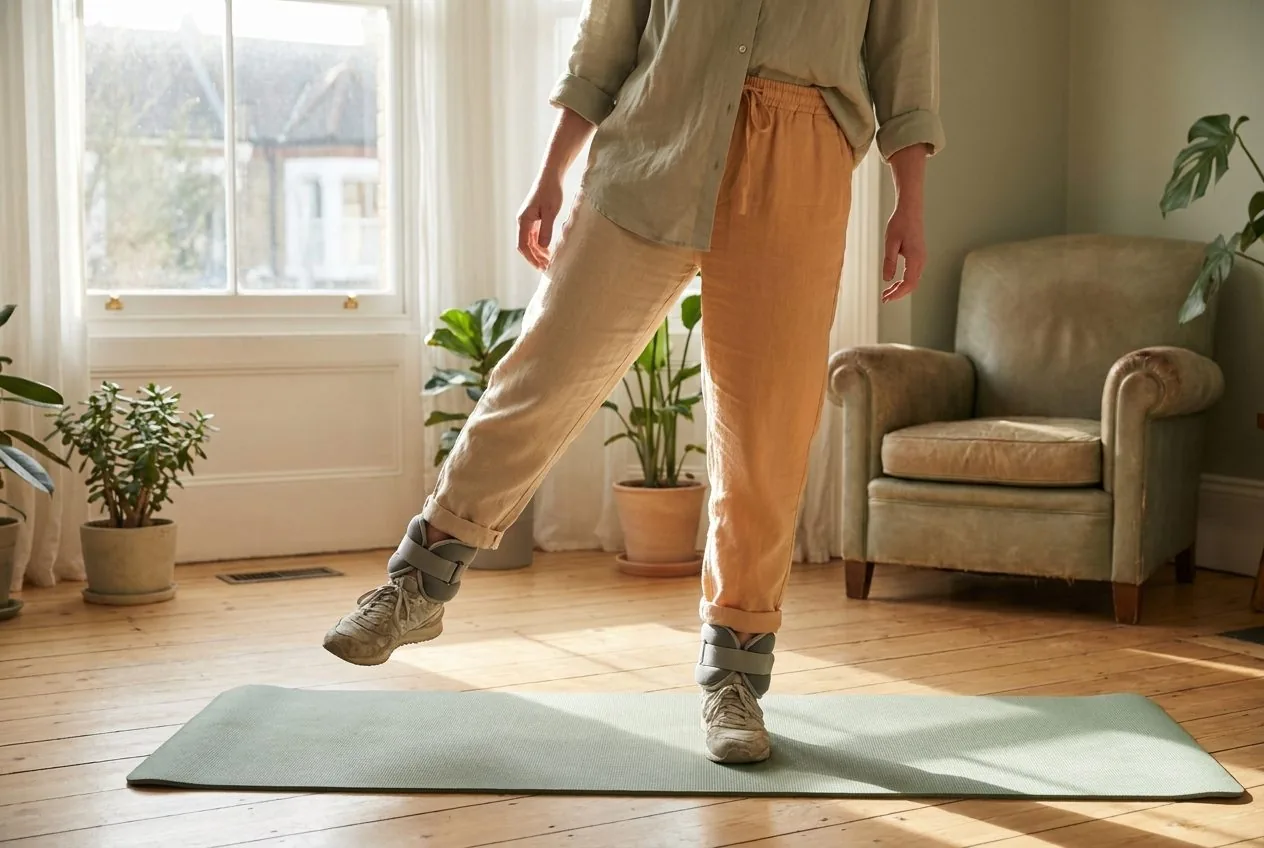
Ankle weights have a slightly dated reputation, all leg warmers and living-room videos, which is a shame, because used gently they are one of the simplest ways to add a little strength to your legs and hips after 40. Strap a light weight to each ankle and a plain leg raise suddenly has something to work against, which is exactly what the small muscles around your knees and hips need to stay strong and keep you steady on your feet. You do not need to swing them fast or wear anything heavy to benefit. In fact, slow and light is the whole point.
The method, in one line: wear light ankle weights, move slowly through a short sequence of controlled leg raises two or three times a week, and add a small amount of weight only when your form stays clean. Do that and ankle weights become a calm, joint-friendly way to build steadier legs.
This article is for information only and is not medical advice. Talk to your healthcare provider before starting a new exercise routine, especially if you have joint injuries, heart conditions, or dizziness.
First, get the weight right
The most common mistake with ankle weights is going too heavy because they feel light in your hands. Remember that the weight sits at the end of a long lever, your leg, so its effect multiplies once your leg is extended and moving. A pair that feels trivial standing still can be plenty during a slow side-lying lift.
- For a true beginner: start at the lowest setting, which on adjustable sets can be as little as half a pound, and prove your form is clean before adding anything.
- To progress: adjustable ankle weights let you add a small amount at a time, adding intensity without adding impact on the joints (UNC Center for Aging and Health), which is far kinder than jumping straight to a heavier fixed pair.
If you are completely new to strength work, begin lighter than you think and earn the next increment. There is no prize for heavy, and clean form with a light weight beats sloppy form with a heavy one every time.
These don’t have to look clinical
If gray physical-therapy straps are what comes to mind, it’s worth updating that picture. Current ankle weights come in slim fabric shells and solid colors that sit under leggings without announcing themselves, more lifestyle accessory than medical gear. A pair you actually like reaching for is a pair you use; our ankle weights vs glute bands comparison covers picking one, alongside a band, if you want the fuller buying guide.
The one rule: slow and controlled
Ankle weights punish speed. A fast, swinging leg raise turns the weight into momentum that yanks at your knee, which is where their unfair reputation comes from. Done slowly, the same move is gentle and effective, because your muscle, not momentum, does the work. Make every repetition slow on the way up and slower on the way down, and never wear ankle weights for walking, jogging, or anything with impact (WebMD). Save them for the deliberate, controlled moves below.
The gentle sequence (6 moves)
Three of these moves load the same muscle groups the Otago fall-prevention program strengthens with adjustable ankle weights: the knee extensors, the knee flexors, and the hip abductors (UNC Center for Aging and Health). Side-lying and standing hip abduction against resistance at the ankle are also among the exercises that activate the side-hip gluteus medius most (Int J Sports Phys Ther). Breathe out as you lift rather than holding your breath (National Institute on Aging), stop any movement that causes sharp pain, and keep a wall or sturdy chair nearby for the standing moves.
- Seated leg extension. Sit tall in a sturdy chair, and slowly straighten one knee until the leg is nearly level, squeezing the front of the thigh. Lower with control and switch sides. This warms the knee gently before anything harder.
- Standing hip abduction. Hold a wall or chair and lift one leg slowly out to the side, torso tall and toes pointing forward. Lower with control. This trains the side-hip muscles that keep you steady on your feet.
- Standing hamstring curl. Hold a chair and slowly bend one knee to bring your heel toward your backside, keeping your thighs level. Lower slowly, small and controlled rather than swung.
- Standing glute kickback. Hold a chair and press one leg slowly back and slightly down, squeezing the glute at the top without arching your lower back. Lower with control and switch sides.
- Lying straight-leg raise. Lie on your back, one knee bent and the other leg straight. Raise the straight leg slowly to the height of the bent knee, then lower with control, keeping your lower back gently pressed down.
- Side-lying leg lift. Lie on your side with legs stacked, and lift the top leg slowly to a comfortable height, leading with the heel. Lower with control and switch sides. Small and slow beats high and fast.
One slow set of 8 to 12 repetitions of each move is effective, and two or three sets may be more effective once one feels easy. Train the same muscles at least two days a week, but not two days in a row, so they can recover (National Institute on Aging).
A gentle weekly rhythm
You do not need a complicated schedule, just enough structure that the sessions actually happen and your legs get time to recover. Here is a simple rhythm that fits around an ordinary week.
| Day | Session | Time |
|---|---|---|
| Monday | Ankle weight sequence (the six moves) | 15-20 min |
| Tuesday | Easy walk | 20-30 min |
| Wednesday | Rest or gentle stretching | As needed |
| Thursday | Ankle weight sequence (the six moves) | 15-20 min |
| Friday | Easy walk | 20-30 min |
| Saturday | Optional third session | 15 min |
| Sunday | Rest | Rest is part of the plan |
Pairing your leg work with regular walking is deliberate. Walking builds the daily habit and keeps your legs moving through their full range, while the ankle weights add the gentle strength that makes those walks, and your stairs, feel easier. If you want the walking half mapped out, our walking plan for women over 40 slots in beside this without competing for time. Recovery matters just as much as the sessions themselves, so keep at least one full day between weighted workouts and never train through sharp joint pain.
Common mistakes to sidestep
Going too heavy, too soon. Ankle weights feel light in your hand and heavy on your leg. Start at the lowest setting, keep your form clean for every rep, and add small amounts only once the current weight feels easy.
Swinging the leg. Momentum does the work instead of your muscle, and it tugs at the knee. Slow the lift, slow the lower even more, and you turn a risky move into a safe one.
Wearing them for cardio. Ankle weights are not made for walking or step workouts; walking or running in them may strain the ankle and raise injury risk for the hips, back, and knees (WebMD). Use them only for the deliberate, controlled moves here.
Skipping the warm-up. Cold joints do not love added load. A minute or two of easy, unweighted leg swings and marches wakes everything up first. A light resistance band is also a lovely gentler alternative on days your knees want less; our glute band guide for stronger hips covers picking one that stays put.
Grab the printable sequence
If you would like this sequence as a simple one-page checklist to keep by your mat, join our newsletter and we will send you our gentle-strength starter guide, plus honest reviews and protein-first recipes, with no shame and no miracle promises. It is the easiest way to remember the order and the form cues while the moves are still new.
When a structured program helps
Ankle weights work best inside a plan that progresses. The Otago Exercise Program, for example, combines its ankle-weight strengthening moves with balance exercises in sessions of up to 30 minutes, three times a week, and makes them progressively more challenging over time (UNC Center for Aging and Health). If you know you do better with a plan that tells you exactly what to do each session, our honest look at Old School New Body reviews one option built around brief, joint-friendly resistance sessions that suit a midlife body. As always, keep your expectations grounded and check with your provider before starting anything new.
The gear you actually need
Very little. A light, adjustable pair of ankle weights so you can add small amounts as you get stronger, and a sturdy chair or a bit of wall for balance. That is the whole kit. If you are still deciding between ankle weights and a band for hip work, our ankle weights vs glute bands comparison lays out which tool fits which goal.
The honest bottom line
On their own, ankle weights will not reshape your legs. What leg-strengthening work does support is narrower and still worth having: the National Institute on Aging notes that muscle-strengthening exercise makes it easier to get up from a chair and climb stairs, helps slow the loss of muscle mass, and helps prevent falls (National Institute on Aging). Start at the lowest setting, keep every lift slow, and add weight in small steps only when your form stays clean. You will find more routines to build on in our gentle strength section.
Frequently Asked Questions
- How heavy should ankle weights be for a woman over 40?
- Start at the lowest setting that lets you do slow, clean repetitions, and progress slowly. Adjustable sets like those used in the Otago fall-prevention program start from as little as half a pound. The muscles these moves target are small, and a weight that feels like nothing while you stand still becomes plenty once your leg is extended and moving under control. Adjustable ankle weights are ideal because they let you add a small amount at a time, so you can nudge the challenge up in gentle steps as your legs adapt rather than jumping ahead of your joints.
- Are ankle weights safe for sensitive knees?
- They can be, with light weight and slow, controlled movement, but they need more care than resistance bands. Because the weight sits at the end of your leg, fast or swinging moves add strain at the knee. Keep every rep slow, avoid any high-impact or jumping movement while wearing them, and favor floor and standing leg raises. If your knees are a concern, start very light, begin with the seated extension, and check with your provider before starting.
- How often should I do an ankle weight routine after 40?
- The National Institute on Aging suggests muscle-strengthening activities at least two days a week, without working the same muscle group on two days in a row so the muscles can recover. Two or three short sessions a week with a rest day between fits that well. One slow set of 8 to 12 repetitions per move is effective to start, and a second or third set can add more once that feels easy.
- Can ankle weights help me feel steadier on my feet?
- Regular, gentle work on the muscles around your hips and knees tends to support better stability and more confident everyday movement, which can help you feel steadier on your feet. It is not a guaranteed fix and it is no substitute for medical care if you have balance concerns, but strengthening those muscles is a sensible, well-supported thing to do: the National Institute on Aging notes that muscle-strengthening exercise helps prevent falls. If you have had falls or dizziness, talk to your provider before starting.
Sources & references
- UNC Center for Aging and Health, Adjustable ankle weights (Otago) (opens in new tab)
- UNC Center for Aging and Health, Otago Exercise Program brochure (opens in new tab)
- National Institute on Aging, Three types of exercise (opens in new tab)
- WebMD, What to know about wearable weights (opens in new tab)
- Int J Sports Phys Ther, Gluteal activity in hip abduction exercise (opens in new tab)
Before you go
The 7-Day Protein-First Meal Plan for Women Over 40
A complete protein-first week, finished for you: your personal protein target, a one-page shopping list, 21 recipes at 25-35 g protein each, and a timed 90-minute prep schedule. Printable PDF, paired with a free 7-lesson email course.
Free guide
The 7-Day Protein-First Meal Plan for Women Over 40
A complete protein-first week, finished for you: your personal protein target, a one-page shopping list, 21 recipes at 25-35 g protein each, and a timed 90-minute prep schedule. Printable PDF, paired with a free 7-lesson email course.