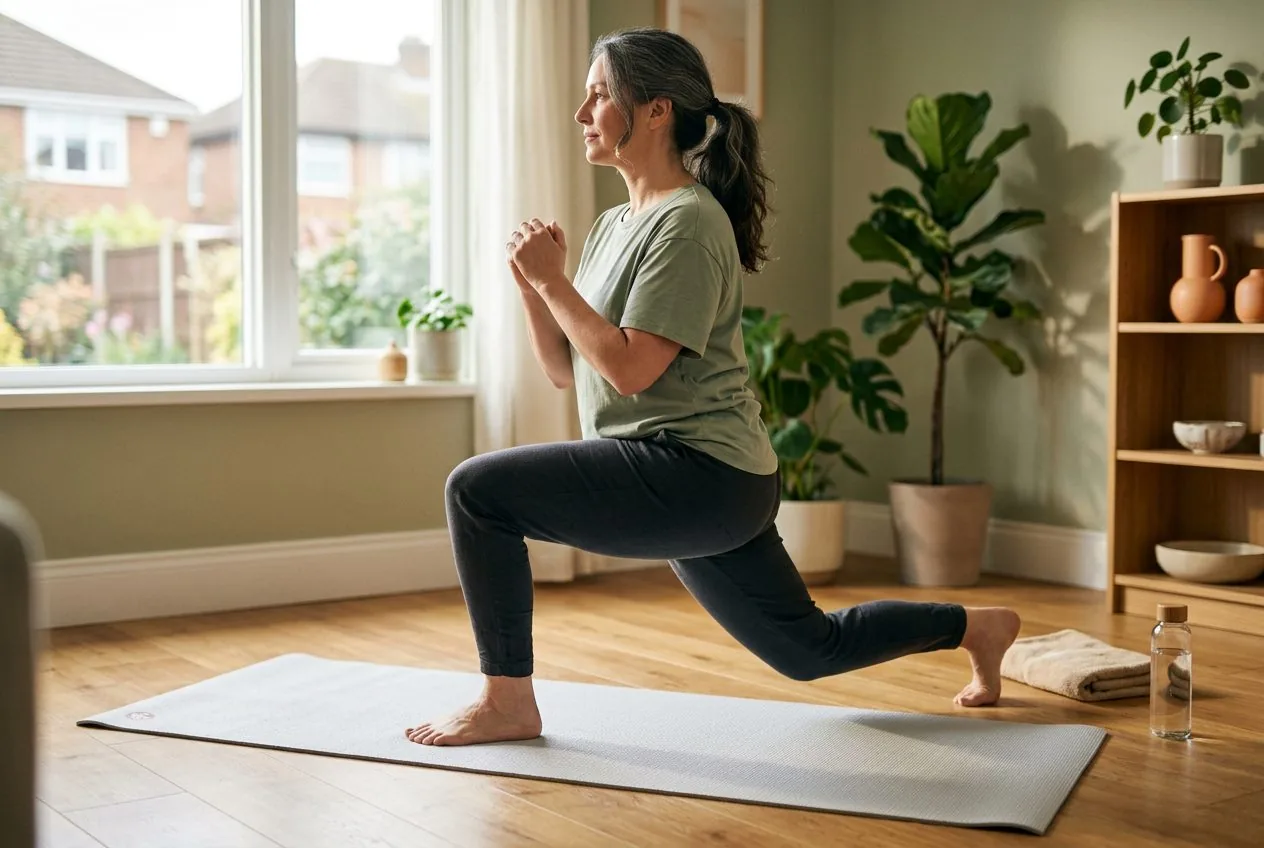
If the idea of “strength training” conjures a rack of weights and a gym membership you will never use, this is for you. You can build real, useful strength after 40 with nothing but your own body, a wall, and a sturdy chair. Bodyweight moves have a quiet advantage too: because the load is only ever you, they are easy to keep gentle, easy to do in a corner of the living room, and impossible to leave at the shop. The goal here is not to exhaust you. It is to give your muscles a reason to stay strong so that stairs, shopping bags, and getting up off the floor keep feeling easy.
The method, in one line: move slowly through a short sequence of bodyweight moves two or three times a week, make each move a little harder only when your form stays clean, and let the habit, not the intensity, do the work.
This article is for information only and is not medical advice. Talk to your healthcare provider before starting a new exercise routine, especially if you have joint injuries, heart conditions, or dizziness.
Why bodyweight strength suits a midlife body
There is nothing beginner-ish about training with your own body. Some of the most useful strength you can own is the kind that helps you stand up, carry things, and stay steady, and every one of those is a bodyweight pattern first. Three things make this approach a smart fit after 40.
It is genuinely gentle. You control every inch of every move, so you can keep the range small and the pace slow while your joints get used to being asked to work. Nothing swings, nothing drops, and nothing is heavier than you already carry around all day.
It rehearses real life. A sit-to-stand is just standing up. A hip hinge is just bending over safely. Training these patterns on purpose means the versions you do without thinking, twenty times a day, stay strong and protected.
It removes every excuse. No equipment to buy, no room to clear, no waiting for anything to arrive. You can do the whole sequence beside your bed, which makes it far likelier to actually happen on a busy or low-energy day.
The one rule: slow and controlled
Bodyweight moves reward control the same way weighted ones do. A slow sit-to-stand is far more useful than a fast, bouncy one, because your muscle does the work instead of momentum. Make every repetition slow on the way up and slower on the way down, breathe steadily rather than holding your breath, and treat clean form as the whole point. When a move starts to feel easy, your first progression is not more repetitions, it is more control: slow it down further, or add a short pause at the hardest point.
The 10 moves
Here is a joint-friendly sequence you can build into a 20 to 25 minute session. Move slowly, breathe, and stop any movement that causes sharp pain. Aim for around 8 to 12 slow repetitions of each, or a short hold where noted, resting as needed. Keep a wall or sturdy chair nearby for balance.
- Sit-to-stand. Sit tall on the edge of a sturdy chair, lean forward slightly, and stand up through your whole foot without using your hands. Lower slowly back to the seat. This is the strength behind every stair.
- Wall push-up. Face a wall with hands a little wider than your shoulders, bend your elbows to bring your chest toward the wall, and press slowly back. Keep your body in one gentle line; step your feet back to make it harder.
- Glute bridge. Lie on your back with knees bent and feet flat, press through your heels to lift your hips into a gentle slope, squeeze your glutes at the top, and lower slowly. Keep the work in your hips. When bridges feel easy, a loop band above the knees adds gentle resistance; our glute band buyer’s guide covers picking one that stays put.
- Bird-dog. On hands and knees, reach one arm forward and the opposite leg back until both are level, then return slowly and switch sides. Keep your trunk quiet, as if balancing a glass of water on your lower back.
- Dead bug. Lie on your back, arms reaching up and knees bent over your hips, then slowly lower one arm overhead and the opposite leg toward the floor. Keep your lower back gently pressed down, then switch sides.
- Standing hip hinge. Stand tall, soften your knees, and push your hips back to lower your chest with a flat back, then squeeze your glutes to stand. This is the safe way to bend for the rest of your life.
- Standing calf raise. Hold a counter, rise slowly onto the balls of both feet, pause, and lower with control. This strengthens the lower legs and ankles that keep you steady.
- Modified side plank. Lie on your side propped on a forearm with knees bent, lift your hips into a gentle line from shoulder to knee, hold briefly, and switch sides. Keep it short and honest.
- Wall sit. Slide your back down a wall until your knees are comfortably bent, and hold while breathing steadily. Start short and build up, and come out the moment your knees complain.
- Standing knee lift. Stand tall with a hand near a counter, brace your middle, and lift one knee slowly toward hip height without leaning back, then lower and switch sides. If you later want light resistance on leg moves like this, our ankle weights vs glute bands comparison helps you pick the gentler tool for your goal.
These ten moves span the muscle groups the CDC asks adults to strengthen on 2 or more days a week, from legs and hips (sit-to-stand, bridge, wall sit) to back (bird-dog, hip hinge), chest and arms (wall push-up), and abdomen (dead bug, side plank) (CDC). The calf raise and standing knee lift add the kind of balance work, such as standing on one foot, that the CDC recommends for older adults (CDC).
A gentle weekly rhythm
This rhythm pairs strength days with easy walks because the CDC’s baseline for adults combines both: at least 150 minutes a week of moderate activity such as brisk walking, plus muscle-strengthening work on 2 or more days (CDC). The table below is a gentle starting point toward that, not the full target.
| Day | Session | Time |
|---|---|---|
| Monday | Bodyweight sequence (the ten moves) | 20-25 min |
| Tuesday | Easy walk | 20-30 min |
| Wednesday | Rest or gentle stretching | As needed |
| Thursday | Bodyweight sequence (the ten moves) | 20-25 min |
| Friday | Easy walk | 20-30 min |
| Saturday | Optional third session | 15 min |
| Sunday | Rest | Rest is part of the plan |
Pairing your strength work with regular walking is deliberate. Walking builds the daily habit and keeps you moving through your full range, while the bodyweight moves add the strength that makes those walks, and your stairs, feel easier. Recovery matters just as much as the sessions themselves, so keep at least one full day between strength workouts and never train through sharp joint pain.
Common mistakes to sidestep
Rushing the reps. Speed lets momentum do the work your muscles should be doing, and it is a common source of strain. Slow the lift, slow the lower even more, and an easy-looking move becomes a genuinely useful one.
Chasing high numbers. Twenty sloppy repetitions do less than eight clean ones. Stop a set when your form starts to fade, not when you hit an arbitrary count.
Skipping the warm-up. Cold joints do not love sudden work. A minute or two of easy marching, gentle arm circles, and a few slow, shallow squats wakes everything up first.
Holding your breath. Bracing your middle is good; freezing your breath is not. Keep breathing steadily through every repetition so you stay relaxed and stable.
Grab the printable sequence
Want the sequence on paper? Join our newsletter and we will send you our gentle-strength starter guide, a simple companion to keep by your mat or bed while the ten moves and their form cues are still new.
When a structured program helps
Old School New Body is a home strength program from Steve and Becky Holman, sold through ClickBank (Old School New Body). Its sales page pitches workouts that take about a quarter of the time of traditional training, which is the vendor’s own claim. Our honest look at Old School New Body reviews whether its brief resistance sessions suit a midlife body. As always, keep your expectations grounded and check with your provider before starting anything new.
The honest bottom line
Bodyweight training will not transform your body on its own, and no honest guide should pretend otherwise. What consistent, gentle work with these moves genuinely tends to support is easier stairs, steadier standing, and the everyday strength that quietly protects you as the years add up (CDC). Start with one round, move slowly, and work the sequence two or three times a week. Make each move a little harder only when your form has earned it, pair the sessions with enough protein and a little walking, and let the habit do the real work. When you are ready to add a light tool, our gentle standing strength moves show how a simple band extends the same ideas, and if you decide to build a small corner of gear around the habit, our home gym setups for every budget keeps the shopping list sensible. You will find more routines throughout our gentle strength section.
Frequently Asked Questions
- Can bodyweight moves really build strength without weights after 40?
- Yes, especially when you are starting out or returning after a break. Your own body is a real load, and moves like sit-to-stands, wall push-ups, and bridges ask your muscles to work against it in a controlled way, which is exactly the gentle challenge that tends to support stronger, steadier movement. As the moves get easy, you make them harder by slowing them down, adding a short pause, or doing a couple more repetitions. At some point you may want a band or a light weight to keep progressing, but you can build a genuine base with nothing but the floor and a wall first.
- How often should I do a bodyweight routine after 40?
- The CDC recommends muscle-strengthening activity on at least 2 days a week that works all the major muscle groups, so two or three sessions of this sequence, with a day of rest in between, covers that baseline for most people. The rest days are when your muscles recover and adapt, so treat them as part of the plan rather than a day off from it.
- Are bodyweight squats safe for sensitive knees?
- They can be, with a shallow range and slow, controlled movement. Using a chair for the sit-to-stand is a smart way to limit how far you go and to give yourself a target, and you can simply stand partway if a full sit is uncomfortable. Keep your knees tracking over your toes, press through your whole foot, and stop any movement that causes sharp pain. If your knees are a real concern, start with the chair, keep the range small, and check with your provider before progressing.
- What if I cannot get down to the floor easily?
- You can build a full routine without ever lying down. Lean on the standing moves here, the sit-to-stand, wall push-up, standing hip hinge, calf raise, and standing knee lift, and you have a complete session that trains your legs, hips, upper body, and core while staying on your feet. Getting up and down from the floor is itself a skill worth keeping, so if you would like to work toward it gently, add the bridge and bird-dog only when you feel ready, using a sturdy chair to help you down and up.
Sources & references
Before you go
The 7-Day Protein-First Meal Plan for Women Over 40
A complete protein-first week, finished for you: your personal protein target, a one-page shopping list, 21 recipes at 25-35 g protein each, and a timed 90-minute prep schedule. Printable PDF, paired with a free 7-lesson email course.
Free guide
The 7-Day Protein-First Meal Plan for Women Over 40
A complete protein-first week, finished for you: your personal protein target, a one-page shopping list, 21 recipes at 25-35 g protein each, and a timed 90-minute prep schedule. Printable PDF, paired with a free 7-lesson email course.