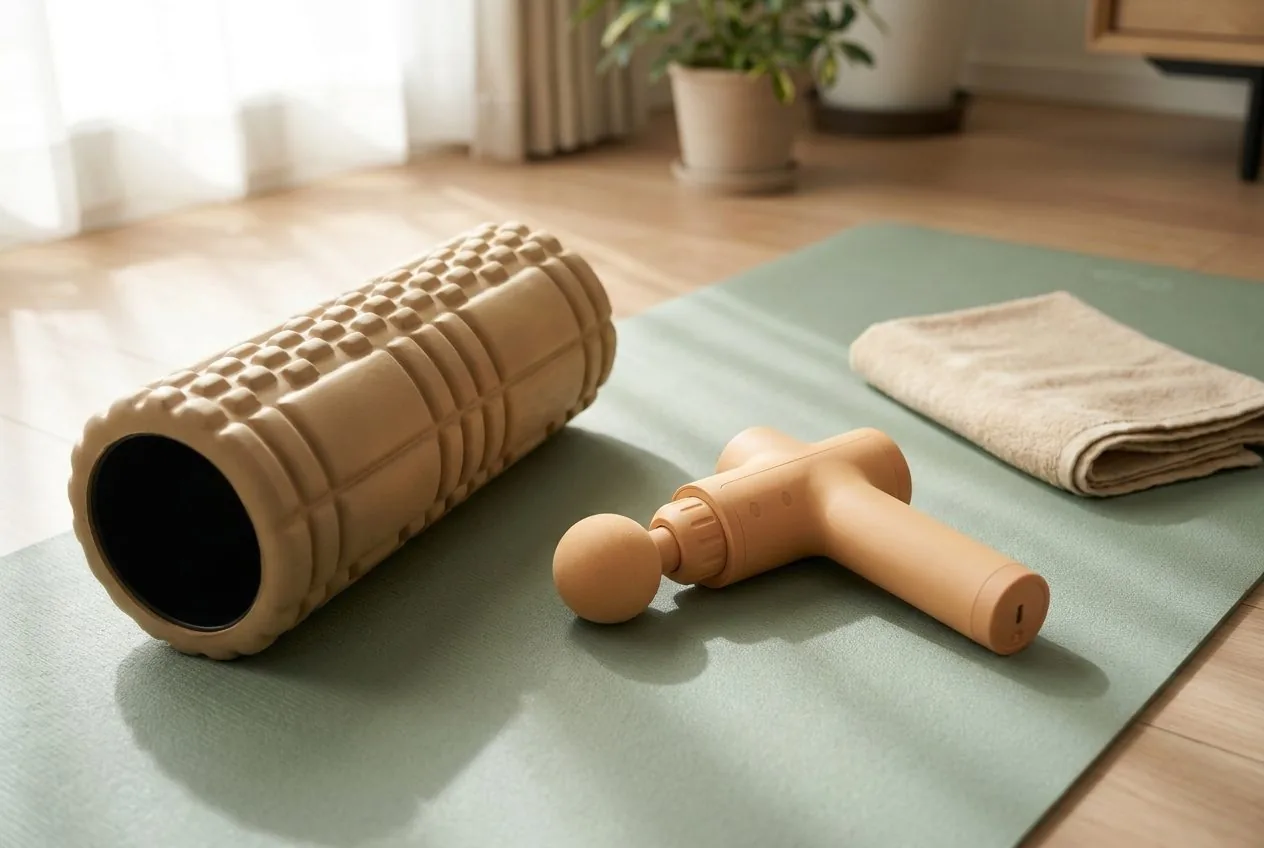
If you want an easy way to ease tight muscles at home after 40, two tools keep coming up: the humble foam roller and the buzzing massage gun. They do a similar job, helping a muscle feel looser and more comfortable (Frontiers in Physiology; Journal of Functional Morphology and Kinesiology), but they go about it in very different ways, and both are sold as the one thing you need, which does not help. So let us settle it honestly, without pretending one is a miracle and the other is useless. Both are good. They just suit slightly different people and bodies.
Short answer for skimmers: if you are comfortable getting down onto the floor and want the affordable start, choose a foam roller. It is cheap, needs no charging, and covers big muscles well. If getting down and up is hard on your knees or hips, or you want to ease a tight spot from the sofa, choose a massage gun for its adjustable, reach-anywhere convenience. Some people end up owning both, using the roller for broad work and the gun for pinpoint relief.
This article is for information only and is not medical advice. Talk to your healthcare provider before starting a new recovery or exercise routine, especially if you have joint injuries, circulation conditions, take blood thinners, or are pregnant.
The quick comparison
| Feature | Foam roller | Massage gun |
|---|---|---|
| Cost to start | Lowest | Higher |
| How it works | Your body weight over a broad surface | Adjustable percussion you aim at a spot |
| Where you use it | On the floor, mostly | Sitting, standing, anywhere |
| Best at | Broad, whole-muscle work on legs and back | Pinpointing one stubborn tight area |
| Getting started | Needs floor access and some mobility | Easy from a chair or sofa |
| Upkeep | None; it just sits there | Needs charging |
| Watch out for | Getting down and up; too-firm rollers | Loud cheap models; misuse on joints |
All prices are approximate as of mid-2026 and move constantly, so check current pricing before you buy.
Which should you pick? A quick decision framework
“I want the cheapest, simplest start.” Foam roller. It costs the least, never needs charging, and does a genuinely good job on the large muscles most people want to loosen. If your budget is tight and your floor is friendly, start here.
“Getting up and down off the floor is the hard part.” Massage gun. Being able to ease a tight calf or shoulder while sitting in a chair removes the single biggest barrier for many women over 40, and the adjustable intensity keeps it gentle.
“I want to target one specific stubborn spot.” Massage gun. Its precision suits a single nagging knot far better than a roller, which spreads its pressure over a wide area by design.
“I want broad, soothing pressure over a whole muscle.” Foam roller. Rolling a hamstring or the upper back gives a spread-out, whole-muscle sensation that many people find more relaxing than percussion.
“I want neither the fuss of choosing nor the ceiling of one tool.” Own both. Use the roller for broad work on the days you are happy on the floor, and keep the gun by the sofa for quick, targeted relief on the days you are not.
The over-40 lens: what actually matters
The reason this comparison matters is that easing tightness gently is a real comfort as the years add up, and the right tool is simply the one you will reach for. Here is how each suits a midlife body.
Joints and access first. A foam roller is soothing over a broad muscle, but it does ask you to get down onto the floor and back up, which is the very thing some over-40 knees and hips resist. A massage gun sidesteps that entirely, letting you work a muscle from a chair with the intensity dialed low. If floor time is your sticking point, the gun quietly wins on access alone. If the floor is no trouble, the roller’s spread-out pressure is lovely.
Control, honestly. Both let you control how much pressure you apply, just differently. On a roller you adjust by shifting how much body weight you place on it, which takes a little practice to keep gentle. On a gun you simply choose a speed, which makes staying gentle more obvious. Neither is hard to use kindly; the gun’s dial is just a touch more foolproof at the very start.
Sustainability. The best tool is the one you actually use on a tired evening. For some women that is the roller by the mat; for others it is the gun within arm’s reach of the sofa. Be honest about which you will reach for when you are low on energy, because a tool you use twice a week beats a fancier one that stays in the box. If you want the full detail on choosing a gun before deciding, our best massage gun for recovery guide breaks down the specs that matter.
A gentle way to use either one
Reassuringly, the principles barely change between the two tools, so you are not learning two different skills. Whichever you pick, the same gentle rules keep it comfortable and safe.
- Warm up first. A minute of easy movement makes muscles more receptive than working them stone cold.
- Go slow. Roll or glide slowly along the length of a muscle. Speed and force are not the goal; steady, gentle contact is.
- Stay on muscle. Keep both tools off bones, joints, the spine itself, the front of the neck, and any bruised or injured area (Cleveland Clinic).
- Keep it short. A minute or two on a tight area is plenty (Cleveland Clinic). Parking hard on one spot is a common way to overdo it.
- Breathe and ease off. If something feels sharp rather than pleasantly firm, lighten up or move on. Discomfort is not a badge of honor here.
Used this way, both tools become a calm few minutes that help you feel looser before a walk or more settled after one. If you would like the roller version mapped out move by move, our foam roller moves for mobility how-to walks through a gentle sequence.
Both are tools, not magic
Here is the honest part a product page will not tell you: neither a foam roller nor a massage gun will transform your body or truly heal anything on its own. They are comfort and mobility tools, and the value comes from using them gently and regularly alongside the things that genuinely matter. What consistent, gentle use tends to support is muscles that feel looser, a nicer readiness to move, and a calmer wind-down (Frontiers in Physiology), none of which replace sleep, rest days, easy movement, and enough protein. That easing effect is worth having. It is just not a miracle, and any honest guide should say so.
Whichever tool you choose, the brand and the price matter far less than the fact that you use it kindly and often. Pair a few gentle minutes with regular walking and a little strength work and you have covered the fundamentals. Our gentle strength section gives you plenty of joint-friendly routines to loosen up before and after.
The honest bottom line
Foam rollers and massage guns are not rivals so much as two answers to the same question: how do I ease tight muscles gently at home? If you want the cheapest, simplest start and you are comfortable on the floor, buy a foam roller. If getting down and up is the hard part, or you want adjustable relief you can use from the sofa, buy a massage gun. Both do a genuinely nice job of helping you feel looser, and if you can stretch to both, the pair covers nearly everything you would want, broad work on the roller and pinpoint relief from the gun.
Start gentle with either one, keep it slow and off the joints, and use it often enough to make it a habit. The best recovery tool is simply the one you will reach for when you are tired, and then use kindly for years.
Frequently Asked Questions
- Is a foam roller or a massage gun better for women over 40?
- Neither is simply better; they suit slightly different people. A foam roller is cheaper, uses your own body weight for broad, spread-out pressure, and covers big areas like the back and thighs well, but it asks you to get down onto the floor. A massage gun is portable, adjustable, and precise, and you can use it sitting on the sofa, but it costs more and needs charging. If you are comfortable on the floor and want the affordable start, choose the roller. If getting down and up is hard on your joints, the gun is the kinder pick.
- Which is gentler on the joints, a foam roller or a massage gun?
- Both can be gentle when used sensibly, and both can be uncomfortable if you overdo them. A foam roller spreads its pressure over a wide area, which many people find soothing, but a firm one on a tender spot can be intense, and getting onto the floor is itself a hurdle for cranky knees or hips. A massage gun lets you dial the intensity right down and reach a muscle without lying down, which can be easier on the joints overall. With either, the rule is the same: go gentle, stay on muscle, and keep off bones and joints.
- Do I need both a foam roller and a massage gun?
- You do not need both, though they complement each other nicely if you want them. A foam roller shines for broad, whole-muscle work on the legs, hips, and upper back, while a massage gun is better for pinpointing one stubborn tight spot or working somewhere the floor makes awkward. A sensible approach is to start with one, usually the cheaper roller, and add a gun later only if they find they want targeted relief they can do from a chair. Start with one, use it for a few weeks, and you will know whether you want the other.
- Can either one actually help me recover after exercise?
- Both tend to support how loose and comfortable your muscles feel, which is why they are pleasant before or after gentle movement, but be realistic about what they do. Neither heals an injury or replaces the real recovery that comes from sleep, rest days, and enough protein. Think of them as comfort and mobility tools that help you feel a little looser and more ready to move, not as treatments. Used gently and regularly, that easing effect is genuinely nice to have; it is just not a miracle.
Sources & references
- Frontiers in Physiology, Meta-analysis of foam rolling on performance and recovery (opens in new tab)
- Journal of Functional Morphology and Kinesiology, Effects of Massage Guns on Performance and Recovery (opens in new tab)
- Cleveland Clinic, Do Massage Guns Actually Work? (opens in new tab)
- Cleveland Clinic, How to Ease Pain with Massage Rollers (opens in new tab)
Before you go
The 7-Day Protein-First Meal Plan for Women Over 40
A complete protein-first week, finished for you: your personal protein target, a one-page shopping list, 21 recipes at 25-35 g protein each, and a timed 90-minute prep schedule. Printable PDF, paired with a free 7-lesson email course.
Free guide
The 7-Day Protein-First Meal Plan for Women Over 40
A complete protein-first week, finished for you: your personal protein target, a one-page shopping list, 21 recipes at 25-35 g protein each, and a timed 90-minute prep schedule. Printable PDF, paired with a free 7-lesson email course.