Your knees ache going down the stairs. Getting up off the floor takes a plan. And every time you mention wanting to feel stronger, someone tells you to “just move more,” as if that is simple advice when everything already hurts and every workout you can find online opens with jump squats or a run around the block. If that sounds familiar, nothing is wrong with you, and you are not too old for this.
Here is the part that actually matters: you can build real strength after 40 with joint-friendly moves, with no jumping and no running anywhere in the plan. But for most of us, strength is not even the part that fails first. We know that gentle strength work is one of the best things we can do for our bodies after 40 (NSCA), we buy the bands and the dumbbells with good intentions, and then life gets busy and the gear ends up in a cupboard. You just have not built a system that survives a tired, ordinary week. This guide is about that system, not another punishing plan you will abandon by Friday.
The method, in one line: make your strength session so small and so anchored to daily life that you almost cannot skip it, keep the gear in plain sight, track showing up rather than intensity, and let both the sessions and the strength grow only once the habit is steady. Build the habit first, and the strength follows.
This article is for information only and is not medical advice. Talk to your healthcare provider before starting a new exercise routine, especially if you have joint injuries, heart conditions, or dizziness.
Why habits beat motivation after 40
Motivation is a mood, and moods are unreliable. Some days you feel ready to move and some days you do not, and if your routine depends on the good days, it collapses on the ordinary ones. A habit works differently: it runs on a trigger and repetition rather than enthusiasm, so it keeps going when your energy is low (British Journal of General Practice), which after 40 is exactly when you need it most.
There is a kinder reason too. When you build a strength routine on willpower, every missed day feels like a personal failure, and shame is a terrible coach. When you build it as a small, anchored habit, a missed day is just a missed day, and you pick it up again tomorrow without drama. The system carries you, so you do not have to carry it.
The 5-step habit system
Here is the whole method, in five steps. None of them is about lifting harder. They are about making the lifting happen at all.
- Anchor it to something you already do. Pick a reliable daily moment as your trigger: the kettle boiling, the coffee brewing, the school run finishing. Do your session right after that anchor, every time, so the routine has a cue instead of depending on you remembering or feeling like it.
- Shrink it until it is almost too easy. Start with a session so short you cannot reasonably talk yourself out of it, as little as five to ten minutes, two or three days a week. This feels too small on purpose. Simpler actions become habitual more quickly (British Journal of General Practice), so a tiny habit you keep beats an ambitious one you quit, and you can always grow it later.
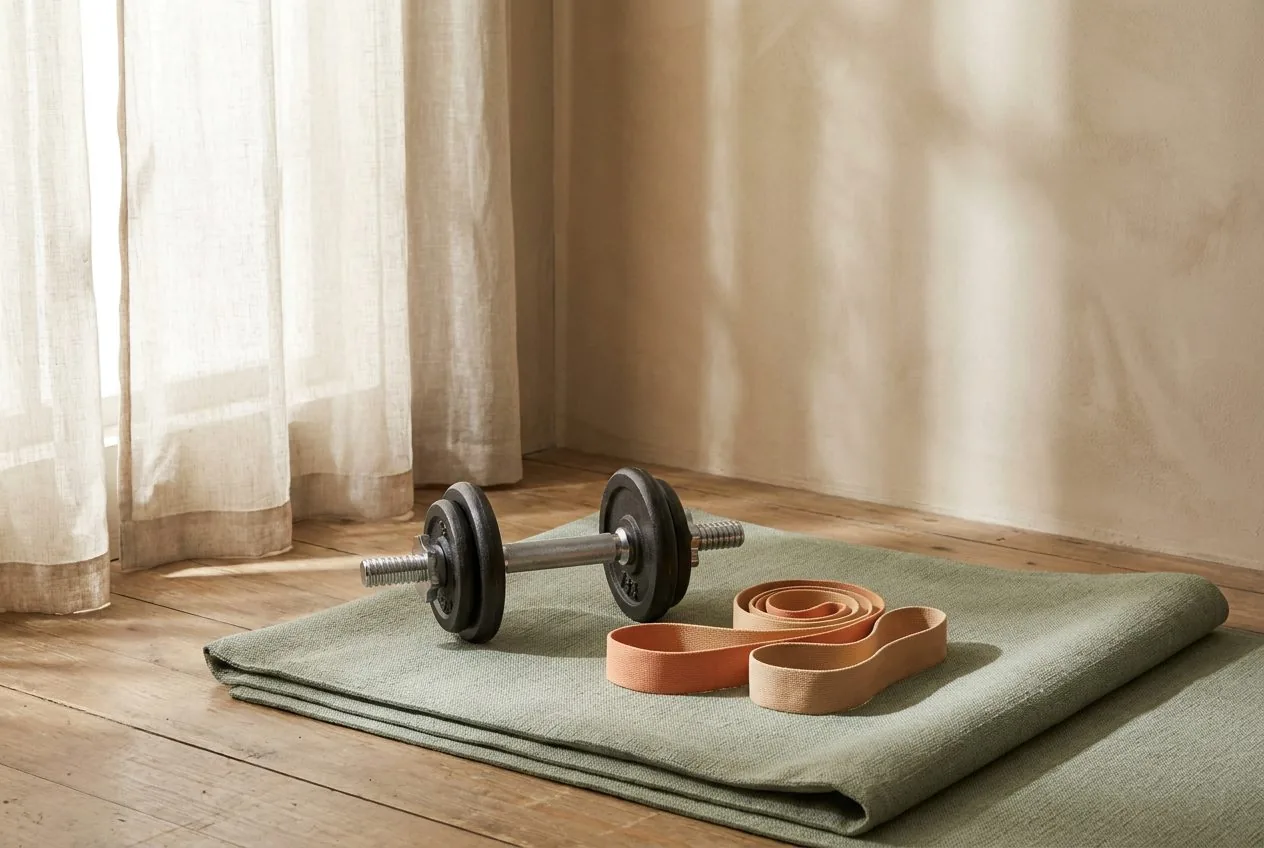
- Keep the gear in sight. Leave your bands and light dumbbells where you will see and reach them, by the sofa or on the kitchen counter, not tidied away in a closet. The equipment you can see is the equipment you use; the equipment you have to dig out is the equipment you skip.
- Track the streak, not the intensity. Put a calendar on the fridge and mark an X on every day you show up. At the start, the only goal is to hit the days you planned. You are building the habit before you build the strength, and the growing chain of X marks is quietly motivating.
- Progress only when it feels easy. Once your short session feels comfortable and automatic, add a little: one more rep, a slower lowering phase, a heavier band, or a small bump in dumbbell weight. One gentle step at a time (National Institute on Aging). Let the habit stay ahead of the effort, not the other way around.
A five-minute starter session
You need almost nothing to begin, and the session can be genuinely tiny. Here is a gentle full-body starter you can do with a resistance band and a light pair of dumbbells. Do one slow round to begin, and add a second only when the first feels easy.
- Band squat or goblet squat. Stand on a band and hold the handles at your shoulders, or hold a light dumbbell at your chest, and sit down between your hips with your chest up. Stand through your whole foot. Around 8 to 12 slow reps.
- Banded row. Anchor a band in a door and pull the handles to your ribs, squeezing your shoulder blades. Slow and controlled. Around 8 to 12 reps.
- Overhead press. Press light dumbbells or band handles up from your shoulders, ribs down and core braced. Lower with control. Around 8 to 10 reps.
- Glute bridge. Lie on your back, rest a light dumbbell on your hips or loop a band above your knees, and drive up by squeezing your glutes. Around 10 to 12 reps.
That is a complete session in about five minutes. It is not impressive, and that is exactly the point. Impressive is not the goal; repeatable is.
Common mistakes that break the habit
Starting too big. The classic error is an ambitious hour-long plan that feels great for three days and impossible by the second week. Start absurdly small. You can always add later, and almost no one regrets starting gently.
Relying on motivation. If your plan needs you to feel like it, it will fail on the days you do not. Anchor the session to a daily cue so it runs whether you are enthusiastic or not.
Hiding the gear. Bands and dumbbells stuffed in a cupboard are out of sight and out of mind. Leave them where you trip over them, at least while the habit is young.
Treating a missed day as failure. One skipped session does not derail a forming habit (British Journal of General Practice). What matters is restarting the next day without a fuss. Miss, shrug, resume.
Grab the printable starter guide
If you would like this system and the starter session as a simple one-page checklist for the fridge, join our newsletter and we will send you our gentle-strength starter guide, plus honest reviews and protein-first recipes, with no shame and no miracle promises. Having the plan on paper, by your gear, makes showing up easier while the habit is still forming.
When a structured program helps
The habit system solves the “will I show up” problem. It does not always solve the “what exactly do I do, and when do I progress” problem. If you know you do better when someone tells you precisely what to do each session, a structured program can lift that decision off your plate and keep you progressing. Our honest look at Old School New Body reviews one option built around brief, joint-friendly resistance sessions that suit a midlife body and a busy schedule. As always, keep your expectations grounded and check with your provider before starting anything new.
The gear you actually need
Very little, and you may already own it. A set of resistance bands and a light pair of adjustable dumbbells cover nearly everything a gentle home routine needs, and together they cost less than a single piece of gym equipment. If you are choosing bands, our best resistance bands for women over 40 guide breaks down the formats, and for weights, our best adjustable dumbbells for women over 40 buyer’s guide covers what to look for. If you are torn between the two, our resistance bands vs dumbbells comparison settles it honestly.
The honest bottom line
Building strength after 40 is far less about the perfect workout than about the habit that keeps you coming back to a good-enough one. Anchor your session to daily life, shrink it until skipping feels silly, keep your gear in sight, and celebrate showing up before you chase intensity. What a steady strength habit genuinely tends to support is more energy, better posture, easier daily movement, and muscle that quietly protects your metabolism over the years (Current Sports Medicine Reports). Start with five minutes this week, keep it small enough to repeat, and let the habit do the real work. You will find more routines to build on in our gentle strength section.
Frequently Asked Questions
- How often should a woman over 40 strength train to build a habit?
- Two or three short sessions a week is the sweet spot, with at least a day of rest between them so your muscles can recover and adapt. When you are starting out, frequency and consistency matter far more than length or intensity. A ten-minute session you actually do three times a week beats an hour-long plan you attempt once and abandon. Build the habit first, then let the sessions grow naturally as it sticks.
- How long until a strength habit feels automatic?
- It varies a lot from person to person. In habit research summarized in the British Journal of General Practice, a daily behavior took around 66 days on average to feel automatic, with considerable variation between people and behaviors, and simpler actions became habitual more quickly. The trick is to make the habit small enough that you rarely skip it, because every session you keep makes the next one easier. Missing one day is normal and does not undo your progress; in the same research, automaticity soon resumed after a missed day, so just pick it back up.
- What is the minimum equipment I need to start strength training at home?
- Very little. A set of resistance bands and a light pair of adjustable dumbbells cover almost everything a gentle home routine needs, and together they usually cost less than a single piece of gym equipment. Bands are gentle, portable, and great for control; dumbbells let you load a known weight and track progress precisely. You can even start with just bands and add dumbbells later. The best kit is the one you will actually reach for.
- I have no motivation to exercise. How do I start anyway?
- Stop relying on motivation, because it comes and goes, and build a system instead. Make the session so small it feels almost silly to skip, attach it to something you already do every day, and keep the gear in plain sight. Once a behavior is triggered by a cue in your day rather than by willpower, it tends to persist even after motivation fades, so the point is to lower the bar to starting until showing up is easier than not. Consistency, not enthusiasm, is what quietly rebuilds strength.
Sources & references
Before you go
The 7-Day Protein-First Meal Plan for Women Over 40
A complete protein-first week, finished for you: your personal protein target, a one-page shopping list, 21 recipes at 25-35 g protein each, and a timed 90-minute prep schedule. Printable PDF, paired with a free 7-lesson email course.
Free guide
The 7-Day Protein-First Meal Plan for Women Over 40
A complete protein-first week, finished for you: your personal protein target, a one-page shopping list, 21 recipes at 25-35 g protein each, and a timed 90-minute prep schedule. Printable PDF, paired with a free 7-lesson email course.