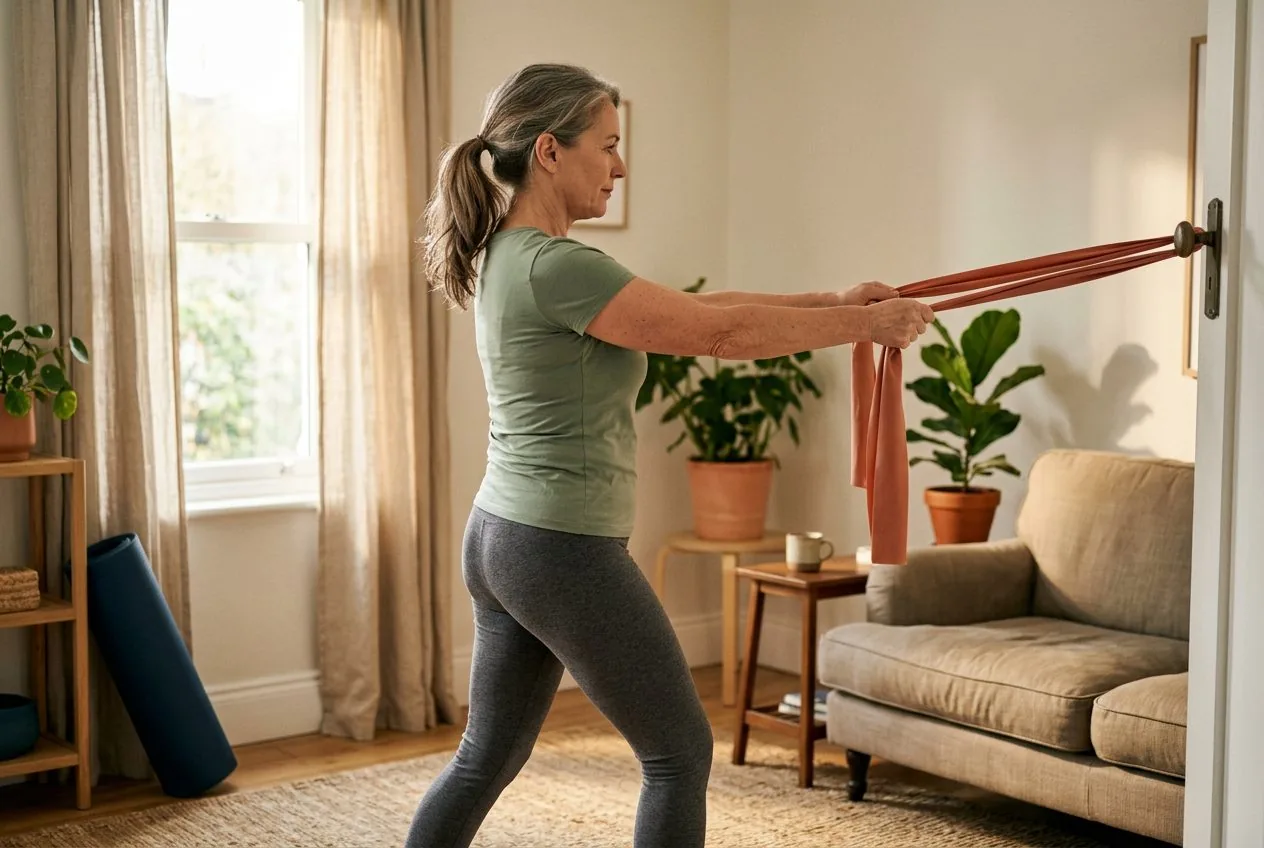
If you started semaglutide or tirzepatide expecting the scale to move and nothing else to change, here is the part that rarely comes up at the pharmacy counter: weight loss on these medications does not come from fat alone (Journal of the Endocrine Society). Some of it is muscle, and muscle is exactly what keeps your metabolism, your strength, and your everyday stamina steady in midlife. That is not a reason to worry, and it is definitely not a reason to stop your treatment. It is a reason to add one specific habit alongside it: resistance training, done consistently, a few times a week.
This is not a workout that promises to melt anything or transform your body by a deadline. It is a method, a realistic routine you can do at home with a set of resistance bands, built around what current clinical guidance actually recommends for people on GLP-1 medications. Nothing here requires a gym, a trainer, or an hour you do not have. Here is exactly how to do it.
This article is for information only and is not medical advice. Talk to your healthcare provider before changing your diet or exercise routine, especially if you have a medical condition or take medication. If you are on a GLP-1 medication such as semaglutide or tirzepatide, check with your prescribing provider before starting a new exercise routine, and stop and check in with them if you notice unusual dizziness, chest pain, or a new inability to eat enough.
Why strength training belongs in your GLP-1 routine
Muscle is metabolically active tissue. It is also the thing that makes stairs, groceries, and getting up off the floor feel easy instead of effortful as the years add up. Our plain-English guide to what actually changes in your metabolism after 40 walks through why muscle already tends to decline gradually from your 40s onward, medication or not.
Rapid or substantial weight loss, whatever drives it, tends to pull some muscle along with the fat unless you give your body a specific reason to protect it. That reason is resistance training. It will not stop every gram of muscle loss, nobody can honestly promise that, but it meaningfully shifts what you lose toward fat and away from the muscle you want to keep. That is why a growing body of clinical guidance for people using GLP-1 medications now includes resistance training several times a week as a standard recommendation, alongside adequate protein (The Obesity Society). Neither habit is optional if the goal is to come out the other side of this stronger, not just lighter.
This is also, honestly, not a new idea dressed up for a new medication. The advice that muscle needs a reason to stick around during any period of significant weight change has been part of general midlife strength guidance for years. What has changed is the pace at which some women are now losing weight, which is exactly why clinicians are being more explicit about pairing GLP-1 treatment with a strength habit rather than assuming it will happen on its own.
If you want the food side of this picture, our honest look at natural ways to support your body’s own GLP-1 response covers protein, fiber, and the daily habits that pair with medication or stand on their own. Think of that guide as the kitchen half and this one as the exercise half. Together, they are the two levers that matter most here.
The weekly plan
You do not need a gym membership or an hour a day. You need two to three sessions a week, roughly 20 to 30 minutes each, with a rest day between sessions that hit the same muscles (Frontiers in Clinical Diabetes and Healthcare). Here is a simple weekly shape to start from:
| Day | Focus | What it covers |
|---|---|---|
| Monday | Full body, moderate band | Legs, back, chest, and shoulders in one session |
| Tuesday | Rest or a walk | Recovery, not another workout |
| Wednesday | Full body, moderate band | Repeat the Monday pattern, same or slightly heavier band |
| Thursday | Rest or a walk | Recovery |
| Friday | Full body, lighter or heavier band | Adjust based on how the week felt |
| Saturday & Sunday | Rest, or gentle movement | Walking, stretching, or a full day off |
Three sessions a week is the sweet spot for most women following this plan, though two is a genuinely useful minimum on a demanding week (CDC). The exact days matter far less than the rhythm: work, rest, work, rest.
Adjusting the plan on a rough week
GLP-1 medications can bring days of lower appetite, energy, or mild nausea, especially around a dose change, and a rigid plan that ignores that is not a realistic one. On a rough day, keep the session but shrink it: fewer moves, lighter tension, or ten minutes instead of twenty-five. On a genuinely bad day, skip the session entirely and pick the plan back up at the next scheduled day rather than trying to make it up. Two shortened sessions you actually complete beat one perfect session you were dreading and one you skipped out of exhaustion.
Why bands, specifically
Dumbbells and bodyweight moves both build real strength too, and you are welcome to mix them in. Bands earn their place in a GLP-1 routine for a few practical reasons. Their resistance is lightest at the start of a movement and builds through the range, which is forgiving on days when a joint feels cranky or your energy is lower than usual. They are inexpensive, they store in a drawer, and they travel in a suitcase, which matters if appointments or side effects disrupt your normal week. If you are curious how bands stack up against dumbbells in more detail, our resistance bands vs dumbbells comparison weighs cost, joints, and progress side by side, including the case for owning both eventually.
The method, step by step
Step 1: Get one resistance band set with a few tension levels. A set of loop or tube bands that ranges from light to medium-heavy lets you start easy and grow into the next level without buying again. If you want a full breakdown of types before you buy, our buyer’s guide to resistance bands for women over 40 compares loop, tube, and fabric options honestly.
Step 2: Pick five to six moves that cover your whole body. A simple full-body session covers a leg move, a hip move, a pushing move, a pulling move, and a core move. Our six standing strength moves you can do anywhere is a ready-made list with band options built in, and every move works standing up, no floor required.
Step 3: Do 8 to 12 slow, controlled reps per move. Speed lets momentum do the work your muscles should be doing. Slow is the whole point, especially if energy is already lower than usual on a treatment week.
Step 4: Rest a day between sessions that repeat the same muscles. Muscle adapts and rebuilds on the rest days, not during the workout itself. Skipping rest does not speed up the process; it just adds fatigue on top of fatigue.
Step 5: Anchor each session to a protein-forward meal. Protein gives your muscles the raw material to respond to the work you just asked them to do (Obesity Pillars). Our guide to hitting 30 grams of protein per meal after 40 makes this practical in real food, which matters even more when appetite is smaller than it used to be.
Step 6: Progress slowly, and only when the current level feels genuinely easy. Move to the next band tension, add a rep, or extend the range of a move once your current level stops being a real challenge. There is no prize for rushing this.
Common mistakes to avoid
Skipping strength for cardio alone. Walking and cardio are genuinely good for you, and worth keeping, but they do not protect muscle the way resistance work does. If you can only fit one type of movement in on a given week, resistance training is the one with the specific job description here.
Training through real nausea or exhaustion. A light band session on an easy day is a good idea. Pushing through a genuinely rough medication day is not. Scale the session down, or skip it, and pick the routine back up when you feel more like yourself.
Under-eating protein on purpose. A smaller appetite is not an invitation to let protein slide. If a full meal feels like too much, split your protein target across smaller portions through the day instead of skipping it.
Buying the heaviest band and hoping to grow into it. Start lighter than you think you need. The first few weeks are about clean form and a habit that sticks, not about how much resistance you can wrestle with on day one.
Judging week one by soreness or the scale. Neither tells you much this early. Judge the first few weeks by whether you showed up for the sessions you planned. Everything else follows from that.
Want this routine on paper?
A printable version of this weekly plan, with space to check off each session, comes with the newsletter signup below. Some weeks go better with a box to check than with a memory to trust, and that is not a character flaw, it is just how habits work.
When a structured program helps
If you would rather follow a complete plan than assemble your own from scratch, a simple, low-cost strength framework can do the deciding for you. Our honest Old School New Body review looks at a program built on short, repeatable resistance sessions using basic movements and a similar few-times-a-week rhythm to what is outlined here. It is not personalized to your medication or your history, so the clinician-first advice above still applies, but it can remove the guesswork of what to do on a given day.
What you actually need
The whole kit here is modest, and you likely will not need more than this to start:
- A resistance band set with a few tension levels. This is the one piece of equipment the plan is built around.
- A sturdy chair or counter for balance on standing moves, no cost involved.
- A yoga mat, useful but not required, for any moves you do on the floor.
You do not need a squat rack, a subscription, or a home gym. A drawer with one band set in it is enough to run this entire routine.
The honest bottom line
Resistance training will not undo everything a fast pace of weight loss can do to your muscle, and no honest guide should promise that. What two to three sessions a week with a set of resistance bands genuinely tends to support is a better ratio of what you lose, steadier everyday strength, and a body that comes out the other side of treatment more capable, not just lighter. Pair it with enough protein, keep the sessions short and consistent, and let your prescribing provider stay in the loop the whole way. Start with one session this week. That is the entire plan working. You will find more joint-friendly routines in our Gentle Workouts & Strength section.
Frequently Asked Questions
- Why does resistance training matter on GLP-1 medications?
- When you lose weight, whether from a calorie change or a medication like semaglutide or tirzepatide, some of what comes off is muscle, not only fat. Resistance training gives your body a reason to hold on to the muscle you have while the medication and your habits do the rest of the work. It will not stop every bit of muscle loss, but it meaningfully changes the ratio of what you lose. Talk to your prescribing provider about how this fits your specific treatment.
- How often should I do resistance training on semaglutide or tirzepatide?
- A frequency commonly mentioned in current clinical guidance for people on GLP-1 medications is two to three sessions a week, with at least one rest day between sessions that work the same muscles. That is a realistic, non-punishing pace for most people, including on weeks when appetite or energy is lower than usual. Consistency at a moderate level beats an ambitious plan you cannot keep up. Confirm the right frequency for you with your provider.
- Can resistance bands really help protect muscle on GLP-1 medication?
- Yes, within reason. Muscle responds to progressive resistance no matter what tool provides it, and a good band set can supply plenty of that for most women's needs. Bands are also gentle on the joints and easy to use on lower-energy days, which matters on a medication that can affect appetite and energy. They are not the only option, dumbbells and bodyweight work count too, but they are an affordable, low-friction place to start.
- How much protein do I need while on a GLP-1 medication?
- Protein needs do not shrink just because appetite does. If anything, protein matters more, since you are eating less overall and want more of it to go toward keeping muscle. Many clinicians point to a target similar to general midlife guidance, roughly 25 to 30 grams per meal, split into smaller or more frequent meals if a full plate feels like too much. Our guide to hitting 30g of protein per meal after 40 breaks this down in real food. Ask your provider or a dietitian for a number specific to you.
- What if I feel too fatigued or nauseated to exercise on GLP-1?
- That is common, especially early on or right after a dose increase, and it is worth naming rather than pushing through blindly. On rough days, a much shorter or lighter session, even five to ten minutes with a light band, still sends a useful signal to your muscles and beats skipping entirely. Persistent nausea, fatigue, or trouble eating enough is a conversation for your prescribing provider, not something to power through alone.
- Do I need a gym, or are bands enough for this?
- For most women following a two to three times a week routine like the one here, a set of resistance bands is enough to genuinely challenge your muscles at home, no gym required. Bands are not a permanent ceiling. Dedicated lifters eventually outgrow them. But for building and protecting strength during a medication-assisted weight change, they cover the need well and travel easily if your routine or your schedule gets disrupted.
Sources & references
- Journal of the Endocrine Society, semaglutide and body composition (STEP 1) (opens in new tab)
- The Obesity Society, Nutritional Priorities to Support GLP-1 Therapy (opens in new tab)
- Frontiers in Clinical Diabetes and Healthcare, GLP-1 agonists and exercise (opens in new tab)
- CDC, Adult Activity: An Overview (opens in new tab)
- Obesity Pillars, Optimizing GLP-1 therapies (opens in new tab)
Before you go
The 7-Day Protein-First Meal Plan for Women Over 40
A complete protein-first week, finished for you: your personal protein target, a one-page shopping list, 21 recipes at 25-35 g protein each, and a timed 90-minute prep schedule. Printable PDF, paired with a free 7-lesson email course.
Free guide
The 7-Day Protein-First Meal Plan for Women Over 40
A complete protein-first week, finished for you: your personal protein target, a one-page shopping list, 21 recipes at 25-35 g protein each, and a timed 90-minute prep schedule. Printable PDF, paired with a free 7-lesson email course.