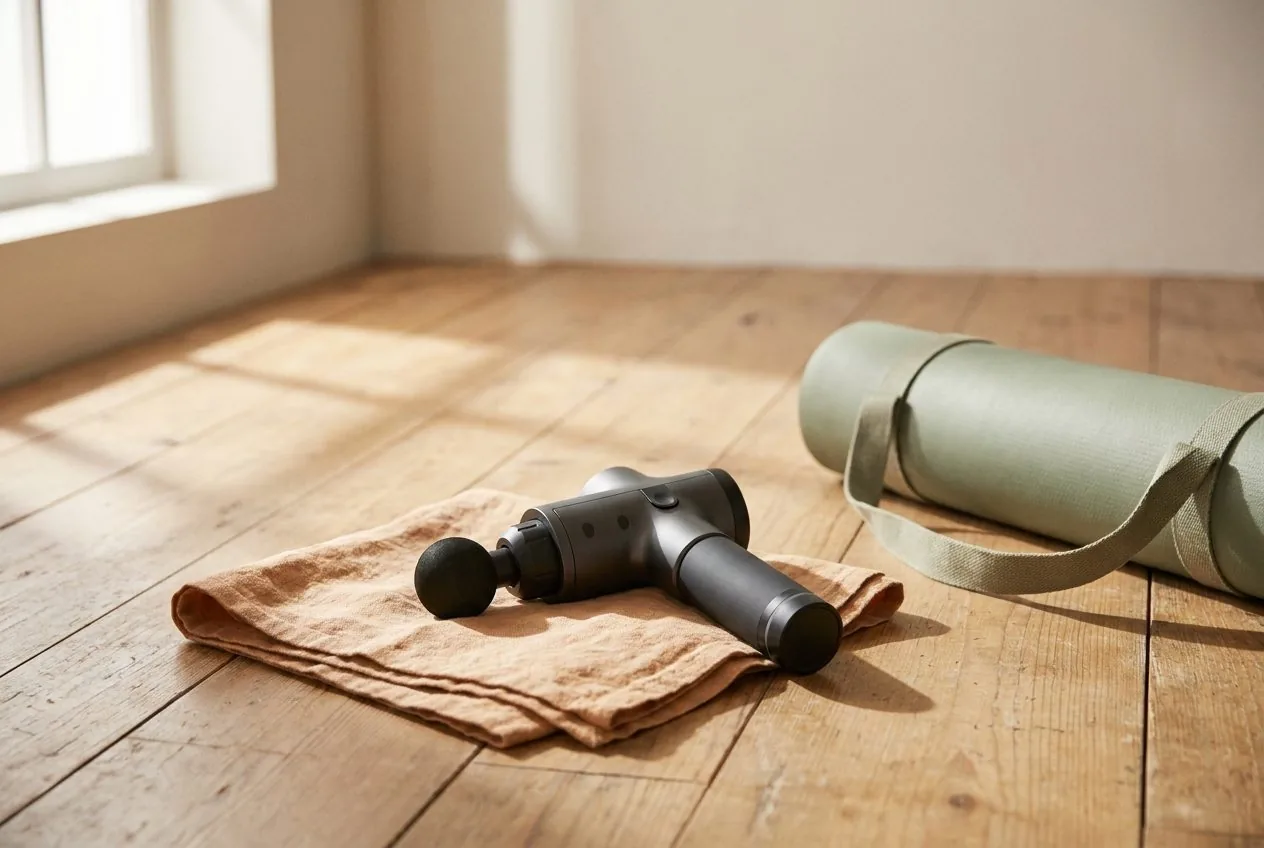
A massage gun is worth it for some women over 40 and an easy skip for others, and the deciding factor is not the price tag; it is whether muscle tightness is actually part of your week. If you regularly finish a walk, a strength session, or a long day on your feet with tight calves or a stiff upper back, a massage gun, sometimes called a percussion massager, gives you an easy, controllable way to feel looser, and it earns its spot by the sofa. If tension is rare for you, or a foam roller already does the job, you can skip the buy without missing a thing. Here is the full worth-it-or-skip-it verdict: what percussion genuinely helps with after 40, what to realistically expect, where caution matters, who should buy, and what to look for if you do.
This is a category verdict based on the features that matter for a woman over 40, not a lab test of one branded model. Massage guns are a crowded, fast-changing market, and prices move constantly, so we focus on what stays true no matter what is in stock this month.
Our verdict: worth it for the regularly tight and stiff, as a mid-range, lightweight gun with a genuinely gentle lowest speed, a quiet motor, and a comfortable grip. 8/10. The right buy is not the most powerful device but the one that is quiet, light in the hand, and soft enough at its lowest setting to feel good. Comfort and quiet beat a big power number every time.
This article is for information only and is not medical advice. Talk to your healthcare provider before starting a new recovery or exercise routine, especially if you have joint injuries, circulation conditions, take blood thinners, or are pregnant.
What percussion actually helps with after 40
The honest case for the gun is comfort and control, not transformation. Three things give it genuine value for a midlife body.
It is gentle and adjustable. A good gun lets you dial the intensity right down, so you decide exactly how much pressure a tender calf or a tight shoulder gets. That control matters more after 40, when a little goes a long way and you want to ease a muscle, not batter it.
It reaches where hands tire. Working a knot in your own upper back or the side of a hip by hand is awkward and quickly tiring. A gun does the repetitive part for you, which makes it far more likely you will actually spend the couple of minutes that help.
It lowers the bar to recovery. Recovery habits stick when they are easy. A gun that sits by the sofa, charged and ready, turns “I should stretch” into something you actually do while an episode plays, which is exactly the kind of low-effort habit that lasts.
Realistic expectations, before you spend
Here is the boundary an honest verdict has to draw. Gentle percussion tends to support how loose and comfortable a muscle feels (Journal of Functional Morphology and Kinesiology), and many people find it a pleasant way to feel readier before movement and calmer after it (Cleveland Clinic). That is the whole promise, and it is a real one. What a massage gun does not do is the deeper work: it does not build strength, heal injuries, or substitute for the things that genuinely drive recovery, which are sleep, rest days, easy movement, and enough protein. If you buy it as a comfort and mobility tool, you will likely be pleased. If you buy it as a treatment, you will be disappointed, and no spec sheet fixes that.
A word of caution
A massage gun is for muscle, not bone or joint, and it deserves a little respect in where you point it. Keep it off bones, joints, the front of the neck, the spine, bruises, and any injured or swollen area (Hackensack Meridian Health), and favor the lowest comfortable speed with slow gliding strokes rather than parking it in one spot. Keep each area to a minute or two (Cleveland Clinic). And if you take blood thinners, have a circulation condition, are pregnant, or have recently had surgery or an injury, talk to your provider before using one at all. None of this makes the gun dangerous for the typical user; it makes it a tool with a short list of rules, and the rules are easy to follow once you know them.
Who should buy, and who does fine with a foam roller
Buy if you often notice tight calves, stiff shoulders, or an achy upper back, you like the idea of an easy recovery habit you can do on the sofa, and you will actually use a few gentle minutes a couple of times a week. For that woman, the gun removes just enough friction to turn good intentions into a habit.
Stick with a foam roller if you already own one and enjoy it, if your budget is tight, or if floor work does not bother you. A roller works the same large muscles with your body weight, costs far less, and never needs charging. The gun’s advantages are reach and convenience, not a different result. Our foam roller vs massage gun comparison weighs the two side by side if you are on the fence.
Skip both for now if you rarely feel muscle tightness, or if you have a condition, take blood thinners, or have an injury that makes percussion a bad idea until a clinician says otherwise. Gear you would use with caution is gear worth pausing on.
If you buy: the five things that matter
Five things separate a massage gun you will reach for weekly from one that lives in a drawer:
- How quiet is it? Some models are quiet while others are fairly noisy (Cleveland Clinic). A quiet motor you can run in front of the television is worth more than any headline power figure.
- How light is it? You hold it out at arm’s length to reach your own back and shoulders. A lighter body is far kinder to your wrist and hand, especially if your grip is not what it was (Cleveland Clinic).
- How gentle is the lowest speed? A genuinely soft lowest setting lets you start easy and stay comfortable. A gun whose slowest speed is still fierce is no friend to a midlife body.
- Is the grip comfortable? A handle you can hold without your wrist complaining decides whether you finish the session or quit halfway. Ergonomic shapes help.
- Does the battery last? A charge that survives a couple of weeks of short sessions means the gun is always ready. A flat battery is a used excuse to skip.
| Feature | What to look for | Why it matters after 40 |
|---|---|---|
| Weight | Lighter, comfortable held at arm’s length | Kinder to the wrist when reaching your own back |
| Noise | Quiet enough for the sofa | You will only use what you can use anywhere |
| Lowest speed | Genuinely soft, not just “less fierce” | Lets you ease a muscle, not punish it |
| Grip | Ergonomic, easy to hold | Decides whether you finish the session |
| Battery | Lasts a couple of weeks of short use | Always ready means always used |
| Attachments | A soft round head and a flatter one | The two you will actually use; ignore the rest |
All prices are approximate as of mid-2026 and move constantly, so check current pricing before you buy.
The profile to look for is a mid-range, lightweight model with several speed settings, a quiet motor, and a soft round attachment, priced in the sensible middle rather than the top of the range. Several speed settings let you keep almost everything at the lowest one or two, where the pressure is pleasant and controllable, and the soft round head suits the large muscles of the calves, thighs, hips, and upper back, which is where nearly all of your use will happen. You can ignore most of the bristling extra attachments; they look impressive in the box and gather dust after.
Pros and cons
| Pros | Cons |
|---|---|
| Eases everyday muscle tightness comfortably | A comfort tool, not a treatment or a cure |
| Fully adjustable, so you control the intensity | Cheap models can be loud, heavy, and harsh |
| Reaches spots your hands cannot work easily | Needs charging and can be misused on joints |
| Sits by the sofa, so the habit is effortless | Easy to overpay for power you never use |
| Light, portable, and quick to use | Not suitable for injured, swollen, or bruised areas |
Honest criticisms
No product category is perfect, and a fair verdict includes the ugly parts.
The cheap ones can be unpleasant. Some of the lowest-priced guns are loud, heavy, and fierce even on their slowest speed, which is the opposite of what you want. If your budget only stretches to the very bottom of the range, a foam roller is likely the better spend.
It is easy to misuse. A massage gun is for muscle, not bone or joint, and pressing it onto your spine, a knee, or a tender area is a mistake. The tool asks a little care in where you point it, and any honest verdict has to say so plainly.
It does not replace the basics. A gun can help a muscle feel looser, but rest, sleep, gentle movement, and enough protein are what genuinely help your body recover and get stronger. Treat the gun as a pleasant extra, not the main event.
The honest bottom line
So, massage gun after 40: worth it or skip it? Worth it, if muscle tightness is a regular guest in your week and you want an easy, controllable comfort habit; the right buy is a light, quiet, mid-range model with a genuinely gentle lowest speed and a comfortable grip, used slowly on big muscles and kept away from joints and sore spots. Skip it, without guilt, if tightness is rare, if a foam roller already serves you, or if a health condition puts percussion on hold until a clinician says otherwise. Either answer is a good one, because the real recovery work was always going to come from sleep, rest, movement, and protein anyway. And if daily walking is the movement your calves keep complaining about, our walking pad review for women over 40 covers the indoor option that keeps the habit alive when the weather turns.
If you are still weighing the gun against the simpler, cheaper option, our foam roller vs massage gun comparison lays out which recovery tool fits which person, and the rest of our gentle strength section gives you gentle routines worth recovering from.
Frequently Asked Questions
- Is a massage gun worth it, or is it recovery hype?
- It is worth it for the woman who regularly notices tight calves, stiff shoulders, or an achy upper back and wants an easy, controllable way to feel looser on the sofa. Gentle percussion does that one job pleasantly well, and a good mid-range gun makes the habit effortless. It is hype only if you expect more than comfort: a gun does not heal injuries, fix posture, or replace sleep, rest, and protein. And if you rarely feel muscle tightness, or a foam roller already covers your needs, skipping the buy is the smarter call.
- Would a foam roller do the same job for less?
- For many women, honestly, yes. A foam roller works the same large muscles using your body weight, costs a fraction of the price, never needs charging, and doubles as a gentle mobility tool. Where the gun earns its higher price is convenience and reach: it gets to your upper back and shoulders without floor work, lets you dial the pressure precisely, and turns a chore into something you do while an episode plays. If getting down to the floor is unappealing or your hands tire quickly, the gun wins. If you already own and enjoy a roller, you can happily stop there.
- Do I need an expensive massage gun, or will a budget one do?
- For most women over 40, a mid-range gun is plenty, and the very cheapest ones can disappoint. What you are really paying for as the price climbs is a quieter motor, a lighter body that is kinder to your wrist, and a gentler lowest speed. You do not need the strongest, loudest, most powerful model on the shelf. You need one that is comfortable to hold, quiet enough to use on the sofa, and soft enough at its lowest setting to feel good rather than punishing. Comfort and quiet beat raw power for this use.
- Is a massage gun safe to use on my own?
- Used sensibly on the large muscles of the legs, hips, and upper back, it is straightforward for most people. The care comes in where you point it: keep it off bones, joints, the front of the neck, the spine itself, bruises, and any injured or swollen area, and use the lowest comfortable speed. If you take blood thinners, have a circulation condition, are pregnant, or have recently had surgery or an injury, check with your provider before using one. When in doubt, go lighter, slower, and steer clear of the spot entirely.
- Can a massage gun really help my muscles recover?
- Gentle percussion tends to support how loose and comfortable a muscle feels and can ease the tightness many people notice after activity, which is why so many find it pleasant before or after movement. Be clear-eyed about the limits, though: it is a comfort and mobility tool, not a treatment, and it will not heal an injury or replace rest, sleep, and enough protein. Think of it as a nice way to feel a little looser and more ready to move, and let the real recovery come from the basics.
Sources & references
Before you go
The 7-Day Protein-First Meal Plan for Women Over 40
A complete protein-first week, finished for you: your personal protein target, a one-page shopping list, 21 recipes at 25-35 g protein each, and a timed 90-minute prep schedule. Printable PDF, paired with a free 7-lesson email course.
Free guide
The 7-Day Protein-First Meal Plan for Women Over 40
A complete protein-first week, finished for you: your personal protein target, a one-page shopping list, 21 recipes at 25-35 g protein each, and a timed 90-minute prep schedule. Printable PDF, paired with a free 7-lesson email course.