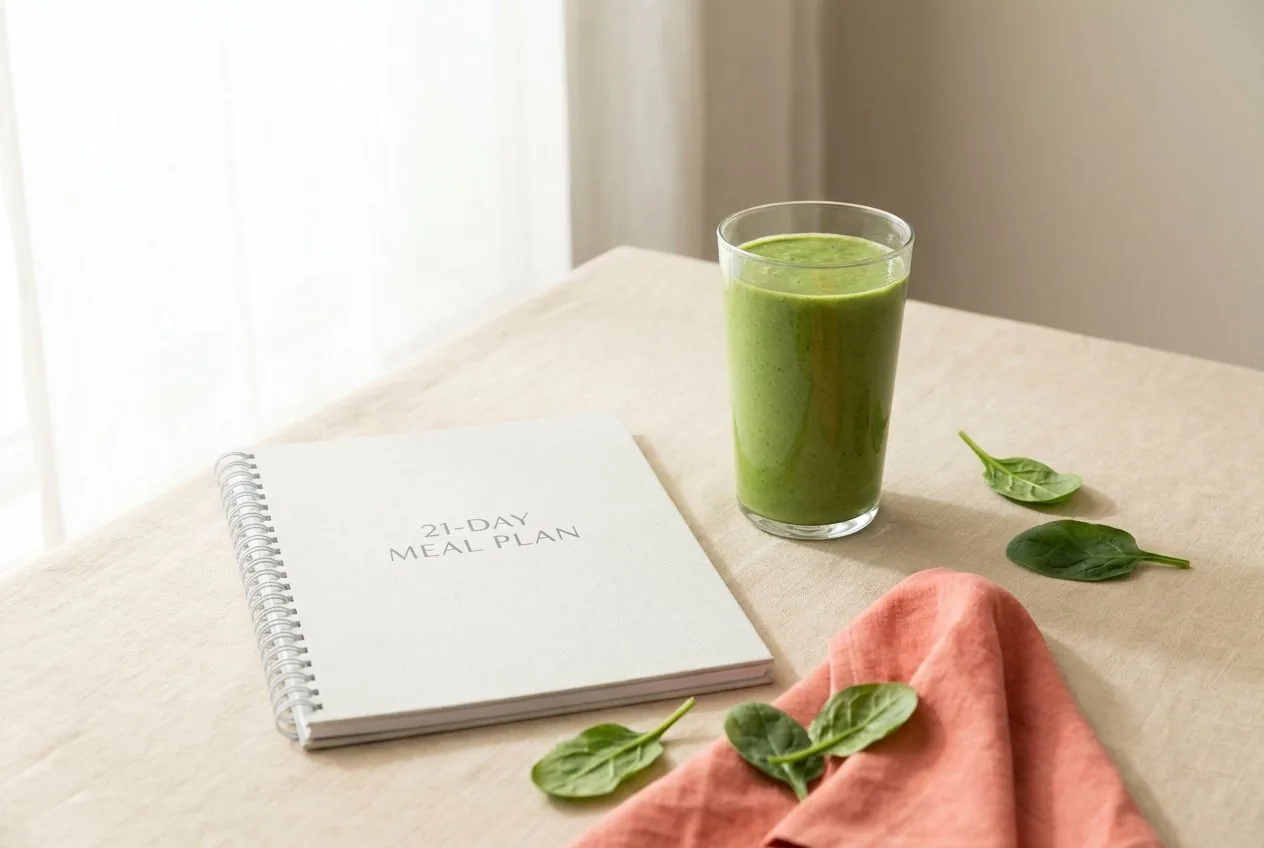
Is The Smoothie Diet worth buying for a woman over 40?
- Our verdict: 3.5/5. A clear, fairly priced 21-day structure that works through an ordinary calorie deficit, not smoothie magic.
- Around $27 one-time (list price $47) for digital downloads: a 21-day schedule, 36 recipes, weekly shopping lists, and a prep guide.
- The recipes run light on protein for midlife needs; add protein powder or Greek yogurt and build your one solid meal around protein.
- Beyond advice on transitioning back to regular meals, there is no separate maintenance plan for day 22, and weight lost on a short program often returns without one.
- The 60-day money-back guarantee is real and handled by ClickBank, the payment platform, not by the vendor.
- Skip it if you dislike liquid meals, want a plan the family can share, or have diabetes, take medication, or have a history of disordered eating (clinician first).
You have probably seen it between the recipe pins: a bright green smoothie, a bold promise, and a price tag around $27. The Smoothie Diet is one of the most heavily promoted weight-loss programs on the internet, and if you have been tempted, nothing is wrong with you. Wanting a simple plan that makes the food decisions for you is a completely reasonable wish, especially when you are busy, tired, and past the age where skipping dessert was enough.
So here is what this review is and is not. It is based on our research into the program materials, the program’s public structure, and user feedback. We did not buy it and test it on our own bodies, and we will not pretend we did. What we can give you is a clear breakdown of what is inside, how the math actually works, and what the mechanics mean for you if you are over 40. That last part matters, because almost nobody reviewing this program bothers with it.
Our verdict: 3.5/5. A clear, fairly priced 21-day structure that works through an ordinary calorie deficit. It runs light on protein and has no structured maintenance plan, and those are the two things a midlife body needs most.
This article is for information only and is not medical advice. Talk to your healthcare provider before changing your diet or exercise routine, especially if you have a medical condition or take medication. If you have diabetes, take any medication, or have a history of disordered eating, talk to a clinician before starting any meal-replacement plan, this one included.
What The Smoothie Diet Is (and What It Costs)
The Smoothie Diet is a digital program created by Drew Sgoutas, who presents himself as a certified health coach and nutrition expert. He is not a doctor, as his own sales page states, and he lists health-coach credentials rather than a registered dietitian license (The Smoothie Diet). That does not make the program useless, but it is worth knowing before you take three weeks of nutrition direction from it.
The pitch is simple: for 21 days, you replace most of your meals with smoothies made from his recipes. You pay once, around $27 (discounted from a $47 list price), and download everything (The Smoothie Diet). There is no shipped box and no app subscription. Always check the current price on the official site, since promotions move it around.
Based on our research into the program materials, your purchase includes:
- A 21-day schedule that tells you which smoothie to make on which day
- 36 smoothie recipes, mostly built from fruit, leafy greens, and a liquid base
- Weekly shopping lists organized so you shop once per week
- A prep guide with make-ahead and freezer tips
- An optional 3-day “Detox” intro meant to ease you into the plan
One honest note about that word “detox.” Inside this program it is a branded theme, a label for three days of simpler fruit-and-vegetable smoothies before the main plan starts. It is not a physiological detox. Your liver and kidneys already handle that job around the clock, and no smoothie changes it.
The program sells through ClickBank, which means it carries a real 60-day money-back guarantee (ClickBank). More on that below.
What’s Actually Inside, Week by Week
The 21 days break into three weekly blocks, and the structure is honestly the strongest thing about the program.
Week 1 is the learning curve. You get your shopping list, stock the kitchen, and settle into the rhythm the materials describe: two smoothies a day, one solid whole-food meal, and a couple of snacks (Healthline). This week can feel the hardest, because liquid meals are a genuine adjustment.
Week 2 is the routine week. The recipes keep rotating so you are not drinking the same green blend on repeat, and the prep guide earns its keep here. Batch-prepping freezer bags of smoothie ingredients turns daily chopping into a quick blend.
Week 3 is the home stretch. By now the plan runs itself, which is pleasant. It is also where the program’s biggest gap shows: there is no separate, structured plan for day 22. We will come back to that.
How It Really Works (It’s Not the Smoothies)
Here is the part the sales page will not tell you plainly, so we will.
The Smoothie Diet works because it drops most people to a calorie intake of around 1,500 a day (Healthline). That is the entire mechanism. A smoothie made from fruit, greens, and almond milk usually carries far fewer calories than the lunch it replaces, so swapping meals for smoothies creates a calorie deficit. Research on weight loss is boring and consistent on this point: a sustained deficit changes weight, and the specific food that creates the deficit matters far less than the marketing wants you to believe.
There is no magic ingredient. Spinach is not doing anything a smaller sandwich could not do. If that feels deflating, flip it around: the program’s usefulness does not depend on secret smoothie science, only on whether the structure helps you eat less without misery. For some people, it truly does.
If you want the deeper story on why the same deficit feels different at 48 than it did at 28, our plain-English guide to metabolism after 40 walks through it without the doom.
What a Plan Like This Means for a Body Over 40
This is where our review parts ways with the generic ones.
Research suggests inactive adults lose 3% to 8% of their muscle mass per decade (Current Sports Medicine Reports), and the risk of age-related muscle loss rises after menopause if nothing pushes back (Maturitas). Muscle is the engine that keeps your metabolism steadier, your joints supported, and your future self independent. The two things that protect it are strength work and protein.
That second one is the problem here. The ESCEO expert consensus for postmenopausal women recommends 1.0-1.2 g/kg of body weight per day (Maturitas), and some of the program’s fruit-forward recipes are low in protein, which makes that target harder to reach (Healthline). Three weeks of low protein while eating around 1,500 calories invites your body to give up muscle along with fat, which is exactly what you do not want at 45 or 55.
The fix is simple, and to be fair, nothing in the program forbids it: add a scoop of plain protein powder or half a cup of plain Greek yogurt to your smoothies, and build your one solid meal around protein. If you would rather design your own from scratch, our high-protein smoothies for women over 40 do that math for you.
Fiber deserves a mention too. Aiming for 25 g or more per day supports fullness and digestion (Harvard T.H. Chan School of Public Health), and smoothies made with whole fruit and greens rather than juice can genuinely help you get there.
Honest Criticisms
Every program in this niche has a hype review somewhere. This is not one, so here is what our research flagged.
1. The protein runs too low for midlife needs
We covered this above, but it belongs at the top of the list. As written, the recipes skew toward fruit and greens, and a 40+ body on roughly 1,500 calories needs protein protected first. You can patch this yourself, but you should not have to discover it on your own.
2. Liquid meals are less filling
Research on satiety suggests liquid calories tend to quiet hunger less than the same calories eaten as solid food (Hormone and Metabolic Research). Two smoothie meals a day means some people feel genuinely hungry, especially in week 1. Protein, fat, and fiber in the blender soften the problem, and our breakfast smoothies that keep you full till lunch were built around exactly this issue, but the program itself does not solve it for you.
3. There is no maintenance plan
The program is 21 days long. The sales page says it shows you how to transition back to regular meals while keeping some smoothies, but there is no separate, structured maintenance plan (The Smoothie Diet). What do you eat on day 22? How do you return to normal meals without sliding straight back into old patterns? Much of that is still up to you, and it is a big factor in whether anything you achieved sticks.
4. The marketing writes checks the program can’t cash
The sales page leans on urgency timers and dramatic transformation stories. We will not repeat those claims here, because they are the vendor’s marketing, not evidence. The product underneath is a reasonable, simple meal-replacement structure. It is not the life-changing event the advertising suggests, and you deserve to buy it, or skip it, knowing that.
Pros and Cons
| Pros | Cons |
|---|---|
| Clear 21-day structure with zero meal decisions | Protein runs low unless you adjust the recipes yourself |
| Low one-time cost, around $27 | Liquid meals leave many people hungrier than solid food would |
| Weekly shopping lists and prep guide save real time | No structured maintenance plan for day 22 and beyond |
| Simple recipes using normal grocery ingredients | Marketing overpromises what a calorie deficit can do |
| Real 60-day ClickBank money-back guarantee | Created by a health coach, not a dietitian |
Who It’s For (and Who Should Skip It)
The Smoothie Diet may suit you if:
- You want a short, clearly mapped reset with every decision made for you
- You already like smoothies and own a blender
- You are willing to add protein to the recipes
- You want a low-cost way to test whether outside structure helps you
Skip it if:
- You dislike liquid meals, because three weeks is a long time to be annoyed
- You want a plan the whole family can eat with you at the table
- You are looking for a long-term way of eating rather than a short program
- You have diabetes, take any medication, or have a history of disordered eating. In that case, talk to a clinician before starting any meal-replacement plan. That is not fine print; it is the actual first step.
What We Won’t Promise
You will find plenty of reviews promising specific numbers by specific dates. We will not, because nobody can honestly do that.
Here is what fair expectations look like instead. A three-week calorie deficit typically produces a modest change, and part of any early change is usually water rather than fat. Results vary widely from person to person depending on your starting point, sleep, stress, medications, and how closely you follow the plan. And without a structured maintenance plan, weight lost on a short program often returns once it ends. That is not a flaw in you; it is what short programs do when nothing follows them.
Go in expecting a modest, honest nudge and a structured break from decision fatigue, and you are far more likely to finish the 21 days feeling like they were worth it.
Price, Guarantee, and Refund Facts
- Price: around $27 as a one-time payment, discounted from a $47 list price. Check the current price on the official site, since it moves with promotions
- Format: digital download only, nothing ships
- Guarantee: a 60-day money-back guarantee handled through ClickBank, the retailer, so it is a platform policy rather than only a vendor promise
- Refund process: refunds go through ClickBank’s standard order support using the receipt from your purchase email. You do not have to argue your case with the program’s creator
Frequently Asked Questions
Does The Smoothie Diet work?
It can, in the same way any structured calorie deficit can. Replacing meals with lower-calorie smoothies puts most people around 1,500 calories a day, and research consistently ties a sustained deficit to weight change. There is no smoothie magic involved, and how much changes, and whether it lasts, varies from person to person.
Is The Smoothie Diet safe for women over 40?
For most healthy adults, three weeks of smoothie-heavy eating is unlikely to cause harm, but the plan is not designed around midlife protein needs, so we recommend adding protein to it. If you have diabetes, take medication, or have any history of disordered eating, talk to your healthcare provider first. A clinician who knows your history beats any review, ours included.
How much does The Smoothie Diet cost?
Around $27 as a one-time payment for the digital materials, discounted from a $47 list price. Check the current price on the official site. The purchase runs through ClickBank and carries a 60-day money-back guarantee.
Can I do it with a busy schedule?
This is genuinely one of its stronger points. Smoothies take a few minutes to blend, the shopping lists are done for you, and the prep guide covers freezer batching. The main friction is social: work lunches and family dinners take some planning when your meal is in a to-go cup.
What happens after the 21 days?
This is the program’s weakest point. The sales page promises advice on transitioning back to regular meals, but there is no separate maintenance plan, and without one, old routines tend to return and the weight often follows. Before you start, decide what your first normal week afterward will look like. A protein-forward breakfast habit is a good anchor to land on.
Do I need a fancy blender?
No. The recipes are fruit, greens, and liquid, which any basic blender handles. If yours struggles with frozen fruit, let it thaw on the counter for a few minutes first.
How does the refund work?
The 60-day money-back guarantee is handled by ClickBank, the payment processor, not by the program’s creator. You contact ClickBank order support with your receipt, and the policy applies whether or not you finished the program.
Final Verdict
The Smoothie Diet earns its 3.5 out of 5 honestly. It is a fair price for a genuinely clear structure, and for a certain tired, decision-fatigued season of life, three weeks of “just follow the list” has real value. It loses points for low protein, for offering no structured plan for day 22, and for marketing that oversells a perfectly ordinary calorie deficit.
If you buy it, buy it with open eyes: add protein, plan your exit week before you start, and treat it as a structured beginning rather than a solution. For the short version of who the plan suits, see our page on the 21-day smoothie plan that makes the food decisions for you. And if you are still weighing options, everything we cover in our honest program reviews is held to the same standard: mechanics over marketing, and no promises we cannot back.
Sources & references
- ClickBank, Return and subscription cancellation policy (opens in new tab)
- The Smoothie Diet, official sales page (opens in new tab)
- Healthline, The 21-Day Smoothie Diet review (opens in new tab)
- Current Sports Medicine Reports, Resistance training is medicine (opens in new tab)
- Maturitas, ESCEO consensus on protein for postmenopausal women (opens in new tab)
- Hormone and Metabolic Research, Solid vs liquid meal replacements (opens in new tab)
- Harvard T.H. Chan School of Public Health, Fiber (opens in new tab)
Before you go
The 7-Day Protein-First Meal Plan for Women Over 40
A complete protein-first week, finished for you: your personal protein target, a one-page shopping list, 21 recipes at 25-35 g protein each, and a timed 90-minute prep schedule. Printable PDF, paired with a free 7-lesson email course.
Free guide
The 7-Day Protein-First Meal Plan for Women Over 40
A complete protein-first week, finished for you: your personal protein target, a one-page shopping list, 21 recipes at 25-35 g protein each, and a timed 90-minute prep schedule. Printable PDF, paired with a free 7-lesson email course.