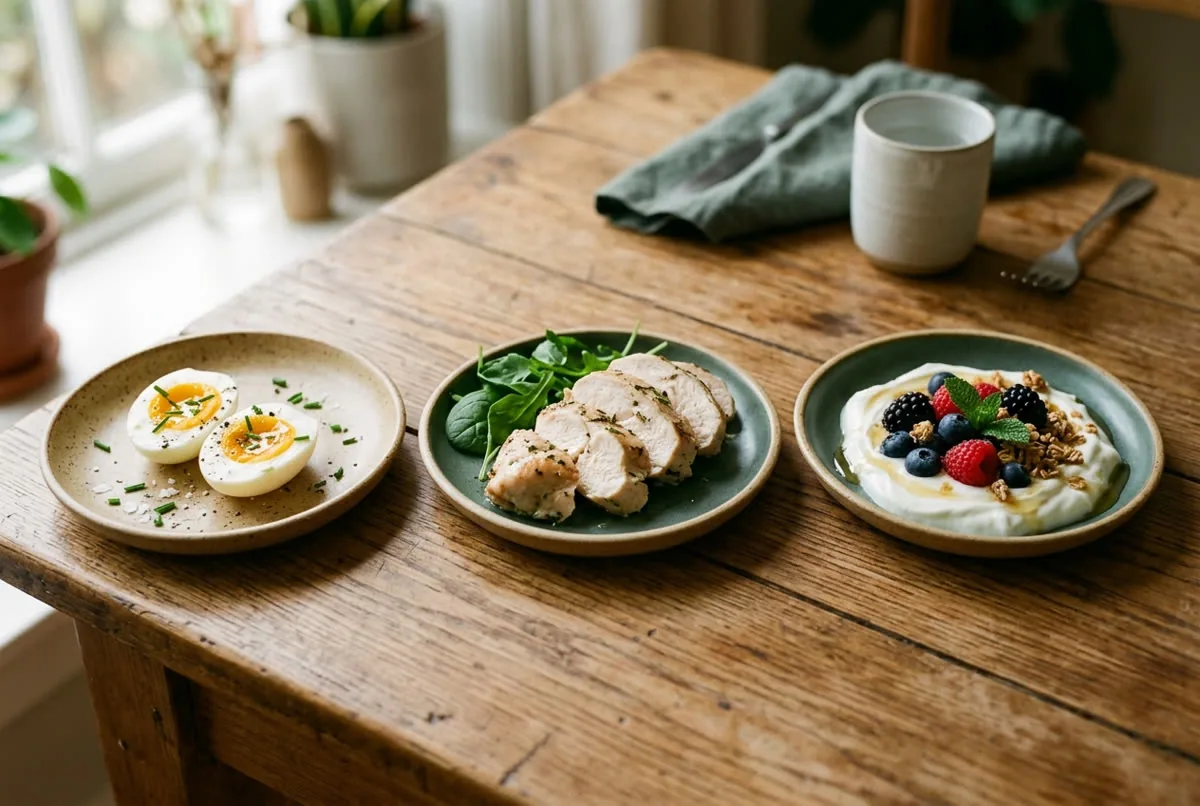
If you are on a GLP-1 medication and someone told you to eat “1.2 to 1.6 grams of protein per kilogram,” here is the number in plain English: for a woman who weighs 165 pounds, that is roughly 90 to 120 grams a day. Now here is the part nobody mentions. That target was written as a daily total. It says nothing about how to fit it into a day when you feel full after six bites of chicken.
That gap is the real problem, and it is worth naming honestly. This article covers what the current clinical advisories actually say, what they deliberately leave open, and how to think about spreading protein across meals when your appetite is not cooperating.
This article is for information only and is not medical advice. It is not a substitute for guidance from your prescriber or a registered dietitian. Talk to your healthcare provider before changing your diet or exercise routine, especially while taking a prescription medication. Nothing here is meant to guide whether or how you take your medication.
Key takeaways
- Two clinical advisories published in 2025, not 2026, set the protein targets people quote. They do not fully agree with each other.
- The joint advisory from four US obesity and nutrition societies proposes 1.2 to 1.6 g/kg/day during active weight reduction. A later international consensus narrows it to 1.2 to 1.5 g/kg of actual body weight.
- Neither document says anything about how to split that protein across meals. That guidance does not exist yet for GLP-1 users specifically.
- Both documents name menopausal status as a factor that may raise muscle-loss risk.
- The per-meal research that does exist comes from general nutrition studies, not GLP-1 studies. It is a reasonable starting point, not a rule.
What do the GLP-1 protein guidelines actually say?
There is no single 2026 rulebook. There are two separate advisory documents, both published in 2025, and they give slightly different numbers.
The first is a joint Advisory from the American College of Lifestyle Medicine, the American Society for Nutrition, the Obesity Medicine Association, and The Obesity Society, published in Obesity in May 2025. It states that higher protein targets, “such as 1.2 to 1.6 g/kg/day, have also been proposed during active weight reduction” (Nutritional priorities to support GLP-1 therapy for obesity, Obesity, 2025). It also offers an alternative for people who find gram-per-kilogram math unhelpful: an absolute target of 80 to 120 grams a day.
The second is an international expert consensus statement built with a modified Delphi method, published in Obesity Pillars in November 2025. It recommends “a protein intake of 1.2 to 1.5 g/kg actual body weight/day” during the weight-loss phase, dropping to at least 0.8 g/kg during maintenance (Nutritional and lifestyle supportive care recommendations, Obesity Pillars, 2025).
Notice three things. The ranges differ at the top end. The second document specifies actual body weight while the first openly says the field has not settled whether targets should use actual, adjusted, or ideal body weight, or fat-free mass. And both are advisory documents, not a finished standard of care.
That honesty matters more than a tidy number. If you have seen a confident post announcing “the 2026 GLP-1 protein guidelines,” it was almost certainly repackaging these 2025 documents under a fresher headline.
Why does muscle matter so much on these medications?
Because a meaningful share of the weight lost is not fat.
In the STEP 1 trial of semaglutide, roughly 40 percent of the weight lost was lean soft tissue. In the SURMOUNT-1 trial of tirzepatide, that figure was closer to 26 percent (Tinsley and Nadolsky, SAGE Open Medical Case Reports, October 2025). Those are different drugs and different study designs, so the honest read is a range rather than one headline number.
Some lean tissue loss is expected with any substantial weight loss, and lean mass includes water and organ tissue, not only muscle. But the direction is clear enough that every current advisory treats muscle preservation as a priority rather than an afterthought.
After 40, that concern stacks on top of one you may already be managing. The joint advisory specifically flags that low protein intake caused by reduced appetite “may contribute to muscle loss and increased risk for sarcopenia, particularly among those with older age, perimenopausal or menopausal status, lower testosterone, sedentary behavior, or lack of resistance/strength training.” The Obesity Pillars consensus makes a similar point, listing post-menopausal women among the subgroups that “might be particularly susceptible.”
You are not imagining the overlap. If you want the background on what shifts in these years, our overview of metabolism and hormone changes after 40 covers the wider picture.
Do the guidelines say anything about protein at every meal?
No. This is the honest gap, and it is worth being direct about it.
Both 2025 documents give a daily protein target. Neither one recommends a per-meal distribution, a per-meal gram figure, or a meal-timing pattern for people on GLP-1 medications. A separate commentary in the International Journal of Obesity in November 2025 put the wider problem plainly, noting that “no formal consensus recommendations currently exist for individuals commencing GLP-1 RAs” on nutritional screening and that “there remains no global consensus framework” (Spreckley, Ruggiero and Brown, International Journal of Obesity, 2025).
So when you see a per-meal number attached to GLP-1 advice, it is not coming from GLP-1 research. It is being borrowed from general nutrition research and applied by reasonable people using reasonable judgment. That is not a scandal. It is just worth knowing the difference between a tested recommendation and a sensible extrapolation.
Where does the per-meal advice actually come from?
The most-cited study is not about medication at all.
Researchers fed healthy adults the same total daily protein in two patterns: evenly split across three meals at about 30 grams each, or skewed toward dinner. Over 24 hours, muscle protein synthesis ran 25 percent higher in the even group (Mamerow et al., The Journal of Nutrition, 2014).
That study is more than a decade old, was run in healthy adults rather than people on appetite-suppressing medication, and used a small sample. It is suggestive, not definitive.
Still, it explains why “spread it out” became standard advice, and why a protein target you hit entirely at dinner is probably working less well than the same grams spread across the day. Our guide to hitting 30 grams of protein per meal after 40 breaks the pattern down in ordinary food.
The wrinkle is that the study asked healthy people to eat three normal meals. It did not ask anyone to do that on a medication that makes food feel like a chore.
How do you spread protein out when you are not hungry?
Start by lowering the stakes. The daily target is a direction, not a test you pass or fail each day.
A few approaches that fit the constraint rather than fighting it:
- Front-load the day. Protein at breakfast, when food may still feel manageable, banks grams you might not get at dinner. Our guide to protein at breakfast after 40 has straightforward options.
- Shrink the meal, not the protein. A half portion of a protein-dense food beats a full portion of something mostly carbohydrate. Eggs, Greek yogurt, cottage cheese, fish, and tofu carry more protein per bite than bread or rice.
- Eat the protein first. If a plate feels like too much, the protein is the part worth finishing.
- Use four or five smaller sittings instead of three meals. The even-distribution research used three, but nothing about the underlying idea requires exactly three. Smaller and more often is often more realistic on a low-appetite day.
- Drink some of it. A liquid feels easier than a plate when you are full. Milk, kefir, and a blended smoothie all count.
That last point is where protein powder earns its place. It is a convenience tool for days when chewing a full meal is not happening, not a requirement and not better than food. If you want the certification-first way to choose one, we cover it in our guide to protein powder for women on GLP-1 medications.
What does the exercise side of this look like?
Here the two documents disagree slightly again, and it is worth knowing.
The joint advisory recommends “regular strength training at least three times weekly plus at least 150 min of moderate-intensity aerobic exercise weekly.” The Obesity Pillars consensus is a little gentler, describing an individualized program built on at least 150 minutes of moderate to vigorous aerobic activity plus resistance training each week.
Both documents make the same underlying point: protein alone is not the lever. Protein supplies the raw material, and resistance training supplies the reason for your body to use it on muscle. Neither works nearly as well without the other. Our resistance band routine for women on GLP-1 medications is a realistic place to start if a gym is not part of your week.
On days when energy or nausea makes a full session unrealistic, a shorter and lighter version still sends a useful signal. Persistent nausea, fatigue, or trouble eating enough is a conversation for your prescriber rather than something to push through alone.
What is still unsettled?
Quite a lot, and you deserve to hear it plainly.
The weight basis for the gram-per-kilogram target is genuinely unresolved. Whether an even three-meal split is the right pattern for people on appetite-suppressing medication has not been tested. The 2025-2030 Dietary Guidelines for Americans landed on a similar 1.2 to 1.6 g/kg range for weight management in adults with overweight or obesity, but an American Society for Nutrition Perspective has already argued the evidence does not justify extending that figure to everyone across the whole lifespan (American Society for Nutrition, 2026). If you want the general version of that number for women over 40, we walk through it in our guide to how much protein women over 40 need.
None of that uncertainty means the advice is useless. It means the honest version is a range and a direction rather than a prescription, and that your prescriber or a registered dietitian is the right person to turn a range into your number, particularly if you have kidney disease or another condition that affects protein needs.
The short version
Aim for a daily protein range your provider agrees with, somewhere near the Obesity Pillars consensus range of 1.2 to 1.5 grams per kilogram of your actual body weight while you are actively losing. Spread it across the day rather than saving it for dinner, using whatever number of sittings your appetite allows. Pair it with resistance training a few times a week. Treat the per-meal split as a sensible habit borrowed from general nutrition research rather than a rule handed down from GLP-1 studies, because that is exactly what it is.
Progress here looks like steadier energy, strength that holds, and habits you can keep on a low-appetite week. Those are the things protein and resistance training genuinely protect.
Frequently Asked Questions
- Is there an official 2026 GLP-1 protein guideline?
- No. The numbers circulating as "2026 guidelines" come from two documents published in 2025. One is a joint Advisory from the American College of Lifestyle Medicine, the American Society for Nutrition, the Obesity Medicine Association, and The Obesity Society, published in Obesity in May 2025. The other is an international expert consensus statement published in Obesity Pillars in November 2025. Both are advisory documents rather than a finished standard of care, and they give slightly different protein ranges. Anything presented as a single tidy 2026 rulebook is repackaging those two.
- How much protein do the advisories actually recommend on a GLP-1?
- The joint Advisory says higher targets such as 1.2 to 1.6 grams per kilogram per day have been proposed during active weight reduction, and offers an absolute alternative of 80 to 120 grams a day. The later Obesity Pillars consensus narrows it to 1.2 to 1.5 grams per kilogram of actual body weight per day while you are losing, dropping to at least 0.8 grams per kilogram during maintenance. Your own number depends on your body and your health history, so treat these as ranges to discuss with your prescriber or a registered dietitian.
- Do the guidelines say how much protein to eat per meal?
- No, and this is the honest gap. Both 2025 documents give a daily total only. Neither recommends a per-meal gram figure, a distribution pattern, or a meal-timing rule for people on GLP-1 medications. When you see a per-meal number attached to GLP-1 advice, it is being borrowed from general nutrition research and applied by reasonable judgment, not drawn from GLP-1 studies.
- Why do people say to spread protein evenly across meals?
- It traces back to a 2014 study in The Journal of Nutrition that fed healthy adults the same daily protein either evenly across three meals at roughly 30 grams each, or skewed toward dinner. Muscle protein synthesis over 24 hours ran about 25 percent higher in the even group. That study was small, more than a decade old, and run in healthy adults rather than people on appetite-suppressing medication, so it is a reasonable starting point rather than a proven rule for GLP-1 users.
- How do I get enough protein when I have almost no appetite?
- Work with the constraint instead of against it. Front-load protein earlier in the day if food feels more manageable then, eat the protein portion of a plate first, choose protein-dense foods over a bigger volume of carbohydrate, and consider four or five smaller sittings rather than three full meals. Liquids like milk, kefir, or a blended smoothie often go down easier than a plate. If you consistently cannot eat enough, that is worth raising with your prescriber rather than managing alone.
- Does menopause change any of this?
- Both advisories flag it as a risk factor rather than issuing separate numbers. The joint Advisory notes that low protein intake from reduced appetite may contribute to muscle loss and sarcopenia risk, particularly with older age and perimenopausal or menopausal status. The Obesity Pillars consensus lists post-menopausal women among subgroups that might be particularly susceptible to accelerated muscle decline. Neither sets a different protein target for this group, so the general range still applies.
Sources & references
- Obesity, Nutritional priorities to support GLP-1 therapy: joint Advisory (2025) (opens in new tab)
- Obesity Pillars, GLP-1 nutrition and lifestyle expert consensus (2025) (opens in new tab)
- SAGE Open Medical Case Reports, Lean soft tissue during GLP-1 weight loss (2025) (opens in new tab)
- International Journal of Obesity, Bridging the GLP-1 nutrition guidance gap (2025) (opens in new tab)
- The Journal of Nutrition, Protein distribution and 24-h muscle protein synthesis (2014) (opens in new tab)
- American Society for Nutrition, Perspective on 2025-2030 DGA protein recommendations (opens in new tab)
Before you go
The 7-Day Protein-First Meal Plan for Women Over 40
A complete protein-first week, finished for you: your personal protein target, a one-page shopping list, 21 recipes at 25-35 g protein each, and a timed 90-minute prep schedule. Printable PDF, paired with a free 7-lesson email course.
Free guide
The 7-Day Protein-First Meal Plan for Women Over 40
A complete protein-first week, finished for you: your personal protein target, a one-page shopping list, 21 recipes at 25-35 g protein each, and a timed 90-minute prep schedule. Printable PDF, paired with a free 7-lesson email course.