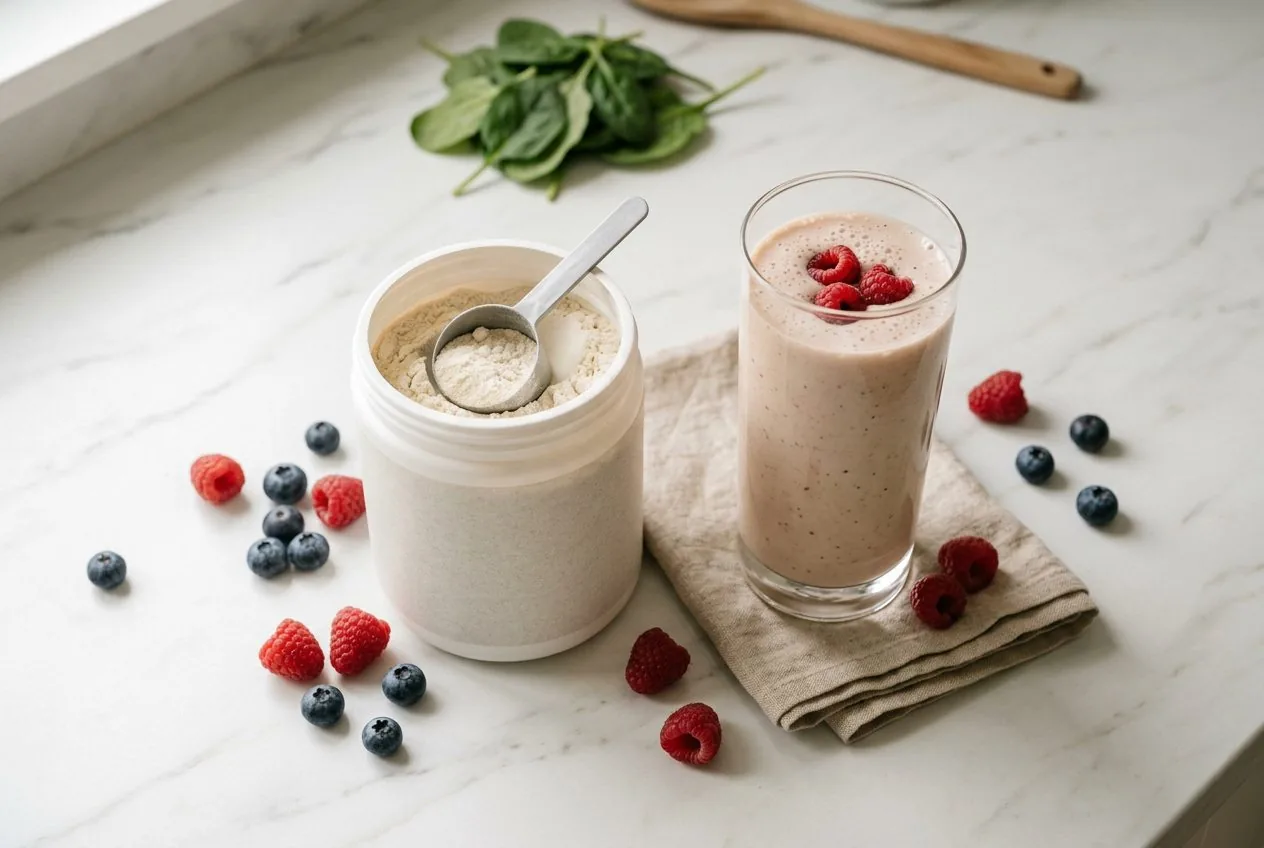
If your doctor started you on a GLP-1 medication and someone in a comment section scared you with “you’ll lose all your muscle,” take a breath first. That worry is legitimate, and it is also manageable with a few unglamorous habits, one of which is simply getting enough of the right protein. This is not a list of miracle shakes. It is a plain-language way to pick a protein powder using the same yardstick a careful dietitian would reach for: independent, third-party certification, not the claims printed on the tub.
This article is for information only and is not medical advice. Talk to your healthcare provider before changing your diet or starting any supplement, especially if you take a GLP-1 medication or another prescription. Nothing here is meant to guide how or whether you take your medication.
Why muscle deserves attention on a GLP-1
Weight loss from GLP-1 medications comes with one important caveat: research on these medications estimates that roughly a quarter of the weight lost is lean mass, which includes muscle, not only fat (International Journal of Obesity). Muscle is not just about strength. It is tied to your metabolism, your balance, and how steady your energy feels day to day, a mechanism we walk through in what actually changes in your metabolism after 40. None of this means the medication is wrong for you. It means protein and light strength work earn a bigger role while you are on it, and a smart protein powder choice is one small, manageable piece of that picture.
What to look for first: three certifications, not flavors
Before you compare a single flavor or price, look for one of these three labels on the actual package.
NSF Certified for Sport. Run by NSF International, this program independently tests a specific product for banned substances and confirms the label matches what is really inside (NSF Certified for Sport). It was built for tested athletes, but the underlying promise, an outside lab checked this, not just the company selling it, matters to anyone.
Informed Sport. A similar independent, batch-tested certification. It screens every batch for banned substances before release, not just when the product first launches (Informed Sport).
Clean Label Project. An organization that tests widely sold protein powders for heavy metals such as arsenic, lead, and cadmium, along with other contaminants (Clean Label Project). Its testing has found real variation across the category, and products that carry its certification or awards have been checked against that specific bar.
None of these labels are a health claim, and none of them mean a product will work better for your goals. They mean someone independent looked, which matters more when a shake becomes a bigger share of your daily nutrition, as it often does when appetite drops on a GLP-1 medication.
How we picked these, and what we have not tested ourselves
Honesty first: we did not run our own lab panel on any of these tubs. What we did is cross-check each pick against the certifying body’s own public listings, such as NSF’s certified product database, and against the brand’s own product page where no listing confirmed a seal. Certifications are granted per product, and sometimes per flavor or production batch, so before you buy, look for the actual seal printed on the specific box in front of you rather than assuming it carries over from a sibling product in the same lineup. Formulas and certification status also change over time, so treat this as a well-researched starting shortlist, not a permanent verdict.
Certified picks worth knowing about
Grass-fed whey isolate, NSF Certified for Sport. Brands such as Momentous and Klean Athlete publish whey isolate lines carrying the NSF Certified for Sport seal (NSF, Momentous listings; NSF, Klean listings), typically low in sugar with a short ingredient list. This tier usually sits at the higher end of the price range for the certification and quality control.
A widely available banned-substance-tested option. Optimum Nutrition’s Gold Standard 100% Whey is labeled banned substance tested on the brand’s US product page, which does not name the certifying program (Optimum Nutrition). Confirm the exact tub and flavor you are buying shows an actual Informed Sport or NSF seal before treating it as certified, since not every product in a large lineup carries one.
A hydrolyzed whey isolate option. Dymatize ISO100 is a hydrolyzed whey protein made from whey isolate, and the brand labels it banned substance tested (Dymatize). Hydrolyzed whey is partially broken down before you drink it (Frontiers in Nutrition), which some people find gentler on a stomach that is already emptying more slowly.
If dairy does not agree with you. Pea and rice protein blends are a reasonable substitute. If a brand publishes independent heavy-metal testing results for its plant-based powder, look for that disclosure on the label or the brand’s site before you buy.
The quick comparison
| Pick type | Certification | Protein form | Good to know |
|---|---|---|---|
| Grass-fed whey isolate (Momentous, Klean Athlete) | NSF Certified for Sport | Whey isolate | Low sugar; higher price point |
| Widely available whey (Optimum Nutrition Gold Standard) | Brand-labeled banned substance tested | Whey blend or isolate | Confirm the exact tub carries a seal |
| Hydrolyzed whey isolate (Dymatize ISO100) | Brand-labeled banned substance tested | Hydrolyzed whey isolate | Gentler on a slow-digesting stomach |
| Plant-based blend | Brand-published heavy-metal testing | Pea and rice blend | Best if dairy does not sit well |
Whey isolate or plant protein while your stomach is adjusting
Isolate forms of whey carry less lactose and fat than whey concentrate (Frontiers in Nutrition), which many people find easier to tolerate when digestion is already moving more slowly. A thinner, simpler shake tends to sit better than a thick, high-fat one in the first weeks on a new medication dose. If dairy has never agreed with you, a pea-rice blend is a fine substitute; the certification questions above apply the same way regardless of which protein source you choose.
Who does not need a specialty certified powder
If you are not an elite or tested athlete, you eat a varied diet, and your budget is tight, a plain, reputable grocery-store whey or plant protein is a completely reasonable choice. A certification is a bonus layer of quality control, not a requirement for a protein powder to be safe or useful. If you are not sure you need powder at all, our honest look at whether you need protein powder in smoothies over 40 covers the food-first alternatives.
Common mistakes to avoid
Trusting the words “third-party tested” alone. That phrase appears on many labels with no named certifying body and no way to verify it. Look for the actual NSF, Informed Sport, or Clean Label Project mark, not a vague claim.
Ignoring the rest of the label. A certification does not cancel out a high-sugar, heavily sweetened formula. Check total sugar and the ingredient list even on a certified product.
Treating a shake as a meal replacement long-term. Protein powder is a convenient add-on to real food, not a substitute for eating enough overall, which matters more than usual when appetite is already reduced.
Assuming one flavor equals the whole lineup. Certifications can apply to specific SKUs. Check the exact product in your cart, not the brand’s homepage claim.
The honest bottom line
A certified protein powder will not do the muscle-protecting work by itself. What genuinely helps is a reasonable protein target spread across your day, which we make concrete in how to hit 30 grams of protein per meal after 40, alongside the food-first habits in natural ways to support your body during weight loss after 40. A shake with an independent seal on it is simply a lower-effort way to close a protein gap on days when real food will not cover it. If you would rather build meals around a structured plan instead of counting grams, our Smoothie Diet review is an honest look at one option, and you will find more protein-forward ideas in our Smoothies & Simple Meal Prep section. Pick the certification that matches what you can afford, check the actual seal on the actual box, and let your provider weigh in on anything specific to your medication.
Frequently Asked Questions
- What does NSF Certified for Sport mean on a protein powder?
- It means an independent lab, not the manufacturer, tested that specific product for banned substances and confirmed the label actually matches what is in the tub. NSF International runs the program, and it was built for tested athletes, but it is a useful trust signal for anyone who wants proof a supplement was checked by someone with no stake in selling it. It does not mean the product is more effective, tastier, or right for your body; it means the quality control claim is independently verified.
- Do I need a special protein powder if I am on a GLP-1 medication?
- No single powder is required, and a regular grocery-store tub is not unsafe by default. What changes for many people on a GLP-1 medication is appetite and how food sits, so a lower-sugar, easy-to-digest option, and one with independent testing behind it, can be a reasonable preference rather than a necessity. This is general nutrition information, not a medical requirement, so bring your specific situation to your doctor or a dietitian.
- Is whey or plant protein better while on a GLP-1 medication?
- Neither is universally better. Whey isolate is lower in lactose and fat than whey concentrate, which some people find easier on a stomach that empties more slowly on these medications, and it mixes smoothly into a thin shake. Plant blends made from pea and rice work well for anyone who reacts badly to dairy. The honest answer is that digestion is individual, so a smaller trial size beats guessing from a label.
- How much protein should I aim for while on a GLP-1 medication?
- Many dietitians point toward a higher target than the old minimum once weight loss is underway, often discussed in a similar range to the general 25 to 30 grams per meal guidance we use across this site. Exact needs depend on your body, your medication, and your health history, so this is a starting point for a conversation with your provider or a registered dietitian, not a personal prescription.
- Are certified protein powders safer than regular ones?
- Certification means a third party checked for specific things, banned substances, label accuracy, or heavy metals depending on the program, not that every other product on the shelf is dangerous. Most mainstream protein powders are fine for most people. A certification is a shortcut for the quality-control checking you would otherwise have to do yourself, not a verdict that uncertified products are unsafe.
Sources & references
- International Journal of Obesity, GLP-1 receptor agonists and muscle health meta-analysis (opens in new tab)
- NSF Certified for Sport, What our mark means (opens in new tab)
- NSF Certified for Sport, Momentous certified products (opens in new tab)
- Informed Sport, Certification program (opens in new tab)
- Clean Label Project, Protein powder study (opens in new tab)
- Optimum Nutrition, Gold Standard 100% Whey product page (opens in new tab)
- Dymatize, ISO100 product page (opens in new tab)
- Frontiers in Nutrition, Whey protein supplementation in older adults (opens in new tab)
Before you go
The 7-Day Protein-First Meal Plan for Women Over 40
A complete protein-first week, finished for you: your personal protein target, a one-page shopping list, 21 recipes at 25-35 g protein each, and a timed 90-minute prep schedule. Printable PDF, paired with a free 7-lesson email course.
Free guide
The 7-Day Protein-First Meal Plan for Women Over 40
A complete protein-first week, finished for you: your personal protein target, a one-page shopping list, 21 recipes at 25-35 g protein each, and a timed 90-minute prep schedule. Printable PDF, paired with a free 7-lesson email course.