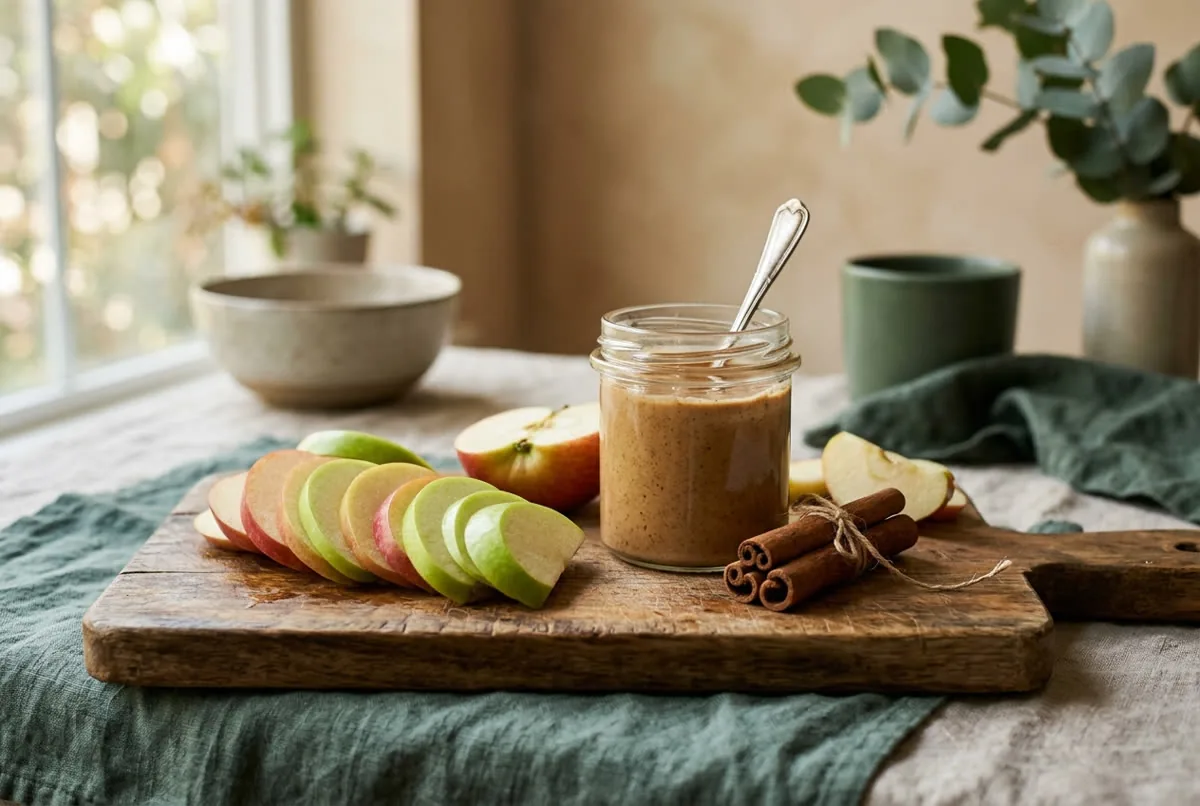
September means apples are suddenly everywhere: farmers market bins, grocery store end caps, a bag from a neighbor’s tree you didn’t ask for but aren’t turning down. If your go-to snack lately has been whatever’s fastest rather than whatever actually holds you until dinner, apple season is a good moment to swap in something that does both, no elimination diet or new rulebook required, just a fruit that’s already in season and already cheap.
The short answer: A medium apple carries roughly 3.7 grams of fiber and no added sugar, and that fiber, soluble pectin, is what slows down how fast the fruit’s natural sugar reaches your bloodstream. Eat the peel, pair the apple with a source of protein or fat like nut butter, and you have a genuinely high-fiber, low-sugar snack that fits the season instead of fighting it.
This article is for information only and is not medical advice. Talk to your healthcare provider before changing your diet or exercise routine, especially if you have a medical condition or take medication.
Are apples actually low in sugar, or is that just what we tell ourselves?
Apples taste sweet, so it’s easy to lump them in with anything else that tastes sweet. But the sugar in an apple doesn’t arrive alone.
A medium apple, about 5 ounces, carries roughly 3.7 grams of fiber from pectin, a soluble fiber, and about 81 calories (NH Fruit Growers). That fiber matters more than the sweetness does. Viscous soluble fiber slows how quickly sugar enters your bloodstream after you eat, and in a clinical feeding study, adding a viscous soluble fiber like guar gum to a glucose-containing meal measurably reduced the blood-sugar spike compared with the same meal without the fiber (Zoe). An apple isn’t a lab-dosed spoonful of guar gum, but the underlying mechanism is the same one at work: fiber slows sugar down.
So the honest answer to “are apples low sugar” is that they’re not sugar-free, nothing whole and naturally sweet is, but the sugar comes wrapped in enough fiber that your body doesn’t process it the way it processes the same grams of sugar sitting in a soda or a fruit snack. That’s a meaningfully different experience for your blood sugar, even if the sugar line on a nutrition label looks similar on paper.
That difference is worth paying attention to in your 40s and 50s specifically, when a lot of women notice their energy dipping harder in the afternoon than it used to. A snack that spikes blood sugar and then lets it drop tends to leave you reaching for the next thing within the hour. A snack built around fiber, like an apple eaten the way it comes, tends to leave you steadier for longer, which is really the whole point of choosing one snack over another.
Peel it or leave it? The healthiest way to eat an apple as a snack
If you’ve ever peeled an apple out of habit, thinking you’re trimming away something you don’t need, it’s worth reconsidering. Unpeeled apples provide their most plentiful nutrients just under the skin (NH Fruit Growers). Peeling doesn’t make the apple healthier; it strips away part of what you’re eating it for. If texture is the actual objection, a snacking variety like Honeycrisp or Gala, both described by USApple as good for snacking, is an easier sell than fighting the peel out of principle (USApple).
The bigger lever, more than peel-or-no-peel, is what you eat the apple with. Fiber alone slows sugar absorption; adding protein and healthy fat slows it further and turns a piece of fruit into something that holds you until your next meal instead of sending you back to the pantry an hour later. A tablespoon or two of a natural nut butter, the kind whose label reads nuts and maybe salt, does exactly that job, and it’s worth knowing that plenty of jars marketed as “natural” earn the label while the sweetened, oil-added versions quietly work against the point. Our full breakdown in Is Natural Nut Butter Worth the Extra Cost After 40? covers what to look for on the label before you reach for a jar.
Making it work on a busy week
None of this needs to be fussy. Slice a few apples at the start of the week and keep them in a container with a splash of water and lemon or lime juice, which slows the browning enough that they still look appetizing on day three. Keep a jar of natural nut butter and a container of plain Greek yogurt within easy reach in the fridge so the pairing is a ten-second decision instead of a project. If you’re packing snacks for the day, a small container of nut butter next to apple wedges travels well in a lunch bag with an ice pack, in line with FDA advice to keep cut produce refrigerated (FDA), which makes this an easy one to carry to work or errands without planning ahead.
Does the variety matter, or is any apple “in season” right now?
U.S. Honeycrisp harvest begins in September (USApple), while Gala harvest begins in mid-July and Granny Smith in August, and both of those are typically available year round (USApple; USApple).
What we don’t have is a solid variety-by-variety breakdown of fiber or sugar grams, Honeycrisp against Granny Smith against Gala, so we’re not going to hand you numbers that don’t exist. What’s actually established is the timing: different varieties are harvested at different points from summer into fall, rather than any documented nutrition gap between them. For a high-fiber, low-sugar snack, the variety matters less than eating the peel and pairing it well. Pick whichever one is freshest and tastes best to you right now, and let the calendar sort out which variety that happens to be.
There’s a practical upside to that spread you can actually use: because different varieties come in at different points, you’re not stuck stocking up on a single week’s harvest and hoping it lasts through fall. You can rotate through whichever variety is freshest at the store this fall instead of committing to one bag and one flavor for the whole season.
Apple fiber vs. a fiber supplement: does the source matter?
Fiber is one of the nutrients the 2020 Dietary Guidelines Advisory Committee report flagged as a shortfall for the general population, alongside calcium and potassium (Nutritional Outlook, 2020). The Daily Value for fiber on nutrition labels is 28 grams a day (FDA), and a single medium apple gets you roughly 13 percent of that in one snack. That’s a meaningful dent from something you can eat one-handed while you’re doing something else entirely.
The research behind this article doesn’t include a head-to-head comparison of apple fiber against a specific fiber supplement, so we’re not going to invent one. What the research does support is the mechanism: viscous soluble fiber, whether it comes from an apple’s pectin or a supplement like guar gum, slows how fast sugar enters the bloodstream after a meal, and that slowing effect is what blunts a blood-sugar spike (Zoe). A whole apple delivers that fiber attached to water, vitamin C and the kind of volume that fills you up, which a powder or capsule doesn’t replicate. If you’re already leaning on other fiber-forward staples like chia or ground flax in your smoothies, an apple is simply another route to the same underconsumed nutrient; our chia seeds vs. ground flaxseed comparison breaks down how those two stack up if you want to compare.
None of this means a fiber supplement is a bad idea if your meals genuinely fall short most days. It means whole-food fiber, an apple, a pear, oats, chia, doesn’t need to be replaced by a supplement to matter. Given that fiber is a shortfall nutrient for so many people, adding a piece of fruit you were probably going to eat anyway is one of the lowest-effort ways to close part of that gap without changing anything else about how you eat.
Building a fall snack plate around what’s actually in season
Apples aren’t the only thing peaking right now, and pairing them with what else is in season is more about assembling a satisfying plate than following a recipe.
A few simple combinations that keep the fiber-and-protein pairing doing the actual work:
- Apple slices, unpeeled, with a tablespoon of natural nut butter and a sprinkle of cinnamon.
- Apple wedges dipped in plain Greek yogurt with a spoonful of ground flaxseed stirred in.
- Diced apple folded into warm oatmeal instead of a sugary topping.
- Apple and a small handful of walnuts or almonds, for a version with no dairy involved.
- Apple slices added to a lunchtime salad alongside a protein you’re already eating, for the same fiber-and-protein pairing outside of snack time.
None of these need a recipe card, and all five keep the peel on and pair the apple with something that slows sugar absorption further, rather than leaning on the apple alone. One or two apple-based snacks like this across a day is a reasonable place to start if you’re used to reaching for something packaged instead, and there’s no need to overhaul every snack at once to see the difference. If soups and warmer meals are more your speed as the weather turns, our 9 high-protein fall soups and chili roundup applies the same food-first, protein-forward logic to dinner instead of snack time.
Pick one apple this week and try it two ways: peel on, paired with a real source of protein or fat, instead of eaten alone or peeled out of habit. That single swap, keeping the fiber where it already is and giving your blood sugar something to slow it down, is the whole idea behind a high-fiber, low-sugar fall snack. Everything else here is just detail.
Frequently Asked Questions
- Are apples actually low in sugar, or is that a myth?
- They are not sugar-free, but a medium apple's roughly 3.7 grams of fiber, mostly pectin, slows how quickly that sugar gets absorbed, which is a different experience for your blood sugar than the same sugar grams without the fiber attached (NH Fruit Growers; Zoe).
- Does peeling an apple make it healthier?
- No. Unpeeled apples provide their most plentiful nutrients just under the skin, so peeling removes part of what you are eating the apple for rather than adding any benefit (NH Fruit Growers).
- How much fiber is actually in one apple?
- About 3.7 grams in a medium, 5-ounce apple, roughly 13 percent of the 28-gram Daily Value for fiber used on nutrition labels (NH Fruit Growers; FDA).
- Do different apple varieties matter for nutrition?
- The clearest documented difference between varieties is harvest timing, not fiber or sugar content: U.S. Honeycrisp harvest begins in September, Gala harvest begins in mid-July and Granny Smith in August, and both of those are typically available year round (USApple). There is no reliable variety-by-variety fiber or sugar breakdown, so pick whichever tastes best to you right now.
- What pairs well with an apple for a more filling snack?
- A source of protein or fat, like a tablespoon or two of natural nut butter, plain Greek yogurt, or a spoonful of ground flaxseed, slows sugar absorption further and makes the snack hold you longer than the apple alone would.
Sources & references
- NH Fruit Growers (opens in new tab)
- Nutritional Outlook (opens in new tab)
- Zoe (opens in new tab)
- FDA, Daily Value on the Nutrition and Supplement Facts Labels (opens in new tab)
- FDA, Selecting and Serving Produce Safely (opens in new tab)
- USApple, Honeycrisp (opens in new tab)
- USApple, Gala (opens in new tab)
- USApple, Granny Smith (opens in new tab)
Before you go
The 7-Day Protein-First Meal Plan for Women Over 40
A complete protein-first week, finished for you: your personal protein target, a one-page shopping list, 21 recipes at 25-35 g protein each, and a timed 90-minute prep schedule. Printable PDF, paired with a free 7-lesson email course.
Free guide
The 7-Day Protein-First Meal Plan for Women Over 40
A complete protein-first week, finished for you: your personal protein target, a one-page shopping list, 21 recipes at 25-35 g protein each, and a timed 90-minute prep schedule. Printable PDF, paired with a free 7-lesson email course.