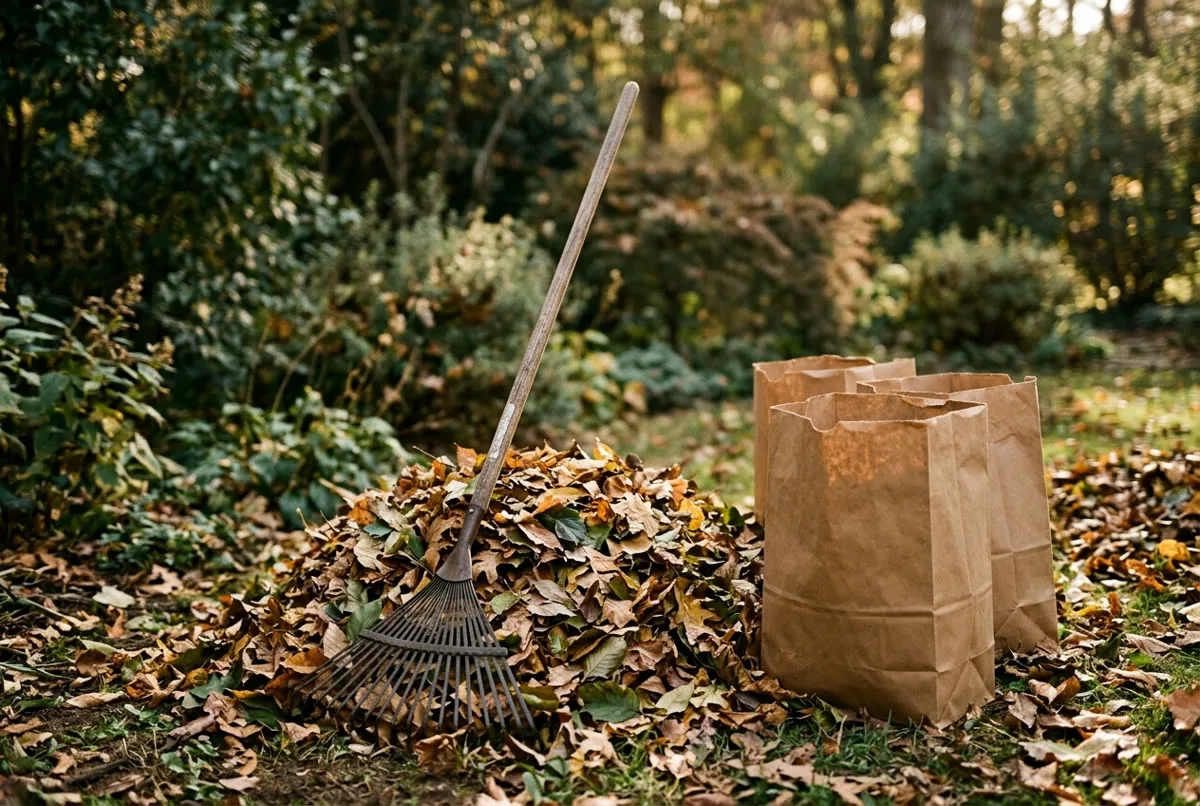
September’s first leaves are already coming down, and if you’re the one clearing them, you know how a “quick raking session” turns into a full afternoon of bending, twisting, and hauling bags to the curb. You feel strong going in, and by evening your lower back is telling a different story. That afternoon-to-evening flip is common enough that orthopedic practices publish raking-specific injury guidance every fall, and it’s worth taking seriously before you start.
The short answer: Keep your back straight and rake from your arms and shoulders instead of twisting your spine, bend at the knees and hips (never the waist) when you pick up a leaf bag, warm up and stretch before you start, and break the job into stretches with a rest every 20 to 30 minutes.
Why Fall Yard Work Is Harder on Your Back Than It Looks
Raking-related injuries send thousands of people to the doctor every year, and back pain is the most common complaint, though the chore can also take a toll on shoulders, necks, and hands (Cleveland Clinic, 2024-10-16). That’s a useful number to sit with, because most of us don’t walk into yard work expecting it to be the thing that puts us on the couch for a week.
Part of the problem is how we think about the task. Orthopedic guidance treats raking, bagging, and hauling as a workout, not a casual chore, and recommends warming up beforehand the same way you would before a training session (Cleveland Clinic, 2024-10-16). After 40, most of us aren’t doing hundreds of repeated pulling motions on a regular Tuesday, so a Saturday spent raking asks tissue and joints to handle a movement pattern they haven’t practiced since last fall. Treating it like exercise instead of a chore is the mental shift that makes the rest of this guidance click.
You don’t need to overhaul your whole weekend for this. Three habits, form while raking, form while lifting, and pacing, cover most of what actually causes the injuries described above. None of them require special equipment or extra time carved out of your day. They’re mostly about how you move through a task you were going to do anyway.
The Raking Form That Actually Protects Your Back
A chiropractor quoted by Cleveland Clinic gives specific, practical form advice, and it’s worth committing to memory before you touch the rake.
Keep the twisting out of it
Twisting the spine repeatedly while raking places stress on the discs in the lower back, and even a slight forced twist can injure the fibers around them (Cleveland Clinic, 2024-10-16). Instead of pivoting from the waist with every pull, keep your back straight and let your arms and shoulders generate the sweeping motion. Think of your torso as a fixed column and your arms as the moving part.
Hold it close and bend the knees
Hold the rake close to your body rather than reaching out at arm’s length, and bend your knees slightly instead of standing stiff-legged and hinging from the back (Cleveland Clinic, 2024-10-16). A slight knee bend, with one foot just in front of the other, helps distribute your weight evenly and can help prevent undue strain on your knees and back.
Switch hands regularly
Every so often, switch which hand is at the top of the handle. Raking the same direction for an hour loads one side of your body unevenly, and alternating sides is a simple way to avoid overusing one shoulder or one side of your lower back (Cleveland Clinic, 2024-10-16). Set a rough mental timer, five minutes with your right hand leading, five with your left, and it becomes automatic after a couple of sessions.
How to Lift and Carry Leaf Bags Without Straining Your Back
Once the leaves are piled, the real risk shows up: lifting a stuffed, awkward bag off the ground. Bend at the knees rather than the waist, keep your back straight and your core tight, get a secure grip on the bag, and stand up slowly while keeping that straight back (Cleveland Clinic, 2024-10-16; Raleigh Orthopaedic, accessed 2026-10).
Lifting injuries are a genuine occupational hazard in workplaces, which is part of why the federal government maintains a dedicated formula for lifting tasks. NIOSH’s Revised Lifting Equation is a tool to calculate the risk of work-related musculoskeletal disorders and set a recommended weight limit for manual lifting tasks (CDC NIOSH), which tells you this isn’t a minor footnote, it’s an active area of federal research. A backyard leaf bag isn’t a warehouse pallet, but the mechanics that protect a warehouse worker’s spine protect yours too.
In practice, that means:
- Squat down to the bag rather than leaning over it from a standing position.
- Get a solid grip and pull the bag in close to your torso before you start to stand.
- Straighten your legs to lift, not your lower back.
- If a bag feels heavier than expected once you’ve gripped it, set it back down and split it into two before trying again instead of muscling through with your back.
- Carry bags one at a time rather than stacking two to save a trip. The extra weight and awkward shape cancel out any time you save.
Warm Up Before You Touch the Rake
Because raking and bagging function like a workout, orthopedic guidance recommends warming up, for example with a brisk walk around your yard to get your blood circulating, and stretching before you start (Raleigh Orthopaedic, accessed 2026-09). That’s a short investment compared to what a pulled muscle costs you in missed workouts and disrupted sleep the following week.
If you already have a warm-up routine before strength training, that same pattern works here: a few minutes of easy movement to get blood flowing, followed by gentle mobility work for the shoulders and hips before you start the repetitive pulling motion. Arm circles, a few bodyweight squats, and some gentle torso rotations (standing still, not while holding a rake) cover the areas this guidance flags.
Pace the Job So You’re Not Paying for It All Week
Taking breaks about every 20 to 30 minutes is recommended because raking is such a repetitive motion, and a few minutes of doing something else, or just resting, gives tired muscles a reprieve (Cleveland Clinic, 2024-10-16). If your yard takes three hours to clear, that’s five or six short breaks, not one marathon push with a water bottle waiting at the end.
Use those breaks to switch tasks rather than just stopping and standing around. Rake for twenty minutes, bag for a while, then haul what’s already bagged to the curb. Rotating between raking, bending to bag, and carrying spreads the repetitive load across different muscle groups instead of hammering your lower back the entire afternoon. It also gives you a natural checkpoint to notice how your body feels before pushing into the next stretch.
If you notice sharp pain, numbness, or a back that doesn’t loosen back up after a short break, that’s your cue to stop for the day and finish the rest tomorrow rather than pushing through to get it all done in one sitting. A finished yard isn’t worth a week of favoring one side while you get dressed.
Two Assumptions Worth Retiring
“Raking is light chore work, so I don’t need to warm up.” Orthopedic guidance treats raking like a workout precisely because it demands repetitive back, shoulder, and arm effort that most people aren’t conditioned for the rest of the year. Skipping the warm-up because the task looks casual, rather than because you’ve actually assessed the effort involved, is exactly the assumption that leads to the injuries described above.
“Bending from the waist to grab a bag is fine if it feels light.” Lifting technique guidance calls for bending at the knees with a straight back when you pick up a bag of leaves, and whatever you’re grabbing is probably heavier than you think (Cleveland Clinic, 2024-10-16). That’s why the habit matters even on bags you could probably muscle through with bad form.
Building the Strength to Handle Yard Work, Season After Season
Good form during the two or three hours you spend raking matters, but so does what your body can handle the rest of the year. The hips, core, and shoulders that keep you stable while bending to lift a bag are the same muscles a regular strength routine trains. If your current routine is thin on structured lower-body and core work, a program built around functional strength for this decade of life, rather than generic workouts, can make next fall’s cleanup feel a lot less like a one-day event that wrecks your week.
Recovery matters too. A few hours of repetitive pulling and bending can leave shoulders and lower back tight the next day even when you used good form the whole time. Our Foam Roller for Recovery After 40 review looks at whether adding one to your post-yard-work routine is worth it, and if core stability during bending and lifting is something you want to build on purpose, our Pilates Ring Worth It for Core Strength After 40 breakdown covers a low-cost way to work on it between seasons.
None of this means you need to train specifically for raking leaves. It means the squats, hip hinges, and rotational core work already common in a gentle-strength routine happen to be the exact movement patterns that protect you on cleanup day. Consistency in the off-season is what makes the form cues above easier to actually hold when your arms are tired and the pile still isn’t finished.
Your Next Step
Before your next big cleanup, walk through the form checklist once: straight back while raking, rake held close to the body, knees bent to lift, breaks every 20 to 30 minutes. None of it requires new equipment or a gym membership, just a few minutes of warm-up and the discipline to stop and reset every half hour instead of pushing through to the finish. Your back will thank you on Sunday morning.
Frequently Asked Questions
- What's the correct way to bend when lifting heavy leaf bags?
- Bend at the knees rather than the waist, keep your back straight and your core tight, get a secure grip on the bag, and stand up slowly while keeping your back straight. Bags of leaves are often heavier than they look, so avoid overfilling them, especially when the leaves are wet.
- Should I stretch before yard work like I would before a workout?
- Yes. A chiropractor quoted by Cleveland Clinic calls raking a physical activity just like a workout, and orthopedic guidance recommends warming up, for example with a brisk walk around your yard, and stretching before you start.
- What's the best way to hold a rake to protect my back and shoulders?
- Hold the rake close to your body instead of reaching out at arm's length, bend your knees slightly rather than standing stiff-legged, and keep your back straight so your arms and shoulders generate the sweeping motion instead of your spine twisting.
- How often should I take breaks during a big yard cleanup?
- Take a break about every 20 to 30 minutes. Raking is a repetitive motion, and doing something else for a few minutes, or just resting, gives tired muscles a reprieve.
Sources & references
Before you go
The 7-Day Protein-First Meal Plan for Women Over 40
A complete protein-first week, finished for you: your personal protein target, a one-page shopping list, 21 recipes at 25-35 g protein each, and a timed 90-minute prep schedule. Printable PDF, paired with a free 7-lesson email course.
Free guide
The 7-Day Protein-First Meal Plan for Women Over 40
A complete protein-first week, finished for you: your personal protein target, a one-page shopping list, 21 recipes at 25-35 g protein each, and a timed 90-minute prep schedule. Printable PDF, paired with a free 7-lesson email course.