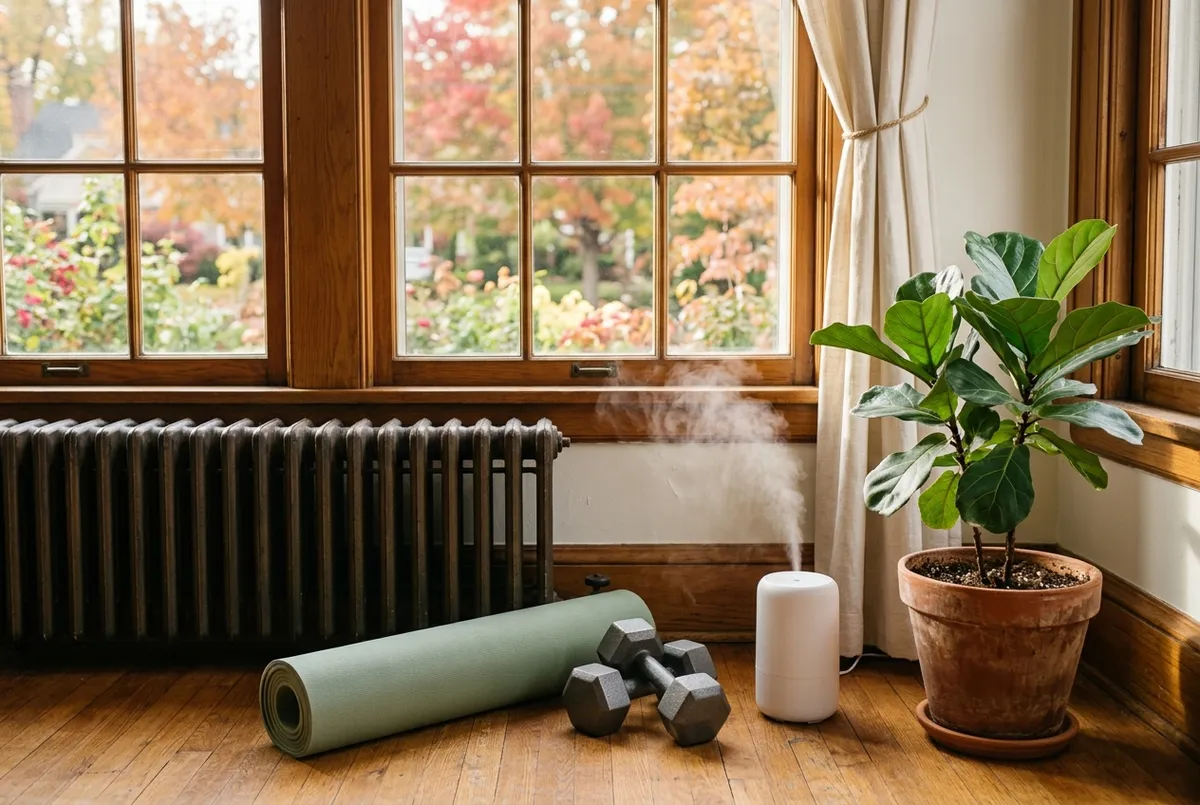
Your furnace kicks on sometime in October and within a week or two the air in your house feels different: drier, stiller, sealed up against the cold. If you train at home, or you’ve just noticed you feel more stuffed up or tired after a workout once heating season starts, it’s a fair question to ask whether the air itself is part of it.
The short answer: Heating season really does change your indoor air. Once the furnace takes over and the windows stay shut, less fresh air comes in, and allergists note that dry winter indoor air often irritates sinus passages. What hasn’t been directly studied is whether that specific shift slows workout recovery after 40. The physiology is plausible. The direct proof isn’t there yet.
What actually happens to your air once the heat comes on
The basic mechanism is simple. The EPA notes that bringing more fresh air indoors helps reduce indoor pollutants, and suggests opening windows and doors when weather permits (EPA, accessed September 2026). In heating season the weather rarely permits, so the natural air exchange of warmer months (open windows, doors propped, air moving through the house) drops off, and pollutants have fewer ways out of a closed-up home.
On top of that, winter indoor air tends to be dry. The American Academy of Allergy, Asthma & Immunology notes that dry indoor air in winter is often the cause of chapped lips, dry skin, and irritated sinus passages (AAAAI). If you’ve noticed a scratchier throat or a stuffier nose once the heat kicks on, that’s not in your head. It’s a documented seasonal shift, not a symptom specific to training or to being over 40.
Two separate things are going on at once, and it’s worth keeping them apart. One is humidity: the actual moisture content of the air, which forced-air heat pulls down. The other is ventilation: how much fresh air is exchanging with the outside at all. Both tend to drop during heating season, but they’re not the same fix. A humidifier addresses the first. Cracking a window or running an exhaust fan addresses the second, even in the cold, though the EPA material used for this piece doesn’t spell out a specific window-opening protocol for winter, so treat brief, occasional ventilation as a reasonable general practice rather than a study-backed prescription.
Should you worry about your home gym specifically
If you train in a basement, garage, or spare room, the same sealed-house dynamic applies there too, and it can be worse. Those spaces often get less airflow than the rest of the house even in summer, and once the furnace takes over and windows stay shut for months, whatever dust, humidity swings, or combustion byproducts exist in that room have less chance to clear out. Nothing in the research reviewed here singles out home gyms as a special case with its own numbers. It’s the same general heating-season logic the EPA describes for the whole house, just potentially more pronounced in a room that already had weaker ventilation to begin with. If your home gym is in a below-grade space, the humidity check described below is worth doing there specifically, not just in the main living area.
Does that connect to workout recovery specifically
Here’s where the research on this topic gets honest rather than convenient: it doesn’t. Dry air and reduced ventilation irritating your airways is well established. A direct line from “my house has drier winter air” to “my muscles take longer to recover from a workout” has not been studied in a way that would let us claim it as fact.
The closest research is a 2025 study that monitored eleven indoor air quality parameters over eighteen weeks in a home rehabilitation setting. Researchers found frequent exceedances of international air-quality standards, and those numbers improved after an air purifier was installed (Healthcare, MDPI, 2025, https://doi.org/10.3390/healthcare13131493). That’s a real, useful data point, but it was a single-patient study of someone recovering from a spinal cord injury in a home-rehab context, not a study of general workout recovery in midlife women. The authors also note that research on indoor air quality in the homes of people doing physical rehabilitation remains limited, which means nobody can currently make a strong causal claim in either direction (same source).
So the honest version is this: it’s physiologically reasonable that breathing drier, more polluted air could make you feel more fatigued, more congested, or generally less recovered after a workout, because irritated airways and low-grade inflammation are known to affect how you feel. But “reasonable” is not the same as “proven.” Anyone telling you dry winter air is definitively slowing your recovery is going further than the research currently supports.
This matters because it’s easy for a plausible-sounding mechanism to get repeated online until it hardens into a fact nobody actually checked. Dry air irritating your airways is real. Airway irritation making you feel more run-down in general is also reasonable. But the specific claim “heating season is why your recovery is worse after 40” skips a step that hasn’t been tested. If your recovery has genuinely changed since the heat came on, it’s worth also considering the more ordinary, better-studied explanations: less daylight affecting sleep and energy, shorter days cutting into outdoor movement, or simply a busier fall schedule squeezing your sleep and protein intake. Air quality is one plausible piece of a bigger seasonal picture, not necessarily the main one.
What the furnace tune-up and filter advice actually buys you
The EPA’s recommendations here are unglamorous and specific: change or clean your heating system’s filters regularly, and make sure fuel-burning appliances like furnaces are properly installed, adjusted, and maintained (EPA, accessed September 2026). Its winter guidance adds two carbon monoxide steps: test CO alarms monthly, and clear snow and ice from outside furnace vents so pollutants, including carbon monoxide, don’t build up indoors (EPA, December 17, 2025).
None of that is marketed as a recovery hack. It’s basic home maintenance that happens to reduce the amount of irritant-laden or, in a worst case, dangerous air you’re breathing while you train in your living room or basement gym. If you’re going to do one thing from the EPA’s list before the weather turns, this is the one with the clearest safety case attached to it.
The humidity number worth knowing
The EPA recommends keeping indoor relative humidity between 30% and 50% (EPA, accessed September 2026). Forced-air heat tends to push a house below that range, which is the mechanism behind the dried-out, irritated feeling in your nose and throat once winter sets in.
You don’t need to obsess over a number to act on this. A cheap hygrometer (many are combined with a basic room thermometer) tells you roughly where your house sits. If you’re consistently well under 30%, a humidifier in the room where you train or sleep is a reasonable, low-cost response. If you’re pushing past 50%, that’s its own problem (mold risk), so the goal is the range, not “more humidity is always better.”
What we don’t know yet
To be direct about the limits here: as far as this research turned up, there is no published study that directly measures how heating-season indoor air quality affects workout recovery time, soreness, or performance in adults over 40. The EPA material is about general indoor air quality and respiratory health. The one directly relevant study followed a single patient, is specific to post-injury home rehabilitation, and its authors note that research in this area remains limited.
That gap doesn’t mean the connection is imaginary. Reduced ventilation and drier air affecting how your airways feel is well documented, and how your airways feel plausibly affects how a workout feels and how wrecked you are afterward. It just means nobody has run the study that would let us say “dry winter air definitively slows recovery after 40” as a fact rather than a reasonable guess. If you notice a real difference in how you feel training through the winter months compared to summer, that’s useful personal data. It’s not, on the current evidence, a confirmed physiological finding you can generalize to everyone.
What you can actually do this week
Get your home into the EPA’s target range
Pick up a basic hygrometer, check where your house currently sits, and adjust toward 30-50% relative humidity with a humidifier or dehumidifier as needed. This is the single most evidence-backed action in this whole topic, because it’s the EPA’s own stated target, not an inference.
Handle the HVAC basics before it gets cold
Change your filter on whatever schedule your system calls for, and if you haven’t had a furnace tune-up this year, book one before you’re deep into heating season. This is about clean combustion and reduced irritant exposure, not a training hack, but it’s the kind of unglamorous maintenance that actually moves the numbers the EPA cares about.
Keep the basics that are actually studied doing the heavy lifting
Recovery after 40 still comes down mostly to the things with real evidence behind them: enough protein across the day, enough sleep, and giving your body some way to work out stiffness between sessions, whether that’s a foam roller, a slow walk, or a few minutes with a percussion massage tool if that’s what gets you to actually do the mobility work. Air quality is a reasonable variable to clean up if it’s cheap and easy, like most of the steps above are. It isn’t a substitute for the fundamentals, and nothing here should be read as a promise that fixing your home’s humidity will noticeably change how sore you feel on Tuesday.
If winter training has felt harder for you the past few years and you’ve been chalking it up to age alone, it’s worth ruling out the boring, fixable stuff first: check your home’s humidity, get the furnace looked at, and keep doing the recovery basics that already have evidence behind them. That’s a more honest starting point than chasing a connection between air quality and recovery that the research hasn’t confirmed yet.
Frequently Asked Questions
- Does dry heated indoor air actually make workout recovery harder?
- It's plausible but not proven. Allergists note that dry indoor air in winter often irritates sinus passages, and closed-up homes get less fresh air. A direct, well-controlled study connecting that specifically to workout recovery after 40 has not been done.
- Should I be worried about air quality in my home gym during winter?
- The same heating-season dynamics that affect the whole house apply to a home gym, and can be more pronounced in a basement or garage space with weaker airflow to begin with. There's no published evidence singling out home gyms as a special case with their own numbers.
- What can I do about dry air from my furnace when I work out at home?
- The EPA recommends keeping indoor relative humidity between 30% and 50%, changing or cleaning your heating system's filters regularly, and making sure fuel-burning appliances like furnaces are properly installed, adjusted, and maintained, which reduces exposure to combustion byproducts like carbon monoxide.
- Does indoor humidity affect muscle soreness or fatigue?
- This specific link hasn't been directly studied. The closest research is a 2025 single-patient study on home-based rehabilitation that found air quality improved after adding a purifier, and its authors note that research on indoor air quality in home rehabilitation remains limited.
Sources & references
Before you go
The 7-Day Protein-First Meal Plan for Women Over 40
A complete protein-first week, finished for you: your personal protein target, a one-page shopping list, 21 recipes at 25-35 g protein each, and a timed 90-minute prep schedule. Printable PDF, paired with a free 7-lesson email course.
Free guide
The 7-Day Protein-First Meal Plan for Women Over 40
A complete protein-first week, finished for you: your personal protein target, a one-page shopping list, 21 recipes at 25-35 g protein each, and a timed 90-minute prep schedule. Printable PDF, paired with a free 7-lesson email course.