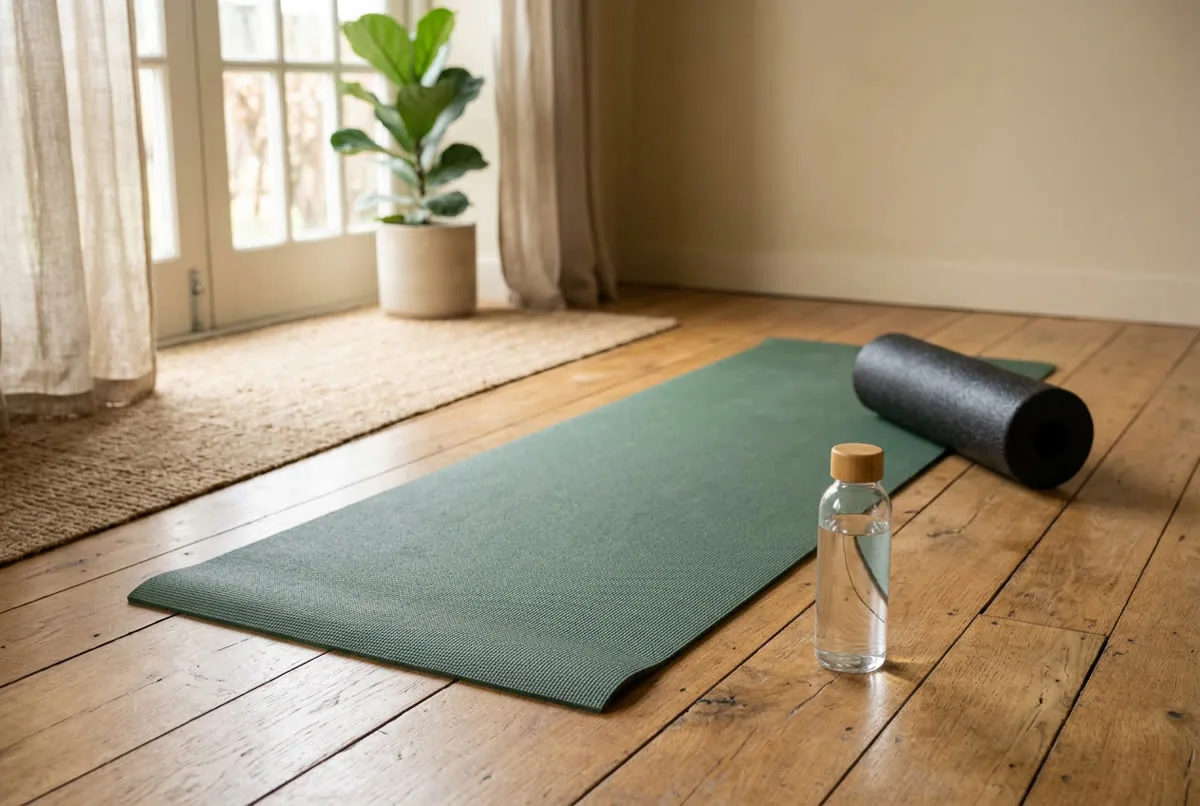
You finish your last set, you’re breathing hard, and the last thing you want to do is lie on the floor and hold stretches for five minutes. So you skip it, grab your water bottle, and get on with your day. Most women over 40 make that same call, workout after workout, and it turns out the research on what that choice actually costs you is more specific than most fitness advice gives credit for.
The short answer: Skipping the cool-down stretch will not make you sorer tomorrow. But building a regular stretching habit still matters after 40, just not for the reason most people assume. The real payoff is long-term joint mobility and balance, not next-day recovery.
Joints tend to feel tighter and less forgiving after 40 than they did at 25, and that shift makes the question of whether stretching is worth your time feel more urgent, not less. The problem is that most of what gets repeated about cool-downs, that they prevent soreness or head off injury, was never really tested before it became standard advice. So we went looking for what the actual studies say, separated the parts that hold up from the parts that don’t, and built a routine around what’s left standing.
Does Stretching After a Workout Actually Prevent Soreness?
This is the myth worth clearing up first. A systematic review and meta-analysis pooling 10 randomized controlled trials and 229 participants looked specifically at whether post-exercise stretching helps with strength recovery or delayed-onset muscle soreness. The researchers compared people who stretched after training against people who simply rested, and measured outcomes at 24, 48, and 72 hours later.
They found no measurable difference. Stretching after a workout did not reduce soreness or speed up strength recovery compared with passive rest. The review’s authors went further, concluding that evidence-based claims about stretching aiding post-workout recovery should be avoided, because the data supporting that idea is limited and low quality (Frontiers in Physiology, 2021).
So if you’ve ever skipped your cool-down and then braced for a worse day-after ache, the research says that fear isn’t backed by evidence. Your soreness the next day has more to do with the workout itself than whether you stretched afterward.
If Cool-Downs Don’t Help Recovery, Why Do Trainers Still Recommend Them?
Fair question, and it’s not that trainers are making it up. Active cool-downs are a near-universal part of workout guidance, and it is widely believed they help recovery (Sports Medicine, 2018). But a 2018 narrative review looked closely at what cool-downs actually deliver, and the answer was underwhelming.
The review found that active cool-downs are largely ineffective at improving same-day or next-day performance. They also don’t appear to prevent injuries, despite being a near-universal part of workout guidance (Sports Medicine, 2018). In other words, the advice has outrun the evidence. It’s a habit that got baked into fitness culture before anyone tested whether it did what people assumed.
That doesn’t mean cool-downs are pointless. It means the reason to do one has almost nothing to do with recovery or injury prevention, and everything to do with something else entirely.
It also explains why this can feel confusing. You’ve probably heard a trainer or a fitness app tell you a cool-down “flushes out lactic acid” or “prevents next-day stiffness.” Those explanations sound plausible, which is part of why they spread, but the same review found that active cool-downs speed up lactate recovery in the blood, not necessarily in muscle, and that most evidence shows they do not significantly reduce muscle soreness (Sports Medicine, 2018). Once you separate the folklore from the finding, the decision about whether to stretch gets a lot simpler.
So What’s the Real Benefit of Stretching After 40?
Here’s where the picture actually gets useful. Separate from the post-workout recovery question, researchers have studied what happens when older adults stretch consistently over time, not just after a single session.
A 10-week static stretching program in older adults produced a significant increase in ankle dorsiflexion range of motion and a measurable decrease in tissue hardness (Frontiers in Medicine, 2024). That’s a real, evidence-backed outcome. It just isn’t the same-day soreness fix people expect.
Why does ankle and joint range of motion matter enough to build a habit around? Because age-related decline in joint range of motion is linked to decreased mobility, worse balance function, and a higher risk of falls (Frontiers in Medicine, 2024; Biology, 2021). That connection is the actual case for stretching after 40. It’s not about tomorrow’s soreness. It’s about staying mobile and steady on your feet years from now.
Static stretching, the kind where you hold a position rather than bounce through it, has generally been recommended to counteract age-related loss of range of motion, and in a study of older adults a single session increased ankle range of motion and decreased muscle stiffness (Biology, 2021).
The 5-Minute Cool-Down Stretch Routine to Actually Do
If the goal is long-term range of motion and mobility rather than tomorrow’s soreness, the routine itself can be simple. Five static stretches, one minute each, done after your workout while your muscles are still warm. Static means you find a comfortable end range and hold still there, breathing normally, rather than bouncing or pulsing into the stretch. That’s also the version tested in the older-adult studies above.
A quick note on what tends to go wrong: people either skip the routine entirely because it feels like it doesn’t “do” anything, or they hold each stretch to the point of sharp pain, thinking more discomfort means more benefit. Neither serves you well. Mild tension, not pain, is the target, and five consistent minutes beats an occasional fifteen.
Minute 1: Calf and Ankle
Stand facing a wall, step one foot back, and keep that back heel on the floor while you lean forward slightly. Hold for 30 seconds, then switch legs. This targets the same ankle dorsiflexion range of motion studied in older adults.
Minute 2: Hamstring
Sit on the floor with one leg extended and the other bent, foot resting against the inner thigh. Hinge forward from the hips toward the extended foot without rounding your back. Hold 30 seconds per side.
Minute 3: Hip Flexor
From a kneeling lunge position, front knee bent at roughly 90 degrees, gently press your hips forward until you feel a stretch along the front of the back hip. Hold 30 seconds per side. A folded towel or mat under your knee makes this more comfortable.
Minute 4: Chest and Shoulders
Clasp your hands behind your back and gently lift them while opening your chest, or use a doorway to stretch one arm at a time. Hold 30 seconds. This one matters more than people expect if you spend hours a day at a desk or a phone.
Minute 5: Lower Back and Glutes
Lie on your back, pull one knee toward your opposite shoulder, and hold 30 seconds per side. Finish with a gentle full-body stretch, arms overhead, for the last few seconds.
None of these require equipment, though a basic mat makes the floor stretches more comfortable, and some people prefer a foam roller before stretching to loosen tight spots first. If you’re deciding whether a roller is worth adding to that routine, we broke down the evidence in our foam roller review for recovery after 40.
How Long Before You Notice a Difference?
Patience matters here, and so does honesty about the timeline. The study that found a real range-of-motion improvement in older adults ran for 10 weeks of consistent static stretching before researchers measured a significant change in ankle dorsiflexion and tissue hardness (Frontiers in Medicine, 2024).
That’s the honest picture: this is a slow-build habit, not a same-day fix. Individual results depend on your starting mobility, consistency, and how the stretches are performed, and that study measured a specific population under specific conditions, not a guarantee for every reader. But it does tell you what a realistic commitment looks like, consistent, not occasional.
Is It Safe to Skip the Cool-Down Entirely?
In terms of soreness and next-day recovery, yes. The meta-analysis on post-exercise stretching found no measurable downside to skipping it compared with just resting (Frontiers in Physiology, 2021). If you’re short on time after a workout, you are not sabotaging your recovery by walking away.
But that’s a different question from whether skipping stretching altogether, as a long-term habit, is a good idea after 40. The research connecting joint range of motion to mobility, balance, and fall risk suggests there’s something worth protecting here that has nothing to do with soreness. Balance and steady footing are also worth training directly, not just through flexibility work. If that’s a gap for you, our balance trainer review for steady footing after 40 walks through one option.
So the real answer isn’t “stretching is essential” or “stretching is pointless.” It’s more specific than that. Skip it on a rushed day without guilt. But if you want the joint mobility and balance benefits the research actually supports, treat the five minutes as a habit you build over weeks, not a box you check after every single workout.
Your Next Step
Pick one thing from this and start there. If five minutes feels like too much some days, do the calf, hamstring, and hip flexor stretches only, since those cover the joints that tend to tighten most from sitting and from strength training. Do it consistently for a few weeks before judging whether it’s working, since the range-of-motion research that backs this habit measured change over 10 weeks, not one session. And if you’re building out the rest of a home mobility and recovery routine, it’s worth looking at what actual equipment earns a place in it versus what’s just clutter.
Frequently Asked Questions
- Does stretching after a workout actually prevent soreness?
- No. A meta-analysis of 10 randomized controlled trials with 229 participants found post-exercise stretching had no measurable effect on delayed-onset muscle soreness or strength recovery at 24, 48, or 72 hours compared with passive rest (Frontiers in Physiology, 2021).
- If cool-downs don't help recovery, why do trainers still recommend them?
- Active cool-downs are a near-universal part of workout guidance and are widely believed to help recovery, but a 2018 narrative review found they are largely ineffective at improving same-day or next-day performance and don't appear to prevent injuries (Sports Medicine, 2018).
- What's the real benefit of stretching regularly after 40 if not recovery?
- The evidence-backed benefit is long-term joint range of motion, not recovery. A 10-week static stretching program in older adults significantly increased ankle dorsiflexion range of motion and decreased tissue hardness, and better joint range of motion is linked to improved mobility and lower fall risk.
- How long does it take to see a range-of-motion improvement from stretching?
- The study showing a significant range-of-motion increase in older adults ran for 10 weeks of consistent static stretching before measuring results, so this is a habit that pays off over weeks, not overnight.
- Is it safe to skip cool-down stretching entirely?
- For recovery and soreness, yes, the research found no downside to skipping it compared with rest. But skipping stretching long-term means missing out on range-of-motion gains, and research links age-related loss of range of motion to reduced mobility, poorer balance, and a higher risk of falls.
Sources & references
- Frontiers in Physiology, Post-exercise stretching meta-analysis (2021) (opens in new tab)
- Sports Medicine, Do we need a cool-down after exercise? (2018) (opens in new tab)
- Frontiers in Medicine, 10-week static stretching in older adults (2024) (opens in new tab)
- Biology, Hold-relax and static stretching in older adults (2021) (opens in new tab)
Before you go
The 7-Day Protein-First Meal Plan for Women Over 40
A complete protein-first week, finished for you: your personal protein target, a one-page shopping list, 21 recipes at 25-35 g protein each, and a timed 90-minute prep schedule. Printable PDF, paired with a free 7-lesson email course.
Free guide
The 7-Day Protein-First Meal Plan for Women Over 40
A complete protein-first week, finished for you: your personal protein target, a one-page shopping list, 21 recipes at 25-35 g protein each, and a timed 90-minute prep schedule. Printable PDF, paired with a free 7-lesson email course.