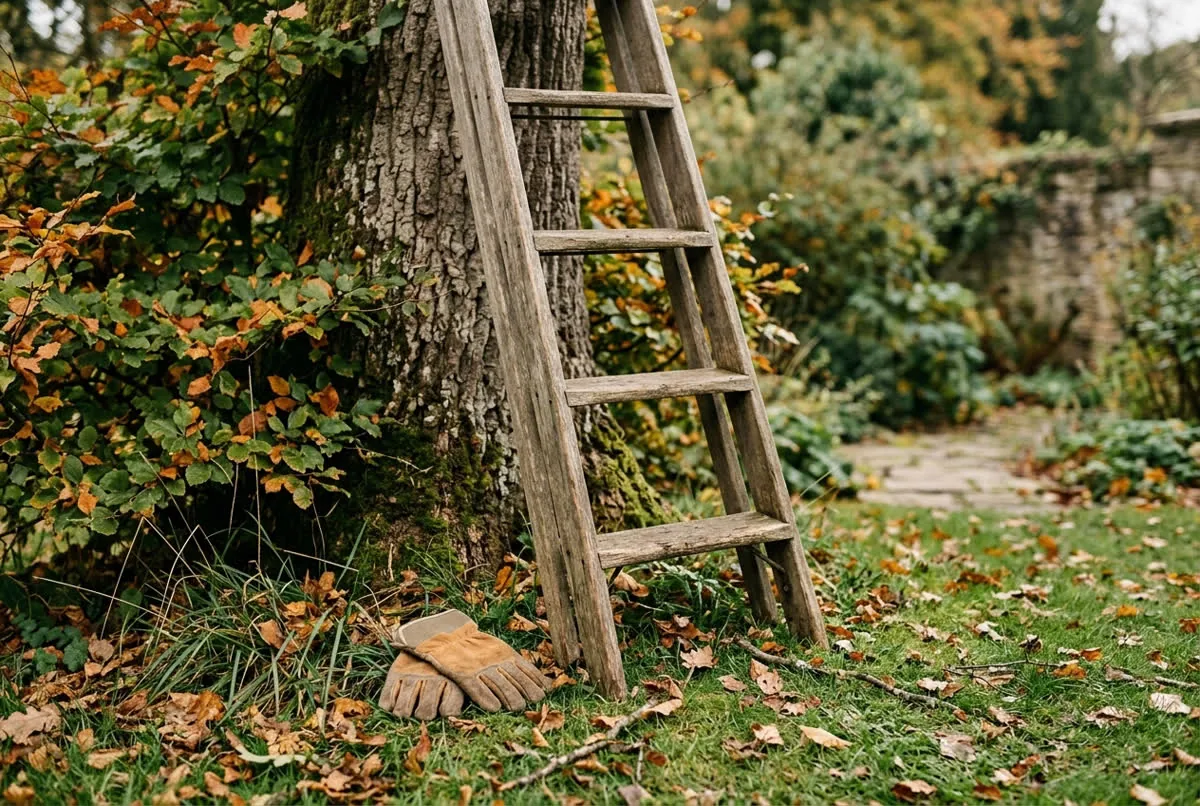
The gutters are full, the leaves are coming down fast, and the ladder is already leaning against the shed. You’ve climbed it every October for years, but this time your foot searches a half second longer for the rung, and the ground underneath is soft and uneven from last week’s rain. You’re not imagining it: the way your body handles a shifting rung or a lumpy patch of lawn is a trainable thing, not a fixed trait you either have or don’t.
The short answer: Balance training, specifically single-leg stands and heel-to-toe walking, paired with lower-body strength work, is what can actually reduce fall risk on a ladder or uneven yard ground. “Being more careful” isn’t a substitute. It doesn’t change how your body reacts in the half second after a rung shifts or the grass gives way underfoot.
Is Your Fall Risk on a Ladder Actually Changing?
Here’s what the data can and can’t tell you. The clearest numbers come from older adults, not women in their 40s and 50s specifically, so it’s worth being precise about what applies to you right now versus what’s coming down the road.
Domestic ladder falls are common in older people, with incidence reported as high as 2.13 per 1,000 per year in that age group, and both the risk of death and the severity of injury are greater for older climbers (International Journal of Environmental Research and Public Health, 2021). Zoom out further and the trend is moving in the wrong direction: the CDC’s age-adjusted fall death rate among older adults rose 21%, from 64.7 per 100,000 in 2018 to 78.4 per 100,000 in 2024 (CDC). One in four adults 65 and older reports falling each year (CDC), older adult falls lead to about 4.5 million emergency department visits a year in the US, and falls cause 88% of emergency visits and hospitalizations for hip fractures in that age group (CDC).
If you’re in your 40s or 50s, those specific numbers aren’t about you yet. But they describe where the curve is heading, and the underlying mechanism, balance capacity, doesn’t switch on at 65. It’s something you either maintain through your 40s and 50s or you don’t, and ladders make an unforgiving place to find out which one you did.
Ladders also aren’t just a household hazard for retirees. National surveillance data analyzed by NIOSH found ladder falls caused 113 worker fatalities and an estimated 34,000 nonfatal injuries treated in emergency departments in a single year, which tells you ladder use carries measurable injury risk well outside construction sites and outside any single age bracket (CDC/NIOSH, MMWR, 2014).
What that combination of numbers means for you: the sharpest documented risk sits with adults 65 and older, but the injury mechanism behind a ladder fall, a foot that doesn’t correct fast enough when a rung shifts, doesn’t appear out of nowhere on a birthday. It’s the tail end of years of balance capacity either being maintained or slowly going untrained. Fall yard work in your 40s and 50s is a reasonable point to start paying attention to that, not because the statistics say you’re at high risk today, but because the two exercises below are the same ones clinicians recommend once that risk does show up, and they’re cheaper to practice now than to relearn later.
The Two Balance Moves Worth Doing Before You Climb
You don’t need a gym or a full workout block for this. Johns Hopkins Medicine’s fall-prevention guidance pairs a balance series that progresses to standing on one foot with a sit-to-stand exercise for leg strength, since exercises that focus on balance and strength training can reduce the risk of falling (Johns Hopkins Medicine). The National Institute on Aging lists standing on one foot and the heel-to-toe walk among its examples of balance exercises (National Institute on Aging).
The Single-Leg Stand
Stand near a sturdy chair or counter so you have something to grab if you wobble. Lift one foot slightly off the floor and hold the position on the standing leg. Switch sides. This is the same basic movement a ladder demands the second you shift your weight to reach for a gutter or a branch, so practicing it on stable ground builds the exact stability you’ll rely on later.
Heel-to-Toe Walking
Walk in a straight line, placing the heel of one foot directly in front of the toes of the other, as if you’re on a balance beam. It’s a small movement, but it trains the same lateral stability you use crossing a lawn that dips and rises underfoot, which is exactly the kind of uneven ground fall yard work puts you on.
Neither move needs to look impressive to be worth doing. A wobble, a light touch on the chair, a step that drifts off the line, none of that is failure. It’s your nervous system doing exactly what this kind of training is for: practicing the correction in a low-stakes setting so it’s already familiar the moment you actually need it on a rung or a slope.
If you want a tool that makes this easier to practice consistently, a home balance trainer gives you an unstable surface to work the same single-leg and weight-shift patterns on, and we broke down what to look for in our balance trainer review.
How Long Should You Be Able to Balance on One Leg?
There’s an actual benchmark here, not just a vague “better is better.” The CDC’s 4-Stage Balance Test, a screening tool clinicians use with older adults, ends with standing on one foot for 10 seconds, and an older adult who can’t hold a heel-to-toe tandem stand for at least 10 seconds is at increased risk of falling (CDC STEADI). Johns Hopkins Medicine’s one-foot exercise starts at 10 seconds per side and works up to 30 (Johns Hopkins Medicine).
Try it today, before you ever touch the ladder. Time yourself on each side. If you’re nowhere near 10 seconds, that’s useful information, not a verdict. It tells you where to start, and it gives you something concrete to retest in a few weeks once you’ve been practicing the single-leg stand and heel-to-toe walk a few times a week.
A gap between sides is worth noting too. If one leg holds steady well past 10 seconds and the other gives out early, that’s the side to prioritize, since an uneven base can make a small stumble harder to recover from when the ground underneath you is already unpredictable.
Basic Ladder Setup Still Matters
Balance training doesn’t replace basic ladder judgment, it works alongside it. Before you climb: check that the feet are on solid, level ground rather than soft soil or a slope, keep three points of contact (two hands and a foot, or two feet and a hand) whenever you’re moving on the rungs, and resist the urge to lean or reach past the point where your hips stay between the rails (OSHA). None of that requires special equipment. It’s the setting your balance training pays off inside, since the exercises above are what let your body correct quickly if any of those conditions slip for a second.
Should You Just Avoid the Ladder This Year?
It’s a fair question, and skipping the ladder for gutter cleaning or high branches is a reasonable call if you have someone else who can do it or a lower-risk tool for the job. The NIOSH surveillance numbers above (113 fatalities, roughly 34,000 nonfatal emergency-department visits from ladder falls in a single year) make the case that minimizing ladder time isn’t overcautious, it’s just math.
But avoiding the ladder doesn’t solve the rest of fall yard work. Raking on a sloped lawn, hauling bags across wet grass, kneeling and standing repeatedly while clearing beds, all of that happens on the same kind of uneven, shifting ground that a wobbly rung does. If you skip the ladder entirely but never build the balance and lower-body strength to handle that ground confidently, you’ve removed one risk and left the rest standing. Strength work in the legs and hips gives your balance training something to stand on, literally, and our guide to ankle weight moves for steady legs is a low-equipment way to add that piece.
So the honest answer is that ladder avoidance is a reasonable individual choice, especially for the highest jobs, but it doesn’t lower your fall risk on its own. The uneven ground is still there whether or not the ladder is.
Balance Training vs. Just Being Careful
“I’ll just be more careful” feels like a plan, but it isn’t one your nervous system can act on in the moment. Balance training changes how quickly and accurately your body corrects when your center of gravity shifts unexpectedly, whether that’s a ladder rung flexing under your weight or a hidden root catching your foot mid-stride. Being careful is an intention. Balance training is a rehearsed physical response.
That’s the idea behind Johns Hopkins’ guidance to pair a one-foot balance progression with lower-body strength work like the sit-to-stand. Strength gives your muscles the capacity to catch a stumble. Balance training gives your nervous system the practiced pathway to actually use that capacity fast enough to matter. Caution alone gives you neither.
None of this requires overhauling your week. The National Institute on Aging suggests aiming for about three sessions of balance exercises a week, and short sessions of single-leg stands and heel-to-toe walks near a stable support are a realistic way to start moving your baseline in the right direction before the season’s yard work really ramps up. It’s the kind of practice that fits into a coffee break or the minutes before you head outside, not a separate workout you have to talk yourself into.
Do the 10-to-30-second single-leg test on both sides this week, note where you land, and build your first two weeks of practice around closing that gap before you’re back up on the ladder. The gutters, the leaves, and the uneven lawn will still be waiting, but you’ll be steadier for it.
Frequently Asked Questions
- Am I really at higher risk of falling off a ladder now than I was 10 years ago?
- The specific numbers we have point to adults 65 and older: ladder falls tend to be more severe and more often fatal in that age group, and the CDC's age-adjusted fall death rate for older adults rose 21% between 2018 and 2024. If you're in your 40s or 50s, that data isn't about you yet, but the balance capacity behind those numbers doesn't appear overnight at 65, so building it now is worth doing before you're in that statistic.
- What balance exercises can I do at home before tackling yard work on uneven ground?
- Standing on one foot and the heel-to-toe walk are both on the National Institute on Aging's list of balance exercises. Johns Hopkins Medicine pairs a one-foot balance progression, done next to a counter for support, with a sit-to-stand exercise for leg strength, since balance and strength training can reduce the risk of falling.
- How long should I be able to balance on one leg, and what does it mean if I can't?
- The CDC's 4-Stage Balance Test, a screening tool clinicians use with older adults, ends with standing on one foot for 10 seconds, and Johns Hopkins Medicine's one-foot exercise starts at 10 seconds per side and works up to 30. If you're well under 10 seconds, that's a starting point to build from, not a diagnosis.
- Is it safer to avoid ladders altogether for gutter cleaning and yard cleanup after 40?
- Reducing ladder use for the highest or riskiest jobs is reasonable; NIOSH surveillance data found ladder falls caused 113 worker fatalities and an estimated 34,000 nonfatal emergency-department-treated injuries in a single year. But avoiding the ladder doesn't address the uneven ground you're still on for raking, hauling, and bed clearing, so balance and lower-body strength training still matter either way.
Sources & references
- CDC, Facts about older adult falls (opens in new tab)
- CDC, Older adult falls data (opens in new tab)
- CDC/NIOSH MMWR, Occupational ladder fall injuries (opens in new tab)
- Johns Hopkins Medicine, Fall prevention exercises (opens in new tab)
- National Institute on Aging, Types of exercise (opens in new tab)
- CDC STEADI, The 4-Stage Balance Test (opens in new tab)
- OSHA, Portable ladder safety QuickCard (opens in new tab)
- IJERPH, Ladder use in older people (opens in new tab)
Before you go
The 7-Day Protein-First Meal Plan for Women Over 40
A complete protein-first week, finished for you: your personal protein target, a one-page shopping list, 21 recipes at 25-35 g protein each, and a timed 90-minute prep schedule. Printable PDF, paired with a free 7-lesson email course.
Free guide
The 7-Day Protein-First Meal Plan for Women Over 40
A complete protein-first week, finished for you: your personal protein target, a one-page shopping list, 21 recipes at 25-35 g protein each, and a timed 90-minute prep schedule. Printable PDF, paired with a free 7-lesson email course.